
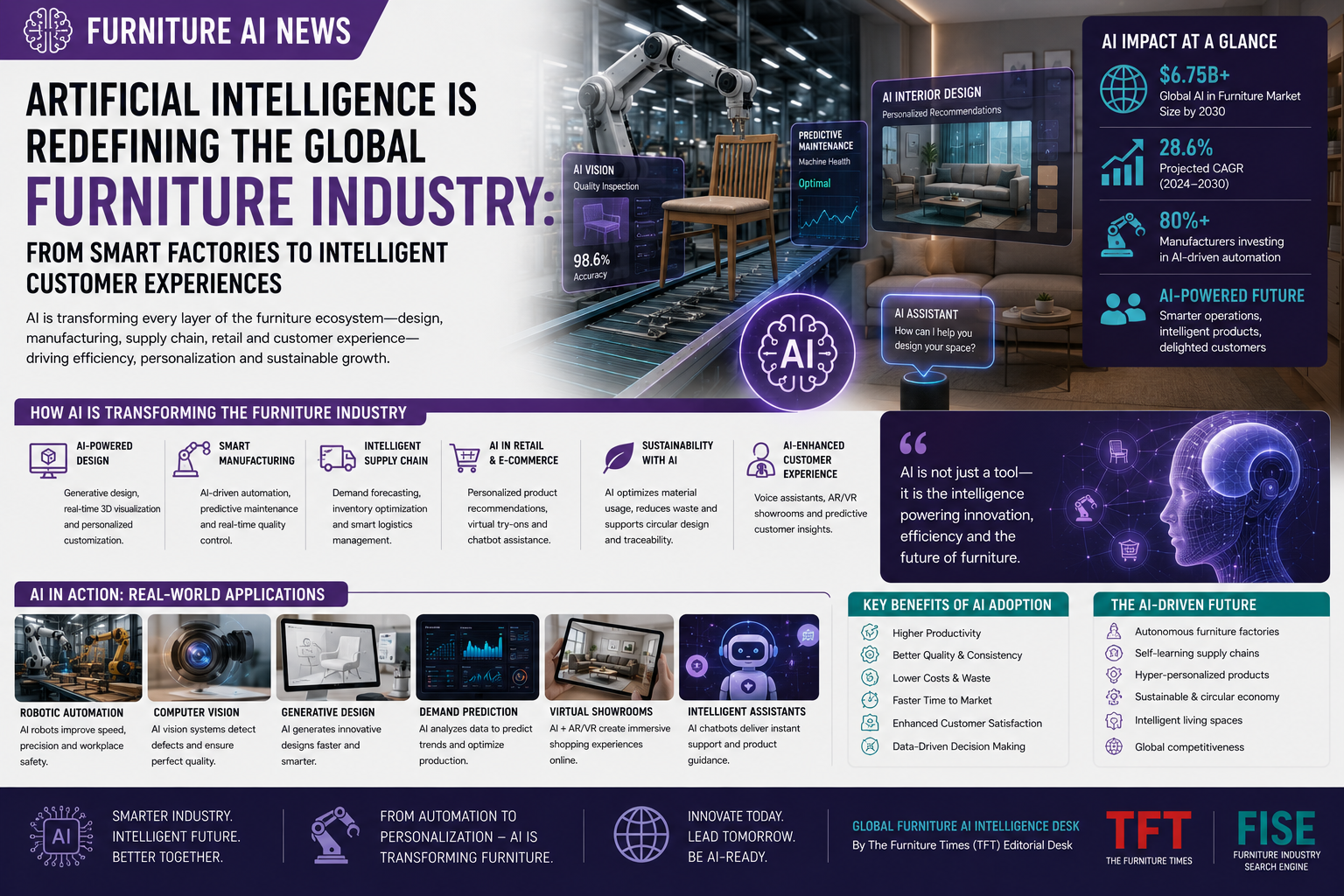
Artificial Intelligence Is Redefining the Global Furniture Industry: From Smart Factories to Intelligent Customer Experiences
Global Furniture AI Intelligence Desk
By The Furniture Times (TFT) Editorial Desk
Executive Summary
Artificial Intelligence (AI) is no longer a future technology.
It is becoming one of the most powerful business tools transforming the global furniture industry ecosystem.
For decades, furniture businesses relied primarily on craftsmanship, experience and traditional manufacturing methods to design, produce and sell furniture. While these strengths remain invaluable, AI is introducing a new layer of intelligence that helps businesses make faster decisions, improve productivity, reduce costs and deliver better customer experiences.
From furniture factories and logistics centres to design studios, retail showrooms and e-commerce platforms, AI is reshaping every stage of the furniture value chain.
According to industry analysts, AI adoption is accelerating across manufacturing, retail, customer service and supply chain management as businesses seek greater efficiency and resilience.
According to The Furniture Times (TFT), Artificial Intelligence will become one of the most influential technologies driving the next generation of the global furniture economy.
The future belongs not to companies that simply manufacture furniture.
It belongs to companies that manufacture intelligently.
AI Is Transforming the Furniture Industry
Artificial Intelligence enables computers and software systems to analyse information, recognise patterns and support decision-making.
Within the furniture industry, AI is being applied to:
- Manufacturing
- Product design
- Customer service
- Marketing
- Supply chain management
- Sales forecasting
- Inventory optimisation
- Quality inspection
- Business intelligence
Rather than replacing people, AI helps professionals work faster, smarter and more efficiently.
Smart Manufacturing Powered by AI
Factories are becoming increasingly intelligent.
AI supports manufacturers by:
Predicting machine failures.
Optimising production schedules.
Reducing material waste.
Monitoring product quality.
Improving factory efficiency.
Managing inventory.
Automating repetitive tasks.
Manufacturers gain better operational control while reducing unnecessary costs.
AI Is Revolutionising Furniture Design
Design teams increasingly use AI to:
Generate design concepts.
Explore material combinations.
Improve ergonomics.
Optimise product dimensions.
Predict customer preferences.
Accelerate product development.
AI assists creativity while allowing designers to focus on innovation and customer needs.
Smarter Supply Chains
Furniture supply chains involve:
Raw materials.
Manufacturing.
Warehousing.
Shipping.
Distribution.
Retail.
AI helps optimise every stage by:
Forecasting demand.
Managing inventory.
Selecting logistics routes.
Reducing delays.
Improving supplier coordination.
Supporting procurement.
More intelligent supply chains improve customer satisfaction and operational resilience.
AI Improves Customer Experiences
Today’s customers expect personalised shopping experiences.
AI enables businesses to provide:
Product recommendations.
Virtual shopping assistants.
Room planning suggestions.
Style recommendations.
Purchase history analysis.
Instant customer support.
Retail becomes more responsive and customer-focused.
AI Strengthens E-Commerce
Furniture e-commerce platforms increasingly use AI for:
Search recommendations.
Visual product matching.
Personalised offers.
Dynamic pricing.
Product categorisation.
Customer engagement.
This helps buyers discover products more efficiently while increasing sales opportunities.
AI Supports Furniture Retail
Retailers benefit from AI through:
Demand forecasting.
Inventory planning.
Customer segmentation.
Marketing automation.
Sales analysis.
Store optimisation.
Businesses can respond more quickly to changing market conditions.
AI Enhances Quality Control
Quality remains essential within furniture manufacturing.
AI-assisted inspection systems help identify:
Surface defects.
Colour inconsistencies.
Assembly issues.
Material flaws.
Dimensional variations.
Earlier detection reduces waste while improving customer satisfaction.
Predictive Maintenance
Unexpected machine breakdowns can disrupt production.
AI analyses machine performance and predicts maintenance requirements before failures occur.
Benefits include:
Reduced downtime.
Lower repair costs.
Improved productivity.
Longer equipment life.
AI and Sustainability
Artificial Intelligence also contributes to sustainability.
It helps businesses:
Reduce waste.
Optimise cutting patterns.
Lower energy consumption.
Improve logistics.
Forecast production.
Minimise excess inventory.
Technology supports both environmental responsibility and profitability.
AI for Furniture Marketing
Marketing teams increasingly use AI to:
Create content.
Generate product descriptions.
Develop advertising campaigns.
Analyse customer behaviour.
Improve SEO.
Support multilingual communication.
AI accelerates marketing while allowing businesses to reach wider audiences.
AI Supports Product Personalisation
Customers increasingly expect customised furniture.
AI helps recommend:
Colours.
Materials.
Dimensions.
Layouts.
Accessories.
Configurations.
Personalisation strengthens customer satisfaction and brand loyalty.
AI Helps SMEs Compete Globally
Artificial Intelligence is not limited to multinational corporations.
Small and medium-sized businesses can use AI for:
Customer communication.
Digital marketing.
Business planning.
Market research.
Translation.
Inventory management.
Sales forecasting.
Technology helps SMEs compete more effectively in international markets.
AI and Furniture Tourism
The emerging Furniture Tourism sector can also benefit from AI.
Future visitors may enjoy:
AI travel assistants.
Digital factory guides.
Multilingual translation.
Personalised itineraries.
Smart visitor experiences.
Technology improves both education and business networking.
AI Will Transform Industry Search
Future buyers will increasingly search using:
Conversational AI.
Voice assistants.
Visual search.
AI procurement systems.
Intelligent recommendation engines.
Businesses that organise their digital information effectively will become easier to discover.
The Importance of Structured Digital Information
Artificial Intelligence depends upon quality information.
Businesses benefit from maintaining:
Accurate product data.
Professional websites.
Structured catalogues.
Educational articles.
Customer reviews.
Digital assets.
Better information enables AI systems to understand businesses more effectively.
Preparing for the AI Economy
Furniture companies should begin preparing today by investing in:
Digital transformation.
Employee training.
Data quality.
Automation.
AI literacy.
Cybersecurity.
Innovation.
Preparation today creates competitiveness tomorrow.
Challenges Ahead
AI also introduces important responsibilities.
Businesses should address:
Data privacy.
Cybersecurity.
Ethical AI use.
Human oversight.
Workforce development.
Responsible implementation ensures technology benefits both businesses and society.
The Future of Furniture AI
Over the next decade, the industry may see:
AI-powered factories.
Autonomous production planning.
Intelligent procurement.
Digital product passports.
Predictive customer service.
Advanced robotics.
AI-assisted design collaboration.
Connected global manufacturing networks.
Artificial Intelligence will become an essential business partner throughout the furniture ecosystem.
The Furniture Times Analysis
Artificial Intelligence represents one of the most important technological opportunities in the history of the furniture industry.
The companies that embrace AI responsibly will strengthen:
Innovation.
Productivity.
Customer experiences.
Sustainability.
Competitiveness.
Global growth.
AI should not be viewed as replacing craftsmanship.
It should be viewed as empowering craftsmanship through intelligence.
Final Verdict
The furniture industry is entering the Age of Artificial Intelligence.
Businesses that combine:
Human creativity.
Traditional craftsmanship.
Digital intelligence.
Operational excellence.
Customer understanding.
Continuous innovation.
Will become tomorrow’s global leaders.
Artificial Intelligence is not replacing the furniture industry.
It is helping reinvent it.
The future belongs to companies that use technology to create better products, stronger businesses and greater value for customers around the world.
Because the next generation of furniture will not only be beautifully designed.
It will also be intelligently imagined, intelligently manufactured and intelligently delivered.
By The Furniture Times (TFT) Editorial Desk
Global Furniture AI Intelligence Desk | July 2026
“TFT tells their story. FISE helps the world find them.”
The furniture industry ecosystem is a $1 Trillion Dollar Industry.
