
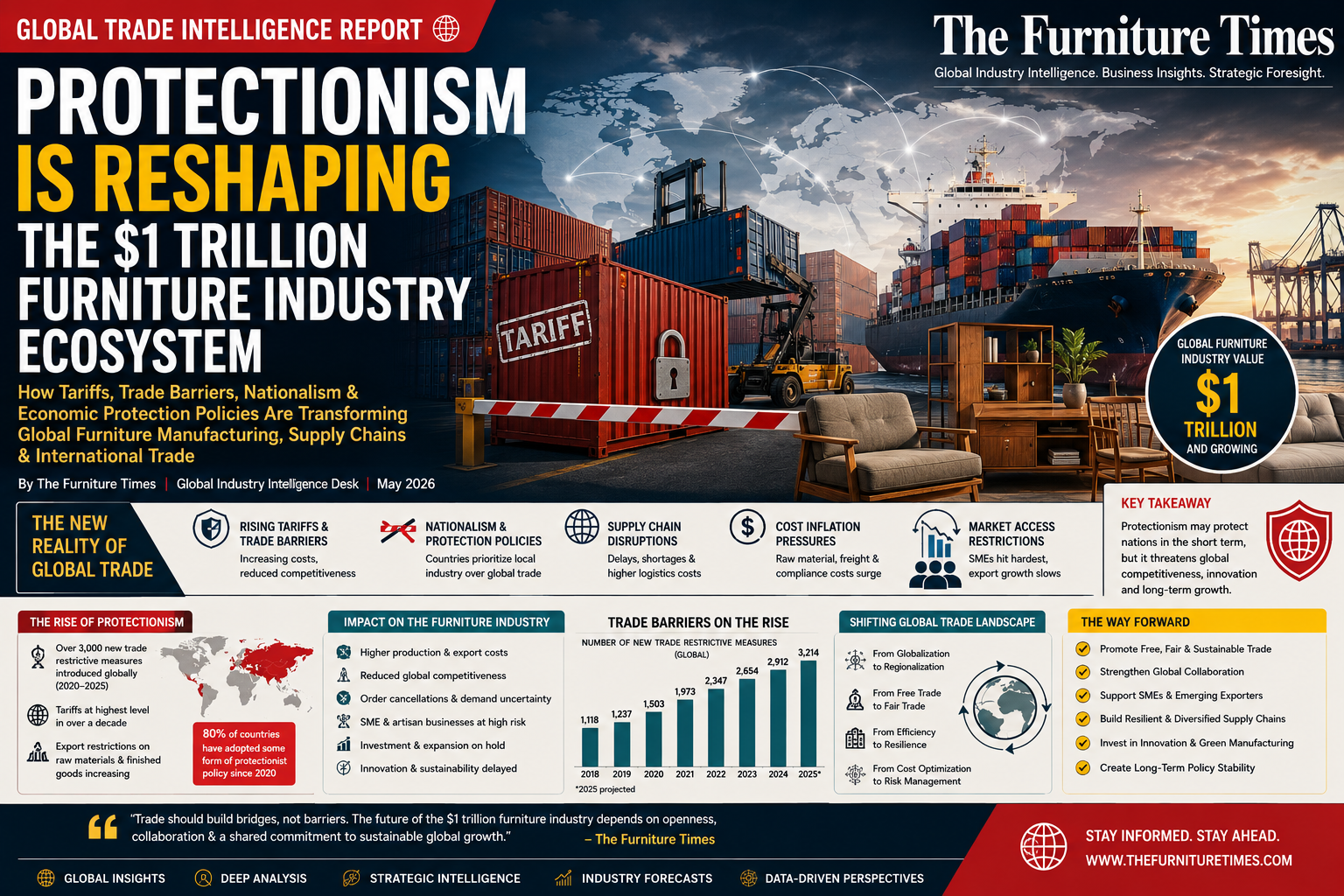
Protectionism Is Reshaping the $1 Trillion Furniture Industry Ecosystem
Global Trade Intelligence Report | The Furniture Times
How Tariffs, Trade Barriers, Nationalism & Economic Protection Policies Are Transforming Global Furniture Manufacturing, Supply Chains & International Trade
By The Furniture Times | Global Industry Intelligence Desk | May 2026
The global furniture industry is entering one of the most politically sensitive and economically uncertain periods in modern trade history.
For decades, the furniture ecosystem expanded through:
- globalization
- open trade
- low-cost manufacturing
- international sourcing
- cross-border supply chains
- export-driven production
- global logistics integration
Countries specialize in different parts of the ecosystem:
- China became a manufacturing giant
- Vietnam emerged as an export powerhouse
- Malaysia strengthened wood furniture production
- Italy dominated luxury design
- Indonesia led in teak and rattan
- India expanded modular and wooden manufacturing
- Europe focused on premium interiors
- the Middle East became a hospitality and luxury market
The global furniture ecosystem became deeply interconnected.
But now another force is rapidly reshaping the industry:
protectionism.
Across:
- tariffs
- import restrictions
- anti-dumping measures
- localization policies
- trade wars
- geopolitical tensions
- national industrial protection systems
the furniture industry is increasingly moving away from pure globalization toward:
controlled economic nationalism.
And the impacts are becoming enormous.
What Is Protectionism?
Protectionism refers to government policies designed to protect domestic industries from foreign competition.
This can include:
- import tariffs
- anti-dumping duties
- quotas
- trade restrictions
- localization requirements
- domestic manufacturing incentives
- export controls
- subsidy systems
The goal is usually to:
- protect local manufacturers
- preserve jobs
- reduce foreign dependence
- strengthen domestic production
- improve trade balance
But while protectionism may help some industries temporarily,
it can also create:
- higher costs
- supply-chain instability
- trade tension
- inflationary pressure
- global fragmentation
Why Furniture Industry Is Highly Vulnerable
The furniture ecosystem is one of the world’s most globally interconnected industries.
A single furniture product may involve:
- wood from one country
- fabric from another
- foam from another
- hardware from another
- manufacturing elsewhere
- logistics through multiple ports
- retail distribution in another region
Furniture supply chains are deeply globalized.
This means protectionist policies can disrupt the entire ecosystem rapidly.
The Global Furniture Industry Was Built on Globalization
Modern furniture trade expanded because:
- low-cost manufacturing countries supplied global demand
- shipping became cheaper
- containerization improved logistics
- global sourcing became easier
- international trade agreements expanded access
This allowed:
- affordable furniture
- large-scale exports
- fast international growth
- global supply-chain efficiency
Consumers benefited from:
- lower prices
- more choices
- faster product availability
The Rise of Global Trade Tensions
In recent years, the global economy has experienced:
- U.S.-China trade wars
- tariff escalation
- geopolitical conflicts
- supply-chain disruptions
- export restrictions
- sanctions
- economic nationalism
These developments increasingly affect the furniture ecosystem directly.
Tariffs Are Reshaping Furniture Trade
Tariffs increase the cost of imported goods.
When tariffs rise:
- furniture becomes more expensive
- margins shrink
- supply chains shift
- sourcing becomes uncertain
- consumers pay more
The furniture industry is especially vulnerable because many products depend on:
- imported materials
- international components
- cross-border manufacturing
The U.S.-China Furniture Trade Transformation
One of the biggest examples has been:
the U.S.-China trade conflict.
For years, China dominated global furniture exports.
But tariffs and geopolitical tension pushed many companies to:
- diversify manufacturing
- relocate sourcing
- reduce China dependence
This accelerated growth in:
- Vietnam
- Malaysia
- Indonesia
- India
- Mexico
The furniture supply chain began reorganizing globally.
Vietnam’s Rise Through Trade Diversification
Vietnam became one of the biggest beneficiaries of shifting global trade patterns.
Why?
Because buyers sought:
- lower tariff exposure
- diversified sourcing
- alternative manufacturing hubs
Vietnam rapidly strengthened:
- wooden furniture exports
- upholstery manufacturing
- hospitality furniture production
Protectionism unintentionally created:
new industrial winners.
Malaysia & Indonesia Also Benefited
Countries such as:
- Malaysia
- Indonesia
also benefited from sourcing diversification.
Global buyers increasingly searched for:
- alternative wood suppliers
- lower geopolitical risk
- diversified manufacturing ecosystems
This increased opportunity for Southeast Asia.
But Protectionism Also Creates Uncertainty
While some countries benefit, the broader ecosystem suffers from:
- unpredictability
- unstable sourcing
- rising costs
- logistical complications
- buyer hesitation
Businesses struggle because:
uncertainty is difficult to plan around.
Factories may hesitate to:
- expand
- hire workers
- invest in machinery
- scale exports
when future tariffs or trade rules remain unclear.
SMEs Suffer the Most
Large multinational companies often adapt more easily because they can:
- diversify factories
- shift sourcing
- negotiate logistics
- absorb short-term losses
But SMEs often rely on:
- single export markets
- limited buyers
- narrow profit margins
- fixed production systems
Protectionism can severely damage smaller manufacturers.
Rising Costs Across the Entire Ecosystem
Protectionist policies increase costs throughout:
- manufacturing
- logistics
- warehousing
- raw materials
- shipping
- retail pricing
Eventually:
consumers pay more.
Furniture inflation becomes a major issue.
Especially after:
- COVID-19
- shipping crises
- fuel volatility
- labour shortages
additional tariffs can intensify pricing pressure.
Hospitality Industry Feels the Impact
Hotels, resorts, restaurants, and commercial projects depend heavily on imported furniture systems.
Protectionism can increase:
- project costs
- procurement delays
- fit-out uncertainty
- budget overruns
Large hospitality developments become more vulnerable when:
- supply chains become politically unstable.
Supply Chains Are Becoming Politicized
The furniture industry is increasingly influenced not only by:
- economics
but also by:
- geopolitics
- diplomatic relationships
- trade alliances
- sanctions
- national security concerns
This creates:
“political supply chains.”
The Return of Local Manufacturing
One major effect of protectionism is renewed interest in:
domestic manufacturing.
Countries increasingly want to:
- reduce import dependency
- strengthen local factories
- preserve industrial jobs
- improve economic resilience
This creates opportunity for:
- local furniture production
- regional manufacturing hubs
- domestic supply-chain ecosystems
But Local Manufacturing Is Not Easy
Rebuilding domestic manufacturing requires:
- skilled labour
- infrastructure
- raw materials
- machinery investment
- long-term industrial policy
Many countries lost manufacturing capacity after decades of globalization.
Rebuilding it takes time.
Labour Costs Complicate Reshoring
Many developed countries face:
- high labour costs
- labour shortages
- declining manufacturing interest among youth
This makes reshoring expensive.
Furniture manufacturing remains labour-intensive.
Therefore:
complete localization is difficult.
Protectionism Can Trigger Retaliation
Trade restrictions often trigger:
- counter-tariffs
- retaliatory policies
- trade disputes
- export restrictions
This creates:
a cycle of economic tension.
The furniture ecosystem becomes trapped between:
- politics
- economics
- supply-chain realities
Environmental & ESG Complications
Protectionism may also complicate:
- sustainable sourcing
- ESG compliance
- green manufacturing systems
Why?
Because global sustainability systems often rely on:
- international cooperation
- cross-border supply chains
- certified sourcing ecosystems
Fragmented trade systems may reduce efficiency in sustainability transition.
Logistics & Shipping Become More Complex
Furniture logistics already face pressure because furniture products are:
- bulky
- container-heavy
- warehouse-intensive
Protectionism adds:
- customs delays
- border complications
- tariff documentation
- compliance pressure
- trade-route uncertainty
This increases operational complexity significantly.
Consumer Psychology Is Changing
Consumers increasingly experience:
- rising furniture prices
- delayed delivery
- reduced product availability
Many do not realize:
global trade politics are influencing their living rooms.
A tariff on wood panels, foam, steel, or imported furniture may eventually affect:
- sofas
- beds
- kitchens
- wardrobes
- hospitality projects
Is Protectionism Entirely Negative?
Not entirely.
Protectionism can help:
- revive local industries
- create domestic jobs
- strengthen industrial resilience
- reduce dangerous overdependence
But excessive protectionism may also:
- reduce efficiency
- increase inflation
- fragment trade systems
- slow innovation
- weaken international cooperation
Balance becomes critical.
The Furniture Industry Needs Strategic Balance
The future may require:
- regional manufacturing diversification
- smarter trade cooperation
- resilient supply chains
- balanced industrial policy
- sustainable localization
The goal should not be:
isolation.
The goal should be:
resilience without fragmentation.
The Future: Regional Ecosystems May Rise
The furniture industry may gradually evolve toward:
- regional production hubs
- localized supply chains
- diversified sourcing systems
- multi-country manufacturing networks
Instead of depending heavily on one country.
This could reshape:
- Asia
- Europe
- Middle East
- North America
- Africa
into more regionally balanced ecosystems.
Technology & Digital Ecosystems Become More Important
As global trade becomes more uncertain, industries increasingly need:
- visibility
- supplier intelligence
- sourcing transparency
- communication infrastructure
- digital discovery systems
Platforms like:
may become increasingly important for:
- supplier discovery
- regional sourcing
- trade intelligence
- ecosystem visibility
- communication stability
TFT Philosophical Industry Insight
The furniture industry was built on:
- interconnectedness
- trade
- craftsmanship
- global cooperation
Protectionism reminds the world of one critical reality:
No country fully builds the furniture ecosystem alone anymore.
Modern furniture products are global creations involving:
- materials
- labour
- logistics
- technology
- design
- manufacturing ecosystems
from multiple nations.
The challenge now is finding a balance between:
- national protection
and: - global cooperation.
Final Thought
The global furniture industry is entering a new era where:
- trade politics
- tariffs
- industrial nationalism
- supply-chain resilience
- regional manufacturing
- ESG
- sustainability
will increasingly shape the future of the ecosystem.
The future winners will not simply be:
- the cheapest manufacturers
They will be:
- the most adaptable
- the most resilient
- the most diversified
- the most visible
- the most strategically connected
Closing Insight
“The future of the furniture industry may no longer belong only to the biggest factories or the cheapest exporters.
It may belong to the ecosystems that can balance resilience, sustainability, regional strength, and global cooperation.”
