Why the Global Furniture Industry Needs Its Own Review Ecosystem
General Review Sites Serve Everything — Furniture Businesses Need Industry-Specific Visibility, Context and Reputation
By The Furniture Times (TFT) Editorial Desk | FurniReviewology | Furniture Reviews | Industry Trust | SMEs & MSMEs | Furniture Industry Search | Global Furniture Ecosystem
The furniture industry has spent decades building extraordinary products, manufacturing capabilities, supply chains, retail networks and global brands.
Yet when it comes to digital reputation, much of the industry is still being evaluated through systems that were never specifically designed for furniture.
A restaurant can be reviewed.
A dentist can be reviewed.
A hotel can be reviewed.
A supermarket can be reviewed.
A mobile application can be reviewed.
And a furniture manufacturer, retailer, exporter, component supplier or hospitality furniture specialist may be placed inside essentially the same broad review environment.
General review platforms are valuable. They have helped make customer experiences more visible and given consumers a stronger voice.
But furniture is not a generic industry.
It is an enormous, interconnected ecosystem involving products that can last for years, complex manufacturing processes, global sourcing, customization, installation, logistics, project procurement, after-sales service and relationships between businesses that may continue for decades.
The industry therefore needs something more.
It needs furniture-specific context.
It needs industry-specific discovery.
It needs structured company identities.
It needs meaningful reputation information.
And it needs an environment where manufacturers, brands, suppliers, retailers, designers, SMEs, MSMEs and other industry participants can be understood within the context of what they actually do.
That is the opportunity behind FurniReviewology.
Furniture Is Not Just Another Retail Category
The word “furniture” may sound like a single category.
In reality, it represents an enormous collection of industries operating within one ecosystem.
Consider only a small part of it:
Residential furniture.
Office furniture.
Outdoor furniture.
Hospitality furniture.
School furniture.
Healthcare furniture.
Kitchen furniture.
Children’s furniture.
Mattresses.
Upholstered furniture.
Wooden furniture.
Metal furniture.
Plastic furniture.
Rattan furniture.
Contract furniture.
Custom furniture.
Luxury furniture.
Ready-to-assemble furniture.
Furniture components.
Hardware.
Foam.
Fabrics.
Leather.
Wood panels.
Machinery.
Finishing materials.
Packaging.
Logistics.
Design.
Installation.
Repair and restoration.
Each category operates differently.
A company manufacturing 50,000 dining chairs annually should not necessarily be understood in the same way as a boutique furniture designer producing ten custom pieces.
A supplier of drawer slides cannot be evaluated using exactly the same considerations as a mattress retailer.
A hospitality furniture manufacturer working on 300-room hotel projects has different operational requirements from a neighborhood furniture store.
This is why context matters.
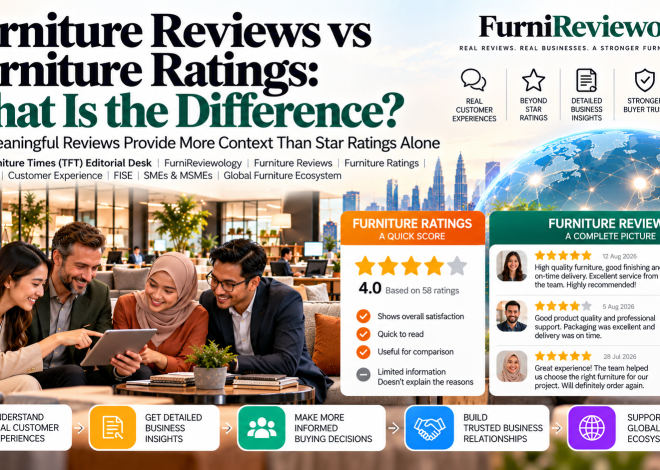
Five Stars Don’t Tell the Whole Furniture Story
Star ratings are simple.
That simplicity is one reason they became popular.
But furniture transactions can be complicated.
Imagine two furniture businesses both rated 4.5 stars.
What does that actually tell a professional buyer?
Does one manufacture furniture while the other only retails it?
Can either handle contract projects?
Does the manufacturer export?
Can it customize?
What materials does it specialize in?
Does it manufacture internally or outsource?
Which product categories does it serve?
Does it have experience in hospitality?
Does it supply residential projects?
How is its packaging?
How reliable is its delivery?
How responsive is its sales team?
What happens when there is a defect?
How does it handle replacement parts?
How does the furniture perform after prolonged use?
A number cannot answer all these questions.
A rating is a signal. Context turns that signal into useful information.
This is one reason furniture deserves a more specialized review environment.
Consumers and Professional Buyers Need Different Information
The furniture ecosystem serves both B2C and B2B markets.
Their review requirements can differ considerably.
A consumer purchasing a sofa may care about:
comfort, appearance, value, delivery, assembly, durability and after-sales service.
An international importer evaluating a manufacturer may care about:
production capacity, consistency, packaging, lead times, communication, quality control, customization and export experience.
An interior designer may focus on:
design flexibility, materials, finishes, samples and specification accuracy.
A hotel procurement company may evaluate:
project execution, commercial durability, installation, replacement capability and deadline performance.
A retailer may care about:
product consistency, margins, repeatability, delivery reliability and customer support.
All are discussing furniture.
But they are not discussing the same purchasing experience.
A furniture-focused review ecosystem can create room for these differences.
The Industry Has a Reputation Fragmentation Problem
Today, information about one furniture company may be scattered across the internet.
Some reviews may be on Google.
Others may appear on Facebook.
Some may be on marketplaces.
Others may appear in trade directories.
The company website contains another version of its story.
A trade exhibition profile contains another.
News articles may provide additional information.
Social media contains more.
A buyer can potentially find valuable information, but the process is fragmented.
This creates friction.
The problem becomes greater with smaller companies.
A major global brand may have thousands of digital references.
An excellent SME manufacturer may have very few.
The SME might have been manufacturing furniture successfully for 20 years, but a buyer searching online could find almost nothing beyond a telephone number and an outdated website.
That is not necessarily a reflection of the company’s capability.
It may simply reflect a digital visibility gap.
FurniReviewology Is About Building Furniture-Specific Context
FurniReviewology is intended to help create a dedicated environment around furniture companies, furniture reviews and furniture-industry reputation.
The concept is bigger than collecting ratings.
It is about helping businesses establish a meaningful industry identity.
Who are you?
Where are you?
What do you manufacture?
What do you sell?
Which furniture categories do you serve?
What services do you provide?
What markets do you participate in?
What experiences have customers had with your company?
What should prospective buyers know about you?
This type of structured information can make company discovery more useful.
Instead of seeing only a business name and star rating, the industry can begin building richer company profiles.
Reviews Should Help Buyers Ask Better Questions
A responsible review ecosystem should not tell buyers:
“This company is automatically safe because it has good reviews.”
That would be an oversimplification.
Reviews should be considered one information source among many.
For major orders, buyers should still conduct appropriate due diligence, request samples, verify company information, evaluate specifications, inspect factories where necessary, understand warranties, review commercial terms and perform the checks appropriate to the transaction.
The purpose of furniture reviews is not to replace due diligence.
It is to make the research stage richer.
A review may alert a buyer to questions worth asking.
A pattern of positive feedback may highlight strengths.
Repeated complaints may identify areas requiring investigation.
Detailed experiences may provide context unavailable in a product catalogue.
That is how reviews become useful industry intelligence rather than merely digital decoration.
Reputation Should Not Belong Only to Big Brands
There is another important reason the furniture industry needs dedicated review infrastructure.
SMEs and MSMEs need a place in the reputation economy.
Large companies can spend heavily on branding.
They can purchase advertising.
They can hire public-relations agencies.
They can employ SEO specialists.
They can exhibit internationally.
They can operate large social media campaigns.
Smaller manufacturers often cannot.
Yet some of those companies produce outstanding furniture.
Some have served customers for decades.
Some possess specialized manufacturing knowledge passed through generations.
Some employ skilled craftspeople.
Some supply bigger brands without receiving public recognition.
A specialized furniture ecosystem can help make these companies more visible.
Their reputation should not disappear simply because their marketing budget is small.
Free Listing Can Be the First Step
This is why free listing on FurniReviewology can matter.
For a furniture SME, MSME, manufacturer, supplier, retailer, designer or service provider, establishing an industry profile can be the beginning of a broader digital identity.
The sequence is straightforward:
Get listed.
Make sure your company information is accurate.
Explain what you manufacture, supply or sell.
Identify your categories.
Keep your information updated.
Build genuine customer experiences.
Encourage authentic reviews.
Strengthen your digital reputation over time.
The important thing is to begin.
A business cannot build visibility from a profile that does not exist.
From FurniReviewology to FISE: Reputation Meets Discovery
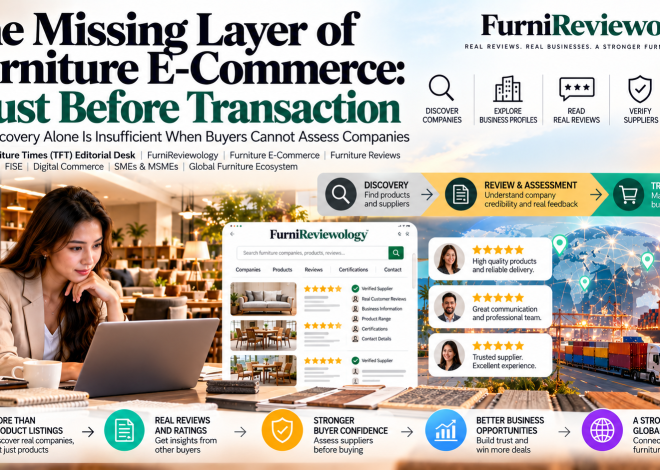
A review ecosystem becomes considerably more powerful when connected with industry discovery.
That is where FISE — Furniture Industry Search Engine enters the picture.
FISE focuses on helping make the furniture ecosystem searchable.
Think about the potential journey.
A buyer needs outdoor furniture manufacturers.
The buyer searches.
Relevant companies become discoverable.
The buyer identifies potential suppliers.
Then comes the next question:
“What do I know about these companies?”
This is where structured company information and furniture-specific reputation become valuable.
FISE can support the discovery layer.
FurniReviewology can support the reputation and review layer.
The relationship is natural.
Search helps buyers discover possibilities. Reviews help buyers investigate those possibilities.
And Then There Is TFT
The third component is The Furniture Times — TFT.
Companies are not static database entries.
They have stories.
A manufacturer opens a factory.
A retailer expands.
A supplier launches a material.
A brand introduces a collection.
A business receives certification.
A company enters a new export market.
A factory invests in automation.
An SME develops an innovative product.
An entrepreneur builds something new.
These developments help buyers and the wider industry understand a business.
TFT provides the media and industry-intelligence dimension.
This creates three complementary functions:
FISE — Discovery
TFT — Visibility and Storytelling
FurniReviewology — Reviews and Trust
That combination is much more meaningful than treating reviews as isolated star ratings.
The Furniture Industry Needs an Ecosystem, Not Another Digital Island
The internet already contains countless directories.
The objective should not be to create another disconnected list of company names.
The furniture industry needs connectivity.
A manufacturer should be discoverable.
Its profile should explain what it does.
Its products should be identifiable.
Its news and developments should be visible.
Its customers should have opportunities to share genuine experiences.
Buyers should have more information available when conducting research.
And the smallest businesses should have opportunities to participate alongside larger companies.
This is what transforms a directory into an ecosystem.
The AI Era Makes Industry-Specific Information More Important
The importance of structured industry information is likely to increase as AI changes online discovery.
Buyers are beginning to move beyond traditional keyword searches.
They increasingly ask complete questions.
“Find furniture manufacturers specializing in hospitality projects.”
“Which companies manufacture outdoor furniture in Asia?”
“Find office furniture suppliers serving hotels and commercial projects.”
“Which manufacturers produce sustainable wooden furniture?”
AI systems attempt to identify, organize and summarize available information.
Companies with limited, inconsistent or fragmented information may become harder for these systems to understand.
This creates another reason for furniture companies to establish stronger digital identities.
Your business should not only be understandable to existing customers.
It increasingly needs to be understandable to search engines, databases and AI discovery systems.
Don’t Wait for the Furniture Review Economy to Mature Without You
Digital ecosystems become more valuable as participation grows.
This creates an important opportunity for furniture businesses today.
Do not wait until competitors have already established extensive profiles, accumulated reviews, published years of news and built strong searchable identities before deciding that digital reputation matters.
Start earlier.
If you manufacture furniture, establish your presence.
If you supply components, establish your presence.
If you operate a furniture store, establish your presence.
If you are an exporter, establish your presence.
If you are an interior or furniture designer, establish your presence.
If you are an artisan, establish your presence.
If you operate an SME or MSME, establish your presence.
Being small is not a reason to remain invisible.
Your Reputation Already Exists — The Question Is Whether It Is Searchable
Every established furniture business already has a reputation.
Customers have opinions.
Suppliers have experiences.
Employees know the company.
Retail partners know the products.
Architects may have specified them.
Hotels may have used them.
Consumers may have lived with their furniture for years.
The problem is that much of this reputation remains offline, fragmented or difficult to discover.
The next stage of furniture-industry digitalization should help make legitimate business identity and customer experience more structured and accessible.
That is the gap FurniReviewology wants to help address.
Get Listed. Become Searchable. Build Your Reputation.
For furniture businesses, the message is simple:
Do not wait until a buyer is searching for you to start becoming discoverable.
Create your FurniReviewology presence.
Take advantage of the opportunity for a free listing.
Provide accurate information about your company.
Build genuine reviews over time.
Strengthen your visibility within the furniture ecosystem.
Become searchable through FISE.
Share meaningful company developments through TFT.
And create a digital footprint that reflects the business you have spent years building offline.
The furniture industry’s digital future will not belong only to the largest companies.
It can include the factory.
The workshop.
The retailer.
The designer.
The exporter.
The component producer.
The startup.
The SME.
The MSME.
And the global brand.
But businesses have to participate.
Don’t remain invisible in an industry that is becoming increasingly searchable.
The Global Furniture Ecosystem
The Furniture Industry is a $1 Trillion USD Ecosystem in the world
Furniture Industry Search Engine – FISE helps the world find them.
The Furniture Times – TFT tells their story.
FurniReviewology helps the world trust them.