The Furniture Industry After the QR Code: Why Every Product Will Need a Permanent Digital Identity
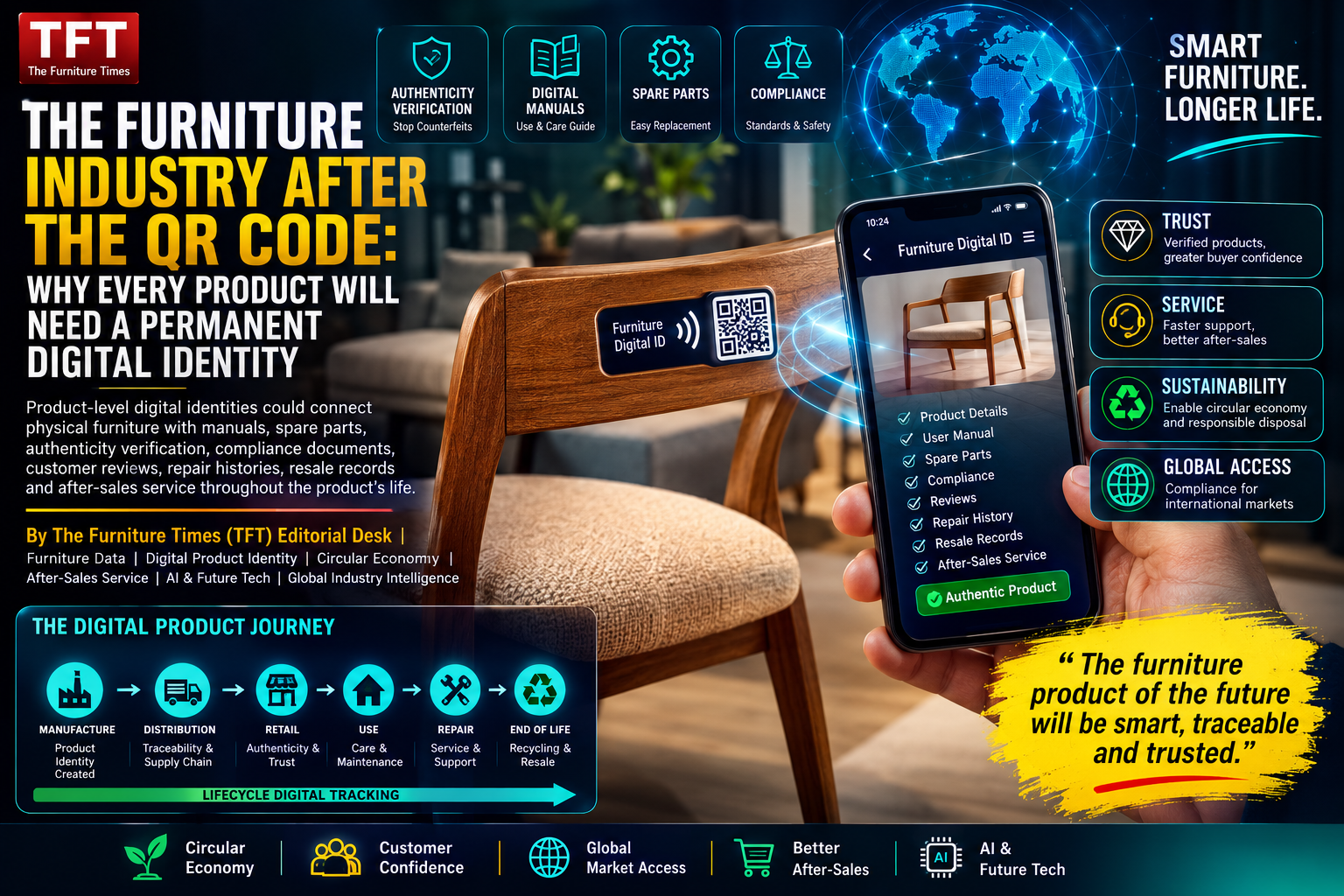
Product-level digital identities could connect physical furniture with manuals, spare parts, authenticity verification, compliance documents, customer reviews, repair histories, resale records and after-sales service throughout the product’s life
By The Furniture Times (TFT) Editorial Desk | Furniture Data | Digital Product Identity | Circular Economy | After-Sales Service | AI & Future Tech | Global Industry Intelligence
The QR code has become one of the most recognisable connections between physical products and digital information.
A furniture manufacturer can place a QR code on a chair, table, sofa, cabinet or bed. A customer scans it and reaches a website containing assembly instructions, warranty information, product photographs or contact details.
That is useful—but it is only the beginning.
A QR code is not itself a product identity. It is a data carrier: a visual mechanism that directs a device toward information stored elsewhere. If the destination page is deleted, the domain expires, the company closes or the product record changes, the printed code may lead nowhere.
The furniture industry must therefore begin thinking beyond the QR code.
The larger opportunity is to give every furniture product—or every relevant model, batch or individual item—a persistent digital identity that can survive changes in ownership, location, service providers and commercial channels.
Such an identity could become the permanent connection between the physical product and its complete digital history.
A future buyer might scan a code on a ten-year-old chair and discover:
- Who manufactured it
- Where and when it was produced
- Its model and batch
- Its dimensions and materials
- Assembly instructions
- Safety warnings
- Test standards
- Spare parts
- Repair instructions
- Warranty status
- Service history
- Authenticity status
- Customer reviews
- Recall notices
- Resale records
- Recycling guidance
This is not merely a technical upgrade. It could change how furniture is manufactured, purchased, maintained, trusted, resold and recovered.
The QR code is the doorway—not the building
The distinction between a QR code and a digital product identity is fundamental.
| QR code | Digital product identity |
|---|---|
| A scannable data carrier | A persistent record connected to a product |
| Can contain a static URL | Uses a stable, unique identifier |
| May link to one webpage | Can provide different information to different users |
| Can break when a URL changes | Designed to remain accessible over the product’s life |
| Usually contains limited context | Can connect multiple databases and lifecycle records |
| Does not prove authenticity by itself | Can support verification and controlled data |
| Often created for marketing | Can support compliance, service, resale and recycling |
The industry should not ask only, “Should we place a QR code on the product?”
It should ask:
“What permanent product identity should the code represent, who controls the information, and how will that identity remain useful for the next 10, 20 or 30 years?”
Furniture needs a longer digital memory
Furniture has a longer useful life than many consumer goods.
A sofa may remain in use for 10 or 15 years. A solid-wood table may serve several generations. Hotel furniture may be refurbished and moved into a secondary market. Office chairs can be repaired repeatedly. Heritage furniture may remain valuable for a century.
Yet the digital information supporting these products frequently disappears within a few years.
The manufacturer changes its website. A retailer removes the discontinued product page. The customer loses the instruction booklet. Product codes are replaced. Spare-part information becomes difficult to locate. The original invoice disappears.
The physical furniture survives, but its information does not.
This creates a digital amnesia problem.
A permanent product identity could preserve essential information for as long as the furniture remains in use.
The European Digital Product Passport signals the direction
The European Union’s Ecodesign for Sustainable Products Regulation establishes a framework for Digital Product Passports.
Under the regulation, a Digital Product Passport is connected through a data carrier to a persistent unique product identifier. The data must be based on open standards and, where appropriate, be machine-readable, structured, searchable and transferable through an interoperable network without vendor lock-in.
The framework also anticipates access for relevant participants such as customers, manufacturers, importers, distributors, repairers, refurbishers, remanufacturers, recyclers, market-surveillance authorities and customs authorities. EUR-Lex
The EU’s Digital Product Passport Registry went live in a testing environment in July 2026. The Registry is intended to store identifiers and high-level metadata rather than all detailed product information. European Commission
However, this does not mean every item of furniture already requires a Digital Product Passport in the same form. Product-specific obligations depend on future delegated acts and implementation requirements.
Furniture businesses should therefore distinguish between:
- The current regulatory framework
- Product-specific legal obligations
- Voluntary digital identity programmes
- Future readiness
The direction is nevertheless clear: product information is becoming more persistent, structured, interoperable and connected to physical goods.
What should a furniture digital identity contain?
Not every user needs access to the same information.
A customer wants instructions and service. A repairer needs component specifications. A recycler needs material details. A regulator may need compliance records. The manufacturer may need protected production information.
A digital identity should therefore use permission-based information layers.
Public product identity
Information available to any user might include:
- Brand
- Manufacturer
- Product name
- Model
- Product category
- Dimensions
- Materials
- Colour and finish
- Country of manufacture
- Production period
- Intended use
- Care instructions
- Assembly manual
- Safety warnings
- Warranty contact
- Spare-parts portal
- Recall status
- End-of-life guidance
Owner information
A registered owner might access:
- Purchase date
- Warranty status
- Service bookings
- Replacement-part orders
- Product registration
- Ownership transfer
- Maintenance reminders
- Extended-care plans
Repair and service information
An authorised or independent repair professional might need:
- Exploded product diagrams
- Component codes
- Fastener specifications
- Mechanism details
- Diagnostic procedures
- Service instructions
- Approved substitutes
- Repair history
- Safety precautions
Compliance information
Regulators, buyers or authorised users might access:
- Applicable standards
- Test reports
- Declarations
- Certifications
- Batch information
- Material declarations
- Chemical-compliance information
- Timber traceability
- Factory information
- Recall and corrective-action records
Circularity information
Refurbishers and recyclers may need:
- Material composition
- Disassembly sequence
- Hazardous components
- Reusable parts
- Repair options
- Recycling categories
- Disposal instructions
- Recommended recovery route
The digital identity should not expose confidential manufacturing information indiscriminately. Access rights must be designed carefully.
Model, batch or individual item?
One of the first design decisions is the identification level.
Model-level identity
Every product of the same model shares one identity.
This is suitable for:
- General specifications
- Manuals
- Care instructions
- Standard spare parts
- Marketing information
Its weakness is limited traceability. It may not identify production changes, batches or individual ownership.
Batch-level identity
Products made within one defined production batch share an identity.
This can support:
- Material traceability
- Factory records
- Quality investigations
- Targeted recalls
- Production-date identification
Item-level identity
Every physical product has its own identifier.
This can support:
- Individual warranty
- Service history
- Authenticity
- Ownership transfer
- Rental
- Resale
- Asset management
- Product-specific repairs
Item-level identity offers the greatest lifecycle value but creates more data, governance and implementation complexity.
A practical furniture system may combine all three levels:
- Model identity for general product information
- Batch identity for manufacturing traceability
- Item identity for ownership, service and resale
Manuals should remain attached to the product
Assembly instructions are commonly printed on paper and placed inside packaging.
After assembly, the booklet is often discarded or lost.
Years later, the owner may need to:
- Disassemble the product before moving
- Reassemble it
- Tighten hardware
- Replace a damaged component
- Confirm a maximum load
- Identify a safety warning
- Transfer the product to another owner
A product-level digital identity can make the correct manual permanently accessible.
The system should provide:
- Current manual
- Original manual version
- Assembly video
- Exploded diagram
- Hardware list
- Safety information
- Language selection
- Accessibility options
- Downloadable offline copy
Manual version control matters. If the product design changes, the system must serve the instructions corresponding to the actual product—not merely the latest commercial model.
Spare parts could become easier to identify
Furniture repair frequently fails because the owner cannot identify a small component.
The chair may need:
- A castor
- A gas lift
- An arm pad
- A glide
- A screw
- A connector
- A hinge
- A drawer slide
- A handle
- A bed slat
- A recliner cable
- A fabric cover
The customer may send unclear photographs to a retailer, and the retailer may no longer stock the product.
A digital identity could connect the item with an exploded parts diagram and display:
- Original component code
- Current replacement
- Compatibility
- Colour
- Dimensions
- Installation instructions
- Availability
- Price
- Delivery options
- Authorised repair services
This turns the digital identity into a long-term after-sales channel.
Spare-parts information can extend product life
A chair should not be discarded because one castor breaks.
A cabinet should not become unusable because one hinge is damaged.
Making components identifiable and orderable can reduce:
- Premature disposal
- Warranty cost
- Customer frustration
- Repair time
- Service errors
- Incorrect part orders
It can also create recurring revenue for manufacturers while improving sustainability.
Authenticity verification can protect brands and buyers
Counterfeit and unauthorised lookalike products are a serious issue in design-led furniture.
A visual code by itself does not guarantee authenticity because a counterfeiter can copy the printed image.
A stronger verification system may combine:
- Unique item identifier
- Secure database record
- Cryptographic signature
- Tamper-evident label
- NFC or other data carrier
- Manufacturing registration
- Ownership history
- Dealer verification
When scanned, the system could confirm whether:
- The identifier exists
- It corresponds to the correct product
- The item has been reported stolen
- The identity has been duplicated suspiciously
- The seller is an authorised dealer
- The product’s ownership can be transferred
This could be particularly valuable for:
- Designer furniture
- Limited editions
- Heritage reproductions
- Luxury furniture
- Collectible products
- Contract furniture with controlled specifications
- Certified sustainable products
No identity system can eliminate counterfeiting entirely. But it can make verification easier and copying more difficult.
Reviews could be connected to real products
Online reviews are valuable, but they can be unreliable.
Some reviews may relate to the retailer rather than the product. Others may be fake, incentivised or attached to the wrong model. Product variants may change while old reviews remain combined.
A digital identity could improve review quality by connecting feedback with:
- Verified model
- Batch
- Purchase
- Ownership duration
- Use environment
- Service history
- Product version
A customer scanning a five-year-old sofa could review its actual long-term performance, not simply its appearance on delivery day.
Reviews could examine:
- Comfort
- Durability
- Finish
- Assembly
- Material ageing
- Mechanism performance
- Spare-part availability
- Warranty response
- Repairability
- Value over time
This is where FurniReviewology could become a critical trust layer.
Instead of treating all reviews as identical, FurniReviewology could help separate:
- Verified owner reviews
- Professional evaluations
- Project-buyer feedback
- Service reviews
- Product-longevity updates
- Resale-condition assessments
FurniReviewology helps the world trust not only the company, but potentially the product’s documented history.
After-sales service can follow the product
Furniture service is often organised around the original customer’s invoice.
This becomes difficult when:
- The invoice is lost
- The product was purchased through a dealer
- The retailer closes
- Ownership changes
- The product moves to another country
- The model is discontinued
A persistent product identity allows service to follow the item.
The owner could scan the product and:
- Register it
- Check warranty coverage
- Submit a service request
- Upload photographs
- Book a technician
- Order components
- View repair status
- Receive maintenance reminders
- Transfer ownership
The manufacturer can see which product is involved before the customer-service conversation begins.
This can reduce diagnosis time and improve first-contact resolution.
The identity could preserve repair history
A digital repair history can increase confidence in used furniture.
The record might show:
- Date of service
- Issue
- Repair provider
- Parts replaced
- Safety inspection
- Upholstery renewal
- Refinishing
- Structural repair
- Current condition
This should not become a system for publicly exposing private owner information. Personal data and product-service data must be separated appropriately.
The purpose is to preserve relevant product history while respecting privacy.
Resale could become more trustworthy
Second-hand furniture transactions suffer from information gaps.
Buyers may not know:
- The exact model
- Product age
- Original material
- Authenticity
- Recall status
- Repair history
- Replacement-part availability
- Original dimensions
- Current market value
A transferable digital identity could support a verified resale record.
When the product changes hands, ownership could be transferred without deleting its product history.
The new owner might receive:
- Product specifications
- Manuals
- Repair records
- Authenticity confirmation
- Remaining spare-part support
- Care instructions
- Warranty information, where transferable
A stronger information record can increase resale value.
Furniture with verifiable identity and service history may command greater confidence than an anonymous item.
Digital identity could support rental and commercial assets
Commercial furniture is often managed as part of an asset portfolio.
Hotels, offices, schools, healthcare facilities, restaurants and property managers need to know:
- What assets they own
- Where each item is located
- When it was installed
- When it was last inspected
- Whether it requires repair
- What warranty applies
- Which spare parts are compatible
- When replacement is due
- Whether it can be redeployed
A product-level identity could connect with asset-management systems.
A hotel renovating 500 rooms could scan furniture and decide whether each item should be:
- Retained
- Repaired
- Reupholstered
- Moved
- Resold
- Donated
- Recycled
This turns furniture from an anonymous expense into a managed asset.
Recall management could become more precise
Furniture recalls can be inefficient when manufacturers cannot identify exactly which products are affected.
A problem may concern:
- One component supplier
- One production date
- One batch
- One factory
- One configuration
- One country
Without item or batch identity, a company may need to issue a broad recall covering products that are not actually affected.
A digital identity can support targeted communication.
The system could notify registered owners, retailers, service providers and asset managers when:
- A safety warning is issued
- An anchoring kit is required
- A component must be replaced
- Assembly instructions have changed
- A repair campaign is available
This improves consumer protection and can reduce unnecessary recall cost.
The product identity must survive the manufacturer
Furniture can outlive the company that made it.
This creates an important governance question: who maintains the product information if the manufacturer closes?
The EU’s Ecodesign framework anticipates that Digital Product Passport information may need to remain available after insolvency, liquidation or cessation of activity, including through backup arrangements involving an independent service provider. EUR-Lex
Furniture-industry identity systems should plan for:
- Company closure
- Acquisition
- Brand sale
- Domain expiration
- Software-provider failure
- Database migration
- Product discontinuation
- Ownership transfer
A permanent identity cannot depend entirely on one temporary webpage.
Open standards are essential
If each furniture company creates an incompatible proprietary identity system, the industry will produce another layer of fragmentation.
Interoperability allows information to move between:
- Manufacturers
- Retailers
- Marketplaces
- Repairers
- Asset managers
- Resale platforms
- Recyclers
- Regulators
- Search engines
- AI systems
The EU framework emphasises open, interoperable, machine-readable and transferable data without vendor lock-in.
This principle should guide furniture-industry development even where a regulatory passport is not yet mandatory.
A manufacturer should be able to change technology providers without losing the identity and history of millions of products.
What happens when the code is damaged?
A data carrier located on furniture may be exposed to:
- Cleaning chemicals
- Abrasion
- Sunlight
- Moisture
- Heat
- Upholstery replacement
- Refinishing
- Vandalism
- Removal
- Paint
- Physical damage
The identity system therefore needs a durability strategy.
Possible carriers include:
- Printed QR code
- Laser engraving
- Durable label
- Metal plate
- NFC tag
- RFID
- Digital watermark
- Embedded identifier
More than one carrier may be appropriate for high-value or long-life furniture.
The identifier could appear:
- On the product
- Inside a drawer
- Under the frame
- Behind a removable panel
- On packaging
- In the manual
- On the invoice
- In the owner’s account
Redundancy can help preserve access.
Privacy must be designed from the beginning
A digital product identity can create privacy risks if it exposes ownership, location or personal service information.
The system should separate:
- Public product data
- Protected commercial data
- Owner account data
- Regulatory information
- Service records
- Resale history
A person scanning furniture in a hotel room should not gain access to guest information. A buyer should not automatically see the previous owner’s name or address. A public scan should not reveal sensitive factory information.
Essential controls include:
- Access permissions
- Authentication
- Consent
- Data minimisation
- Encryption
- Audit logs
- Ownership verification
- Secure transfer
- Retention rules
- Breach response
The EU framework states that customer personal data should not be stored in a Digital Product Passport without explicit consent and requires appropriate security, integrity and fraud prevention.
A digital identity must not become a surveillance tool
Smart furniture may collect:
- Occupancy
- Posture
- Sleep patterns
- Adjustment preferences
- Usage frequency
- Location
- Environmental information
This operational data should not automatically become part of a public product identity.
The identity can point to controlled services, but the furniture industry must avoid combining product traceability with unjustified monitoring.
Users should know:
- What data are collected
- Why they are collected
- Who receives them
- How long they are stored
- How to disable collection
- How to delete personal data
Trust will collapse if product identity becomes hidden surveillance.
The danger of creating a digital landfill
A poor implementation could create millions of QR codes leading to:
- Broken links
- Outdated manuals
- Missing product records
- Generic home pages
- Unavailable spare parts
- Unsupported applications
- Inaccurate data
- Expired warranty portals
That would produce a digital landfill alongside the physical furniture-waste problem.
The objective is not to place a code on every item as quickly as possible. The objective is to create a maintained information system with long-term value.
Who is responsible for updating the record?
Different actors may contribute at different lifecycle stages.
| Actor | Possible responsibility |
|---|---|
| Manufacturer | Original identity, materials, manuals and compliance data |
| Retailer | Sale information and customer registration |
| Installer | Installation confirmation and site information |
| Owner | Registration, transfer and service requests |
| Repairer | Repair and component-replacement history |
| Refurbisher | Condition, restoration and material changes |
| Resale platform | Ownership transfer and listing verification |
| Recycler | Recovery outcome and material processing |
| Regulator | Safety notices or access to compliance data |
Update rights must be controlled.
A customer should not be able to alter compliance information. A repairer should not overwrite the original product specification. A resale platform should not declare authenticity without verification.
The system needs a clear data-governance model.
Furniture companies need better master data first
A digital identity cannot repair inaccurate product information automatically.
Before implementation, manufacturers need to standardise:
- Product names
- Model codes
- SKU structures
- Dimensions
- Units
- Materials
- Finishes
- Components
- Suppliers
- Drawing revisions
- Test reports
- Manuals
- Spare parts
- Packaging
- Factory records
If the company’s internal systems disagree, the product passport will expose the inconsistency.
Digital identity is therefore part of the furniture industry’s larger data transformation.
AI search will make product identity more valuable
AI systems are moving from recommending brands to answering detailed product questions.
A future customer may ask:
- Is this chair authentic?
- Which castor fits this work chair?
- Has this bunk bed been recalled?
- Can this table be refinished?
- What material is inside this sofa?
- Is a replacement cover available?
- What is the resale value?
- How should this cabinet be recycled?
A structured digital identity can make these questions easier to answer accurately.
Instead of AI guessing from generic web pages, it could retrieve product-specific information from an authorised source.
This could reduce misinformation and improve after-sales support.
The role of FISE in product-level discovery
Furniture Industry Search Engine is being developed to help the world discover manufacturers, suppliers, retailers, designers, service providers and other participants across the global ecosystem.
The next stage of furniture discovery could extend from companies to products.
A persistent product identity could connect a physical item with:
- Manufacturer profile
- Product category
- Supplier ecosystem
- Replacement components
- Repair services
- Retail availability
- Compliance information
- Resale opportunities
- Customer reviews
FISE could help answer not only “Who makes furniture?” but also:
- Who made this specific product?
- Where can I find its parts?
- Who can repair it?
- What alternative products exist?
- Is the manufacturer still operating?
- Which authorised sellers carry it?
This moves search from general discovery toward lifecycle utility.
The role of TFT in explaining the product’s story
Furniture products contain stories:
- Where the material came from
- Who designed the product
- How it was manufactured
- Which craft traditions influenced it
- What problem it solves
- How it can be maintained
- Why it is important
The Furniture Times can provide the editorial and intelligence context around the product.
A digital identity could connect the item with:
- Designer interviews
- Factory stories
- Material explainers
- Launch coverage
- Sustainability reports
- Market analysis
- Repair guidance
- Heritage documentation
The code becomes more than a technical label. It becomes a portal into the product’s history.
The role of FurniReviewology in lifecycle trust
FurniReviewology can help build a trust layer around products, companies and service providers.
A future identity record could connect with:
- Verified product reviews
- Long-term durability reviews
- Delivery feedback
- Repair-service ratings
- Resale-condition reports
- Manufacturer responsiveness
- Warranty outcomes
The value lies in connecting feedback to verified products and transactions without compromising user privacy.
TFT tells the product’s story.
FISE helps the world find the product and its ecosystem.
FurniReviewology helps the world trust its history.
A practical roadmap for furniture manufacturers
Phase 1 — Clean the data
- Standardise product codes
- Verify dimensions
- Update manuals
- Create spare-parts lists
- Organise test reports
- Control drawing revisions
- Identify production batches
Phase 2 — Create persistent identifiers
- Decide model, batch or item level
- Select recognised identifier standards
- Avoid unstable marketing URLs
- Establish lifecycle ownership
- Plan identifier placement
Phase 3 — Build the customer layer
- Manuals
- Warranty
- Care information
- Service requests
- Spare-parts ordering
- Safety notices
Phase 4 — Build the professional layer
- Repair information
- Component compatibility
- Exploded diagrams
- Refurbishment instructions
- Asset-management integration
Phase 5 — Build trust and circularity
- Authenticity verification
- Reviews
- Service history
- Ownership transfer
- Resale
- Recycling information
Phase 6 — Prepare for regulatory interoperability
- Monitor product-specific requirements
- Use open standards
- Protect data integrity
- Establish backup arrangements
- Avoid vendor lock-in
Questions every furniture company should ask
- How long will the identifier remain valid?
- What happens if our website changes?
- Who owns the product data?
- Can we move to another technology provider?
- Which information is public?
- Which information requires permission?
- Can customers transfer ownership?
- Can repairers update service records?
- How do we prevent counterfeit codes?
- How will recalls be communicated?
- What happens if the company closes?
- Can the code survive cleaning and refinishing?
- Are spare parts connected to the correct variant?
- Can AI systems read the structured information?
- Does the system comply with privacy requirements?
If these questions cannot be answered, the programme is still a QR-code project—not a complete digital identity system.
TFT conclusion: furniture needs a memory
The furniture industry has spent centuries perfecting physical products while preserving surprisingly little information about them.
Once furniture leaves the factory, its manuals disappear, components become difficult to identify, ownership changes and repair histories are lost. Products that could remain useful are discarded because nobody knows how to maintain them.
A permanent digital identity can give furniture a memory.
It can connect the product’s origin with its future.
It can connect manufacturing with repair, ownership with resale, authenticity with trust and material information with recycling.
The QR code may remain the visible doorway—but the real innovation lies behind it.
Within the $1 trillion furniture industry ecosystem, product-level identity could become one of the most important infrastructures of the circular and connected economy.
The Furniture Times tells their story.
Furniture Industry Search Engine helps the world find them.
FurniReviewology helps the world trust them.
The next generation of furniture will not only occupy physical space.
It will carry a verifiable digital history throughout its life.
Be the next one. Be part of the movement.
Editorial note: The EU Ecodesign for Sustainable Products Regulation creates a framework for product-specific Digital Product Passport requirements. This article does not state that every furniture product is currently subject to an identical mandatory passport. Businesses should monitor applicable delegated acts and obtain professional regulatory advice.
Sources:
EUR-Lex — Ecodesign for Sustainable Products Regulation
European Commission — Digital Product Passport Registry
European Commission — DPP Registry Goes Live
GS1 — Data carriers under the ESPR framework