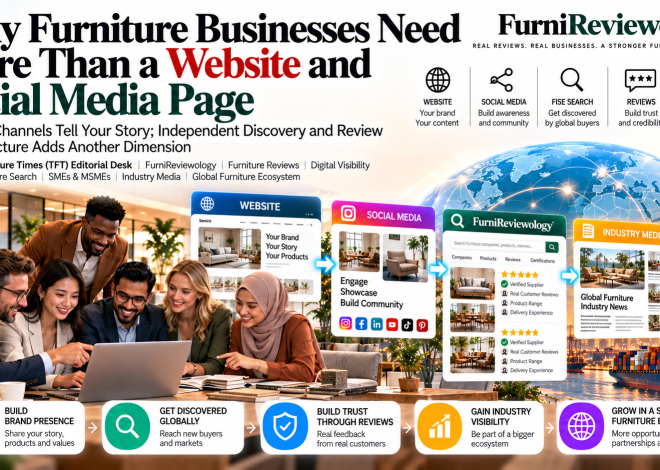

The Global Furniture Industry Is Huge — But Its Digital Reputation Infrastructure Remains Fragmented
Why the Next Opportunity Is to Connect Furniture Discovery, Company Identity, Reviews, Reputation and Industry Intelligence
By The Furniture Times (TFT) Editorial Desk | FurniReviewology | Furniture Reviews | Digital Reputation | FISE | Furniture Search | Industry Intelligence | SMEs & MSMEs | Global Furniture Ecosystem
The global furniture industry is enormous.
It stretches from forests and raw materials to components, machinery, manufacturing, design, logistics, wholesale, retail, hospitality, commercial projects, e-commerce, repair, restoration and recycling.
It includes multinational corporations.
Family-owned factories.
Export manufacturers.
Independent retailers.
Design studios.
Artisans.
Material suppliers.
Hardware manufacturers.
Component companies.
Technology providers.
Logistics companies.
Interior professionals.
SMEs.
MSMEs.
And millions of people whose livelihoods are connected directly or indirectly to furniture.
Yet despite the scale of this ecosystem, one critical part of its digital infrastructure remains surprisingly fragmented:
Reputation.
A buyer may discover a company on one platform.
Read reviews somewhere else.
Find its catalogue on another website.
See trade-show participation elsewhere.
Read company news on another platform.
Search social media for recent activity.
Visit the company’s website for official information.
Then return to a search engine to verify what they have found.
The information exists.
But it often exists in pieces.
This fragmentation creates an opportunity.
Not necessarily to replace every platform.
Not to force all furniture information into one website.
But to build a more connected furniture ecosystem where:
discovery,
company identity,
reviews,
industry visibility,
and reputation
can work more effectively together.
Furniture Is Globally Connected Physically — But Digitally Fragmented
Consider how connected the physical furniture industry already is.
A sofa sold in Europe may contain:
timber from one country,
fabric from another,
foam from another,
hardware from another,
machinery from another,
design influence from another,
manufacturing in another,
and logistics involving several more.
A hotel in the Middle East may use furniture manufactured across Asia and Europe.
A retailer in North America may source from multiple countries.
An outdoor furniture manufacturer may depend on aluminum, synthetic fibers, fabrics, foam, glass and packaging from different suppliers.
The supply chain is already global.
But digital information about the companies participating in that chain is frequently scattered.
The physical ecosystem is connected.
The Information Ecosystem Still Has Gaps.
The Buyer Often Has to Assemble the Puzzle
Imagine a procurement professional researching a furniture supplier.
The process may look something like this:
Search Engine
Find the company.
Company Website
Understand what it claims to do.
Social Media
Check whether it appears active.
Review Platform
Look for customer experiences.
Business Directory
Verify basic company information.
Industry Media
Look for company developments.
Trade-Fair Website
Check exhibition participation.
Research management or employees.
Marketplace
Look at products.
AI Assistant
Ask for a summary.
Each source may provide something useful.
But the buyer has to assemble the pieces.
This is not necessarily a problem for one company.
Multiply it across hundreds or thousands of potential suppliers and the inefficiency becomes obvious.
The Problem Is Not Lack of Information — It Is Lack of Connection
The internet already contains enormous amounts of furniture information.
The challenge is that much of it is:
unstructured,
duplicated,
outdated,
isolated,
inconsistent,
difficult to compare,
or disconnected from the broader industry context.
A company may have a strong website but no review presence.
Another may have reviews but weak company information.
Another may be well known offline but nearly invisible online.
Another may have excellent products listed on marketplaces but no clear corporate identity.
Another may receive media coverage but remain difficult to discover by category.
The information pieces exist.
They simply do not always connect.
What Does “Digital Reputation Infrastructure” Actually Mean?
Digital reputation infrastructure is broader than a review platform.
It includes the systems and information that allow a buyer to:
identify a company,
discover what it does,
understand where it operates,
see how it fits into the industry,
find customer experiences,
research its activities,
and decide whether it deserves further investigation.
A mature reputation infrastructure therefore involves multiple layers.
Layer 1: Identity
Who is the company?
What is its correct name?
Where is it located?
What does it do?
What categories does it serve?
Is it a manufacturer, brand, retailer, supplier, designer, importer or another type of industry participant?
Without clear identity, every other layer becomes harder.
Layer 2: Discovery
Can buyers find the company when they need what it provides?
This is different from searching the company by name.
If buyers already know the company name, discovery has partly happened.
The larger challenge is:
Can Buyers Find You Before They Know You Exist?
That is the role of search infrastructure.
Layer 3: Reputation
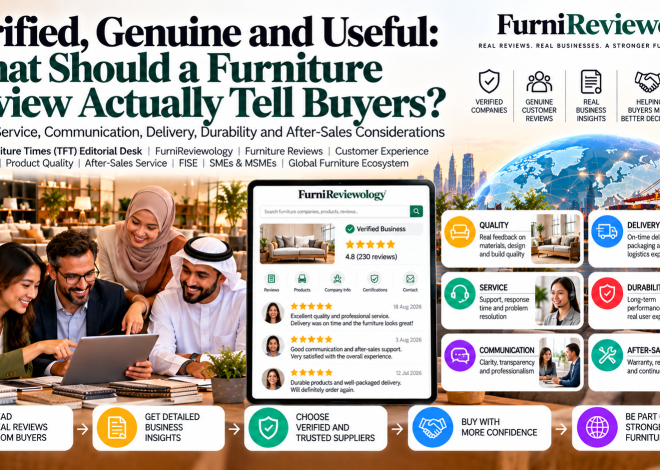
Once discovered, what can buyers learn about customer experiences?
Are there genuine reviews?
What do those reviews discuss?
Quality?
Communication?
Delivery?
Durability?
Service?
Installation?
After-sales support?
How does the company respond when problems occur?
This adds the customer-experience dimension.
Layer 4: Industry Context
What is the company doing?
Has it expanded?
Introduced new products?
Participated in exhibitions?
Entered markets?
Completed projects?
Invested in technology?
Achieved certifications?
Changed leadership?
Industry media can help document these developments.
Layer 5: Verification and Due Diligence
For meaningful commercial transactions, buyers may need deeper verification.
This can include:
business-registration checks,
factory visits,
samples,
certifications,
testing,
references,
quality inspections,
commercial agreements,
and appropriate financial or legal verification.
Digital reputation supports this process.
It does not replace it.
The Furniture Industry Needs Connections Between These Layers
This is where the opportunity becomes interesting.
Instead of thinking about:
search,
reviews,
company profiles,
and industry media
as unrelated digital products, the furniture industry can begin thinking about them as parts of a connected information architecture.
The journey becomes:
Identify → Discover → Research → Review → Understand → Verify → Connect
Each layer supports the next.
FISE: Building the Discovery Layer
FISE — Furniture Industry Search Engine addresses one of the most fundamental problems:
finding the right furniture-industry participant.
The furniture ecosystem contains enormous specialization.
A buyer may need:
office chair manufacturers,
outdoor furniture suppliers,
hotel furniture companies,
mattress manufacturers,
woodworking machinery suppliers,
furniture hardware companies,
foam suppliers,
fabric companies,
furniture retailers,
design studios,
or logistics specialists.
General search serves every subject imaginable.
FISE focuses specifically on the furniture ecosystem.
Its role is:
Help the World Find Them.
FurniReviewology: Building the Reputation Layer
Once a company is found, the next question becomes:
What can I learn about it?
This is where FurniReviewology adds another layer.
FurniReviewology focuses on:
company listings,
business profiles,
furniture reviews,
customer experiences,
and reputation.
The opportunity is to create furniture-specific context around the businesses being researched.
Not merely:
4.6 stars.
But:
What type of company is this?
What furniture does it provide?
What kinds of experiences are customers describing?
What themes appear in those experiences?
What does the wider company profile tell the buyer?
That makes the review more meaningful.
TFT: Building the Industry Intelligence and Storytelling Layer
A company’s reputation is not created only through reviews.
Its activities matter too.
The Furniture Times — TFT adds another information layer through:
industry news,
company developments,
market intelligence,
trade coverage,
manufacturing developments,
technology,
policy,
sustainability,
consumer trends,
and broader furniture-industry analysis.
A buyer researching a company may therefore find not only:
what customers experienced
but also:
what the company has been doing.
That provides additional context.
Three Platforms — Three Different Information Problems
The relationship can be summarized clearly:
FISE
Discovery
Who is out there?
Who provides what I need?
FurniReviewology
Reputation
What customer experiences and company information can I research?
The Furniture Times
Industry Intelligence and Visibility
What is happening with this company, category and wider industry?
Three distinct functions.
One broader furniture ecosystem.
The Goal Is Not to Replace Google
General search engines remain fundamental to digital discovery.
The opportunity is not to replace them.
The same applies to major social platforms, general review sites, marketplaces and professional networks.
Each serves an important purpose.
Furniture-specific infrastructure adds another dimension:
Industry Context.
A specialized environment understands that a:
furniture manufacturer,
hardware supplier,
interior designer,
mattress brand,
hotel furniture contractor,
and furniture retailer
are all part of the same broader ecosystem while serving very different functions.
That structure can improve discovery and research.
The Goal Is Not to Replace Existing Review Platforms Either
Furniture companies may already have:
Google reviews,
marketplace reviews,
retailer reviews,
social-media feedback,
testimonials,
and other customer experiences.
Those should not simply disappear.
FurniReviewology can add a furniture-specific reputation layer.
Different review environments answer different questions.
The opportunity lies in expanding the information available to buyers—not artificially narrowing it.
Fragmentation Hurts SMEs and MSMEs the Most
Large furniture brands can survive fragmented infrastructure more easily.
People already know their names.
Search engines recognize them.
Retailers carry them.
Media covers them.
Consumers discuss them.
They generate enormous amounts of digital information naturally.
An SME or MSME may have none of those advantages.
Consider a small furniture manufacturer with:
25 years of experience,
40 employees,
excellent craftsmanship,
strong repeat customers,
and good production capabilities.
Online, it may have:
an outdated website,
a Facebook page,
a few catalogue PDFs,
and almost nothing else.
The company’s real-world reputation may be strong.
Its digital reputation may barely exist.
This Creates a Digital Inequality Problem
The furniture industry’s digital transformation can unintentionally favor companies that already have:
larger marketing budgets,
stronger SEO,
more content,
more followers,
more media coverage,
and larger digital teams.
But quality furniture is not produced only by large corporations.
Innovation does not belong only to famous brands.
Craftsmanship does not belong only to companies with advertising budgets.
A more structured furniture ecosystem can help reduce this visibility gap.
Free Listings Can Become Digital Inclusion Infrastructure
This is why free FurniReviewology listings matter strategically.
The principle is simple:
Business Size Should Not Determine Whether a Company Can Establish a Basic Digital Industry Identity.
An artisan should be able to participate.
An MSME should be able to participate.
A regional retailer should be able to participate.
A specialist manufacturer should be able to participate.
A component supplier should be able to participate.
A startup should be able to participate.
Free entry reduces one of the barriers to digital inclusion.
From there, businesses can build their presence progressively.
The Furniture Ecosystem Is Bigger Than Finished Furniture
A connected digital infrastructure should also recognize the hidden parts of the industry.
Furniture depends on:
timber,
panels,
foam,
fabric,
leather,
hardware,
fasteners,
adhesives,
coatings,
glass,
metal,
plastics,
rattan,
machinery,
software,
packaging,
logistics,
testing,
design,
installation,
repair,
and recycling.
Many of these businesses remain invisible to the consumer.
But they are essential to the industry.
A genuine furniture ecosystem must make room for them too.
Reputation Should Travel Across the Supply Chain
Imagine a manufacturer searching for a new hardware supplier.
That is a furniture-industry reputation question.
Imagine a hotel searching for an outdoor furniture manufacturer.
Another reputation question.
Imagine a retailer evaluating a sofa factory.
Another.
Imagine a manufacturer evaluating a packaging provider.
Another.
Reputation infrastructure should not be limited only to:
consumer → retailer.
The furniture ecosystem also needs stronger:
business → business
information flows.
B2B Reputation Is an Enormous Opportunity
Furniture B2B transactions can involve:
large deposits,
long production periods,
custom specifications,
international shipping,
multiple containers,
technical drawings,
factory inspections,
and substantial commercial risk.
Yet supplier reputation information can still be surprisingly fragmented.
Professional buyers frequently rely on:
agents,
references,
trade-show meetings,
factory visits,
and personal networks.
These remain valuable.
But digital reputation infrastructure can support them.
It can help buyers identify which companies deserve deeper investigation.
Reviews Should Lead to Better Questions — Not Blind Trust
This principle is essential.
A company having positive reviews does not mean a buyer should skip due diligence.
A listing does not certify reliability.
A media article does not guarantee commercial performance.
A high rating does not eliminate risk.
Instead, the ecosystem should help buyers ask better questions.
A buyer sees repeated praise for quality but concerns about lead times.
Ask about production scheduling.
Reviews praise customization but mention packaging.
Investigate export packaging.
Industry coverage shows rapid expansion.
Ask whether capacity and quality systems have scaled accordingly.
Information should improve judgment.
Not replace it.
The Real Opportunity Is a Furniture Knowledge Graph
Think about the potential long-term architecture.
A furniture company could be connected digitally to:
its country,
categories,
products,
materials,
markets,
reviews,
news,
projects,
certifications,
events,
leadership,
suppliers,
and other industry relationships.
Now the company is no longer simply a website URL.
It becomes part of an interconnected furniture-information network.
That opens possibilities for:
better search,
smarter recommendations,
market intelligence,
supplier discovery,
industry mapping,
and AI-assisted research.
Structured Data Is the Foundation
For this future to work, furniture businesses need structured information.
Not simply:
“We are the best furniture company.”
But:
Company name.
Location.
Business type.
Furniture categories.
Materials.
Markets.
Products.
Capabilities.
Website.
Contact details.
Reviews.
Relevant industry activity.
Structured information is easier for buyers to understand.
It is also easier for digital systems to process.
AI Makes the Fragmentation Problem More Urgent
Artificial intelligence is accelerating the need for connected information.
A buyer may ask:
“Find furniture manufacturers in Southeast Asia specializing in hospitality furniture with export experience.”
Or:
“Which companies supply outdoor furniture suitable for hotels?”
Or:
“Compare potential furniture suppliers and identify what I should investigate before contacting them.”
AI systems need information to answer.
If company data is:
fragmented,
outdated,
contradictory,
or nonexistent,
the business becomes harder to understand.
The future of furniture visibility therefore depends increasingly on becoming:
searchable, structured and connected.
AI May Become the Interface — But Data Remains the Infrastructure
This distinction matters.
The buyer may eventually interact with AI rather than browsing dozens of websites.
But AI still needs underlying information.
That information comes from:
company websites,
structured listings,
reviews,
industry media,
product information,
and other credible digital sources.
AI may become the interface.
The Furniture Ecosystem Still Needs the Information Infrastructure Underneath It.
Fragmentation Also Limits Industry Intelligence
The problem affects more than individual companies.
Imagine trying to answer:
How many outdoor furniture manufacturers exist globally?
Where are furniture SMEs concentrated?
Which countries are strongest in particular furniture categories?
Which supplier categories are expanding?
What issues appear most often in customer reviews?
Which materials are gaining attention?
Which markets are attracting exporters?
When data is fragmented, industry-level understanding becomes difficult.
More structured ecosystems can eventually create better intelligence.
Search Data + Review Data + Industry Intelligence
This is where the longer-term opportunity becomes powerful.
Search activity can reveal:
what buyers are looking for.
Review patterns can reveal:
what customers are experiencing.
Industry media and market intelligence can reveal:
what the sector is doing.
Together, these can create a much deeper understanding of the furniture economy.
The Industry Needs Infrastructure, Not Another Digital Island
The furniture internet already has thousands of websites.
What it needs increasingly is connectivity.
Company websites should remain.
Social media should remain.
General search should remain.
Existing review platforms should remain.
Marketplaces should remain.
Trade fairs should remain.
Industry media should remain.
But furniture-specific infrastructure can help connect the pieces.
That is the opportunity.
Not Another Island.
A Bridge Between Islands.
A Connected Furniture Journey
Imagine the future buyer.
Search
The buyer enters FISE looking for a furniture category.
Discover
Relevant businesses appear.
Profile
The buyer examines structured company information.
Reviews
FurniReviewology provides customer-experience context.
Intelligence
TFT provides relevant company and industry developments.
Compare
The buyer creates a shortlist.
Verify
Appropriate due diligence begins.
Connect
The buyer contacts the company.
Deal
Commercial discussions move forward.
This aligns naturally with the FISE philosophy:
Search. Connect. Discuss. Deal.
The Same Infrastructure Helps the Seller
The ecosystem is not only for buyers.
A manufacturer can discover suppliers.
A retailer can discover brands.
A brand can identify distributors.
A designer can identify manufacturers.
A supplier can identify potential customers.
A company can monitor customer feedback.
An SME can build visibility.
An exporter can establish a stronger digital identity.
A business can communicate developments through TFT.
The ecosystem becomes multidirectional.
The Furniture Company of Tomorrow Needs a Digital Identity
A website alone is no longer enough.
A social page alone is no longer enough.
A marketplace listing alone is no longer enough.
Furniture companies increasingly need a digital identity containing:
Who we are.
What we do.
Where we operate.
What we provide.
How buyers can find us.
What customers experience.
What our company is doing.
How we participate in the industry.
This identity should grow with the company.
SMEs: Do Not Wait for the Ecosystem to Become Crowded
There is an advantage to starting early.
Businesses that begin now can build:
company history,
reviews,
search visibility,
industry references,
profiles,
product information,
and reputation
over time.
A digital footprint compounds.
A company joining years later begins from zero.
That creates urgency.
Not artificial urgency.
Strategic urgency.
Build Before You Need It.
Get Your Furniture Business Into the Ecosystem
Whether you are a:
manufacturer,
brand,
supplier,
retailer,
wholesaler,
exporter,
importer,
designer,
artisan,
component company,
material supplier,
technology company,
service provider,
SME,
or MSME,
start establishing your digital industry identity.
Get listed on FurniReviewology.
Build your company profile.
Encourage genuine customer reviews.
Become searchable through FISE.
Share meaningful developments with TFT.
Maintain accurate information.
Build your reputation continuously.
Do not wait until an international buyer searches for you.
Be ready before the search happens.
From Fragmentation to Connection
The furniture industry does not lack businesses.
It does not lack products.
It does not lack talent.
It does not lack stories.
It does not lack customer experiences.
It does not lack information.
What it lacks is enough connection between those information layers.
That is the opportunity.
Connect discovery with identity.
Connect identity with reviews.
Connect reviews with reputation.
Connect reputation with industry context.
Connect companies with buyers.
Connect SMEs with global visibility.
Connect human search with machine discovery.
And connect the fragmented pieces of the furniture economy into a more understandable digital ecosystem.
Because the next phase of furniture digitalization should not simply put more information online.
It Should Make the Information Already Online More Connected, Searchable, Useful and Trusted.
The Global Furniture Ecosystem
The Furniture Industry is a $1 Trillion USD Ecosystem in the world
Furniture Industry Search Engine – FISE helps the world find them.
The Furniture Times – TFT tells their story.
FurniReviewology helps the world trust them.