Carbon Reduction Through Smart Lighting
By The Furniture Times (TFT) | Indoor & Outdoor Lighting | Sustainability & Energy
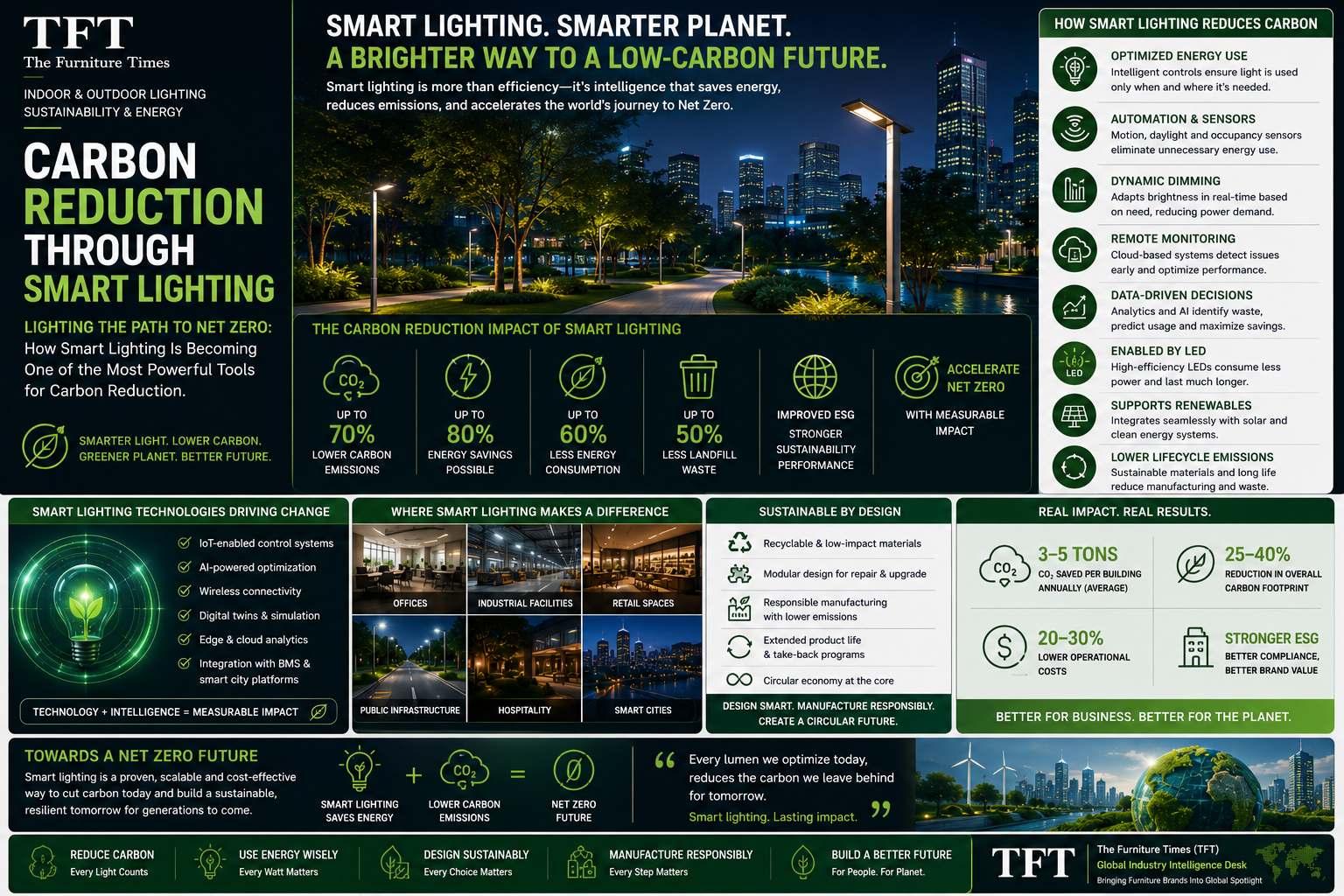
Lighting the Path to Net Zero: How Smart Lighting Is Becoming One of the Most Powerful Tools for Carbon Reduction
The race to reduce global carbon emissions is no longer limited to power plants, electric vehicles, or renewable energy projects. Increasingly, one of the most effective climate solutions is found in a technology that surrounds us every day—lighting.
Across homes, offices, factories, hotels, hospitals, schools, airports, warehouses, retail stores, and public spaces, lighting accounts for a significant share of electricity consumption. Every unnecessary hour that lights remain switched on, every outdated fixture still using inefficient technology, and every poorly designed lighting system contributes to higher energy demand and greater carbon emissions.
Fortunately, a new generation of intelligent lighting technologies is changing that reality.
Smart lighting combines energy-efficient LED technology with Artificial Intelligence (AI), the Internet of Things (IoT), occupancy sensors, daylight harvesting, wireless connectivity, cloud-based management, and real-time analytics to ensure that lighting is used only where, when, and how it is needed. Instead of operating on fixed schedules or manual switches, these systems continuously adapt to changing conditions, reducing wasted energy while improving comfort, safety, and operational efficiency.
For the global furniture industry ecosystem, this shift is creating new opportunities. Furniture manufacturers, lighting companies, architects, interior designers, hospitality operators, commercial property developers, retailers, and facility managers are designing environments where intelligent furniture and smart lighting work together to support sustainability goals without compromising functionality or aesthetics.
The future of carbon reduction will not rely on one breakthrough technology.
It will depend on thousands of smarter everyday decisions—and lighting is one of the brightest examples.
Why Carbon Reduction Has Become a Global Priority
Governments, businesses, and consumers are under increasing pressure to reduce greenhouse gas emissions.
International climate commitments, corporate Environmental, Social and Governance (ESG) strategies, rising energy costs, and growing public awareness have accelerated the search for technologies that deliver measurable environmental benefits.
Lighting represents one of the quickest and most scalable opportunities.
Unlike many large infrastructure projects, upgrading lighting systems can often deliver immediate reductions in electricity consumption and associated carbon emissions.
Every Kilowatt Saved Means Less Carbon
Electricity generation remains a major source of carbon emissions in many parts of the world.
When lighting systems consume less electricity, power plants burn fewer fossil fuels, reducing greenhouse gas emissions.
Smart lighting achieves this by ensuring energy is never wasted unnecessarily.
Instead of simply producing light, intelligent systems manage it responsibly.
LED Technology Laid the Foundation
The transition from incandescent and fluorescent lighting to LED technology has already reduced global electricity consumption significantly.
LED lighting offers:
- Lower energy demand.
- Longer operating life.
- Reduced maintenance.
- Lower heat generation.
- Higher luminous efficiency.
- Better colour consistency.
- Greater design flexibility.
- Smart system compatibility.
- Improved reliability.
- Reduced environmental impact.
However, combining LEDs with intelligent controls unlocks even greater carbon savings.
Smart Controls Eliminate Unnecessary Energy Use
One of the biggest causes of wasted electricity is lighting empty spaces.
Smart lighting systems automatically respond through:
- Occupancy sensors.
- Motion detection.
- Daylight harvesting.
- Adaptive dimming.
- Scheduling.
- Remote management.
- Voice control.
- AI optimisation.
- Presence detection.
- Cloud-based automation.
Lights operate only when required, reducing unnecessary electricity consumption without affecting user comfort.
Artificial Intelligence Learns How Buildings Behave
Artificial Intelligence adds a new level of intelligence to carbon reduction.
Rather than relying solely on predefined settings, AI continuously analyses how people use buildings.
It can automatically:
- Predict occupancy patterns.
- Adjust brightness throughout the day.
- Coordinate with natural daylight.
- Optimise energy consumption.
- Detect unusual energy usage.
- Recommend maintenance.
- Improve system efficiency.
- Reduce operating costs.
- Balance renewable energy availability.
- Continuously improve performance.
The building becomes more efficient with every passing day.
Commercial Buildings Have the Greatest Opportunity
Large commercial facilities often operate thousands of lighting fixtures simultaneously.
Smart lighting enables organisations to manage:
- Office floors.
- Meeting rooms.
- Warehouses.
- Retail stores.
- Manufacturing facilities.
- Hotels.
- Hospitals.
- Educational campuses.
- Airports.
- Shopping centres.
Even small improvements in efficiency across these facilities can result in substantial carbon reductions over time.
Homes Can Also Make a Big Difference
Carbon reduction is not only a responsibility for large organisations.
Residential buildings collectively represent one of the world’s largest consumers of electricity.
Homeowners are increasingly adopting:
- Smart LED bulbs.
- Occupancy sensors.
- Outdoor solar lighting.
- Automated lighting schedules.
- Smart home ecosystems.
- Voice-controlled lighting.
- Daylight-responsive systems.
- Connected furniture lighting.
- Mobile lighting controls.
- AI-assisted home automation.
Millions of small improvements across individual households can create significant environmental impact on a global scale.
Furniture Is Supporting Energy Efficiency
Furniture manufacturers are integrating intelligent lighting into products that consume less energy while improving user experience.
Examples include:
- LED wardrobes.
- Illuminated kitchen cabinetry.
- Smart shelving.
- Display cabinets.
- Home office desks.
- Hospitality furniture.
- Retail fixtures.
- Bedroom furniture.
- Vanity mirrors.
- Modular storage systems.
Furniture is becoming an active contributor to energy conservation rather than simply occupying space.
Measuring Carbon Performance in Real Time
Cloud-based lighting platforms now provide organisations with detailed insights into energy performance.
Facility managers can monitor:
- Electricity consumption.
- Carbon emissions.
- Occupancy trends.
- Equipment efficiency.
- Energy savings.
- Peak demand.
- Maintenance schedules.
- Asset performance.
- Sustainability targets.
- ESG reporting.
This data enables organisations to make informed decisions and demonstrate measurable environmental progress.
Opportunities Across the Furniture Industry Ecosystem
Demand for low-carbon buildings is creating opportunities for:
- Furniture manufacturers.
- Lighting manufacturers.
- Architects.
- Interior designers.
- Property developers.
- Hospitality operators.
- Retail businesses.
- Facility management companies.
- Smart building technology providers.
- Sustainability consultants.
Businesses that combine intelligent lighting with environmentally responsible furniture and building design will be better positioned to meet future market expectations.
Challenges on the Road to Lower Carbon Emissions
Despite rapid progress, several challenges remain.
These include:
- Upfront investment costs.
- Legacy infrastructure.
- Technology integration.
- Cybersecurity.
- Consumer awareness.
- Skilled workforce shortages.
- Global interoperability.
- Data privacy.
- Recycling of electronic components.
- Long-term maintenance planning.
Addressing these issues will require collaboration between governments, manufacturers, technology providers, and end users.
Smart Cities Will Accelerate Carbon Reduction
The future extends beyond individual buildings.
Smart lighting will increasingly integrate with:
- Renewable energy systems.
- Electric vehicle charging.
- Smart traffic management.
- Public transportation.
- Digital twins.
- Environmental monitoring.
- Urban safety systems.
- Smart grids.
- Outdoor furniture.
- Connected public infrastructure.
Cities will use lighting not only to improve visibility but also to reduce energy demand and support climate goals.
Lighting Is Becoming a Climate Solution
The global conversation around lighting has changed dramatically.
Success is no longer measured only by brightness or product lifespan.
It is increasingly measured by environmental impact.
Smart lighting demonstrates that reducing carbon emissions does not require sacrificing comfort, safety, or design. Instead, it proves that technology can improve quality of life while protecting natural resources.
For the global furniture industry ecosystem, this creates a unique opportunity to design integrated environments where lighting, furniture, architecture, AI, and sustainability work together to build healthier homes, more productive workplaces, more efficient commercial spaces, and more resilient cities.
Every intelligently controlled light represents more than an energy-saving device.
It represents a commitment to a future where innovation serves both people and the planet.
And as nations continue their journey toward net-zero emissions, smart lighting will remain one of the most practical, scalable, and impactful tools available for creating a lower-carbon world.
The Furniture Times (TFT) & Furniture Industry Search Engine (FISE)
“TFT tells their story. FISE helps the world find them.”
“FurniReviewology helps the world trust them.”
The furniture industry ecosystem is a $1 trillion industry ecosystem.