Green Buildings and Intelligent Lighting Systems
By The Furniture Times (TFT) | Indoor & Outdoor Lighting | Sustainability & Energy
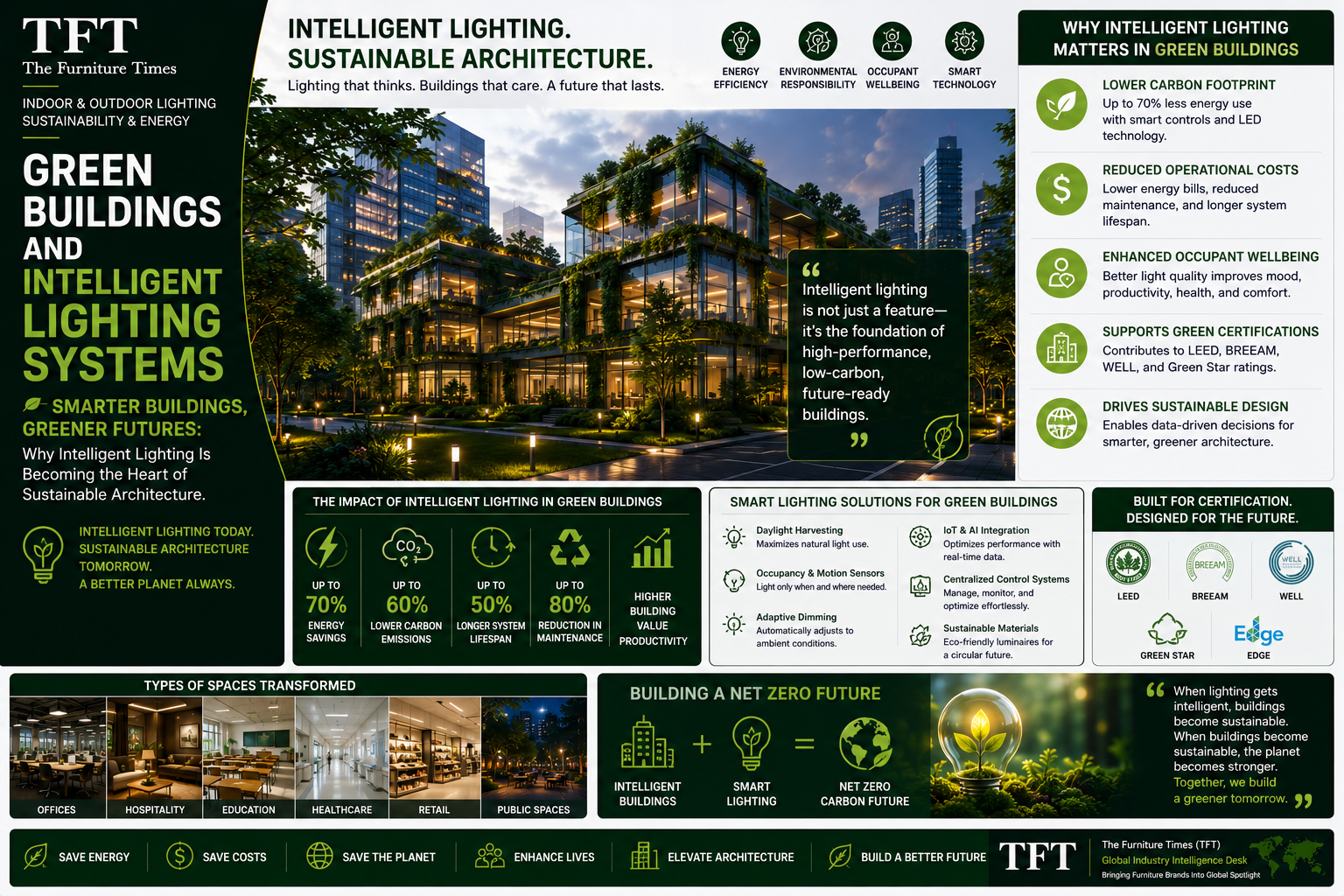
Smarter Buildings, Greener Futures: Why Intelligent Lighting Is Becoming the Heart of Sustainable Architecture
The way we design and construct buildings is undergoing one of the most significant transformations in modern history. For decades, the focus was on creating structures that were larger, faster to build, and visually impressive. Today, however, success is measured by a different standard. A truly modern building is expected to consume less energy, produce fewer carbon emissions, improve occupant wellbeing, and operate intelligently throughout its entire lifecycle.
This evolution has given rise to the global movement toward green buildings—developments designed to minimise environmental impact while maximising efficiency, comfort, and long-term value. At the centre of this transformation lies a technology that is often overlooked but influences every space people occupy every day: intelligent lighting.
Lighting is no longer simply a utility installed after construction is complete. It has become an integrated building system that communicates with sensors, heating and cooling equipment, security platforms, renewable energy systems, cloud-based software, and Artificial Intelligence (AI). Intelligent lighting continuously adapts to occupancy, daylight availability, weather conditions, and user behaviour, ensuring that energy is used only when and where it is truly needed.
For the global furniture industry ecosystem, this shift presents extraordinary opportunities. Furniture manufacturers, lighting companies, architects, interior designers, developers, hospitality operators, commercial property owners, and technology innovators are increasingly working together to create environments where furniture, lighting, and digital technologies function as one sustainable ecosystem.
The buildings of tomorrow will not simply consume fewer resources.
They will actively manage them.
Green Buildings Are Redefining the Construction Industry
Green buildings are designed to reduce their environmental footprint throughout every stage of their lifecycle—from planning and construction to daily operation and eventual renovation or reuse.
Their objectives include:
- Lower energy consumption.
- Reduced carbon emissions.
- Improved indoor air quality.
- Efficient water management.
- Responsible material selection.
- Waste reduction.
- Healthier indoor environments.
- Renewable energy integration.
- Long-term operational savings.
- Greater resilience.
Lighting contributes directly to nearly all of these goals.
Why Lighting Plays Such a Critical Role
Lighting is one of the largest consumers of electricity in many commercial and institutional buildings.
Traditional lighting systems often operate on fixed schedules regardless of whether spaces are occupied.
Intelligent lighting changes this approach entirely.
Instead of simply providing illumination, it responds dynamically to real-world conditions, ensuring that every watt of electricity is used efficiently.
This not only reduces operating costs but also helps lower greenhouse gas emissions associated with electricity generation.
LED Technology Built the Foundation
The widespread adoption of LED lighting has already transformed energy efficiency.
Compared with conventional lighting technologies, LEDs offer:
- Lower electricity consumption.
- Longer operating life.
- Reduced maintenance.
- Higher luminous efficiency.
- Lower heat generation.
- Better colour quality.
- Flexible lighting control.
- Smart system compatibility.
- Lower lifecycle costs.
- Reduced environmental impact.
When combined with intelligent controls, these benefits become even greater.
Intelligent Lighting Learns From the Building
Modern intelligent lighting systems collect information continuously through connected sensors and building management platforms.
They automatically adjust according to:
- Occupancy.
- Natural daylight.
- Room usage.
- Time of day.
- Weather conditions.
- Energy demand.
- User preferences.
- Emergency situations.
- Building schedules.
- Environmental conditions.
Instead of operating as isolated fixtures, lighting becomes part of an intelligent ecosystem.
Artificial Intelligence Optimises Building Performance
Artificial Intelligence enables lighting systems to move beyond automation into predictive intelligence.
AI analyses building data and can:
- Predict occupancy patterns.
- Optimise lighting schedules.
- Reduce unnecessary energy use.
- Balance artificial and natural light.
- Detect equipment faults.
- Improve occupant comfort.
- Forecast maintenance requirements.
- Coordinate with renewable energy systems.
- Support ESG reporting.
- Continuously improve operational efficiency.
The building becomes more responsive with every day of operation.
Furniture Is Becoming Part of the Green Building Strategy
Furniture is increasingly integrated into sustainable building design.
Manufacturers now develop products that support energy efficiency through:
- Integrated LED lighting.
- Smart office workstations.
- Illuminated storage systems.
- Adaptive hospitality furniture.
- Energy-efficient display units.
- Modular office furniture.
- Smart educational furniture.
- Healthcare furnishings.
- Residential storage solutions.
- Connected workplace environments.
Furniture no longer exists separately from the building.
It contributes directly to the overall sustainability strategy.
Occupant Wellbeing Is a Core Objective
Green buildings are designed not only to conserve resources but also to improve people’s daily experiences.
Intelligent lighting supports wellbeing by:
- Reducing glare.
- Supporting circadian rhythms.
- Improving visual comfort.
- Enhancing concentration.
- Lowering eye strain.
- Increasing workplace productivity.
- Creating healthier learning environments.
- Improving patient recovery spaces.
- Supporting hospitality experiences.
- Providing personalised lighting environments.
Sustainability and human comfort increasingly go hand in hand.
Intelligent Lighting Supports Green Building Certifications
Many green building projects pursue internationally recognised sustainability certifications.
Intelligent lighting contributes to performance in areas such as:
- Energy efficiency.
- Indoor environmental quality.
- Lighting control.
- Daylight utilisation.
- Carbon reduction.
- Building automation.
- Smart energy management.
- Occupant comfort.
- Operational performance.
- Sustainable facility management.
As certification standards evolve, advanced lighting systems continue to play a larger role in achieving higher environmental ratings.
Opportunities Across the Furniture Industry Ecosystem
The growth of green buildings is creating opportunities for:
- Furniture manufacturers.
- Lighting manufacturers.
- Architects.
- Interior designers.
- Commercial developers.
- Residential builders.
- Hospitality operators.
- Healthcare providers.
- Educational institutions.
- Smart building technology companies.
Businesses capable of integrating furniture, lighting, sustainability, and intelligent building technologies will be increasingly competitive in global markets.
Challenges on the Journey to Smarter Buildings
Despite growing adoption, several challenges remain.
These include:
- Initial investment costs.
- Retrofitting existing buildings.
- System interoperability.
- Cybersecurity.
- Skilled workforce shortages.
- Technology integration.
- Data privacy.
- Long-term maintenance.
- Standardisation.
- User education.
Addressing these issues will require collaboration across construction, manufacturing, technology, and policy sectors.
The Future Building Will Think Before It Consumes
Tomorrow’s buildings will become increasingly autonomous.
Lighting systems will communicate seamlessly with:
- Solar power systems.
- Battery storage.
- Smart electrical grids.
- Heating and cooling equipment.
- Electric vehicle charging stations.
- Digital twins.
- AI analytics platforms.
- Environmental sensors.
- Occupancy management systems.
- Connected furniture.
Rather than reacting to energy consumption, buildings will anticipate it and optimise resources automatically.
Sustainable Architecture Begins With Intelligent Decisions
Green buildings represent more than an architectural trend.
They reflect a broader commitment to designing environments that respect both people and the planet.
Intelligent lighting has emerged as one of the most practical and impactful technologies supporting this transition. By reducing energy consumption, lowering carbon emissions, improving occupant wellbeing, and integrating seamlessly with AI-powered building management systems, lighting is becoming the foundation upon which sustainable architecture is built.
For the global furniture industry ecosystem, the opportunities extend well beyond manufacturing products. They include creating integrated environments where furniture, lighting, digital technologies, and sustainable design work together to improve homes, offices, hotels, hospitals, schools, retail spaces, and entire cities.
Because the greenest building is not simply the one that uses less energy.
It is the one that continuously learns how to use energy more intelligently.
The Furniture Times (TFT) & Furniture Industry Search Engine (FISE)
“TFT tells their story. FISE helps the world find them.”
“FurniReviewology helps the world trust them.”
The furniture industry ecosystem is a $1 trillion industry ecosystem.