
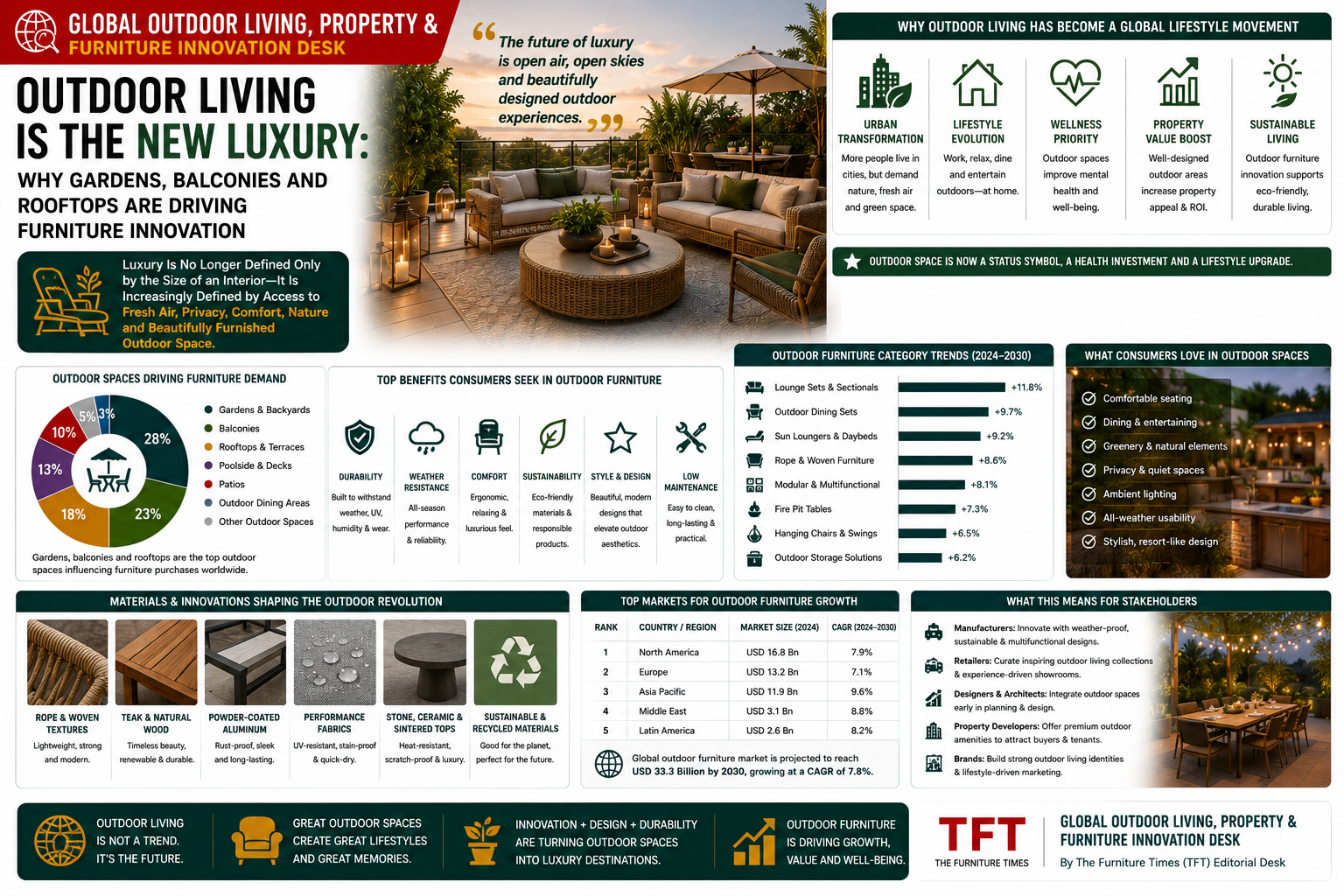
Outdoor Living Is the New Luxury: Why Gardens, Balconies and Rooftops Are Driving Furniture Innovation
Luxury Is No Longer Defined Only by the Size of an Interior—It Is Increasingly Defined by Access to Fresh Air, Privacy, Comfort, Nature and Beautifully Furnished Outdoor Space
Global Outdoor Living, Property & Furniture Innovation Desk
By The Furniture Times (TFT) Editorial Desk
Outdoor living is being redefined.
For many years, outdoor furniture was treated as a seasonal or secondary category. Households purchased basic garden chairs, folding tables, benches or occasional loungers. Hotels installed rows of standard pool furniture. Restaurants used simple terrace seating designed primarily around price and stacking efficiency.
That market still exists, but a more valuable outdoor-living economy is emerging.
Consumers increasingly want gardens, balconies, terraces, courtyards and rooftops to provide the same comfort, atmosphere and visual quality as indoor rooms.
A modern outdoor space may include:
- Deep upholstered sofas
- Dining furniture
- Daybeds and loungers
- Outdoor kitchens
- Bars and serving units
- Rugs and decorative textiles
- Sculptural lighting
- Parasols and shade systems
- Pergolas
- Fire features
- Heating and cooling systems
- Planters and landscape elements
- Charging and entertainment technology
- Storage
- Wellness and exercise areas
The result is a fundamental shift in how outdoor space is valued.
Luxury is no longer expressed only through expensive interiors, imported finishes or large residential floor areas. It is increasingly expressed through the ability to step outside into a private, comfortable and carefully designed environment.
A small balcony with intelligent furniture, greenery, shade and lighting can feel more valuable than an unused formal room.
A hotel rooftop can become a highly visible dining and entertainment destination.
A private garden can become a family living room, wellness retreat and hospitality space.
A resort pool deck can become an income-generating lifestyle environment rather than merely an area surrounding the pool.
This transformation is driving furniture innovation across residential, hospitality, commercial, institutional and public markets.
The scale of the opportunity depends heavily on how the outdoor-furniture category is defined. One broad market estimate values the global sector at approximately US$53.3 billion in 2025, increasing from US$56.1 billion in 2026 to about US$86.6 billion by 2033. A narrower estimate places the market at approximately US$20.5 billion in 2026, rising to US$24.98 billion by 2031. These differences reflect whether studies include wider outdoor-living products, accessories and distribution categories.
The surrounding outdoor-living structures market is also expanding. Pergolas, patios and related structures were valued at approximately US$2.5 billion in 2025 under one assessment and are projected to reach US$4 billion by 2033, supported by home-improvement spending and demand for backyard entertainment environments.
These forecasts indicate that outdoor furniture is increasingly connected to a much larger economic system involving property, architecture, tourism, landscaping, food and beverage, wellness, construction and digital commerce.
Outdoor Space Has Become a New Measure of Wealth
Traditional property luxury was often associated with:
- Large entrance halls
- Formal dining rooms
- Multiple bedrooms
- Imported kitchens
- Marble bathrooms
- Decorative interiors
These remain important, but lifestyle expectations are changing.
Modern buyers also value:
- Private gardens
- Large balconies
- Usable terraces
- Rooftop access
- Outdoor kitchens
- Swimming pools
- Landscaped courtyards
- Views
- Privacy
- Fresh air
- Flexible entertaining space
Outdoor space provides something that interior size alone cannot offer: a direct connection with the surrounding climate, sky, landscape and city.
In dense cities, a private balcony can feel like a rare form of ownership.
In hot regions, shade and evening outdoor living can significantly expand the useful area of a home.
In hospitality, a rooftop or terrace can create an experience that differentiates the property from nearby competitors.
Outdoor luxury is therefore not only about expensive furniture.
It is about transforming space that might otherwise remain empty, uncomfortable or underused into a desirable lifestyle asset.
The Outdoor Room Is Replacing the Traditional Patio
The word “patio” can suggest an area containing a table, several chairs and perhaps a parasol.
The outdoor room is more complete.
It may contain several functional zones:
Lounge Zone
- Sofas
- Armchairs
- Coffee tables
- Side tables
- Rugs
- Fire features
- Ambient lighting
Dining Zone
- Dining tables
- Chairs
- Benches
- Serving units
- Outdoor kitchens
- Bars
Wellness Zone
- Daybeds
- Meditation seating
- Exercise storage
- Spa furniture
- Pool loungers
- Privacy screens
Entertainment Zone
- Modular seating
- Outdoor screens
- Speakers
- Flexible tables
- Charging
- Lighting
Family Zone
- Easy-clean seating
- Children’s furniture
- Storage
- Shaded dining
- Movable products
Outdoor-design coverage in 2026 has increasingly treated gardens and patios as furnished extensions of the home, emphasising distinct zones, adaptable layouts and materials such as teak and powder-coated aluminium.
The economic importance of this development is substantial.
A consumer furnishing one outdoor room may purchase several categories at once rather than one isolated furniture set.
Gardens Are Becoming Lifestyle Destinations
The residential garden once served primarily as:
- Green space
- Children’s play area
- Utility area
- Gardening zone
- Occasional dining space
It is now increasingly designed as a lifestyle destination.
Homeowners may want the garden to support:
- Family meals
- Social gatherings
- Relaxation
- Reading
- Exercise
- Working
- Celebrations
- Outdoor cooking
- Private retreat
- Children’s activities
This creates demand for more sophisticated furniture.
Garden Lounge Furniture
Outdoor sofas are becoming deeper, softer and visually closer to indoor upholstery.
Customers want:
- Modular arrangements
- Removable cushions
- Performance textiles
- Stable frames
- Replaceable covers
- Coordinated tables
- Weather protection
Garden Dining Furniture
Dining collections must support both daily family use and larger gatherings.
Demand is increasing for:
- Extendable tables
- Stackable chairs
- Benches
- Mixed-material tables
- Easy-clean surfaces
- Integrated shade
- Outdoor serving storage
Garden Daybeds
Daybeds communicate leisure and resort-style luxury.
They can become:
- Reading spaces
- Social seating
- Relaxation zones
- Poolside features
- Visual focal points
Fire-Pit Furniture
In suitable climates and locations, fire features can extend the seasonal use of gardens and create a central social zone.
Furniture must be positioned according to:
- Heat
- Circulation
- Safety
- Smoke direction
- Material performance
The garden-furniture market is therefore becoming a complete environment-design market.
Balconies Are Becoming the New Urban Luxury
For millions of apartment residents, a balcony is the only private outdoor space available.
It may be small, narrow, exposed to wind or restricted by building-management rules. Despite those limitations, it can still deliver enormous emotional value.
A balcony can become:
- Breakfast area
- Reading corner
- Miniature garden
- Evening lounge
- Compact workspace
- Private café
- Wellness zone
- Social space
The challenge is that conventional outdoor furniture is often designed for large gardens.
Urban buyers require specialised products.
The Balcony Furniture Opportunity
Compact Bistro Sets
Small tables and chairs allow dining without consuming the entire floor area.
Folding Furniture
Products can be stored when not required.
However, folding mechanisms must tolerate repeated use and outdoor exposure.
Stackable Chairs
Stacking helps residents create additional space.
Railing-Mounted Tables
These use vertical edges rather than floor area, although structural safety and building rules must be considered.
Narrow Benches
A bench can provide seating and storage along one wall.
Corner Seating
Corner designs can use areas that ordinary chairs leave empty.
Modular Mini-Sofas
Compact modules allow the user to create a sofa arrangement without buying one oversized product.
Vertical Storage
Tall, weather-resistant cabinets can hold cushions, gardening tools and household items.
Planter Integration
Furniture and planters can be combined to provide privacy, greenery and spatial definition.
Balcony Design Requires Different Engineering
Balcony furniture must account for:
- Limited floor area
- Wind exposure
- Building load limits
- Drainage
- Lift and doorway access
- Privacy
- Neighbouring units
- Storage
- Fire-safety rules
- Building-management restrictions
Very lightweight furniture may be convenient to move but vulnerable in strong winds.
Very heavy furniture may create handling and floor-loading concerns.
Large umbrellas may be unsafe or visually overpowering in compact spaces.
Furniture companies should therefore design balcony collections as a distinct product category rather than simply offering smaller garden furniture.
Rooftops Are Becoming Urban Revenue Platforms
Rooftops represent some of the most underused spaces in modern cities.
A previously empty rooftop can potentially become:
- Restaurant
- Bar
- Café
- Hotel lounge
- Event venue
- Co-working space
- Residential amenity
- Garden
- Wellness area
- Viewing platform
For developers and hospitality operators, the rooftop is not merely an architectural feature. It can become a revenue-generating destination.
Why Rooftop Furniture Matters
Rooftop furniture must create a compelling experience while surviving demanding environmental conditions.
These include:
- High wind
- Intense UV exposure
- Rain
- Heat
- Temperature variation
- Pollution
- Limited storage
- Difficult delivery access
- Frequent commercial use
The wrong furniture can become unstable, damaged or operationally expensive.
The right furniture can help the space generate:
- Food and beverage revenue
- Event bookings
- Social-media visibility
- Resident satisfaction
- Higher property appeal
- Stronger hotel differentiation
- Longer customer stays
Rooftop Hospitality Is Changing Furniture Design
Rooftop restaurants and bars require furniture that balances:
- Appearance
- Comfort
- Capacity
- Safety
- Mobility
- Cleaning
- Storage
- Climate performance
Operators may need different layouts during the same day.
A rooftop can serve:
- Breakfast
- Casual daytime seating
- Sunset dining
- Night entertainment
- Private events
Modular and movable furniture allows the venue to change without replacing the entire collection.
However, mobility must be balanced with wind stability.
Manufacturers can respond through:
- Weighted bases
- Lockable wheels
- Modular connectors
- Stackable seating
- Removable table surfaces
- Integrated storage
- Furniture anchoring systems
- Furniture designed around wind studies
Rooftop suppliers should work with architects and engineers rather than treating the project as an ordinary outdoor dining installation.
Hospitality Is Turning Outdoor Furniture Into a Revenue Asset
Hotels and resorts once treated outdoor furniture largely as a project cost.
Today, many operators recognise that well-designed outdoor areas can increase commercial performance.
Pool Decks
Premium loungers, daybeds and cabanas can support:
- Better guest satisfaction
- Bookable premium areas
- Food and beverage service
- Branded visual identity
- Social-media content
Restaurant Terraces
Outdoor seating can expand capacity and create a more attractive dining experience.
Hotel Courtyards
Courtyards can become breakfast, cocktail, event or relaxation areas.
Resort Gardens
Furniture can transform landscaped areas into usable guest environments.
Beach Clubs
Daybeds, loungers, umbrellas and dining furniture become part of the commercial product being sold to the guest.
Outdoor furniture therefore contributes to revenue per square metre.
The hospitality buyer does not simply purchase a chair. The buyer purchases the opportunity to seat, serve and retain a guest.
Outdoor Luxury Is Becoming More Democratic
Luxury outdoor living is not limited to large villas and five-star resorts.
The concept is spreading across price segments.
A renter may create luxury through:
- One comfortable balcony chair
- Good lighting
- Greenery
- A compact table
- Coordinated cushions
A middle-income household may prioritise a well-designed terrace instead of a formal interior room.
A café may use a small pavement area to create a premium atmosphere.
Luxury is increasingly understood as the quality of the experience rather than the physical size of the property.
This creates opportunities for outdoor furniture brands at several price points:
- Affordable compact products
- Mid-market modular systems
- Premium material collections
- Bespoke architectural furniture
Design Is Moving From Outdoor Utility to Outdoor Identity
Traditional outdoor furniture was often designed around practical survival.
Current buyers also want emotional and visual identity.
Design directions receiving attention include:
- Earthy colours
- Warm neutrals
- Terracotta tones
- Sculptural shapes
- Tailored stripes
- Natural fibres
- Stone surfaces
- Woven textures
- Painted metal
- Statement umbrellas
- Layered lighting
Recent 2026 design reporting points toward more coordinated, architectural and expressive outdoor environments rather than generic matching sets. Natural materials, refined metalwork, bold fabrics and complete “outdoor room” planning are becoming more visible.
The long-term lesson is not that one colour or shape will dominate.
It is that outdoor furniture is increasingly expected to carry the same design intelligence as indoor furniture.
The Indoor-Outdoor Boundary Is Disappearing
Customers increasingly want visual continuity between interior and exterior spaces.
A living room may open directly onto a terrace.
A kitchen may connect to outdoor dining.
A hotel lobby may extend into a courtyard.
The furniture must therefore coordinate across both environments.
This is driving demand for:
- Similar colour palettes
- Matching materials
- Indoor-style upholstery outdoors
- Slim architectural frames
- Decorative lighting
- Outdoor rugs
- Coordinated cushions
- Shared modular language
The outdoor environment should feel connected to the property without becoming an imitation of the interior.
Outdoor products must still respect climate, drainage, wind, moisture and maintenance.
Comfort Is Becoming the Central Luxury Feature
Outdoor furniture was once expected to be durable first and comfortable second.
That priority is changing.
Consumers want outdoor seating where they can remain for hours.
Luxury comfort involves:
- Appropriate seat depth
- Supportive backrests
- Generous cushions
- Breathable textiles
- Arm support
- Correct table heights
- Shade
- Temperature management
- Flexible sitting positions
However, indoor-level comfort creates technical challenges outdoors.
Deep cushions can absorb more moisture.
Soft filling may dry slowly.
Large upholstered products require storage or protection.
The industry must therefore engineer comfort through:
- Quick-drying foam
- Ventilated construction
- Water-draining bases
- Removable covers
- Performance textiles
- Cushion storage systems
- Protective covers
Furniture Materials Will Determine Outdoor-Living Success
Outdoor luxury cannot depend on appearance alone.
Material performance determines whether the space remains attractive after months or years of exposure.
Teak
Teak remains one of the leading premium outdoor-furniture woods because of its natural oils, stability and established reputation.
It is used in:
- Dining furniture
- Loungers
- Benches
- Sofas
- Resort furniture
- Marine environments
Advantages
- Natural outdoor durability
- Premium perception
- Repairability
- Attractive ageing
- Design versatility
Challenges
- High cost
- Weight
- Variation in quality
- Traceability
- Colour change
- Maintenance expectations
Responsible sourcing and realistic customer education are essential.
Aluminium
Powder-coated aluminium is one of the most strategically important outdoor materials.
It offers:
- Low weight
- Corrosion resistance
- Modern design
- Suitability for extrusion and casting
- Recyclability
- Ease of movement
Its performance depends on:
- Alloy
- Wall thickness
- Welding
- Surface preparation
- Powder-coating quality
- Drainage design
Aluminium is especially valuable for balconies, rooftops, hospitality and modular systems.
Stainless Steel
Stainless steel can create slim, premium structures.
It is suitable for architectural and coastal applications when the correct grade and finish are specified.
However, buyers should not assume every stainless-steel product performs identically near salt, chlorine or pollution.
Rope
Synthetic outdoor rope is gaining attention because it provides a softer, lighter visual alternative to conventional woven products.
Modern rope systems can offer moisture and UV resistance, but their performance depends on fibre quality, construction and care. Current design coverage highlights rope furniture as a growing option for contemporary gardens and compact outdoor areas.
Rattan and Wicker
Natural rattan provides craftsmanship and authenticity but normally requires sheltered conditions.
Synthetic wicker can provide stronger outdoor resistance, although poor-quality material may fade, crack or become brittle.
The category is moving away from generic mass-market appearance toward more distinctive weaving, refined colours and mixed-material design.
Stone and Ceramic Surfaces
Stone, sintered surfaces and ceramics provide:
- Architectural appearance
- Stability
- Heat resistance in suitable specifications
- Premium value
Their challenges include:
- Weight
- Cracking
- Transport
- Installation
- Staining
- Replacement difficulty
Recycled Plastics
Recycled polymers are increasingly used in:
- Chairs
- Benches
- Tables
- Public furniture
- Coastal products
Their long-term value depends on:
- UV resistance
- Structural stability
- Colour performance
- Repairability
- Recyclability after use
Recycled content should not be treated as a substitute for durability.
Performance Textiles
Outdoor fabrics must resist:
- UV fading
- Moisture
- Mould
- Abrasion
- Staining
- Cleaning chemicals
Fabric performance is becoming one of the most important differentiators between low-cost and premium outdoor furniture.
Climate-Specific Furniture Will Become a Major Growth Category
There is no universal outdoor material specification.
Furniture should be matched to its environment.
Tropical Climates
Require:
- Drainage
- Mould resistance
- UV performance
- Corrosion resistance
- Easy cleaning
- Rapid drying
Coastal Climates
Require:
- Salt resistance
- Correct metal grades
- Protective coatings
- Replaceable hardware
- Frequent maintenance
Desert Climates
Require:
- High-UV performance
- Heat-resistant surfaces
- Dust management
- Fade resistance
- Shade integration
Cold and Wet Climates
Require:
- Freeze-thaw durability
- Storage planning
- Protective covers
- Moisture control
- Seasonal flexibility
High-Wind Locations
Require:
- Weight
- Anchoring
- Stable bases
- Controlled umbrella use
- Secure cushions
- Engineering coordination
The furniture company that provides region-specific expertise can compete through knowledge rather than price alone.
Shade Is Becoming Part of the Furniture System
An outdoor area may be beautifully furnished but remain unusable because of direct sunlight, heat or rain.
Shade products include:
- Parasols
- Cantilever umbrellas
- Pergolas
- Retractable roofs
- Awnings
- Screens
- Cabanas
The growing outdoor-living structures market demonstrates that consumers are investing not only in furniture but also in the infrastructure needed to use it more frequently.
Future outdoor furniture collections will increasingly be designed together with shade rather than treated as separate purchases.
Key considerations include:
- Sun direction
- Wind
- Base weight
- Opening mechanism
- Drainage
- Lighting
- Heating and cooling
- Replacement canopies
Lighting Is Becoming Outdoor Furniture’s Invisible Partner
Lighting determines whether an outdoor environment remains usable after sunset.
Outdoor lighting can provide:
- Safety
- Atmosphere
- Wayfinding
- Dining visibility
- Product emphasis
- Vertical texture
- Event identity
The strongest outdoor spaces use several lighting levels:
- General lighting
- Table lighting
- Path lighting
- Landscape lighting
- Decorative lighting
- Integrated furniture lighting
Portable rechargeable lamps are becoming attractive because they allow layouts to change without fixed electrical work.
Furniture designers should consider lighting as part of the complete outdoor experience.
Outdoor Kitchens Are Creating a New Furniture Ecosystem
Outdoor cooking is expanding beyond the portable grill.
Modern outdoor kitchens may include:
- Cabinets
- Counters
- Sinks
- Refrigeration
- Storage
- Bars
- Dining furniture
- Serving units
- Waste systems
This brings furniture manufacturers into collaboration with:
- Appliance companies
- Countertop suppliers
- Builders
- Landscape designers
- Shade specialists
- Lighting suppliers
Outdoor kitchen furniture must tolerate moisture, heat, grease, food spills and frequent cleaning.
The strongest products will use replaceable doors, serviceable hardware and climate-appropriate construction.
Wellness Is Increasing the Value of Outdoor Space
Outdoor environments can support:
- Relaxation
- Meditation
- Exercise
- Social interaction
- Recovery
- Connection with nature
- Reduced indoor crowding
This is important for:
- Homes
- Hotels
- Healthcare facilities
- Senior living
- Offices
- Schools
- Wellness resorts
Furniture determines whether wellness areas are usable.
A landscaped healthcare garden without supportive seating may remain inaccessible to many patients.
A corporate terrace without shade or work surfaces may remain empty.
Wellness-oriented outdoor furniture should consider:
- Support
- Accessibility
- Armrests
- Seat height
- Shade
- Privacy
- Quiet
- Mobility
Outdoor Workspaces Are Emerging
Hybrid work is extending into gardens, balconies, terraces and corporate campuses.
Outdoor work furniture may include:
- Tables at laptop height
- Supportive chairs
- Charging
- Shade
- Acoustic screening
- Mobile furniture
- Meeting tables
- Weather protection
The design challenge is to create professional functionality without turning the garden or terrace into a conventional office.
Furniture should support short periods of work, informal meetings and creative activity.
Sustainability Will Influence Outdoor Furniture More Strongly
Outdoor furniture faces a sustainability contradiction.
Products are exposed to difficult conditions and may fail quickly when poorly manufactured. At the same time, they often combine materials that are difficult to separate.
A typical outdoor sofa may include:
- Aluminium
- Plastic weaving
- Rope
- Foam
- Fabric
- Adhesive
- Hardware
- Protective coatings
Future improvement will require:
- Longer product life
- Replaceable cushions
- Replaceable slings and ropes
- Recoverable metal frames
- Certified timber
- Recycled polymers
- Removable covers
- Mechanical connections
- Take-back systems
- Repair services
A durable product that can be repaired may create greater environmental value than a product marketed as sustainable but discarded after a short period.
Search Behaviour in the Outdoor-Living Economy
Consumers increasingly search around space, climate and lifestyle rather than product name alone.
Garden Searches
- Luxury garden furniture ideas
- Outdoor sofa for large garden
- Garden dining set for entertaining
- Best furniture around fire pit
- Modular garden furniture
- Outdoor furniture with washable covers
Balcony Searches
- Best furniture for small balcony
- Balcony table that folds
- Wind-resistant balcony furniture
- Narrow outdoor bench
- Furniture for condominium balcony
- Small outdoor sofa for apartment
Rooftop Searches
- Rooftop furniture supplier
- Wind-resistant rooftop furniture
- Rooftop restaurant seating
- Commercial rooftop furniture
- Hotel rooftop lounge furniture
- Furniture for outdoor event terrace
Climate Searches
- Outdoor furniture for tropical rain
- Furniture that will not rust near sea
- Outdoor cushions that dry quickly
- Furniture for intense sunlight
- Best patio furniture for cold weather
Hospitality Searches
- Resort outdoor furniture manufacturer
- Commercial pool lounger supplier
- Luxury hotel daybed manufacturer
- Restaurant terrace furniture
- Replacement cushions for hotel furniture
Brands should build content around these complete search intentions.
AI Search Will Reward Climate and Application Expertise
AI-assisted search allows customers to describe a complex outdoor requirement.
A buyer may ask:
Compare teak, aluminium and rope furniture for a rooftop restaurant exposed to strong sun, seasonal rain and moderate wind.
Another may ask:
Recommend a compact outdoor dining set for a condominium balcony that can be folded and stored easily.
Furniture businesses with clear information about:
- Climate suitability
- Product weight
- Materials
- Maintenance
- Dimensions
- Commercial grade
- Wind considerations
- Replacement parts
will be easier for digital systems to understand and recommend.
Generic descriptions such as “all-weather luxury furniture” are unlikely to provide enough decision-making value.
Age Groups Want Different Outdoor Experiences
Gen Z
May value:
- Compact balcony products
- Visual identity
- Social-media appeal
- Portability
- Affordable accessories
- Flexible lighting
Millennials
May seek:
- Family dining
- Modular sofas
- Easy-clean materials
- Children-friendly layouts
- Outdoor work areas
- Entertainment zones
Generation X
May invest in:
- Premium dining
- Outdoor kitchens
- Pool furniture
- Complete lounge settings
- Shade systems
- Durable materials
Baby Boomers
May prioritise:
- Supportive chairs
- Stable armrests
- Shade
- Easy maintenance
- Comfortable dining
- Accessible pathways
- Professional delivery
Outdoor luxury should therefore be designed around the user’s life stage as well as the property.
Regional Outdoor-Living Opportunities
North America
North America held approximately 34% of the global outdoor-furniture market in 2025 under one broad market assessment. Residential patios, decks, gardens, pools and outdoor kitchens support strong demand.
Important opportunities include:
- Modular lounge furniture
- Dining sets
- Fire-pit seating
- Outdoor kitchens
- Pergolas
- Pool furniture
- Replacement cushions
Europe
European demand varies by climate.
Southern Europe has strong terrace, garden, café and hospitality cultures.
Northern Europe requires:
- Seasonal storage
- Covers
- Weather durability
- Flexible furniture
- Heating integration
Sustainability, certified materials and repairability are increasingly important.
Asia-Pacific
The region combines major manufacturing capacity with expanding domestic consumption.
Opportunities include:
- Condominium balconies
- Tropical garden furniture
- Resorts
- Rooftop restaurants
- Urban hospitality
- Premium residential developments
- Outdoor cafés
Malaysia, Indonesia, Vietnam, Thailand, China and India offer manufacturing and market-growth opportunities, while Australia has an established outdoor-living culture.
Middle East
The Middle East offers major premium potential through:
- Villas
- Resorts
- Hotels
- Branded residences
- Rooftop dining
- Pool environments
- Entertainment developments
Products must withstand:
- Heat
- UV
- Dust
- Coastal conditions
- Intensive hospitality use
Shade and cooling integration are especially important.
Africa
Africa offers long-term opportunities through:
- Resorts
- Tourism
- Urban residential development
- Restaurants
- Public spaces
- Local manufacturing
Furniture must balance affordability, repairability, climate performance and transport efficiency.
Latin America and the Caribbean
Warm climates and tourism support demand for:
- Resort furniture
- Beach clubs
- Poolside products
- Residential terraces
- Restaurant seating
- Outdoor kitchens
Coastal corrosion, humidity, strong winds and replacement availability must be considered.
The Future of Outdoor Retail Is Experiential
Customers want to understand how outdoor furniture feels and performs.
Retailers should create displays showing:
- Complete outdoor rooms
- Small balconies
- Rooftop-style settings
- Pool environments
- Shade systems
- Lighting
- Outdoor kitchens
- Material ageing
A showroom containing disconnected chairs and tables cannot fully communicate the lifestyle opportunity.
Outdoor furniture retail should help customers plan:
- Space
- Circulation
- Shade
- Storage
- Climate
- Maintenance
- Product protection
The retailer becomes an outdoor-living adviser rather than only a furniture seller.
Strategic Priorities for Outdoor Furniture Manufacturers
Manufacturers should:
- Create separate garden, balcony and rooftop collections.
- Design according to real regional climates.
- Test UV, corrosion, moisture and structural performance.
- Improve cushion drainage and ventilation.
- Offer replaceable slings, ropes, covers and cushions.
- Build modular product families.
- Design furniture around shade and lighting.
- Engineer rooftop products for wind and intensive use.
- Reduce unnecessary material combinations.
- Provide realistic maintenance guidance.
- Publish product weights and exact dimensions.
- Develop compact urban products.
- Create professional hospitality specifications.
- Offer long-term spare components.
- Prepare detailed information for AI and digital search.
Strategic Priorities for Retailers and Project Suppliers
Retailers and suppliers should:
- Sell outdoor environments rather than isolated pieces.
- Display complete lifestyle zones.
- Ask about climate before recommending materials.
- Ask whether the site is residential or commercial.
- Confirm wind, sun and rain exposure.
- Provide space-planning services.
- Explain maintenance honestly.
- Offer covers and storage systems.
- Provide delivery and installation.
- Coordinate furniture with shade and lighting.
- Offer replacement cushions.
- Build relationships with architects and landscapers.
- Create dedicated balcony and rooftop content.
- Document completed projects.
- Explain total lifecycle value.
The Outdoor Furniture Industry Must Move Beyond Seasons
Outdoor furniture has traditionally been marketed through seasonal sales cycles.
This limits strategic thinking.
The future market should be organised around:
- Climate zones
- Property types
- Lifestyle activities
- Hospitality revenue
- Urban space
- Wellness
- Family use
- Year-round functionality
In tropical regions, outdoor living may continue throughout the year.
In colder markets, heating, covers, structures and adaptable furniture can extend the season.
In hospitality, outdoor areas must support operations according to tourism and event schedules rather than retail seasons.
The New Luxury Is Usable Space
A property may contain a large garden but still provide little lifestyle value if it lacks shade, furniture, lighting and functional planning.
A balcony may be small but feel luxurious if every element is carefully selected.
A rooftop may be structurally impressive but remain commercially useless if wind, circulation and furniture have not been planned properly.
The economic value of outdoor space comes from usability.
Furniture turns surface area into experience.
It allows people to:
- Sit
- Eat
- Work
- Rest
- Gather
- Celebrate
- Recover
- Connect with nature
Outdoor Living Is Becoming a Complete Global Economy
The outdoor-living revolution connects:
- Furniture
- Property
- Hospitality
- Landscaping
- Architecture
- Construction
- Lighting
- Shade
- Textiles
- Kitchens
- Wellness
- Retail
- Tourism
- Digital commerce
Every new terrace, balcony, garden or rooftop creates demand across several industries.
The companies that understand these connections can capture greater value than those selling one furniture item at a time.
Gardens, Balconies and Rooftops Are the New Lifestyle Frontiers
The next major furniture opportunity may not come from building another room.
It may come from activating the space that already exists outside it.
Gardens can become family destinations.
Balconies can become private urban retreats.
Rooftops can become hospitality and community assets.
Courtyards can become social centres.
Pool decks can become premium revenue environments.
The future of outdoor furniture will be shaped by companies that combine:
- Design
- Material engineering
- Climate knowledge
- Comfort
- Modularity
- Sustainability
- Project coordination
- Digital visibility
Outdoor living is no longer an optional decoration placed around a property.
It is becoming a measure of how well the property supports modern life.
The new luxury is not simply owning more indoor space. It is having outdoor space that is comfortable, beautiful, functional and ready to become part of everyday living.
