
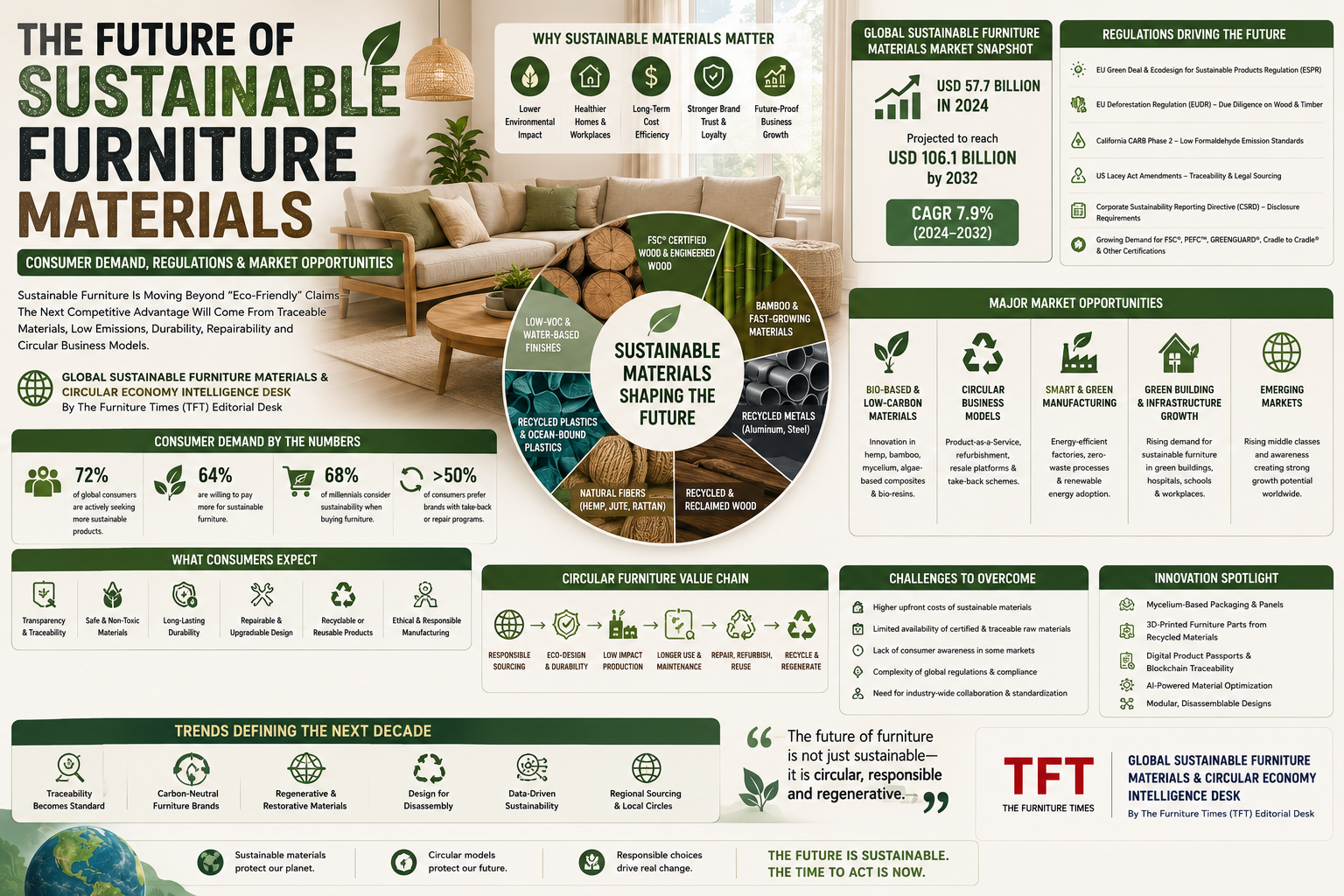
The Future of Sustainable Furniture Materials: Consumer Demand, Regulations and Market Opportunities
Sustainable Furniture Is Moving Beyond “Eco-Friendly” Claims—The Next Competitive Advantage Will Come From Traceable Materials, Low Emissions, Durability, Repairability and Circular Business Models
Global Sustainable Furniture Materials & Circular Economy Intelligence Desk
By The Furniture Times (TFT) Editorial Desk
Sustainability is becoming one of the most influential forces reshaping the global furniture industry ecosystem.
For many years, sustainable furniture was treated as a specialist category. It was often associated with reclaimed wood, bamboo products, recycled plastic chairs or small environmentally conscious brands.
That position is changing.
Sustainability is moving into mainstream furniture procurement, product design, manufacturing, retail, hospitality, construction and government policy.
Consumers increasingly want to know:
- Where did the timber originate?
- Did furniture production contribute to deforestation?
- Does the product contain recycled materials?
- Are composite panels compliant with emission requirements?
- Can the furniture be repaired?
- Are replacement components available?
- Can the product be dismantled and recycled?
- How long is it expected to remain usable?
- Are sustainability claims supported by credible evidence?
- What happens to the furniture at the end of its first life?
Governments, architects, developers, hotel groups and corporations are asking similar questions.
The future sustainable-furniture market will therefore not be defined by one preferred material.
It will be shaped by complete product systems that combine:
- Responsible sourcing
- Material traceability
- Lower emissions
- Efficient manufacturing
- Long product life
- Repairability
- Replaceable components
- Recycled content
- Recyclability
- Refurbishment
- Resale
- Responsible end-of-life management
The strategic change is significant.
Furniture companies will no longer be able to market a product as sustainable simply because it contains wood, bamboo, rattan, recycled plastic or natural fabric.
They will increasingly need to demonstrate how the material was sourced, processed, transported, assembled, used, repaired and recovered.
Sustainable Furniture Is a Product-Lifecycle Question
A furniture material cannot be judged in isolation.
A solid-wood table may use a renewable resource, but its sustainability depends on:
- Forest management
- Legality
- species
- transport distance
- timber drying
- manufacturing waste
- coatings
- product lifespan
- repairability
- end-of-life use
A recycled-plastic chair may reduce demand for virgin material, but its overall value depends on:
- Recycled-content percentage
- durability
- UV performance
- additives
- repairability
- future recyclability
- local recycling infrastructure
A lightweight panel cabinet may use materials efficiently and reduce freight emissions, but weak hardware or moisture-sensitive edges could shorten its life.
A premium sofa may use certified timber and recycled textile content, but permanent adhesives and mixed materials may make disassembly difficult.
The correct question is therefore not:
Which furniture material is sustainable?
It is:
Which material and product system delivers the necessary performance with the lowest credible environmental and social impact throughout its useful life?
Consumer Demand Is Becoming More Informed
Consumer interest in responsible materials is increasing, but purchasing behaviour remains complex.
People may express strong support for sustainable furniture while still prioritising:
- Price
- comfort
- appearance
- dimensions
- availability
- delivery
- maintenance
- durability
Sustainability rarely replaces these purchasing factors.
It must work alongside them.
Forest Stewardship Council consumer research across 33 countries found that 46% of respondents recognised the FSC label, with especially strong recognition among younger adults. Separate FSC-linked research found that 80% of surveyed consumers expected companies to ensure that wood products did not contribute to deforestation.
These findings point to an important shift:
Consumers increasingly place responsibility not only on themselves but also on companies.
They expect furniture businesses to conduct due diligence before products reach the showroom.
What Sustainable Furniture Buyers Actually Want
Customers do not all define sustainability identically.
Responsible Wood Buyers
They may seek:
- Certified timber
- legally harvested wood
- plantation-grown material
- recycled wood
- reclaimed timber
- transparent species information
Health-Conscious Buyers
They may prioritise:
- Lower-emission panels
- low-odour finishes
- material disclosure
- reduced hazardous substances
- products suitable for children or bedrooms
Circular-Economy Buyers
They may seek:
- Repairable furniture
- replacement components
- removable covers
- modular products
- trade-in programmes
- refurbished furniture
- buy-back systems
Climate-Conscious Buyers
They may consider:
- Product lifespan
- local production
- shipping distance
- recycled materials
- manufacturing energy
- packaging reduction
Value-Conscious Buyers
They may not use environmental language but still prefer:
- Durable construction
- repairability
- timeless design
- long warranties
- furniture that can move between homes
This final group is extremely important.
Durability can make sustainable furniture relevant to consumers who are primarily motivated by financial value.
Price Remains the Greatest Commercial Barrier
Sustainable materials can cost more because of:
- Certification
- traceability
- better-quality raw materials
- testing
- smaller production volumes
- lower-emission adhesives
- responsible labour systems
- product take-back programmes
However, a higher manufacturing cost does not always require an unaffordable retail price.
Furniture companies can control costs through:
- Efficient design
- fewer material types
- standard components
- reduced waste
- modular production
- flat-pack logistics
- local sourcing
- replaceable parts
- longer product families
Sustainable furniture will become mainstream only when companies offer credible choices across affordable, mid-market and premium price levels.
It cannot remain a privilege available only to wealthy households.
Regulation Is Moving Sustainability From Voluntary to Mandatory
Furniture sustainability was once driven mainly by brand choice, voluntary certification and green procurement.
Regulation is now becoming a stronger market force.
The European Union’s Ecodesign for Sustainable Products Regulation establishes a framework for product requirements involving durability, repairability, recycled content, environmental information and other lifecycle characteristics. It also creates the framework for Digital Product Passports and mandatory green public-procurement requirements.
Furniture has been identified among the priority product groups in the EU’s 2025–2030 ecodesign working plan. This means future furniture-specific requirements can address areas such as durability, repair, material efficiency and product information, although exact obligations will depend on later product rules.
For furniture businesses, this signals a major transition.
Product sustainability information may become part of market access rather than merely marketing.
Digital Product Passports Could Transform Furniture Transparency
A Digital Product Passport is intended to make relevant product information accessible electronically.
Depending on future furniture-specific requirements, a passport could eventually contain information such as:
- Manufacturer
- model
- material composition
- wood origin
- recycled content
- repair instructions
- replaceable components
- environmental information
- disassembly guidance
- compliance documentation
The European Commission identifies the Digital Product Passport as a central innovation under the Ecodesign for Sustainable Products Regulation. EU technical work is continuing to define how passport data should be structured, prioritised and exchanged across product value chains.
For the furniture industry, Digital Product Passports could support:
- Procurement verification
- warranty management
- maintenance
- refurbishment
- resale
- material recovery
- product authentication
- regulatory compliance
A hotel could scan furniture to identify the approved fabric or replacement component.
A retailer could verify the model and manufacturing batch.
A refurbisher could access disassembly guidance.
A future buyer could review the history and composition of a used product.
The EU Deforestation Regulation Will Affect Wood Furniture Trade
The European Union Deforestation Regulation covers wood and certain derived products, including furniture within its product scope.
Its purpose is to ensure that relevant products entering, leaving or being sold within the EU meet deforestation-free and legal-production conditions.
Following amendments agreed in December 2025, the main application date was moved to 30 December 2026, with later application provisions for some micro and small operators.
The regulation requires supply-chain due diligence and traceability connected to the land from which relevant commodities were produced. Official EU guidance and implementation documents were updated in May 2026.
For furniture manufacturers exporting wood products to Europe, this can require stronger systems for:
- Supplier identification
- timber species documentation
- country of harvest
- geolocation information
- legality evidence
- risk assessment
- record retention
- due-diligence statements
A vague declaration that timber came from a “managed forest” may no longer be enough.
Companies will need verifiable supply-chain data.
The End of Anonymous Timber
Furniture supply chains often involve several stages:
- Forest or plantation
- sawmill
- veneer or panel producer
- component manufacturer
- furniture factory
- exporter
- importer
- retailer or project buyer
At every stage, information can be lost.
The future market will increasingly reward companies that can maintain chain-of-custody information across this journey.
This creates opportunities for:
- Digital timber tracking
- chain-of-custody certification
- supplier auditing
- geolocation systems
- traceability software
- compliance consulting
- verified furniture directories
Manufacturers that begin mapping timber sources early will be better positioned than companies waiting until a customer or regulator demands the information.
Formaldehyde and Indoor Air Quality Remain Critical
Composite wood products—including medium-density fibreboard, particleboard and hardwood plywood—are widely used in:
- Cabinets
- kitchens
- wardrobes
- desks
- shelves
- children’s furniture
- retail fixtures
- bedroom furniture
In the United States, EPA’s TSCA Title VI rules apply formaldehyde-emission standards to regulated composite wood products and finished goods containing them. Covered products manufactured or imported after March 22, 2019, must follow TSCA Title VI certification and labelling requirements.
EPA identifies hardwood plywood, MDF—including thin MDF—and particleboard as the principal regulated composite wood categories. The rules require testing, certification and supply-chain compliance.
The commercial lesson extends beyond the United States.
Furniture customers increasingly want credible information about:
- Panel specifications
- adhesive systems
- emission testing
- coatings
- indoor-air implications
- compliance markets
Manufacturers should avoid using undefined claims such as “chemical free” or “completely non-toxic.”
Furniture contains materials, coatings, adhesives and processes that require more precise communication.
Green Public Procurement Will Influence Commercial Furniture
Governments, universities, healthcare systems and public agencies purchase large quantities of furniture.
Procurement requirements can influence:
- Timber certification
- recycled content
- emission limits
- product durability
- reparability
- spare-part availability
- packaging
- take-back
- social responsibility
The EU sustainable-products framework enables mandatory green public-procurement requirements to be developed for regulated product groups.
This means a furniture company’s sustainability performance can affect access to institutional contracts.
A low-priced desk may lose a tender if it cannot demonstrate:
- Material origin
- emissions compliance
- expected lifespan
- replacement components
- environmental documentation
Procurement-ready sustainability will therefore become a major B2B competitive advantage.
Certified Timber Will Remain Central
Wood is renewable, versatile, repairable and capable of long service.
It remains one of the most strategically important sustainable furniture materials.
However, responsible wood use requires more than choosing a natural material.
Credible systems should address:
- Forest management
- legality
- chain of custody
- species risk
- labour
- biodiversity
- recycled content
FSC certification can apply to solid wood, veneers, plywood, composite panels and other forest-derived products. FSC states that certification helps buyers identify material sourced from responsibly managed forests and recycled sources.
Strong Market Opportunities for Certified Wood
- Residential furniture
- kitchens
- office furniture
- children’s furniture
- hotel furniture
- public procurement
- outdoor collections
- luxury furniture
- mass-market flat-pack furniture
Certification should not be used as a substitute for product quality.
Certified timber can still be wasted through weak design or short product life.
The strongest proposition combines responsible sourcing with durable construction.
Reclaimed Wood: High Story Value, Complex Supply
Reclaimed wood can come from:
- Old buildings
- industrial structures
- railway or transport infrastructure
- discarded furniture
- manufacturing offcuts
- recovered flooring
- agricultural structures
Its advantages include:
- Reuse of existing material
- visual character
- reduced demand for virgin timber
- cultural and historical storytelling
Challenges include:
- Inconsistent supply
- hidden nails or metal
- contamination
- variable moisture
- structural uncertainty
- additional labour
- limited repeatability
Reclaimed wood is especially attractive for:
- Dining tables
- hospitality interiors
- wall panels
- shelving
- statement furniture
- limited collections
It is less suitable for every large-scale standardised product.
Recycled and Upcycled Wood Products
Wood waste can be converted into:
- Particleboard
- fibreboard
- composite panels
- acoustic panels
- moulded components
- small accessories
The commercial opportunity lies in improving material recovery from:
- Factory offcuts
- construction waste
- old furniture
- pallets
- packaging
- demolition timber
However, recovered wood requires sorting and contamination control.
Furniture containing mixed coatings, adhesives, metals and fabrics is more difficult to recycle.
This reinforces the need for design for disassembly.
Bamboo: Renewable Potential With Quality Challenges
Bamboo is frequently promoted as a sustainable furniture material because of its rapid growth and wide availability in several regions.
It can be used in:
- Chairs
- tables
- panels
- shelving
- outdoor or covered furniture
- laminated components
- woven products
Its advantages may include:
- Rapid renewability
- regional availability
- light weight
- strength in suitable applications
- rural income opportunities
Its performance depends on:
- Species
- age at harvesting
- treatment
- drying
- lamination
- adhesives
- finishing
- moisture exposure
Poorly processed bamboo can suffer from:
- Splitting
- insects
- mould
- delamination
- surface deterioration
Bamboo should not be marketed as automatically sustainable or durable.
It needs the same engineering and quality discipline applied to timber.
Rattan and Cane: Craft, Livelihoods and Natural Texture
Natural rattan and cane can support:
- Rural craftsmanship
- local value chains
- lightweight furniture
- repairable woven construction
- hospitality design
- cultural identity
They are especially important across Southeast Asia, South Asia and parts of Africa.
Their future market can grow through:
- Contemporary design
- certified or verified sourcing
- stronger treatment
- improved finishing
- combination with responsibly sourced timber or metal
- digital access to global buyers
Natural rattan is normally better suited to indoor or protected environments unless specifically treated and designed for exposure.
Synthetic woven furniture may provide stronger outdoor performance, but its polymer composition and end-of-life route must be considered.
Recycled Plastic Furniture
Recycled plastics are being used in:
- Outdoor chairs
- benches
- school furniture
- public furniture
- decking-style products
- tables
- coastal furniture
Advantages may include:
- Diversion of plastic waste
- resistance to ordinary moisture
- colour consistency
- ease of cleaning
- moulding flexibility
Challenges include:
- Quality variation
- additives
- UV degradation
- material contamination
- weight
- surface heat
- future recyclability
- microplastic concerns
Recycled plastic should be evaluated through:
- Verified recycled content
- durability
- repair options
- UV performance
- material identification
- take-back systems
A recycled product that fails quickly and cannot be recycled again provides limited circular value.
Recycled Metals
Steel and aluminium are well-established furniture materials with significant recycling infrastructure in many regions.
They are used in:
- Chairs
- tables
- shelving
- bed frames
- office systems
- outdoor furniture
- commercial products
Potential advantages include:
- Structural efficiency
- high recycled-content potential
- recoverability
- standardised processing
- long product life
- repair through welding or replacement
Environmental performance depends on:
- Recycled-content level
- energy source
- metal grade
- coating
- product weight
- design life
- end-of-life separation
Powder coatings, mixed fasteners and permanently bonded materials should be considered during design.
Recycled and Low-Impact Textiles
Furniture upholstery can incorporate:
- Recycled polyester
- recycled wool
- recovered cotton
- plant-based fibres
- regenerated fibres
- production offcuts
The opportunity is substantial across:
- Sofas
- chairs
- mattresses
- acoustic products
- office panels
- outdoor cushions
However, textile sustainability involves several trade-offs:
- Abrasion resistance
- cleaning
- stain treatments
- shedding
- colourfastness
- backing materials
- recyclability
A fabric with recycled content that wears rapidly may create more replacement demand.
Performance and sustainability must be tested together.
Natural Fibres and Agricultural Residues
Furniture manufacturers are exploring materials derived from:
- Hemp
- flax
- jute
- coconut fibre
- rice husks
- wheat straw
- sugarcane residues
- palm residues
- cork
Potential applications include:
- Panel materials
- seat filling
- acoustic products
- moulded components
- insulation
- decorative surfaces
- packaging
These materials can create new rural and agricultural value chains.
Commercial challenges include:
- Moisture resistance
- fire performance
- binding agents
- consistent supply
- odour
- durability
- industrial scaling
- certification
The strongest opportunity may not be replacing every conventional material.
It may be using agricultural residues in applications where they provide reliable technical and economic value.
Mycelium and Bio-Based Materials
Mycelium-based composites and other bio-fabricated materials are attracting interest for:
- Packaging
- acoustic products
- lightweight forms
- decorative components
- experimental furniture
Their advantages may include renewable feedstocks and lower reliance on some petroleum-based materials.
However, the market remains relatively early.
Important questions include:
- Structural strength
- moisture performance
- fire behaviour
- durability
- coating requirements
- industrial consistency
- end-of-life treatment
- cost
Bio-based innovation should be assessed through evidence rather than novelty.
A material is not automatically ready for mass furniture production because it can be grown or composted under controlled conditions.
Low-Emission Adhesives and Finishes
Adhesives and coatings are central to furniture performance.
They influence:
- Bond strength
- water resistance
- surface durability
- appearance
- emissions
- recyclability
The sustainable-material conversation often focuses on visible wood, fabric or metal while ignoring the chemicals used to connect and finish them.
Future opportunities include:
- Lower-emission resin systems
- water-based coatings
- efficient powder coating
- reduced-solvent processes
- mechanically fastened structures
- removable upholstery
- reversible connections
However, lower-emission products still need to meet:
- Durability
- moisture resistance
- abrasion
- stain resistance
- production speed
- repair requirements
A finish that requires frequent replacement may not provide better lifecycle performance.
Design for Disassembly
One of the greatest barriers to furniture recycling is the permanent combination of multiple materials.
A sofa may combine:
- Timber
- steel springs
- foam
- fabric
- plastic
- adhesives
- staples
- zippers
- thread
At end of life, separation can be costly.
Design for disassembly involves:
- Accessible fasteners
- fewer permanent adhesives
- separable material layers
- replaceable upholstery
- standardised hardware
- product instructions
- material identification
This can support:
- Repair
- refurbishment
- resale
- part harvesting
- recycling
The product should not fall apart during use.
The goal is controlled separation at the correct time.
Durability Is the Most Important Sustainable Material Strategy
The furniture industry often focuses on alternative materials while underestimating product life.
A durable piece of furniture can spread its manufacturing impact across many years.
Durability depends on:
- Structural engineering
- material quality
- joinery
- hardware
- upholstery performance
- climate suitability
- maintenance
- repairability
Furniture should be designed for its intended market.
A product that survives twenty years in a controlled indoor environment may fail rapidly outdoors or in a humid, poorly ventilated room.
Sustainability claims should therefore include realistic use conditions.
Repairability Creates New Revenue
Repairability is sometimes viewed as a threat to new furniture sales.
It can instead create recurring business.
Furniture companies can earn from:
- Replacement covers
- cushions
- hinges
- runners
- handles
- table tops
- legs
- recliner mechanisms
- outdoor slings
- refinishing
- reupholstery
A repairable furniture brand can build stronger customer loyalty and lifetime value.
The future commercial relationship can become:
Product sale → maintenance → replacement part → refurbishment → resale → upgrade.
Modular Furniture Supports Longer Ownership
Modular furniture can adapt when:
- Families grow
- customers move
- room dimensions change
- offices are reconfigured
- hotel areas are renovated
Examples include:
- Sectional sofas
- modular wardrobes
- shelving systems
- office workstations
- hotel seating
- storage units
Modularity creates environmental value only when:
- Connectors remain durable
- modules remain available
- dimensions remain consistent
- finishes can be matched
- replacement parts are supported
A modular product with discontinued components after two years provides weak lifecycle value.
The Second-Hand and Refurbished Furniture Market
Sustainable materials will increasingly be connected with furniture resale.
Consumers and organisations are purchasing:
- Vintage furniture
- pre-owned designer pieces
- refurbished office furniture
- restored solid wood
- cleaned and recovered sofas
- hotel furniture
- ex-display products
Furniture companies can enter this economy through:
- Certified resale
- buy-back
- trade-in
- authentication
- refurbishment
- reupholstery
- warranty for second-life products
A well-designed solid-wood table may generate revenue across several owners.
An office chair may be repaired, reupholstered and reconfigured.
A modular sofa may be resold with new covers.
Furniture-as-a-Service
Furniture-as-a-Service replaces one-time ownership with recurring access.
Potential customers include:
- Offices
- students
- expatriates
- short-term residents
- hotels
- rental-property operators
- events
The provider may retain responsibility for:
- Delivery
- maintenance
- repair
- replacement
- collection
- refurbishment
- redeployment
This gives the provider a financial reason to purchase or manufacture durable furniture.
Weak furniture creates higher maintenance and replacement costs for the service provider.
The model therefore aligns business profitability with product longevity more directly than one-time sales.
Greenwashing Is Becoming a Major Business Risk
Common unsupported furniture claims include:
- Eco-friendly
- sustainable
- green
- natural
- non-toxic
- zero impact
- environmentally safe
- 100% recyclable
- all-natural
These terms can mislead when they lack:
- Definitions
- data
- certification
- scope
- testing
- lifecycle context
Furniture companies should use precise claims such as:
- Made with 60% post-consumer recycled aluminium
- Timber sourced through FSC-certified chain of custody
- Tested to applicable formaldehyde-emission requirements
- Replaceable cushion covers available
- Designed for mechanical disassembly
- Manufacturer take-back available in specified markets
Precision is more trustworthy than exaggerated environmental language.
Material Transparency Will Become a Marketing Advantage
Furniture websites and catalogues should increasingly provide:
- Material names
- timber species
- recycled-content percentages
- panel specifications
- textile composition
- coating information
- certifications
- production country
- repair instructions
- spare-part availability
- care guidance
- end-of-life options
A product described only as “premium wood furniture” provides little useful sustainability information.
A stronger description would identify:
- Species
- certification
- construction
- finish
- maintenance
- replacement components
This information also helps search engines and AI systems understand the product.
AI Search Will Reward Evidence
Consumers and commercial buyers increasingly ask detailed questions:
- Which dining-table brands use certified wood?
- Is recycled plastic suitable for coastal furniture?
- Which office chairs have replaceable components?
- What low-emission panels are used in this wardrobe?
- Can this sofa be reupholstered?
- Does this manufacturer provide timber traceability?
AI-assisted systems will depend on published, structured and credible data.
Furniture brands that provide evidence may become easier to recommend.
Brands that rely only on broad sustainability slogans may become less visible or less trusted.
Regional Sustainable-Material Opportunities
Europe
Europe will be strongly influenced by:
- Ecodesign requirements
- Digital Product Passports
- deforestation due diligence
- circular procurement
- repairability
- recycled content
- material disclosure
High-potential opportunities include:
- Certified timber
- refurbished office furniture
- modular products
- low-emission panels
- product-passport services
- resale
- repair networks
North America
Demand is influenced by:
- Composite-wood emission compliance
- green-building procurement
- consumer interest in responsible wood
- corporate sustainability
- healthcare and education requirements
- outdoor durability
Opportunities include:
- TSCA-compliant panel furniture
- certified wood
- recycled metals
- mattress recycling
- furniture refurbishment
- low-emission commercial products
Asia-Pacific
Asia-Pacific combines enormous manufacturing capacity with expanding consumer demand.
The region can lead in:
- Certified plantation timber
- bamboo
- rattan
- rubberwood
- recycled aluminium
- engineered panels
- agricultural-residue materials
- manufacturing-efficiency technology
The main challenge is ensuring that sustainability improvements are supported by traceability, quality control and credible documentation.
Middle East
The Middle East offers opportunities through:
- Luxury hotels
- branded residences
- green buildings
- tourism projects
- major offices
- outdoor furniture
Project buyers may increasingly request:
- Certified wood
- material declarations
- durable climate-specific materials
- low-emission interiors
- replaceable components
- lifecycle documentation
Africa
Africa can create sustainable furniture value chains using:
- Local timber
- bamboo
- rattan
- metal
- agricultural residues
- recycled plastic
- craft manufacturing
The strongest strategy combines sustainability with:
- Affordability
- employment
- local processing
- repairability
- regional distribution
Exporting raw materials while importing expensive furniture captures less local value than developing responsible domestic manufacturing.
Latin America
Latin America has opportunities in:
- Certified plantation wood
- reclaimed timber
- bamboo
- natural fibres
- local craftsmanship
- recycled materials
- hospitality furniture
Brazil, Mexico, Colombia and other regional markets can connect responsible resource management with strong domestic manufacturing and export potential.
Sustainable Residential Furniture Opportunities
Bedroom Furniture
Opportunities include:
- Certified-wood beds
- low-emission wardrobes
- repairable storage
- natural or recycled textiles
- modular children’s furniture
Living-Room Furniture
Opportunities include:
- Replaceable sofa covers
- recycled textiles
- certified frames
- modular seating
- reupholstery services
Dining Furniture
Opportunities include:
- Solid-wood tables
- reclaimed timber
- replaceable surfaces
- repairable chairs
- local craftsmanship
Kitchens and Wardrobes
Opportunities include:
- Lower-emission panels
- recycled-content boards
- replaceable doors
- cabinet refacing
- durable hardware
- modular interiors
Outdoor Furniture
Opportunities include:
- Certified teak
- recycled aluminium
- replaceable slings
- recycled polymers
- repairable cushion systems
- take-back programmes
Sustainable Commercial Furniture Opportunities
Offices
- Refurbished desks and chairs
- modular workstations
- furniture leasing
- asset tracking
- material passports
- reconfiguration services
Hotels
- Replaceable upholstery
- refurbishment programmes
- certified timber
- repairable room furniture
- modular public-area seating
- product standardisation
Healthcare
- Durable cleanable surfaces
- replaceable components
- verified low-emission materials
- long-term spare parts
- refurbishment where appropriate
Education
- Repairable desks
- recycled plastic or metal furniture
- adjustable products
- local manufacturing
- component standardisation
Retail and Restaurants
- Modular displays
- reclaimed materials
- reusable fit-out systems
- furniture rental
- recoverable metal frames
Market Opportunities Beyond Manufacturing
The sustainable-furniture economy will create demand for new services.
Material Traceability Platforms
Systems that track:
- Timber origin
- supplier documentation
- certification
- due-diligence data
- chain of custody
Digital Product Passport Services
Businesses will need support with:
- Product identifiers
- data collection
- passport hosting
- update systems
- access controls
- compliance integration
Furniture Lifecycle Assessment
Specialists can evaluate:
- Material impacts
- manufacturing
- transport
- use
- lifespan
- end of life
Repair and Refurbishment Networks
Local technicians can support:
- warranties
- commercial maintenance
- resale
- take-back
- furniture-as-a-service
Reverse Logistics
Companies will need systems to collect:
- Old office furniture
- mattresses
- hotel furniture
- sofas
- outdoor products
- packaging
Material Recovery
New facilities can separate:
- Wood
- metal
- textiles
- foam
- plastics
- hardware
Sustainability Verification
Buyers will need credible auditing and documentation to distinguish evidence from marketing.
The Business Case for Sustainable Furniture
Sustainable furniture can create value through:
- Market access
- regulatory readiness
- premium positioning
- lower material waste
- stronger corporate contracts
- customer trust
- reduced warranty failure
- recurring repair revenue
- resale value
- long-term brand loyalty
The business case becomes strongest when sustainability improves operational performance.
Examples include:
- Flat-pack design reducing transport volume
- standard components reducing inventory complexity
- durable hardware reducing complaints
- replaceable covers extending sofa life
- certified wood improving tender eligibility
- material traceability protecting export access
- refurbishment generating repeat revenue
Major Risks
Higher Costs Without Customer Understanding
Customers may reject a price premium if benefits are unclear.
Inconsistent Material Supply
Recycled and bio-based materials may vary in quality.
Regulatory Complexity
Different markets have different requirements.
Greenwashing
Unsupported claims can damage trust and create legal risk.
Weak Durability
Alternative materials may fail when introduced without sufficient testing.
Poor End-of-Life Infrastructure
A technically recyclable product may still enter landfill if collection systems do not exist.
Data Burden
Traceability and product-passport systems require reliable information from suppliers.
Certification Confusion
Customers may not understand the differences among labels and claims.
Strategic Priorities for Furniture Manufacturers
Furniture manufacturers should:
- Map every material used in each product.
- Identify timber origin and legality.
- Strengthen chain-of-custody documentation.
- Prepare for deforestation-related due diligence.
- review panel-emission requirements in target markets.
- Design products for longer life.
- Reduce unnecessary material combinations.
- Make high-wear components replaceable.
- Develop disassembly instructions.
- Standardise hardware where possible.
- Measure and reduce factory waste.
- evaluate recycled-content opportunities.
- Test new bio-based materials before scaling.
- publish precise sustainability claims.
- prepare product data for Digital Product Passports.
- create repair and spare-part systems.
- develop take-back or refurbishment pilots.
- train sales teams to explain material evidence.
- build sustainability into product costing.
- treat compliance as part of product development.
Strategic Priorities for Furniture Retailers
Retailers should:
- Request material documentation from suppliers.
- verify certification claims.
- publish timber species and panel information.
- provide emission-compliance information where relevant.
- explain product lifespan and maintenance.
- sell replacement components.
- offer repair and refurbishment.
- introduce certified resale.
- avoid vague green claims.
- create sustainability filters online.
- display material origin where verified.
- train showroom advisers.
- provide product-care guidance.
- build old-furniture collection systems.
- measure customer interest in sustainable attributes.
Strategic Priorities for Hotels, Developers and Corporations
Commercial buyers should:
- Define sustainable furniture requirements before tendering.
- require verified wood sourcing.
- specify emission limits where appropriate.
- evaluate product lifespan.
- require spare components.
- compare refurbishment with replacement.
- include take-back options.
- assess packaging reduction.
- request material and compliance documents.
- track furniture assets after installation.
- standardise products across projects.
- involve facility managers in selection.
- evaluate total lifecycle cost.
- avoid awarding solely on lowest price.
- prepare procurement data for future passport systems.
The Future Material Winners
No single material will dominate every furniture category.
Responsible Wood
Will remain central because of its natural character, repairability and broad application.
Engineered Wood
Will remain essential for affordable furniture, but emission performance, recycled content and moisture durability will become more important.
Recycled Aluminium and Steel
Will grow through outdoor, office and commercial furniture.
Recycled Plastics
Will expand where durability, traceability and future recovery can be demonstrated.
Bamboo and Rattan
Will grow through regional manufacturing, craft, hospitality and natural-design demand.
Recycled and Performance Textiles
Will become increasingly important in upholstery, office systems and mattresses.
Agricultural-Residue Panels
May gain share in selected applications as manufacturing quality and scale improve.
Bio-Fabricated Materials
Will remain an innovation field before achieving wider commercial adoption.
The Future Belongs to Material Systems, Not Material Slogans
The furniture industry often promotes one material as the environmental solution.
Wood is called renewable.
Plastic is called recycled.
Bamboo is called rapidly renewable.
Metal is called recyclable.
Each claim can be true in the right context.
Each can also be misleading when product design, sourcing, durability and end-of-life conditions are ignored.
The future sustainable-furniture winner will not be the company that discovers one perfect material.
It will be the company that builds a credible system connecting:
- Source
- production
- performance
- use
- repair
- recovery
Sustainability Will Become a Requirement for Global Visibility
Furniture buyers are becoming more digital.
Search engines, procurement platforms and AI systems can compare:
- Certifications
- material content
- emissions information
- repairability
- warranties
- product origin
- supplier claims
A brand that cannot explain its materials may become harder to recommend.
A manufacturer that cannot trace timber may lose access to regulated markets.
A project supplier without sustainability documentation may fail prequalification.
A retailer using unsupported environmental claims may lose customer trust.
Sustainability is therefore becoming part of:
- Market access
- search visibility
- procurement readiness
- brand credibility
- investor confidence
- customer loyalty
Sustainable Furniture Must Be Better Furniture
The most sustainable product is not automatically the product with the most environmental labels.
It must also:
- Perform correctly
- remain safe
- provide comfort
- survive its intended environment
- be repairable
- remain visually relevant
- deliver fair value
Consumers will not support sustainable furniture at scale if it is:
- Uncomfortable
- unaffordable
- difficult to maintain
- unavailable
- weak
- unattractive
Sustainability must improve the complete furniture experience.
The Next Furniture Economy Will Be Circular, Traceable and Service-Based
The furniture industry is moving from a linear model:
Extract → manufacture → sell → discard
toward a more circular model:
Source responsibly → manufacture efficiently → use longer → repair → refurbish → resell → recover materials
This transition will not happen immediately.
It requires:
- Better design
- stronger supply-chain data
- consumer education
- repair infrastructure
- reverse logistics
- recycling capacity
- supportive regulation
- new financial models
Furniture companies that begin now can shape the transition instead of reacting to it later.
The Sustainable-Materials Opportunity Is Larger Than Furniture Sales
The next decade will create businesses around:
- Certified materials
- traceability
- product passports
- repair
- refurbishment
- furniture rental
- reverse logistics
- material recovery
- environmental data
- compliance consulting
- certified resale
Furniture will increasingly be sold with information, services and future recovery options.
The successful product will no longer end at checkout.
It will remain connected to the manufacturer, retailer, owner, repairer and future user.
The Furniture Industry Must Prove Its Claims
Consumers want better materials.
Governments want verifiable supply chains.
Commercial buyers want lower lifecycle costs.
Designers want products that support circular interiors.
Manufacturers want profitable access to global markets.
These interests are beginning to align.
The furniture industry now has an opportunity to move beyond superficial environmental marketing and create products that are genuinely:
- Traceable
- durable
- repairable
- lower emitting
- resource efficient
- commercially viable
- recoverable
The future of sustainable furniture materials will not be decided by which material sounds the greenest. It will be decided by which products can prove where their materials came from, how safely they were manufactured, how long they will perform, how easily they can be repaired and what will happen when their first useful life ends.
