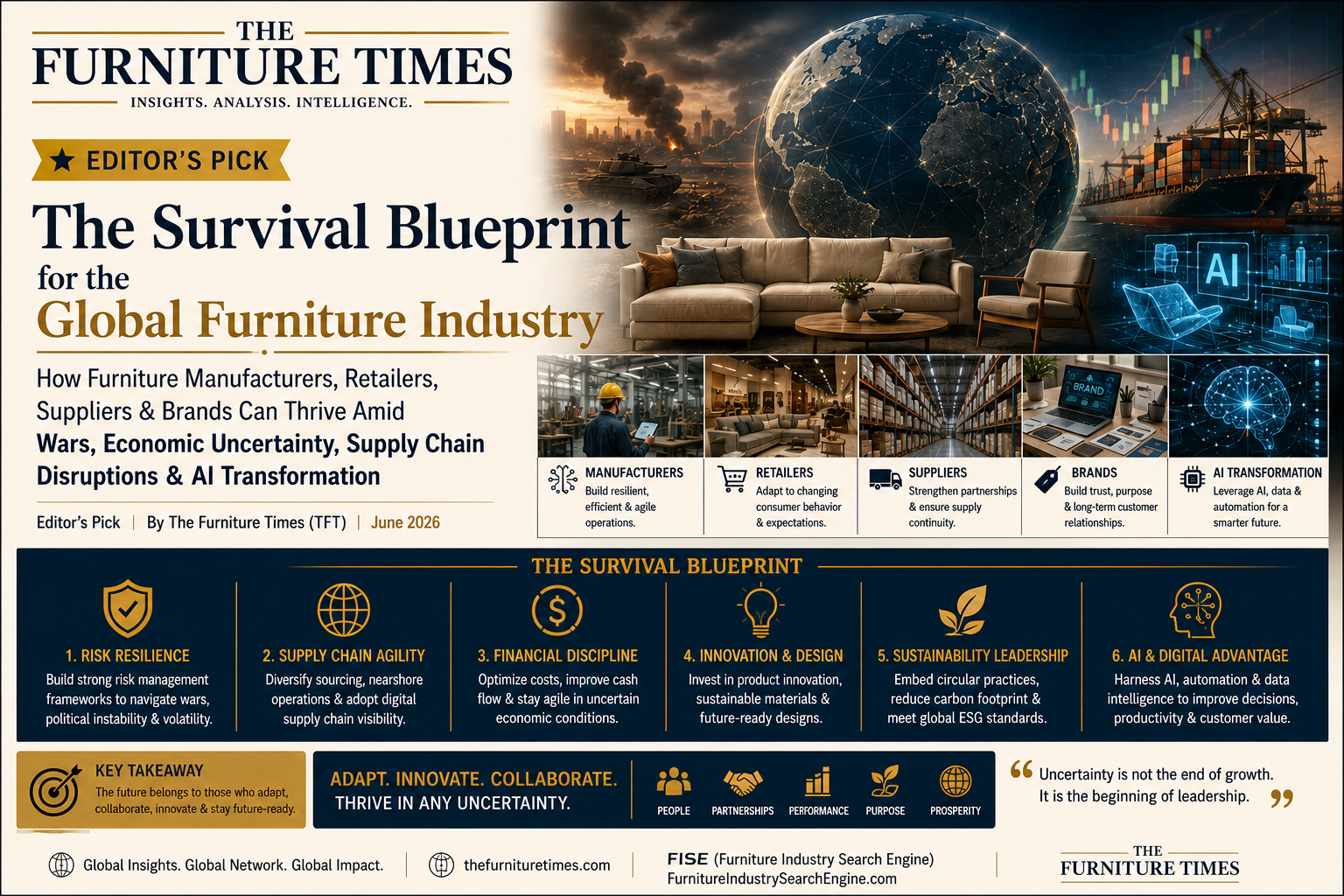
The Survival Blueprint for the Global Furniture Industry
How Furniture Manufacturers, Retailers, Suppliers & Brands Can Thrive Amid Wars, Economic Uncertainty, Supply Chain Disruptions & AI Transformation
Editor’s Pick | By The Furniture Times (TFT) | June 2026
The global furniture industry is standing at a crossroads.
Every day, furniture business owners wake up to headlines about wars, geopolitical conflicts, rising freight rates, inflation, labor shortages, energy volatility, shifting trade policies, and uncertain consumer spending.
Many industry leaders are asking the same question:
Can the furniture industry survive the current global situation?
The answer is yes.
But survival in 2026 is different from survival in 2016.
The furniture businesses that will lead the next decade are not necessarily the biggest.
They are the businesses that can adapt the fastest.
This is not a crisis-management article.
This is a survival blueprint.
The Reality Check
Let’s begin with the truth.
The furniture industry has survived:
World wars
Financial crises
Housing market crashes
Trade wars
Pandemics
Supply chain collapses
Economic recessions
The industry has always found a way forward because furniture is not a luxury for society.
Furniture is infrastructure for everyday life.
People still need:
Beds
Sofas
Dining tables
Office furniture
Outdoor furniture
Hospitality furniture
Educational furniture
Healthcare furniture
The demand may shift.
The channels may change.
The technology may evolve.
But the need remains.
Stop Thinking Like a Furniture Company
One of the biggest mistakes in today’s market is believing you are only a furniture company.
In reality, every furniture business is now becoming:
A technology company
A media company
A search company
A data company
A customer experience company
The companies that understand this transformation early will create significant advantages.
The companies that continue operating exactly as they did ten years ago may struggle.
The future belongs to furniture businesses that embrace change rather than resist it.
Rule #1: Protect Cash Flow at All Costs
During uncertain periods, cash flow becomes more important than growth.
Many furniture businesses fail not because they lack customers.
They fail because they run out of cash.
Industry leaders should focus on:
Inventory Optimization
Reduce slow-moving inventory.
Faster Collections
Improve receivable cycles.
Supplier Negotiations
Build stronger relationships with suppliers.
Controlled Expansion
Avoid unnecessary overhead commitments.
Cash flow is oxygen.
Without it, even profitable businesses can struggle.
Rule #2: Diversify Supply Chains
One supplier is a risk.
One country is a risk.
One shipping route is a risk.
The past few years have demonstrated how vulnerable supply chains can become.
Furniture businesses should actively develop:
Multiple supplier networks
Alternative sourcing regions
Backup logistics options
Regional manufacturing partnerships
The goal is resilience.
Not dependency.
Rule #3: Build Visibility Before You Need It
Many companies only invest in visibility when sales decline.
That is often too late.
Today’s customers discover suppliers through:
Search engines
AI assistants
Industry directories
Online reviews
Social media
Trade platforms
Visibility creates opportunity.
Opportunity creates conversations.
Conversations create business.
The companies generating inquiries during uncertain periods are often the companies that invested in visibility before uncertainty arrived.
Rule #4: Become Searchable
The furniture industry is entering what we call the Search Economy.
Buyers increasingly ask:
Who is the best supplier?
Which manufacturer exports globally?
Who specializes in hospitality furniture?
Which outdoor furniture company serves resorts?
If customers cannot find your business, they cannot buy from you.
Being searchable is no longer marketing.
It is survival infrastructure.
Rule #5: Focus on Trust
Trust is becoming more valuable than advertising.
Customers evaluate:
Reviews
Ratings
Certifications
Project portfolios
Industry authority
Customer experiences
Trust reduces buying friction.
Trust improves conversion.
Trust creates resilience during economic uncertainty.
The companies with strong trust ecosystems often recover faster than competitors.
Rule #6: Follow the Winners
Several furniture-producing countries continue attracting investment despite global challenges.
These include:
Vietnam
Indonesia
India
Malaysia
Mexico
Why?
Because they are building:
Manufacturing capacity
Export capabilities
Skilled workforces
Business-friendly ecosystems
Furniture businesses should monitor these markets closely.
The future opportunities are often found where investment is flowing.
Rule #7: Invest in Relationships
Technology matters.
But relationships still win deals.
In difficult times:
Partnerships matter
Networks matter
Communities matter
Industry associations matter
The strongest businesses often have the strongest ecosystems.
No company succeeds alone.
The furniture industry remains a relationship-driven industry.
Never forget that.
Rule #8: Embrace AI Early
Artificial Intelligence is not replacing the furniture industry.
It is reshaping it.
AI is influencing:
Product discovery
Customer service
Content creation
Market intelligence
Lead generation
Search visibility
The businesses learning AI today may gain advantages that become difficult for competitors to catch later.
The question is no longer whether AI will impact furniture.
The question is how prepared your business will be when it does.
Rule #9: Think Global, Operate Local
The internet has removed geographical barriers.
A manufacturer in Indonesia can serve a buyer in Europe.
A supplier in Malaysia can work with a resort in the Middle East.
A designer in India can collaborate with a project in North America.
The furniture industry is becoming increasingly borderless.
Businesses should think globally while remaining operationally efficient locally.
Rule #10: Build for the Next Decade
Many businesses are still planning quarter-to-quarter.
The winners are planning decade-to-decade.
Ask yourself:
What will customers want in 2030?
How will AI influence buying behavior?
What supply chains will look strongest?
What technologies will dominate manufacturing?
What will trust look like in the digital age?
The future belongs to businesses preparing before change becomes obvious.
The New Furniture Industry Formula
For decades, the formula was simple:
Product + Price = Business
Today, the formula is changing:
Visibility + Trust + Data + Searchability + Adaptability + Product Quality = Sustainable Growth
This is the new reality.
The businesses that understand it early will build lasting competitive advantages.
Editor’s Final Thought
The furniture industry is not dying.
It is evolving.
Every major challenge in history has created new winners.
The current period of uncertainty is no different.
Wars will eventually end.
Freight markets will stabilize.
Economic cycles will recover.
Technology will continue advancing.
What matters most is how businesses respond today.
The next decade will not belong to the biggest furniture companies.
It will belong to the most adaptable.
The most visible.
The most trusted.
The most connected.
And the most prepared.
Because in times of uncertainty, survival is not about avoiding change.
It is about embracing it before everyone else.
Editor’s Pick
By The Furniture Times (TFT)
Bringing Furniture Brands Into Global Spotlight

Related Posts
AI Search Optimization for Furniture Retailers: The Next Competitive Advantage in the Global Furniture Industry
Entrepreneurship Is Pain, Pressure, and Persistence