
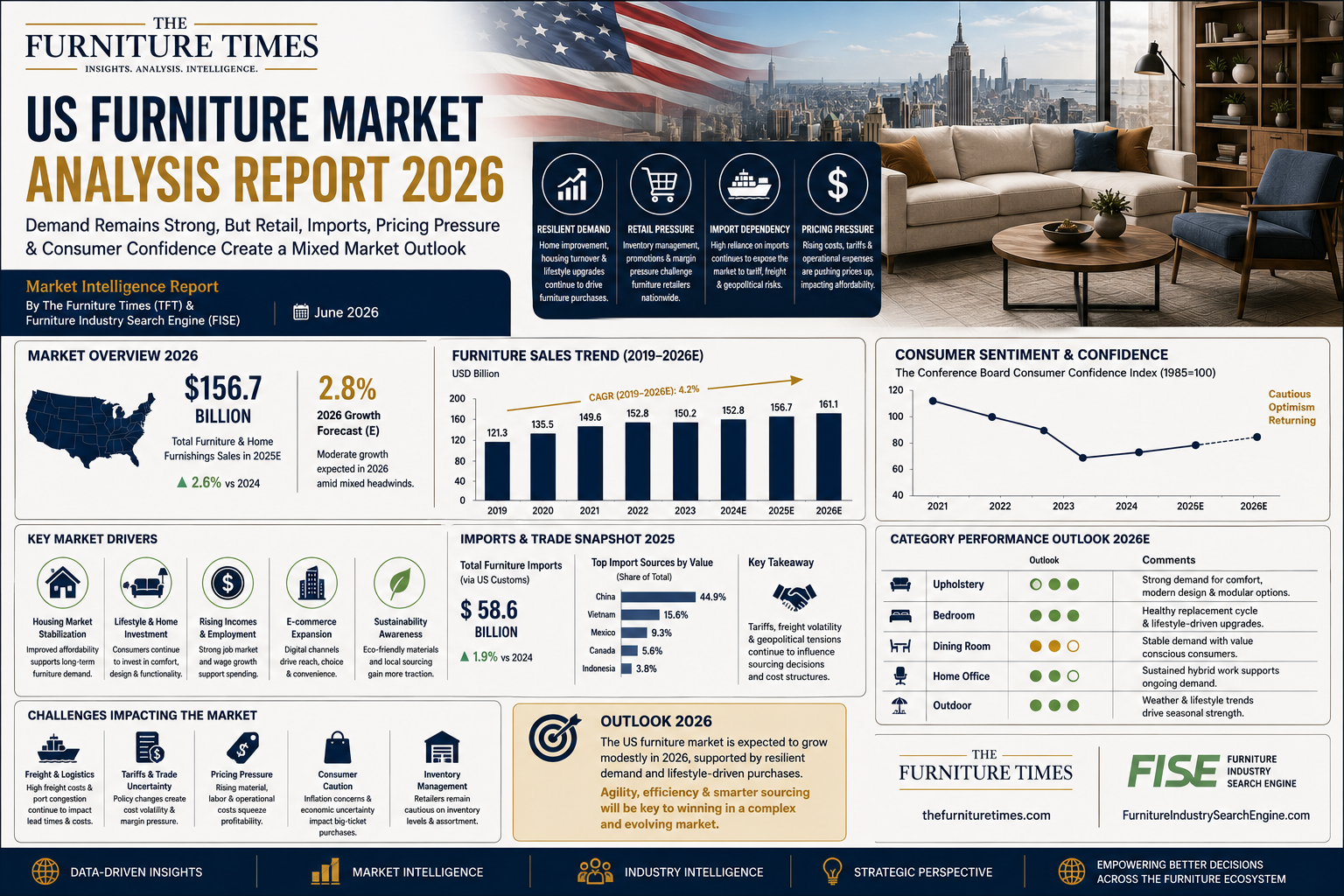
US Furniture Market Analysis Report 2026
Demand Remains Strong, But Retail, Imports, Pricing Pressure & Consumer Confidence Create a Mixed Market Outlook
Market Intelligence Report | By The Furniture Times (TFT) & Furniture Industry Search Engine (FISE) | June 2026
The United States remains the world’s largest furniture demand market, supported by a large consumer base, strong domestic retail structure, sizeable domestic production, and deep exposure to imported furniture. According to Furnilytics data updated on 4 June 2026, the US furniture consumer market reached US$257.2 billion, while specialist furniture retail turnover stood at US$135.6 billion and domestic furniture production reached US$90.8 billion.
This makes the United States one of the most important markets for global furniture manufacturers, retailers, exporters, suppliers, designers, logistics companies, and digital furniture platforms.
Market Snapshot
The US furniture market is large, active, and strategically important, but it is not without pressure. Furnilytics classifies the consumer market as expanding, retail activity as stable, production as expanding, producer pricing as under elevated pressure, and consumer confidence as weakening.
Key indicators include:
Consumer market size: US$257.2 billion
Retail market size: US$135.6 billion
Production market size: US$90.8 billion
Import share: 57.3%
Producer price index: 127.2
Housing activity index: 85.1
Consumer confidence: -38.8 points
These figures show a market with strong structural demand, but also clear warning signs around sentiment, cost pressure, imports, and retail momentum.
The United States Is Still the Global Demand Engine
The US remains a demand-led furniture market. Household furniture spending continues to grow, with Furnilytics reporting a 2.2% annual increase in consumer market size.
This matters because US demand influences the entire global furniture ecosystem. When American consumers buy furniture, the impact is felt across:
Vietnamese factories
Mexican suppliers
Chinese exporters
Canadian manufacturers
Malaysian and Indonesian producers
European luxury furniture brands
US logistics companies
Retailers and e-commerce platforms
For many global manufacturers, the US is not just a market. It is the market.
Retail Is Stable, But Not Booming
Specialist furniture retail turnover reached US$135.6 billion, showing a modest 0.8% six-month year-over-year increase. However, Furnilytics also notes that this remains 3.5% below the 2022 peak.
This tells an important story.
The market is not collapsing. But it is also not accelerating strongly.
Consumers are still buying furniture, but they are more cautious. Retailers are competing harder for attention, traffic, trust, and conversion.
The strongest retailers in this environment will be those that combine showroom experience with digital visibility, financing options, strong reviews, and fast product availability.
Housing Recovery Supports Demand
Furniture demand is closely connected to housing activity. When people buy homes, move, renovate, or upgrade living spaces, furniture demand rises.
Furnilytics reports that US housing activity is recovering, with the index at 85.1 in March 2026, up 43.3% from the 2015 trough, though still 42.2% below the 2022 peak.
This creates a mixed but hopeful signal.
Housing is improving, but it has not returned to peak strength. That means furniture businesses should prepare for gradual recovery, not sudden explosive growth.
Consumer Confidence Is the Weak Link
The biggest concern in the US furniture market is consumer confidence.
Furnilytics reports consumer confidence at -38.8 points, with recent weakening.
This matters because furniture is often a high-consideration purchase. When households feel uncertain about income, inflation, jobs, interest rates, or future expenses, they delay big-ticket purchases.
This can especially affect:
Sofas
Bedroom sets
Dining collections
Mattresses
Luxury furniture
Home office upgrades
Outdoor furniture
Retailers must therefore focus on value communication, trust-building, flexible payment options, warranties, and strong after-sales service.
Domestic Production Is Expanding
The US furniture production market reached US$90.8 billion, with 2.9% six-month year-over-year growth.
This is a positive sign for domestic manufacturing.
It suggests that despite import competition, US furniture production remains relevant and is gaining momentum in selected categories.
Domestic producers may benefit from:
Shorter lead times
Customization demand
Commercial and contract projects
Hospitality furniture
Healthcare furniture
Office furniture
Reshoring interest
Supply chain risk reduction
However, producer costs remain a challenge.
Pricing Pressure Is Still Elevated
The producer price index stands at 127.2, with elevated pressure and a 4.0 percentage point six-month year-over-year increase.
This means manufacturers are facing higher production costs.
Pressure may come from:
Labor
Energy
Raw materials
Foam
Wood
Metal
Packaging
Transport
Compliance costs
If manufacturers pass these costs to retailers, retail prices may rise. If they absorb them, margins shrink.
The real challenge is balancing affordability with profitability.
Import Dependence Remains High
The US furniture market remains heavily connected to global sourcing. Furnilytics reports an import share of 57.3%, described as medium dependence.
Vietnam is the largest furniture supplier to the US, accounting for 26.5% of imports, followed by Mexico at 21.6%, China at 15.8%, Canada at 7.9%, and Italy at 3.6%.
This creates both opportunity and risk.
For exporters, the US remains a major target market.
For US retailers, global sourcing provides variety and cost advantages.
But import dependence also exposes the market to:
Freight disruption
Tariffs
Currency movement
Port congestion
Geopolitical risk
Supplier delays
Compliance and documentation issues
State-Level Opportunity: Where Demand Is Concentrated
Furnilytics shows that US furniture retail turnover is concentrated in major state markets. California leads with about US$15.6 billion, followed by New York, Texas, Florida, and Massachusetts. The top five states together represent about US$57.6 billion in modeled retail turnover.
This is important for market-entry strategy.
Furniture brands entering the US should not treat the country as one market. They should treat it as multiple regional markets.
California may require a different strategy than Texas.
New York may behave differently from Florida.
Massachusetts may require different positioning from North Carolina or Michigan.
Production Geography: Where Manufacturing Strength Lives
On the production side, California leads with about US$7.4 billion, followed by Indiana, North Carolina, Michigan, and Texas. The top five production states total about US$32.3 billion.
This confirms that furniture production in the US is regionally distributed, with strong clusters around traditional manufacturing states and major consumer economies.
For suppliers of machinery, materials, adhesives, foam, hardware, fabrics, software, logistics, and finishing systems, these production states represent key business development zones.
TFT & FISE Analysis: What This Means for the Global Furniture Ecosystem
The US furniture market is healthy, but not easy.
It is large, but competitive.
It is growing, but cautious.
It is import-dependent, but domestic production is expanding.
It has housing recovery, but weak consumer confidence.
It has stable retail, but rising cost pressure.
This creates a market where ordinary companies may struggle, but strategic companies can grow.
The winners will be those who understand that the US furniture market is no longer only a product market. It is a visibility, data, logistics, trust, and pricing discipline market.
Strategic Recommendations
Furniture manufacturers should focus on reliable delivery, flexible customization, cost control, and strong digital catalogs.
Retailers should strengthen online discoverability, improve customer reviews, optimize inventory, and create financing-friendly offers.
Exporters should study state-level demand, not only national figures.
Suppliers should target production clusters such as California, Indiana, North Carolina, Michigan, and Texas.
Digital platforms should build searchable, verified, data-rich profiles for furniture companies targeting the US.
FISE should treat the US as a priority market because import exposure, state-level demand, and global supplier participation make it one of the most valuable discovery markets in the furniture ecosystem.
Final Verdict
The US furniture market remains one of the strongest opportunities in the global furniture industry.
However, the market is entering a more selective phase.
Growth will not automatically reward every supplier.
It will reward those who are visible, searchable, trusted, efficient, competitive, and prepared for regional market differences.
The United States is still the global furniture demand engine.
But in 2026, winning in America requires more than furniture.
It requires intelligence.
It requires searchability.
It requires trust.
It requires data.
And most importantly, it requires the ability to be found when buyers are ready to buy.
By The Furniture Times (TFT) & Furniture Industry Search Engine (FISE)
Global Market Intelligence Desk | June 2026
“TFT tells their story. FISE helps the world find them.”
