
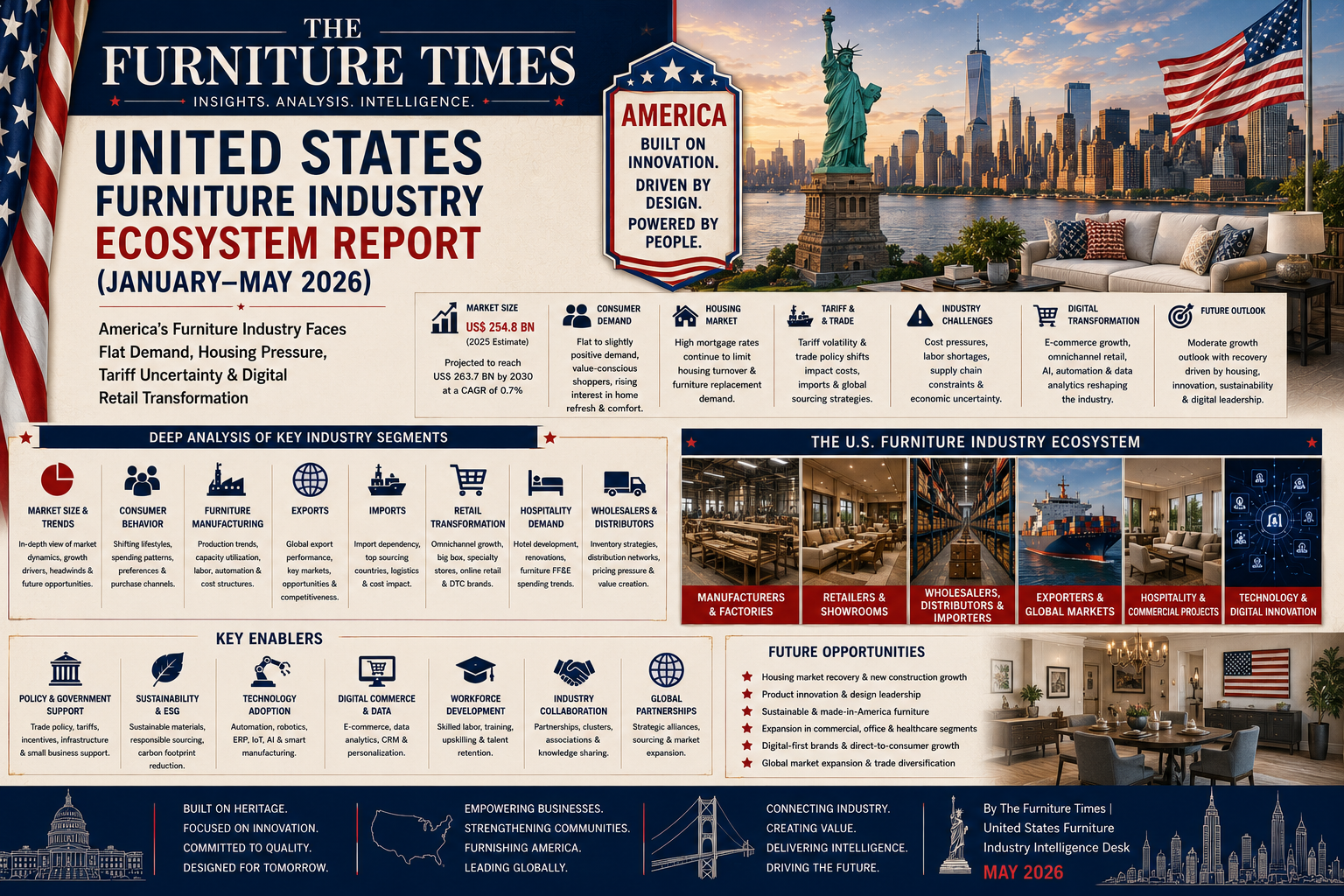
America’s Furniture Industry Faces Flat Demand, Housing Pressure, Tariff Uncertainty & Digital Retail Transformation
United States Furniture Industry Ecosystem Report (January–May 2026)
Deep Analysis of Market Size, Consumer Behavior, Furniture Manufacturing, Exports, Imports, Retail, Hospitality Demand, Wholesalers, Technology & Future Opportunities
By The Furniture Times | United States Furniture Industry Intelligence Desk | June 2026
The United States furniture industry entered 2026 as one of the world’s largest and most influential furniture ecosystems.
Between January and May 2026, the industry faced a mixed environment of opportunity and pressure. The market remained massive, but demand was uneven. Retailers faced cautious consumers, manufacturers dealt with rising costs, and the housing market continued influencing furniture buying behavior.
The U.S. furniture ecosystem includes:
furniture manufacturers
retailers
wholesalers
importers
designers
e-commerce platforms
logistics providers
hospitality suppliers
office furniture companies
home décor brands
The industry is no longer only about selling furniture.
It is becoming a battle of:
Housing Demand
Consumer Confidence
Digital Retail
Tariff Strategy
Visibility
Design Experience
Supply Chain Resilience
January–May 2026 Industry Overview
The first five months of 2026 showed a furniture market under pressure.
Positive drivers included:
large market size
home renovation demand
digital retail growth
demand for multifunctional furniture
hospitality and commercial projects
sustainability interest
Key challenges included:
weak housing activity
elevated interest rates
tariff uncertainty
cautious consumer spending
declining shipments
high inventory pressure
rising costs
The U.S. furniture industry remains strong in scale, but the operating environment is difficult.
Market Size & Growth Outlook
The United States remains one of the largest furniture markets in the world.
Different market estimates place the U.S. furniture market between approximately USD 185 billion and USD 265 billion in 2026, depending on category coverage and methodology.
The market includes:
household furniture
office furniture
outdoor furniture
mattresses
home décor
commercial furniture
hospitality furniture
Long-term growth remains possible, but short-term demand is closely connected to housing, interest rates, consumer confidence, and renovation activity.
Housing Market Pressure Is Affecting Furniture Demand
Furniture demand is highly connected to the housing market.
When people buy homes, move homes, renovate homes, or upgrade interiors, furniture demand rises.
But in early 2026, the U.S. housing market remained difficult due to:
high mortgage rates
affordability pressure
fewer home transactions
cautious consumer confidence
This directly affected furniture categories such as:
sofas
beds
dining sets
bedroom furniture
living room furniture
When consumers delay moving, they often delay major furniture purchases.
Consumer Behavior Is Changing
American consumers are buying furniture more carefully.
They are increasingly asking:
Is it durable?
Is it worth the price?
Does it fit my space?
Can I compare it online?
Does it have reviews?
Is delivery convenient?
Consumers are also increasingly interested in:
multifunctional furniture
smaller-space furniture
sustainable materials
comfortable home furniture
home office products
outdoor living furniture
The buying journey increasingly follows:
Search → Compare → Review → Visit → Buy
Retailers Are Under Pressure
Furniture retailers faced a challenging first five months of 2026.
Many retailers are dealing with:
slower demand
higher operating costs
changing store formats
tariff uncertainty
inventory management pressure
Some legacy retailers are reducing showroom space and using more digital design tools to adapt to changing consumer behavior.
The future U.S. furniture retailer may need smaller showrooms, better digital tools, stronger online visibility, and improved customer experience.
Furniture Manufacturing Remains Challenged
U.S. furniture manufacturing continues facing structural pressure.
Manufacturers are dealing with:
import competition
tariff changes
rising material costs
labor challenges
weak consumer demand
high overheads
New orders started 2026 relatively flat, while shipments were weaker year over year.
This shows that the manufacturing side remains cautious.
Imports Remain Critical to the U.S. Market
The United States remains heavily dependent on imported furniture.
Key sourcing countries include:
China
Vietnam
Mexico
Malaysia
Indonesia
India
Tariff uncertainty continues affecting sourcing decisions.
Many buyers and retailers are now diversifying suppliers to reduce risk.
This creates opportunities for Southeast Asia, India, Mexico, and other alternative manufacturing hubs.
Wholesalers & Distributors Remain Important
Wholesalers and distributors continue playing a major role in the U.S. furniture ecosystem.
They connect:
overseas manufacturers
domestic manufacturers
independent retailers
interior designers
commercial buyers
hospitality buyers
However, wholesalers are also under pressure to modernize.
The future wholesaler must provide:
digital catalogs
faster response times
better logistics visibility
product data
online ordering systems
B2B discoverability
Traditional distribution alone is no longer enough.
E-Commerce & Digital Retail Continue Growing
Digital furniture retail remains one of the strongest long-term shifts.
Consumers increasingly research and compare furniture online before purchasing.
Furniture brands now need:
strong product pages
high-quality images
reviews
room visualization
shipping transparency
clear dimensions
easy financing options
The digital customer does not only want a product.
They want confidence.
Showrooms Are Changing
The traditional large furniture showroom model is under pressure.
Retailers are experimenting with:
smaller formats
design studios
appointment-based selling
digital visualization tools
hybrid online-offline selling
Large rows of sofas and bedroom sets are no longer the only retail model.
The future showroom may become more like a design experience center.
Hospitality Furniture Demand Remains an Opportunity
Hospitality remains an important opportunity area.
Demand continues from:
hotels
resorts
restaurants
cafés
senior living facilities
commercial interiors
Hospitality buyers often need:
durable seating
contract-grade furniture
outdoor furniture
lobby furniture
restaurant furniture
custom FF&E
This segment may remain stronger than some residential categories because it is connected to tourism, renovation, and commercial investment.
Office Furniture Is Still Evolving
The U.S. office furniture market continues adjusting to hybrid work.
Demand is shifting toward:
ergonomic chairs
flexible workstations
collaborative furniture
smaller office layouts
home office products
wellness-focused workplace furniture
Companies are no longer furnishing offices the same way they did before 2020.
The office furniture industry must now serve hybrid working culture.
Outdoor Furniture Remains Strong
Outdoor living continues to be one of the strongest lifestyle categories.
American consumers increasingly invest in:
patios
gardens
decks
poolside spaces
outdoor dining areas
This supports demand for:
outdoor sofas
patio sets
weather-resistant furniture
outdoor dining sets
fire-pit seating
resort-style home furniture
Outdoor furniture remains connected to wellness, lifestyle, and home improvement spending.
Sustainability Is Becoming More Important
U.S. consumers are increasingly interested in:
sustainable furniture
durable materials
recycled content
responsible sourcing
low-emission products
Sustainability is no longer only a luxury message.
It is becoming part of consumer trust.
Furniture brands that clearly communicate material quality, durability, and environmental responsibility may gain stronger long-term advantage.
Technology Is Reshaping the Industry
Technology is changing the U.S. furniture ecosystem through:
AI product recommendations
augmented reality room visualization
digital design tools
online catalogs
inventory systems
supply chain tracking
automated marketing
The future furniture company must become both a product company and a technology-enabled business.
AI Visibility Is Becoming a New Competitive Factor
One of the biggest future shifts is AI search.
Consumers increasingly use AI tools to discover:
furniture brands
product comparisons
design ideas
buying guides
local stores
This means businesses must become:
Searchable
Discoverable
AI-Readable
Trusted Online
The visibility economy is becoming part of the furniture industry.
Competition Is Increasing
The U.S. furniture industry faces competition from:
imports
e-commerce brands
discount retailers
direct-to-consumer companies
marketplace sellers
global manufacturers
Businesses that rely only on traditional retail may struggle.
The future winners will likely combine:
brand trust
digital visibility
strong logistics
product quality
customer experience
flexible pricing
The Furniture Times Industry Insight
The United States furniture industry between January and May 2026 revealed one clear reality:
The market is huge, but not easy.
Growth exists, but it is selective.
Consumers are careful.
Retailers are adapting.
Manufacturers are under pressure.
Digital visibility is becoming critical.
The industry is moving from:
Showroom-Only Selling
to
Search-Led Furniture Commerce
Final Thought
The U.S. furniture industry entered 2026 with both strength and stress.
It remains one of the world’s most valuable furniture markets, but short-term conditions are challenging.
The future of the U.S. furniture ecosystem will depend on:
Housing Recovery
Consumer Confidence
Digital Retail
Supply Chain Resilience
Tariff Strategy
AI Visibility
Brand Trust
The businesses that survive and grow will not only be those with large stores or large inventories.
They will be the businesses that become more visible, more adaptable, more digital, more trusted, and more connected to how modern consumers actually buy furniture.
Because the U.S. furniture industry is no longer only about selling products.
It is about building confidence, experience, visibility, and trust in a changing market.
Sources used for current context include U.S. furniture market estimates, Retail Dive’s 2026 home-sector outlook, Furniture Today/Smith Leonard manufacturer order updates, IBISWorld’s household furniture manufacturing outlook, and recent coverage of showroom downsizing and retail pressure.
