
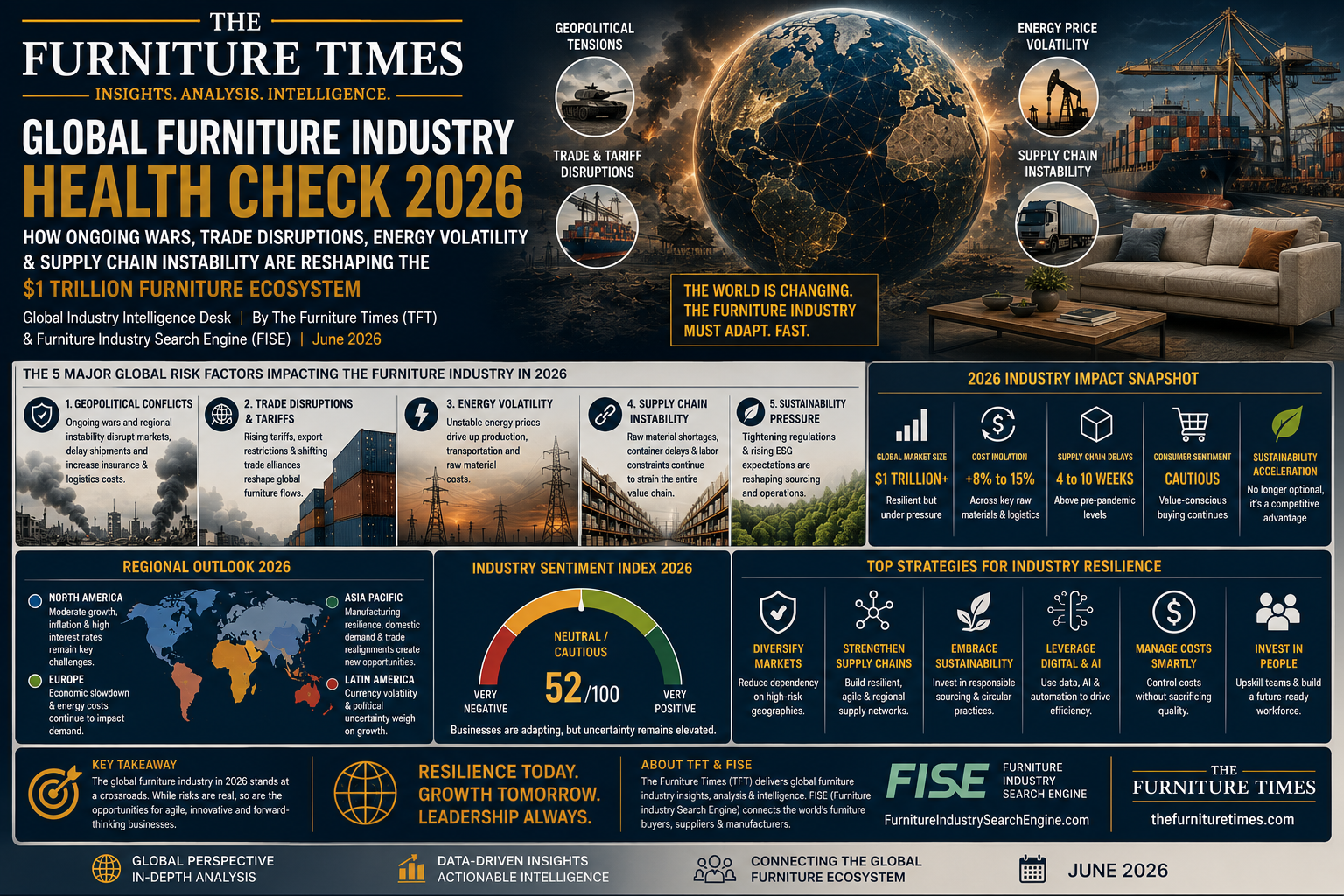
Global Furniture Industry Health Check 2026
How Ongoing Wars, Trade Disruptions, Energy Volatility & Supply Chain Instability Are Reshaping the $1 Trillion Furniture Ecosystem
Global Industry Intelligence Desk | By The Furniture Times (TFT) & Furniture Industry Search Engine (FISE) | June 2026
The global furniture industry finds itself operating in one of the most complex business environments since the COVID-19 era.
Multiple geopolitical conflicts, including the ongoing Russia-Ukraine war, Middle East tensions involving Iran, Israel, and regional actors, Red Sea shipping disruptions, rising energy prices, supply chain uncertainty, and slowing economic growth across several major economies are collectively creating significant pressure on the global furniture ecosystem.
The critical question facing manufacturers, retailers, importers, exporters, suppliers, logistics companies, designers, and investors is simple:
How healthy is the global furniture industry today?
The answer is more complex than many realize.
TFT Global Furniture Industry Health Score
Manufacturing Health
Rating: 7.5/10
Supply Chain Health
Rating: 5.5/10
Consumer Demand Health
Rating: 7/10
Logistics Health
Rating: 5/10
Retail Health
Rating: 6.5/10
Investment Health
Rating: 7/10
Global Industry Health Score
Overall Rating: 6.4/10
The industry remains resilient, but significant stress points continue to emerge.
War Zone Impact Analysis
Russia–Ukraine War
More than four years into the conflict, its effects continue to ripple through global manufacturing and trade.
The furniture industry has experienced impacts through:
Timber supply volatility
Rising energy costs
Higher transportation expenses
Inflationary pressure
Reduced consumer spending power in parts of Europe
European manufacturers remain particularly exposed to elevated operating costs compared to pre-war conditions.
Middle East Conflict
The Middle East has become the largest risk factor for global furniture supply chains in 2026.
The ongoing tensions involving Iran, Israel, regional shipping lanes, and the Red Sea have created significant uncertainty across international logistics networks.
Why This Matters To Furniture
Furniture products are:
Large
Heavy
Container-dependent
Freight-sensitive
Unlike electronics or luxury goods, furniture margins can be significantly affected by shipping costs.
When shipping routes are disrupted, furniture companies often feel the impact quickly.
The Red Sea Problem
The Red Sea remains one of the world’s most important trade corridors.
Shipping disruptions continue to affect global supply chains, particularly between Asia and Europe. Traffic remains below pre-conflict levels, and further escalation risks additional rerouting.
For furniture companies this means:
Longer transit times
Higher insurance costs
Increased inventory requirements
Delayed deliveries
Reduced cash-flow efficiency
Industry research has shown furniture retailers are among the sectors heavily exposed to Red Sea shipping disruptions, particularly in Europe.
Oil Prices: The Silent Threat
Furniture manufacturers may not sell oil.
But they consume its effects every day.
Oil influences:
Transportation
Foam production
Plastics
Packaging
Chemicals
Adhesives
Logistics
Recent geopolitical tensions have pushed oil prices higher and increased concerns regarding energy stability.
Higher energy costs eventually affect:
Furniture factories
Container shipping
Warehouse operations
Raw material suppliers
The Supply Chain Health Check
The good news:
Global supply chains have not collapsed.
The concern:
They remain fragile.
The New York Federal Reserve’s Global Supply Chain Pressure Index indicates continued elevated pressure levels linked to geopolitical disruptions and trade uncertainty.
Many companies have responded by:
Diversifying suppliers
Building inventory buffers
Nearshoring production
Increasing regional sourcing
Winners Emerging From The Crisis
Not every country is losing.
Several furniture-producing nations are strengthening their position.
Vietnam
Continuing to attract international sourcing.
Indonesia
Growing manufacturing investment.
India
Expanding export opportunities.
Malaysia
Benefiting from diversification strategies.
Mexico
Strengthening nearshoring opportunities for North America.
These countries are increasingly viewed as strategic alternatives within global furniture supply chains.
Furniture Retail Health Check
Retail performance remains mixed.
Strong Segments
Luxury furniture
Hospitality furniture
Outdoor furniture
Commercial furniture
Custom manufacturing
Under Pressure
Mid-market retailers
Import-dependent retailers
Businesses with weak digital visibility
Several furniture retailers and brands have recently entered liquidation or closed operations, highlighting ongoing pressure within the retail sector. Consumer confidence remains uneven across regions.
The Rise of the Visibility Economy
One trend continues to accelerate regardless of conflict:
Digital discoverability.
Customers increasingly discover furniture suppliers through:
Search engines
AI assistants
Digital directories
Online reviews
Social platforms
The industry is moving toward what TFT and FISE call the Visibility Economy, where discoverability directly influences commercial opportunity.
Businesses with strong visibility continue generating leads even during market uncertainty.
What Keeps CEOs Awake in 2026?
Furniture executives globally identify several key risks:
Rising Costs
Materials, energy, and labor remain volatile.
Supply Chain Uncertainty
Shipping routes remain vulnerable.
Consumer Demand Fluctuation
Economic uncertainty affects discretionary spending.
Trade Fragmentation
Geopolitical tensions continue reshaping global trade patterns.
Talent Shortages
Manufacturing labor remains difficult to secure in many markets.
The Furniture Industry Risk Map
High Risk
Red Sea shipping exposure
Energy-intensive manufacturing
Single-source supplier dependency
Medium Risk
European retail markets
Long-haul export models
Commodity-driven furniture categories
Lower Risk
Regional manufacturing ecosystems
Diversified sourcing models
High-value custom furniture
Hospitality and project-based businesses
TFT Forecast: 2026–2028
The Furniture Times Global Intelligence Team expects:
Scenario 1: Controlled Stabilization (Most Likely)
Gradual supply chain recovery
Moderate freight stabilization
Steady furniture demand growth
Probability: 55%
Scenario 2: Extended Conflict Disruption
Continued shipping volatility
Higher energy prices
Margin pressure
Probability: 30%
Scenario 3: Rapid Recovery
Reduced geopolitical tensions
Lower freight costs
Stronger global consumer confidence
Probability: 15%
Final Verdict
Despite wars, geopolitical tensions, logistics disruptions, and economic uncertainty, the global furniture industry remains remarkably resilient.
The industry is not facing collapse.
It is facing transformation.
Manufacturers are adapting.
Supply chains are evolving.
Buyers are changing.
Technology is accelerating.
The winners of the next decade will not simply be the largest furniture companies.
They will be the most adaptable, most resilient, most visible, and most discoverable.
In times of uncertainty, industries do not disappear.
They reinvent themselves.
The global furniture industry’s health score of 6.4/10 indicates caution, not crisis.
The ecosystem remains under pressure, but the foundations of global furniture demand, housing growth, urbanization, hospitality expansion, and manufacturing innovation remain intact.
By The Furniture Times (TFT) & Furniture Industry Search Engine (FISE)
Global Industry Intelligence Desk | June 2026
“TFT tells their story. FISE helps the world find them.”
