BIS Certification for Tables and Desks: What Manufacturers Should Prepare For
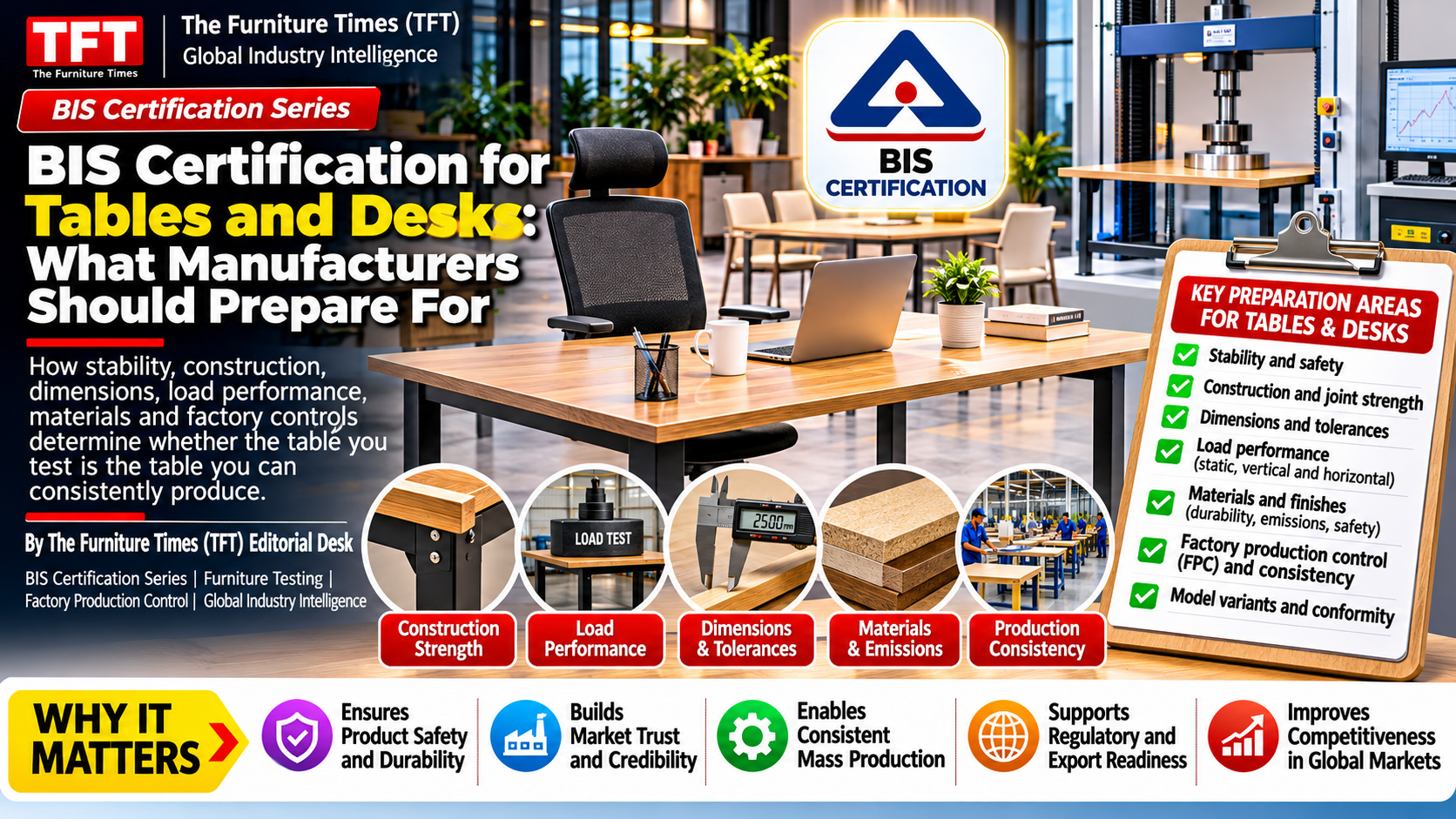
How stability, construction, dimensions, load performance, materials and factory controls determine whether the table you test is the table you can consistently produce
By The Furniture Times (TFT) Editorial Desk | BIS Certification Series | Furniture Testing | Factory Production Control | Global Industry Intelligence
A desk can hold a heavy load and still tip when someone leans on its edge. A conference table can look rigid when first assembled but loosen at its joints after repeated loading. A tabletop sample can meet applicable material requirements while the finished desk fails because its frame, inserts or fasteners cannot carry the load.
Those are three different problems, and none can be ruled out by looking at the product in a showroom.
For manufacturers, the practical challenge of BIS certification is to demonstrate that a declared, fully assembled table or desk meets the applicable requirements—and then make sure routine production matches the construction that was assessed. Changing the legs, extending the top, moving a drawer pedestal or substituting a panel can alter performance even if the product keeps the same catalogue name.
The regulatory starting point: IS 17633:2022, as amended
The Bureau of Indian Standards lists Tables and Desks under IS 17633:2022 in its Scheme-I compulsory-certification listing for furniture. BIS describes the standard as covering the performance and safety of office and domestic tables and desks for adult use in seated and/or standing positions. It covers both fully manufactured products and ready-to-assemble units; for a ready-to-assemble product, the requirements apply to the assembled unit.
There are two separate documents to track. The Furniture (Quality Control) Order, 2025, as amended, determines whether the order applies to the product and transaction. The Indian Standard and current BIS product manual guide the technical and certification work. The November 2026 third amendment introduces conditional relief for certain imports already in the pipeline. It is not a general postponement of certification: eligibility depends on the purchase order, Bill of Lading and Bill of Entry dates, as well as submission of supporting documents.
Why the older test plan should not be reused
BIS’s January 2026 implementation circular says Amendment No. 1 added on-product marking of the performance category with recommended uses, revised a vertical stability load entry in Table 2 and changed how a vertical-load durability provision applies to surfaces above 965 mm. It also removed the resistance-to-mechanical-damage test from Clause 6(a), renamed Clause 6 Raw Material Requirements, and changed the standard’s Annex A wording for Clause 7 safety testing from the same sample to samples from the same lot. The circular identifies PM/IS 17633/3/Dec 2025 as the resulting product-manual revision and says its grouping guidelines and Scheme of Inspection and Testing were modified. services.bis.gov.in
That makes a difference when booking a lab. Do not rely on the 2022 manual’s sample count or assume the June 2025 grouping rules still apply unchanged. Confirm the latest applicable manual, sample quantities, material specimens, marking and model coverage before dispatching anything. Bureau of Indian Standards
Stability, strength and durability answer different questions
| Assessment | What it tells the manufacturer | Design features worth reviewing before testing |
|---|---|---|
| Stability | Whether the assembled product resists overturning under the applicable conditions | Footprint, overhang, height settings, castors and extended elements |
| Strength | Whether the structure withstands the prescribed loads without unacceptable failure or deformation | Top span, underframe, welds, brackets, inserts and fasteners |
| Durability | Whether repeated loading causes deterioration that a one-time test may not reveal | Joint loosening, frame movement, folding hardware and adjustment mechanisms |
| Dimensions and workmanship | Whether the product meets applicable dimensional and construction requirements | Working height, under-top clearance, accessible edges and assembly consistency |
| Raw material requirements | Whether the relevant materials and finishes meet applicable amended requirements | Board specification, laminate, coating, adhesive and supplier substitutions |
BIS identifies dimensions, safety, stability, strength and durability as assessment areas. The design features in the right-hand column are engineering review points, not a substitute for the test methods or acceptance criteria in the amended standard. Tables and Desks Specification
Stability: check where the load lands, not just how much the top can hold
Consider a rectangular desk with two narrow supports set well in from the ends. It may feel firm when weight is placed in the centre. Place a load near one end, however, and the long overhang gives that load more leverage against the support footprint. Increasing the top length without changing the base can therefore create a stability problem without any change to the top material.
The same issue appears in different forms. A pedestal table can be sensitive to edge loading. A mobile table can behave differently from the same model on fixed glides. An extension leaf or open drawer can move load beyond the frame. A height-adjustable desk can respond differently as it rises. These are reasons to review the configurations the product actually offers and agree with the laboratory on the applicable test conditions, rather than sending the easiest configuration to assemble.
Strength: follow the load from the top to the floor
A desk’s performance depends on how the load travels through the top, rails or brackets, joints, legs and feet. A thicker top will not solve a weak insert. A heavier steel leg will not fix an undersized mounting plate. A stronger bracket may simply shift the failure to the panel where the bracket is fastened.
Before formal testing, inspect the areas most likely to move or deform: unsupported top spans, screw holes near panel edges, attachment points next to cable cut-outs, bolted joints in knock-down frames and welds where legs meet cross-members. Review the drawing and the assembled sample together. A reinforcement shown in CAD offers no protection if the factory omits it on a production batch.
Durability: look for movement before something breaks
A table may withstand an initial load without visible damage and still develop play during repeated use. Fasteners can loosen, inserts can move in a panel, brackets can bend gradually, and folding or adjustment mechanisms can develop excess movement. Record where the movement first appears during internal trials. A tabletop that shifts because its fasteners are loosening needs a different remedy from one that bends because the span is too long.
Also keep a marketing load claim separate from a laboratory result. Passing a prescribed test does not by itself establish that a desk can carry a stated weight at any position, at every height or under every pattern of use.
Dimensions and materials: control what the buyer actually receives
Measure the finished assembly, not just the top in isolation. A published desk height can change when a supplier substitutes feet or castors. A drawer, apron, cross-member or cable tray can reduce usable clearance even if the overall desk height stays the same. In a height-adjustable range, the technical file should identify the adjustment range and the components that determine it. Record dimensions for configurations that differ, rather than attaching one drawing to a whole commercial collection.
Treat material substitutions as engineering changes. Replacing one engineered-wood board with another at the same nominal thickness can change fastener retention, stiffness or the way the edge holds up during assembly. Changing a laminate or adhesive can affect material performance without visibly changing the finished product. Moving from steel to aluminium, changing a tube wall thickness or substituting a threaded insert can also change how loads move through the assembly. The applicable Clause 6 checks should be determined from the amended standard; a supplier’s declaration is useful evidence, but it does not settle finished-product performance. services.bis.gov.in
For a ready-to-assemble desk, use the hardware, holes, brackets and instructions supplied to customers. As a practical check, ask someone who did not develop the product to assemble a normal packed unit. If the desk can be assembled with a brace reversed, if the fixing screws are easy to confuse, or if the instructions omit an essential step, fix the kit and instructions before sample dispatch. BIS assesses the assembled unit; a specially reinforced sample is not representative of what the buyer receives. Tables and Desks Specification
Model variants: one collection name does not settle certification scope
A manufacturer may sell a fixed-height desk, a mobile desk and a motorised desk under the same collection name. The commercial name ties them together; it does not show that they share the same construction or can be represented by one sample.
Build a model-by-model variant matrix before requesting grouping. Give each model or SKU a row and record the intended performance category, top and frame materials, key dimensions, support footprint, assembly method, castors or glides, extension elements, height adjustment and drawing revision. Include the differences that a customer may not see, such as a thinner tube or a different insert supplier.
Then explain why the proposed sample represents the group for the relevant assessments. The longest unsupported span might be most demanding for strength; a narrower base or larger overhang might be more demanding for stability. A folding or extending model may raise questions neither configuration answers. These are engineering reasons to propose samples—not permission to group products outside the current BIS rules. BIS specifically notes that the December 2025 manual revised the grouping guidelines.
Factory production control: passing once is not enough
The laboratory assesses samples. The factory has to reproduce the assessed construction across shifts, suppliers and production lots. Use the applicable BIS Scheme of Inspection and Testing to establish the formal controls and frequencies. The following is a practical way to assign responsibility inside the factory. services.bis.gov.in
| Production stage | What to control | Useful evidence |
|---|---|---|
| Incoming materials | Panel type and thickness, metal sections, fittings, castors and hardware | Approved specifications, part codes, supplier and lot records |
| Fabrication | Cut sizes, hole positions, frame alignment, welds and bracket location | Drawings, jig checks and in-process inspection records |
| Assembly and packing | Correct fasteners, brace orientation, joint tightening, hardware count and instructions | Assembly work instruction, kit check and packed-unit audit |
| Finished-product release | Model identity, critical dimensions, workmanship, operation and marking | Final inspection record, approved label and lot-release record |
| Engineering change | Proposed substitutions or changes to dimensions, hardware, frame or finish | Change request, technical review and decision on testing or licence scope |
A common failure of control starts with an ordinary purchasing decision: the specified insert is unavailable, so a replacement with the same thread is ordered. It fits the bolt, but its body is shorter and grips less material. The desk still looks identical at dispatch. Without a formal change review, the purchasing decision has altered a structural joint without anyone checking whether the original evidence still applies.
What to have ready before applying or sending samples
- A declared model list and variant matrix that match the catalogue, application and intended scope.
- Controlled drawings and bills of materials showing critical dimensions, structural parts, joints, fittings and revision numbers.
- A sampling and test plan agreed with the laboratory for the applicable amended requirements, including any material specimens and lot identification.
- Production-representative units, with the same assembly instructions and hardware that customers receive.
- Approved marking artwork that accounts for performance category and recommended uses, alongside applicable Standard Mark and licence particulars.
- Factory inspection and change-control records showing how routine production will stay aligned with the assessed model.
Check the laboratory’s current scope before booking. BIS provides a laboratory search by standard number, but manufacturers should confirm that the facility can handle their specific construction, applicable tests and current amendment. LIMS (Laboratory Information Management System)
The TFT takeaway
Start with the variant matrix, not the lab booking. Put engineering, purchasing, production and quality around one model list. Identify where the products actually differ, confirm which configurations the current rules permit you to group, and agree on what the lab needs to assess. Doing that before the samples leave the factory can prevent the costliest mistake: passing a test on a table that is not the table you intend to sell.
Compliance note: This article is industry guidance, not a substitute for the amended IS 17633:2022, the current BIS product manual, the applicable Quality Control Order or a product-specific determination by BIS.