
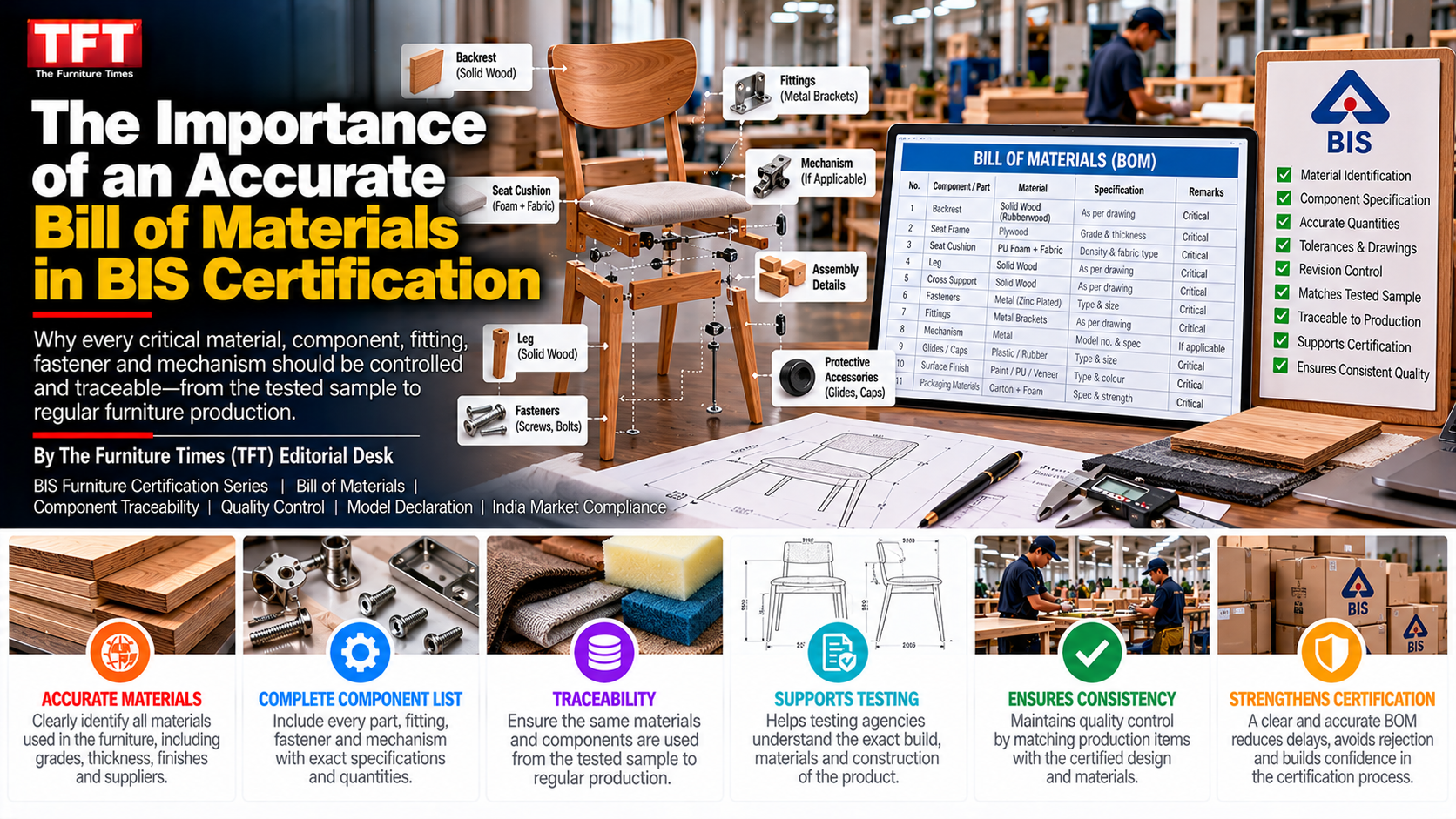
The Importance of an Accurate Bill of Materials in BIS Certification
The Importance of an Accurate Bill of Materials in BIS Certification
Why every critical material, component, fitting, fastener and mechanism should be controlled and traceable—from the tested sample to regular furniture production
By The Furniture Times (TFT) Editorial Desk
BIS Furniture Certification Series | Bill of Materials | Component Traceability | Quality Control | Model Declaration | India Market Compliance
A furniture product does not pass a safety or performance test because of its model name, catalogue photograph or outward appearance.
It passes—or fails—because of the combined performance of every material, component, joint, fastener, fitting and mechanism used in its construction.
A work chair may depend on its base, gas lift, castors, tilt mechanism, seat structure, armrests and fasteners. A table may depend on the thickness of its top, underframe construction, leg sections, welds and connectors. A storage unit may rely on its hinges, runners, shelf supports, wall anchors and panel specifications. A bunk bed may depend on the exact dimensions and strength of its guardrails, ladder, side rails, fasteners and mattress-support system.
If one of those elements changes, the certified product may also change.
This is why an accurate Bill of Materials—commonly called a BOM—is one of the most important technical-control documents supporting furniture BIS certification.
A BOM provides a structured answer to a fundamental compliance question:
What exactly was the certified furniture product made from?
When correctly prepared and controlled, the BOM connects:
- The model declared to BIS
- The engineering drawing
- The sample selected for testing
- The laboratory report
- The approved suppliers
- Incoming-material inspection
- Regular factory production
- Future design and component changes
When the BOM is incomplete or inaccurate, that connection begins to break.
What Is a Bill of Materials?
A Bill of Materials is a controlled list of everything required to manufacture a defined product.
It can include:
- Raw materials
- Fabricated components
- Purchased components
- Hardware
- Fittings
- Fasteners
- Mechanisms
- Adhesives
- Coatings
- Upholstery materials
- Packaging components
- Labels and instructions
A BOM is not simply a purchasing list.
A purchasing list may say:
- Wood
- Steel frame
- Screws
- Fabric
- Foam
- Wheels
A certification-ready BOM should provide enough information to distinguish the approved items from technically different alternatives.
It may identify:
- Part number
- Component name
- Material specification
- Dimensions
- Thickness
- Grade
- Quantity
- Drawing reference
- Approved supplier
- Inspection requirement
- Criticality classification
- Revision level
The exact level of detail should reflect the complexity and safety significance of the product.
The Furniture Categories Covered by the BIS Framework
The Bureau of Indian Standards lists six furniture categories under the Furniture Quality Control Order and Scheme-I certification framework:
| Furniture category | Applicable Indian Standard |
|---|---|
| Work chairs | IS 17631:2022 |
| General-purpose chairs and stools | IS 17632:2022 |
| Tables and desks | IS 17633:2022 |
| Storage units | IS 17634:2022 |
| Beds | IS 17635:2022 |
| Bunk beds | IS 17636:2022 |
Manufacturers must consult the latest QCO, amendments, Indian Standard, product manual and official BIS instructions applicable at the time of application or production. The Furniture QCO has been amended and supplemented by transition-related notifications, so older compliance summaries should not be relied upon without verification.
Not every official product manual necessarily uses the expression “Bill of Materials” in the same way, and the required application documents can vary by product and procedure.
However, BIS states that manufacturers should analyse and document their manufacturing infrastructure, process controls, quality-control arrangements and testing capabilities before applying. The licence is based on assessment of these systems and demonstration of product conformity.
An accurate BOM is one of the strongest practical tools for demonstrating control over the product’s composition.
Why the BOM Matters to BIS Certification
1. It defines the tested construction
A laboratory may test one complete chair, table, bed or cabinet. The test report may state the model number, product category and applicable standard.
But what was inside the tested model?
Was the table frame made from:
- 1.0 mm steel tube
- 1.5 mm steel tube
- Aluminium extrusion
- Solid wood
- Engineered wood
Did the chair use:
- A nylon base
- An aluminium base
- A fabricated steel base
- 50 mm castors
- 60 mm castors
- A Class 3 gas lift
- A different gas-lift specification
Without a controlled component record, the manufacturer may be unable to prove precisely what was tested.
2. It links the sample to regular production
Passing a test with one carefully selected sample is not enough.
The product manufactured after certification should continue to reflect the controlled, declared construction.
The BOM helps confirm that:
- The same material specification is purchased
- The same component type is issued to production
- The same fastener quantity is used
- The same mechanism is installed
- The same structural thickness is maintained
- The same approved revision reaches the production floor
3. It supports model and variant declarations
BIS product manuals may require manufacturers to declare essential model parameters, materials, construction and dimensions.
For example, the published grouping guidelines for tables and desks require manufacturers to declare models with parameters including material, construction, castors, extension elements, fixed or adjustable height and dimensions. They also require a drawing for each declared model.
The BOM provides component-level evidence supporting that declaration.
4. It supports factory inspection
During factory assessment or subsequent inspection, officials may compare:
- Application documents
- Declared model list
- Product drawings
- Component inventory
- Purchase records
- Production records
- Finished products
- Test samples
- Internal inspection records
A controlled BOM helps the manufacturer demonstrate that these records relate to the same product.
5. It controls post-certification changes
A supplier may discontinue a component. Purchasing may find a cheaper alternative. Production may reduce material thickness to save cost. Design may introduce a new mechanism.
Without BOM control, these changes can enter production without a proper assessment of their effect on compliance.
A BOM Is the Product’s Technical DNA
Two furniture products may look identical while being technically different.
Consider two visually similar office chairs.
| Component | Chair A | Chair B |
|---|---|---|
| Base | Glass-filled nylon | Unspecified plastic |
| Gas lift | Approved controlled model | Alternative supplier |
| Castors | 60 mm twin-wheel | 50 mm single-wheel |
| Seat support | 2 mm steel plate | 1.2 mm steel plate |
| Armrests | Fixed | Height-adjustable |
| Back support | Reinforced polymer | Non-reinforced polymer |
| Fasteners | Four M8 bolts | Four M6 bolts |
A catalogue photograph may not reveal these differences.
A generic description such as “black ergonomic office chair” certainly will not.
The BOM identifies the construction that matters.
That makes it the technical DNA of the declared product.
What an Effective Furniture BOM Should Include
A practical BOM should contain document-level information and item-level information.
BOM header
The header should identify:
- Manufacturer’s legal name
- Manufacturing location or unit code
- Product category
- Model name
- Model number
- BOM document number
- Applicable drawing number
- Drawing revision
- BOM revision
- Effective date
- Prepared by
- Reviewed by
- Approved by
- Applicable Indian Standard
- Certification status, where appropriate
The model identifier must match the model used in the BIS application and test report.
Item-level information
Each line should include, where relevant:
- Item number
- Internal part number
- Component description
- Material
- Grade or specification
- Dimensions
- Thickness
- Quantity per finished product
- Approved manufacturer or supplier
- Supplier part number
- Drawing reference
- Inspection method
- Criticality classification
- Remarks
A recommended structure is:
| Item | Part number | Component | Specification | Quantity | Drawing reference | Control status |
|---|---|---|---|---|---|---|
| 01 | WC-101-001 | Seat-support plate | Steel, 2.0 mm | 1 | WC-101-C01 | Critical |
| 02 | WC-101-002 | Chair base | Approved five-star base | 1 | Supplier specification | Critical |
| 03 | WC-101-003 | Gas lift | Approved model and rating | 1 | Supplier specification | Critical |
| 04 | WC-101-004 | Castor | 60 mm twin-wheel | 5 | WC-101-C04 | Critical |
| 05 | WC-101-005 | Seat foam | Declared density and thickness | 1 | WC-101-C05 | Controlled |
| 06 | HW-M8-30 | Assembly bolt | M8 × 30 mm, controlled grade | 4 | Hardware specification | Critical |
The entries must reflect the actual product and should not contain invented or uncontrolled specifications.
1. Raw Materials Must Be Specific
Descriptions such as “wood,” “metal,” “plastic” and “foam” are too broad for effective control.
Solid wood
The BOM may need to identify:
- Species or approved species group
- Grade
- Section size
- Moisture requirements
- Treatment, where applicable
- Finish system
A change in wood species can affect density, joint strength, screw holding, warping and durability.
Engineered wood
Identify:
- Material type
- Thickness
- Grade or applicable specification
- Density, where controlled
- Surface layer
- Edge treatment
- Supplier or approved equivalent
Particleboard, MDF and plywood should not be treated as interchangeable merely because their thicknesses are similar.
Metals
Identify:
- Material grade
- Tube or section shape
- External dimensions
- Wall thickness
- Sheet thickness
- Surface treatment
- Coating system
“MS tube” without dimensions or wall thickness does not adequately define a structural component.
Plastics and polymers
Identify:
- Polymer type
- Reinforcement, if any
- Component model
- Colour or formulation where technically relevant
- Supplier specification
- Recycled-content limitation, if controlled
Replacing a glass-filled polymer with a visually similar unreinforced material may significantly change performance.
Glass
Identify:
- Glass type
- Thickness
- Edge treatment
- Tempering or other treatment
- Dimensions
- Mounting method
2. Every Structural Component Needs Traceability
Structural components transfer the loads applied during normal use and testing.
They may include:
- Chair legs
- Chair bases
- Seat frames
- Backrest supports
- Table legs
- Table underframes
- Bed side rails
- Centre supports
- Slats
- Bunk-bed posts
- Guardrails
- Ladder members
- Cabinet sides
- Shelves
- Base frames
- Wall-anchoring systems
The BOM should connect each structural component with:
- Its drawing
- Material specification
- Critical dimensions
- Quantity
- Production process
- Inspection requirement
A finished product may look unchanged even after a structural component is weakened.
That is why appearance cannot substitute for BOM control.
3. Fittings Must Not Be Treated as Generic Hardware
Furniture performance often depends on purchased fittings.
Examples include:
- Hinges
- Drawer runners
- Shelf supports
- Connectors
- Levelling feet
- Brackets
- Locks
- Catches
- Handles
- Knock-down fittings
- Bed connectors
- Wall anchors
- Extension slides
- Mounting plates
The BOM should identify more than “hinge” or “runner.”
Depending on its significance, it should state:
- Type
- Dimensions
- Material
- Load rating
- Opening angle
- Length
- Mounting pattern
- Supplier model
- Finish
- Quantity
A low-quality hinge may not cause immediate structural collapse, but it can affect durability, door alignment and safe operation.
A different drawer runner can change extension distance and influence a storage unit’s stability.
4. Fasteners Are Small but Safety-Critical
Fasteners are frequently underestimated because they are inexpensive.
However, chairs, beds, tables and bunk beds can fail when fasteners:
- Loosen
- Pull out
- Shear
- Strip threads
- Corrode
- Are installed in insufficient quantities
- Are placed too close to an edge
- Use the wrong grade
- Are replaced with shorter alternatives
The BOM should control:
- Fastener type
- Diameter
- Length
- Thread
- Grade or strength class, where relevant
- Head type
- Material
- Surface finish
- Quantity
- Washer and nut combination
- Installation location
- Tightening requirement, where necessary
The entry “screws as required” is not adequate for a critical structural joint.
If the tested sample used four bolts and production begins using two, the manufactured product may no longer be represented by the test result.
5. Mechanisms Require Model-Level Control
Furniture mechanisms introduce movement, adjustment and additional failure modes.
Examples include:
- Chair gas lifts
- Swivel mechanisms
- Tilt mechanisms
- Reclining systems
- Height-adjustable desk actuators
- Manual crank systems
- Folding systems
- Table-extension mechanisms
- Sofa-bed mechanisms
- Sliding-door systems
- Lift-up bed mechanisms
- Castors with or without brakes
A mechanism entry may require:
- Manufacturer
- Supplier
- Model number
- Mechanism type
- Adjustment range
- Load rating
- Mounting pattern
- Input voltage, where electrical
- Safety features
- Applicable drawing
- Inspection or verification record
A supplier’s statement that two mechanisms are “equivalent” should not automatically authorise substitution.
Technical equivalence must be evaluated against the declared product, applicable standard and certification scope.
6. Upholstery Materials Should Be Controlled
Upholstered furniture may contain several layers:
- Structural seat support
- Webbing
- Springs
- Foam
- Padding
- Fabric
- Leather
- Coated material
- Adhesive
- Thread
- Fasteners
- Decorative trims
A BOM may need to identify:
- Foam type
- Foam density
- Foam thickness
- Fabric or leather specification
- Backing material
- Surface-performance relevance
- Supplier
- Approved colour or finish group
- Adhesive type
- Stitching specification, where structural
A colour change may be decorative. A fabric-construction change may not be.
Manufacturers should distinguish between visually different materials that are technically equivalent and visually similar materials that perform differently.
7. Adhesives, Welds and Coatings Also Matter
Not every important input arrives as a discrete component.
Adhesives
Control may include:
- Adhesive type
- Application area
- Mixing requirement
- Curing time
- Application quantity or method
- Approved supplier
- Storage conditions
- Shelf life
Welds
Welds are normally controlled through drawings and process instructions rather than purchased as BOM components.
The BOM can still link fabricated assemblies to drawings specifying:
- Weld type
- Weld length
- Weld location
- Joint preparation
- Inspection requirement
Coatings
Control may include:
- Paint or powder type
- Coating system
- Surface preparation
- Colour code
- Cure parameters
- Coating thickness, where controlled
- Corrosion-protection treatment
A finish is not always cosmetic. It may influence surface performance, corrosion resistance and product durability.
Critical, Major and Minor Components
Not every BOM item carries the same compliance risk.
Manufacturers should classify components according to the consequences of variation.
Critical components
A change may affect safety, strength, stability, durability or certification scope.
Examples may include:
- Chair base
- Gas lift
- Structural frame
- Castors
- Tilt mechanism
- Table underframe
- Bed connectors
- Bunk-bed guardrails
- Ladder components
- Structural fasteners
- Wall-anchoring system
Major controlled components
A change may affect functionality, surface performance, reliability or declared construction.
Examples may include:
- Hinges
- Drawer runners
- Shelf supports
- Foam
- Upholstery fabric
- Tabletop material
- Cabinet panels
- Coating system
Minor or decorative items
A change may have little technical effect, subject to verification.
Examples may include:
- Decorative badge
- Non-structural trim
- Printed literature
- Certain colour changes
- Packaging graphics
This classification should not be based only on cost.
A low-cost fastener can be more safety-critical than an expensive decorative panel.
The BOM, Drawing and Model Declaration Must Agree
Three documents form a core technical triangle:
- Engineering drawing
- Bill of Materials
- Model and variant declaration
The drawing shows where and how components are used.
The BOM defines what those components are.
The model declaration explains which configurations are proposed for certification.
If the documents disagree, the application becomes difficult to evaluate.
Example of inconsistency
Drawing: Five-star aluminium chair base
BOM: Five-star nylon chair base
Physical sample: Fabricated steel base
Test report: “Office chair, Model WC-25”
Which product was actually tested?
Unless the discrepancy is resolved, the report cannot confidently support the intended scope.
BOM Control Across Product Families
Manufacturers frequently produce several models using common components.
This can be managed through:
- A master BOM
- Model-specific BOMs
- Variant BOMs
- Modular BOMs
- Approved alternative-component lists
- Model-comparison matrices
A family-level system should make common and different components immediately visible.
| Component | Model A | Model B | Model C | Common or different? |
|---|---|---|---|---|
| Frame | Steel | Steel | Aluminium | Different in C |
| Seat panel | Plywood | Plywood | Plywood | Common |
| Base | Four-leg | Sled base | Five-star | Different |
| Armrest | None | Fixed | Adjustable | Different |
| Castors | No | No | Yes | Different |
| Mechanism | None | None | Tilt and gas lift | Different |
This comparison demonstrates why external appearance alone cannot determine model grouping.
The latest applicable BIS grouping guidelines must govern whether models can be covered through one lead model or require separate evaluation.
Approved Alternatives Must Be Controlled
Supply chains change. Manufacturers need flexibility, but flexibility must be managed.
An approved-alternative register may identify:
| Component | Primary source | Approved alternative | Equivalence basis | Approval status |
|---|---|---|---|---|
| Gas lift | Supplier A, Model X | Supplier B, Model Y | Technical review and evidence | Approved |
| Castor | Supplier C, 60 mm | Supplier D, 60 mm | Dimensional and performance review | Conditional |
| Steel tube | Supplier E | Supplier F | Same controlled grade and dimensions | Approved |
| Hinge | Supplier G | Supplier H | Different mounting pattern | Not approved |
An alternative should not be accepted simply because:
- It fits
- It looks similar
- It costs less
- The supplier says it is equivalent
- It has the same commercial name
- It was used previously in another model
The manufacturer should define evidence required for approval.
That evidence may include:
- Technical data sheet
- Dimensional comparison
- Material certificate
- Supplier declaration
- Incoming inspection
- Internal testing
- External testing
- Design review
- Regulatory assessment
Linking the BOM to Purchasing
A technically perfect BOM has little value if the purchasing department does not use it.
Purchase orders should identify controlled specifications or approved part numbers.
Purchasing teams should not order generic descriptions such as:
- Chair wheel
- Bed screw
- Cabinet hinge
- Table pipe
- Black fabric
They should order against approved identifiers.
The purchasing process should prevent:
- Unauthorised substitutions
- Wrong material grades
- Reduced thicknesses
- Different mechanism models
- Unapproved suppliers
- Incorrect quantities
- Outdated specifications
Where suppliers change their product, they should be required to notify the manufacturer.
Linking the BOM to Incoming Inspection
Incoming inspection confirms that purchased materials and components match the approved requirements.
Depending on the item, inspection may include:
- Part-number verification
- Supplier verification
- Quantity check
- Dimensional measurement
- Thickness measurement
- Material certificate review
- Visual inspection
- Functional check
- Load-rating verification
- Batch-number recording
- Sample testing
- Finish or colour verification
The inspection method should reflect the risk.
A decorative label may require only visual inspection.
A chair base or bunk-bed connector may require stronger controls.
Records should allow the manufacturer to trace which batch entered production.
Linking the BOM to Production
Production documents should tell employees which approved components to use.
Controls may include:
- Work orders referencing BOM revision
- Material-issue records
- Component bins with part numbers
- Barcode or QR identification
- Assembly instructions
- Controlled drawings
- First-piece inspection
- In-process quality checks
- Final product verification
Obsolete BOM revisions should be withdrawn.
If one department uses Revision 03 while another uses Revision 05, the factory may produce an uncontrolled hybrid model.
Linking the BOM to Testing
Before a sample is sent for testing, the factory should freeze its configuration.
The test-sample record should identify:
- Model number
- Serial or batch number
- BOM revision
- Drawing revision
- Date of manufacture
- Material batches
- Critical component suppliers
- Mechanism model numbers
- Inspection results
- Photographs
- Sample-selection and sealing details
This creates a clear baseline.
When the test report is issued, it should be stored with the corresponding BOM and drawing revisions.
The business should always be able to answer:
Which exact version of this product passed the test?
Linking the BOM to the Scope of Licence
The scope of a BIS licence is not automatically the company’s entire catalogue.
The product manuals identify how the licence scope is expressed and how models or families are evaluated. For example, the published work-chair product manual identifies the product and design/model number within the scope, while its grouping provisions require manufacturers to declare the varieties intended for coverage. www.scribd.com
The BOM should therefore support the models genuinely covered.
A company should not apply the Standard Mark to an undeclared or technically different product merely because it carries a similar trade name.
BOM Revision Control
Every BOM should have a revision number.
A revision history should record:
- Previous revision
- New revision
- Date
- Component changed
- Old specification
- New specification
- Reason for change
- Models affected
- Technical impact
- Certification impact
- Testing required
- Approval decision
- Effective production date
Example
| Revision | Change | Potential impact | Required action |
|---|---|---|---|
| R00 | Initial release | Certification baseline | Submit/test |
| R01 | Fabric colour changed | Possibly decorative | Technical review |
| R02 | Chair-base supplier changed | Stability/durability risk | Equivalence review and possible testing |
| R03 | Tube thickness reduced | Structural risk | Stop change pending formal assessment |
| R04 | Packaging updated | Normally non-product change | Document approval |
A change should not become effective merely because a revised purchase order was issued.
The Engineering Change Process
A controlled change process should answer:
- What is changing?
- Why is it changing?
- Which models are affected?
- Does it affect material, structure, dimensions or mechanism?
- Does it alter the declared model or family?
- Does it affect test performance?
- Does it require BIS consultation, scope modification or retesting?
- When can production use the new component?
- How will old stock be controlled?
- Which documents must be revised?
The change should be reviewed by relevant functions:
- Design or engineering
- Quality assurance
- Production
- Purchasing
- Regulatory or BIS coordinator
- Senior approval authority
Purchasing alone should not approve a structural substitution.
Common BOM Mistakes in BIS Applications
1. Using generic descriptions
“Wood,” “steel,” “plastic” and “hardware” do not define a product adequately.
2. Omitting small fittings and fasteners
The smallest component may control the joint’s performance.
3. Failing to state thicknesses
Tube wall, panel, sheet and plate thickness can materially affect strength.
4. Listing one component while testing another
The test sample and declared BOM must correspond.
5. Different model codes across documents
The BOM, drawing, test report and application should use consistent identifiers.
6. Allowing uncontrolled supplier substitutions
Commercial equivalence is not automatically technical equivalence.
7. Keeping no revision history
The business then cannot establish which configuration was tested.
8. Using a costing BOM as the compliance BOM
Costing records may group items too broadly and may not contain technical specifications.
9. Omitting consumables that affect performance
Adhesives, coatings and welding inputs may influence quality.
10. Declaring variants without variant BOMs
If models use different bases, mechanisms, materials or fasteners, the differences should be visible.
11. Failing to connect the BOM with incoming inspection
A document without verification does not control materials.
12. Maintaining one BOM at the office and another on the production floor
Only the current approved revision should control manufacturing.
Costing BOM Versus Certification BOM
Many factories already maintain a BOM for costing.
It may state:
- Steel: 4 kg
- Board: 1 sheet
- Fabric: 1.8 metres
- Hardware: one set
- Packaging: one carton
This may support price calculation, but it is not necessarily sufficient for certification traceability.
A certification-oriented BOM must answer technical questions:
- Which steel grade and section?
- What wall thickness?
- Which board type and thickness?
- Which fabric specification?
- Which hardware items?
- Which fastener sizes and quantities?
- Which component drawings apply?
- Which suppliers are approved?
- Which revision was tested?
A company can use an integrated BOM system, but technical control should not be sacrificed for accounting convenience.
A Practical BIS-Readiness BOM Checklist
Product identity
- Is the model number unique?
- Does it match the drawing and application?
- Is the applicable standard identified?
- Is the BOM revision controlled?
Materials
- Are material types clearly stated?
- Are grades and thicknesses included?
- Are approved alternatives identified?
- Are certificates or supplier specifications available where needed?
Components
- Does every structural component have a part number?
- Are dimensions and drawing references linked?
- Are mechanisms identified by model?
- Are fittings described adequately?
Fasteners
- Are type, size, quantity and location controlled?
- Are washers, nuts and inserts included?
- Are tightening requirements defined where needed?
Traceability
- Can purchase records be connected to BOM items?
- Can incoming batches be identified?
- Can components be traced to production lots?
- Is the tested sample linked to a BOM revision?
Variants
- Does each declared model have an accurate BOM?
- Are family similarities and differences visible?
- Are alternative bases, frames, arms and mechanisms declared?
- Is the proposed representative sample appropriate?
Change control
- Is every BOM change reviewed?
- Is certification impact considered?
- Are obsolete revisions withdrawn?
- Are suppliers prevented from making silent substitutions?
A Recommended BOM Control System for SMEs
Furniture SMEs do not necessarily need expensive enterprise software to establish control.
They can begin with:
- A standard BOM template
- Unique model and part numbers
- Controlled revision codes
- A drawing register
- An approved-supplier list
- Incoming-inspection forms
- Component-change forms
- Test-sample configuration sheets
- Read-only controlled copies
- One responsible document owner
As the company grows, it can migrate to:
- ERP
- Product lifecycle management
- Manufacturing resource planning
- Barcode tracking
- Digital work orders
- Supplier portals
- Automated revision control
The sophistication of the software matters less than the discipline of the process.
An uncontrolled ERP system can contain inaccurate data. A well-managed spreadsheet can be effective for a small product range—provided access, approvals and revisions are controlled.
Who Owns the BOM?
The BOM should not belong exclusively to purchasing, design or the BIS consultant.
Responsibility should be shared but clearly assigned.
| Function | BOM responsibility |
|---|---|
| Engineering/design | Define materials, components and technical specifications |
| Purchasing | Buy only approved items and suppliers |
| Incoming quality | Verify received materials and components |
| Production | Use the correct components and revision |
| Quality assurance | Audit product conformity and traceability |
| Testing team | Record the tested sample’s exact configuration |
| BIS coordinator | Align BOM, model declaration, drawings and licence scope |
| Management | Prevent unauthorised cost-driven changes |
One person or controlled system should remain the official document owner.
What Happens When the BOM Is Wrong?
An inaccurate BOM can produce consequences throughout the certification system:
- The wrong model may be tested
- The laboratory report may not match the declared construction
- The representative sample may not cover the intended family
- Inspectors may identify inconsistencies
- The application may require clarification
- Additional samples may be requested
- Testing may need to be repeated
- The requested scope may be restricted
- Production may diverge from the certified model
- Post-certification surveillance may expose the difference
- Product failures and customer claims may increase
The risk is not only regulatory.
An inaccurate BOM also weakens costing, purchasing, inventory, quality, warranty analysis and customer service.
The BOM as a Business Asset
Although this article focuses on BIS certification, an accurate BOM creates wider commercial benefits.
It improves:
- Product costing
- Material planning
- Inventory accuracy
- Supplier negotiation
- Production scheduling
- Defect analysis
- Warranty investigation
- Spare-part availability
- Repair and refurbishment
- Product development
- Export documentation
- Digital product passports
- Sustainability reporting
- End-of-life material recovery
A manufacturer that knows exactly what each product contains can manage the product throughout its lifecycle.
A manufacturer that does not know cannot confidently certify, repair, reproduce or improve it.
The Central Compliance Chain
A strong technical-control system should establish the following chain:
Model declaration → Engineering drawing → Bill of Materials → Approved suppliers → Incoming inspection → Production records → Tested sample → Laboratory report → Licence scope → Continued compliance
The BOM sits at the centre of this chain.
If it is inaccurate, every downstream record becomes harder to trust.
Final Advisory to Furniture Manufacturers
Before submitting a furniture model for BIS certification:
- Finalise the product design
- Assign a unique model number
- Prepare controlled engineering drawings
- Create a complete technical BOM
- Identify critical components
- Approve suppliers and alternatives
- Verify incoming materials
- Freeze the test-sample configuration
- Record the drawing and BOM revisions
- Photograph critical components
- Align the test request with the model declaration
- Establish formal change control
- Prevent unauthorised substitutions
Do not prepare the BOM after the sample has already been tested.
Do not rely on employee memory.
Do not allow suppliers to decide what is equivalent.
Do not reduce thicknesses or change mechanisms without technical review.
Do not assume a visually identical product is technically identical.
The most important question is not:
Do we have a Bill of Materials?
It is:
Does our controlled BOM accurately describe the product we declared, tested and manufacture every day?
A trustworthy answer to that question strengthens the certification application and the factory itself.
Important Regulatory Note
This article provides general industry guidance, not legal or certification advice. Exact requirements depend on the applicable Indian Standard, current BIS product manual, QCO and amendments, application procedure, model grouping, licence scope and official BIS directions. Manufacturers should verify the latest official documents and seek product-specific advice before filing, changing components or applying the Standard Mark.
Sources:
Bureau of Indian Standards—Scheme-I Compulsory Certification Products, Bureau of Indian Standards—Apply for a Licence, BIS Product Manual and Grouping Guidelines for Tables and Desks, IS 17633:2022, BIS Product Manuals