North America’s Short-Term Rental Furniture Economy
Understanding Demand Across Urban Apartments, Suburban Homes, Cabins and Vacation Properties
By The Furniture Times (TFT) Editorial Desk | Airbnb & Homestay Furniture | North America | Short-Term Rentals | Hospitality Furniture | Property Management | Global Market Intelligence
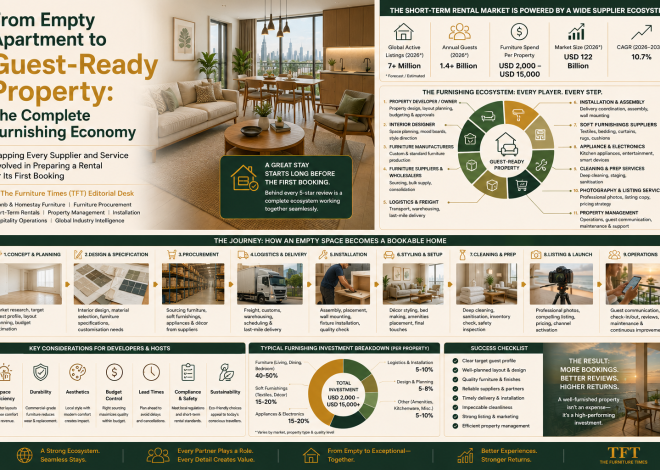
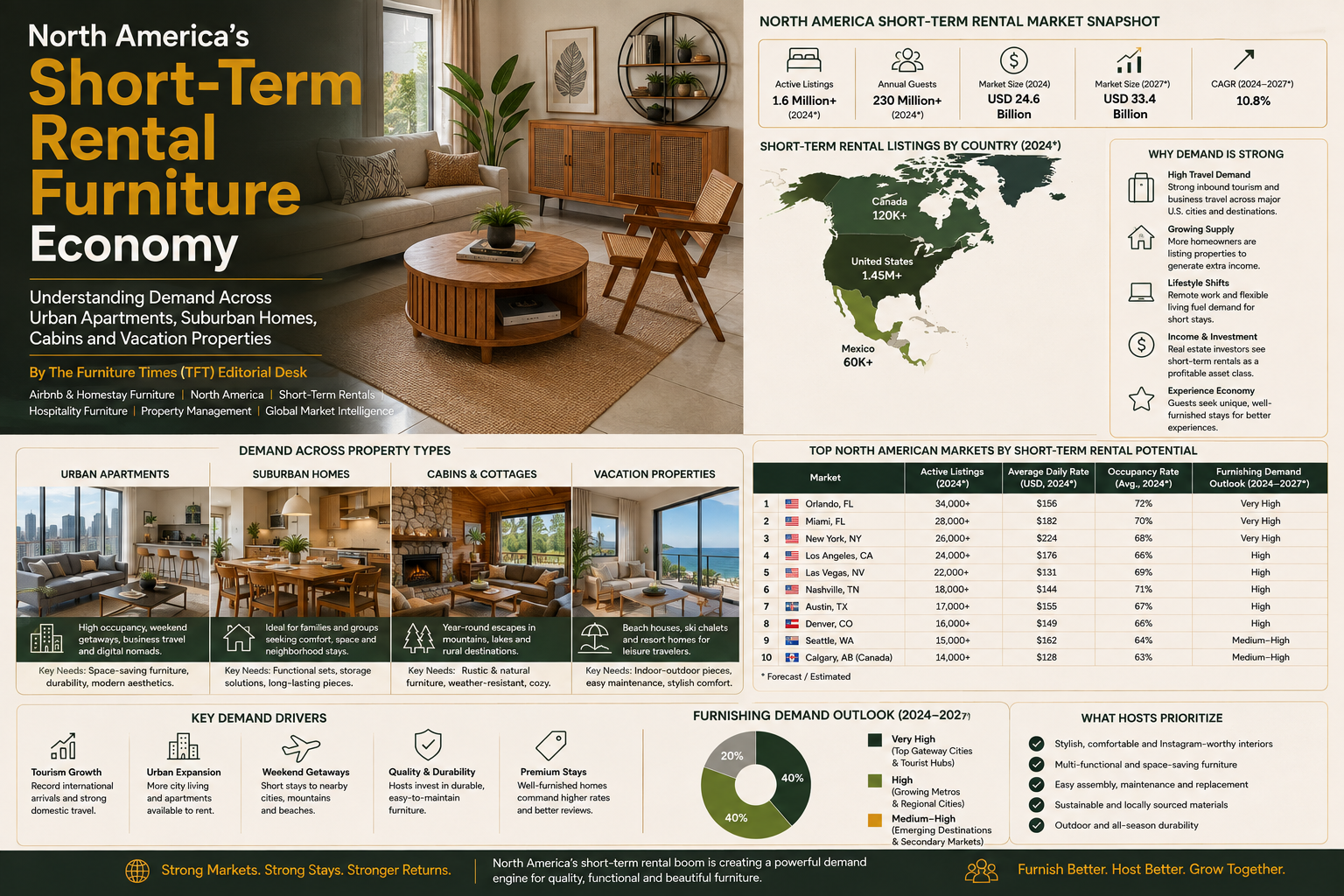
North America has developed one of the world’s largest, most diverse and commercially sophisticated short-term-rental furniture economies.
Across the United States, Canada and Mexico, millions of travellers stay in furnished apartments, suburban houses, mountain cabins, beach properties, desert villas, ski chalets, lake homes, serviced residences and large group-accommodation properties.
Every one of these spaces depends on furniture to attract bookings, support the advertised occupancy, deliver comfort and remain operational through repeated guest turnover.
The region’s opportunity is not limited to furnishing newly launched properties. It includes the extensive replacement, repair, refurbishment, installation and asset-management economy supporting existing vacation rentals.
Beds require new mattresses. Sofas need reupholstery. Outdoor furniture is damaged by sunlight, rain, snow and salt air. Dining chairs become unstable. Sofa-bed mechanisms fail. Design trends change. Property managers standardise their portfolios, while owners renovate to protect ratings and compete more effectively.
North America’s short-term-rental furniture economy should therefore be understood as a recurring commercial market—one connecting travel, property investment, furniture manufacturing, interior design, logistics, maintenance and digital hospitality.
Domestic Travel Is the Foundation of North American Demand
The United States has an enormous domestic-travel economy capable of supporting short-term rentals even when international arrivals weaken.
U.S. Travel Association forecasts indicate that total American travel spending could reach approximately US$1.37 trillion in 2026. Domestic travel is expected to account for around 87% of that total, representing approximately US$1.20 trillion. International inbound spending is projected to recover modestly after declining in 2025, supported partly by travel connected to major events. U.S. Travel Association
This domestic strength is important for furniture demand.
Many North American vacation rentals depend on travellers arriving by car rather than international air passengers. Families book beach homes, cabins, lake properties, ski accommodation and suburban houses for holidays, reunions, sporting events, weddings and weekend breaks.
As a result, furniture demand extends far beyond New York, Los Angeles, Toronto, Vancouver, Mexico City and other major gateways.
It reaches:
- Small coastal towns
- Mountain communities
- National-park gateways
- Rural destinations
- Lake regions
- Ski areas
- Desert communities
- University towns
- Festival destinations
- Suburban event markets
- Business and medical-travel centres
The growth of domestic travel has effectively transformed thousands of local property markets into hospitality-furniture markets.
North America Is Not One Furniture Market
The region contains three major national markets with different characteristics.
| Market | Accommodation Strength | Main Furniture Opportunity |
|---|---|---|
| United States | Enormous domestic demand and diverse vacation-rental inventory | Portfolio furnishing, large homes, cabins, urban apartments and replacement |
| Canada | Urban, coastal, lake, ski and nature-based accommodation | Durable climate-ready furniture, cabins, chalets and regulated professional supply |
| Mexico | International tourism, coastal resorts, villas and urban stays | Outdoor furniture, villa packages, local craftsmanship and tropical performance |
Within these countries, demand varies further by climate, property type and regulation.
A compact apartment in Chicago has little in common with a large vacation home in Orlando. A Canadian ski chalet requires different products from a Toronto serviced apartment. A Mexico City rental has different furnishing priorities from a pool villa in Los Cabos.
Furniture suppliers must therefore develop market-specific systems rather than treat North America as a single uniform territory.
The United States: Scale, Specialisation and Professional Management
The United States is one of the world’s largest short-term-rental markets.
Its strength comes from the combination of:
- A large travelling population
- High domestic tourism expenditure
- Diverse geography
- Extensive second-home ownership
- Mature digital-booking adoption
- Professional property-management companies
- Large vacation homes
- Established furniture-distribution networks
AirDNA says its global short-term-rental data covers more than 10 million Airbnb and Vrbo properties across approximately 120,000 markets, illustrating the scale and geographic fragmentation of the accommodation economy that suppliers must address. AirDNA
The American opportunity includes both small independent hosts and professional operators managing hundreds or thousands of properties.
This mixed structure creates demand for:
- Retail-ready products
- Contract-grade furniture
- Complete room packages
- Bulk procurement
- Customised collections
- Local warehousing
- Installation
- Emergency replacement
- Furniture leasing
- Repair and refurbishment
- Digital asset tracking
Urban Apartments: Compact Furniture With Commercial Performance
Urban short-term rentals, serviced apartments and furnished mid-term rentals require furniture that performs several functions within limited space.
Important markets include:
- New York
- Los Angeles
- Chicago
- Miami
- Boston
- Washington, D.C.
- Philadelphia
- Seattle
- San Francisco
- Austin
- Nashville
- Atlanta
Although short-term-rental regulation is strict in several major cities, legal furnished accommodation remains important for corporate travellers, medical visitors, relocating employees, project workers, families and extended stays.
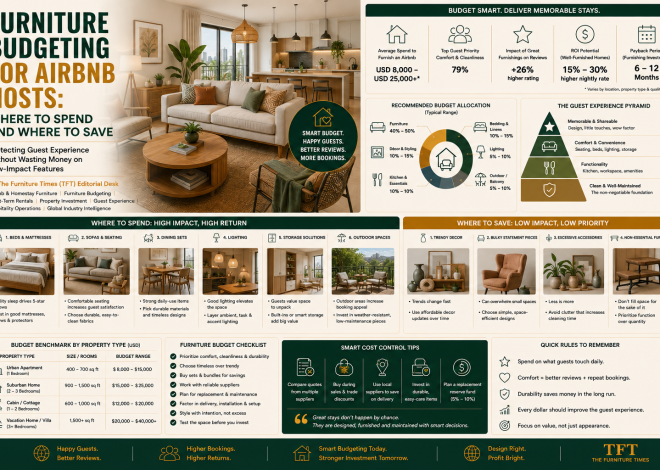
Urban Furniture Requirements
- Storage beds
- Compact sofas
- High-quality sofa beds
- Extendable dining tables
- Wall-mounted desks
- Nesting tables
- Modular wardrobes
- Luggage benches
- Ergonomic task chairs
- Integrated charging
- Slim-profile furniture
- Multifunctional consoles
Space efficiency must not compromise comfort.
A sofa bed that increases advertised capacity but provides poor sleep can damage reviews. A wall-mounted desk must still accommodate a laptop and proper chair. Dining furniture should correspond to the number of guests the property claims to serve.
The best urban furniture helps the operator extract more functional value from limited floor space without creating visual congestion.
Mid-Term Rentals Are Expanding the Furniture Brief
North America’s furnished-rental economy increasingly overlaps with stays lasting 28 days or longer.
These may serve:
- Travelling healthcare professionals
- Relocating employees
- Insurance-displacement guests
- Construction and project workers
- Students
- Digital professionals
- Families between homes
- Film and production crews
- Corporate assignments
Longer stays change furniture expectations.
Guests need more storage, more comfortable workspaces, practical dining furniture and better everyday seating. A property designed only for a two-night leisure stay may not be suitable for someone living there for six weeks.
Furniture companies can develop mid-term packages featuring:
- Larger wardrobes
- Dressers
- Ergonomic desks
- Durable dining chairs
- Comfortable sofas
- Laundry storage
- Flexible shelving
- Entryway organisation
- Higher-quality mattresses
This represents an important bridge between residential, hospitality and corporate furniture.
Suburban Homes: Family Travel and Group Accommodation
Suburban short-term rentals have expanded around airports, business districts, stadiums, hospitals, universities, wedding venues and major attractions.
They also serve families who want more space, parking, kitchens and private outdoor areas than hotels generally provide.
Furniture Demand
- Large dining tables
- Durable family seating
- Sectional sofas
- Multiple bedroom packages
- Bunk beds
- Sofa beds
- Children’s furniture
- Outdoor dining
- Barbecue-area seating
- Game-room furniture
- Workspaces
- Garage and sports-equipment storage
The furnishing challenge is capacity.
A suburban property advertised for ten guests must provide more than beds for ten. It needs enough dining space, seating, storage and bathroom organisation to support ten people realistically.
Poor capacity planning frequently creates dissatisfaction even when the property technically meets the sleeping requirement.
Furniture suppliers can add value by creating occupancy-based packages for six-, eight-, ten- and twelve-guest properties.
Large Vacation Homes: Furniture at Hospitality Scale
The United States has a significant market for large vacation homes serving extended families, reunions, weddings, sports teams and groups of friends.
These properties may include:
- Five to twelve bedrooms
- Multiple lounges
- Large kitchens
- Dining areas for more than ten people
- Game rooms
- Pool areas
- Cinemas
- Outdoor kitchens
- Children’s rooms
- Bunk rooms
Their furniture requirements can resemble a small hotel project.
Commercial Opportunities
- Multi-room bedroom packages
- Large dining tables
- Commercial-quality dining chairs
- Sectional seating
- Bunk-bed systems
- Pool loungers
- Outdoor dining
- Bar stools
- Game-room furniture
- Replacement mattresses
- Furniture inventories
- Installation and assembly
Large homes also experience intensive group use. Products must withstand furniture movement, high occupancy and frequent turnover.
Manufacturers should clearly state weight capacities, structural specifications and intended usage. Residential-looking products may require contract-level reinforcement.
Cabins and Mountain Properties: Durability, Warmth and Storage
Cabin tourism is an important part of the American and Canadian short-term-rental economy.
Major markets include:
- Smoky Mountains
- Blue Ridge Mountains
- Rocky Mountains
- Adirondacks
- Catskills
- Lake Tahoe
- Colorado ski destinations
- Montana
- Utah
- Vermont
- Canadian Rockies
- Québec
- British Columbia
Cabins often compete through atmosphere. Guests expect natural materials, fireplaces, warm textures and furniture that reflects the surrounding landscape.
Product Opportunities
- Solid timber beds
- Robust dining tables
- Benches
- Bunk beds
- Entryway storage
- Boot benches
- Coat racks
- Luggage furniture
- Leather or performance-fabric sofas
- Fireplace seating
- Deck furniture
- Hot-tub-area furniture
Furniture must also accommodate outdoor equipment. Skiers, hikers and families bring boots, coats, bags and sporting gear. Storage that protects the interior can improve both guest experience and cleaning efficiency.
Remote locations make repair and replacement expensive. Products should use accessible components and construction methods that local technicians can service.
Beach and Coastal Properties: Outdoor Living Meets Material Risk
North America’s coastline supports large short-term-rental markets across:
- Florida
- California
- North and South Carolina
- Gulf Coast
- New England
- Hawaii
- Mexico’s Caribbean coast
- Baja California
- Pacific Mexico
- Canadian coastal destinations
Outdoor areas are often central to the booking proposition.
Product Demand
- Outdoor dining sets
- Sun loungers
- Daybeds
- Adirondack-style seating
- Parasols
- Poolside tables
- Outdoor sectional sofas
- Balcony furniture
- Weather-resistant storage
- Bar furniture
Coastal conditions create significant performance challenges:
- Salt air
- High humidity
- UV exposure
- Wind
- Sand
- Rain
- Pool chemicals
Corrosion-resistant frames, UV-stable materials, quick-drying fabrics and secure furniture placement are therefore essential.
The lowest-cost products can become expensive if they corrode, fade or fail within one or two seasons.
Desert Markets: Heat, Sun and Premium Outdoor Design
Desert destinations such as Phoenix, Scottsdale, Palm Springs, Joshua Tree and parts of Nevada, New Mexico and Mexico create another specialised furniture market.
Properties often use architecture, pools and outdoor spaces to differentiate themselves.
Furniture Requirements
- UV-resistant outdoor furniture
- Heat-tolerant materials
- Shaded lounge areas
- Parasols
- Poolside seating
- Low-maintenance surfaces
- Indoor-outdoor dining
- Statement furniture for photography
Extreme sunlight can rapidly fade fabrics, weaken plastics and overheat metal surfaces.
Product specifications should reflect actual temperature exposure rather than generic outdoor-use claims.
Lake Homes: Seasonal Demand and Family Functionality
Lake properties are common throughout the United States and Canada.
They may experience intense summer use followed by long periods of vacancy. Furniture must therefore tolerate seasonal changes, moisture, equipment and large family groups.
Product Opportunities
- Large dining tables
- Benches
- Bunk beds
- Durable sofas
- Outdoor seating
- Deck furniture
- Storage for water-sports equipment
- Entryway organisation
- Furniture covers
- Moisture-resistant products
Seasonal closure creates additional challenges. Products may be exposed to humidity, cold or limited ventilation while the property is unused.
Manufacturers and suppliers can offer storage guidance, protective covers and maintenance packages for seasonal operators.
Ski Chalets: High-Value Seasonal Furnishing
Ski properties in the United States and Canada often serve premium guests and large groups.
Furniture must support:
- Heavy winter clothing
- Wet equipment
- Group dining
- Long indoor stays
- Fireplace use
- Multiple sleeping arrangements
- Premium photography
- High nightly-rate expectations
Important categories include:
- Boot benches
- Drying-area storage
- Large dining tables
- Deep lounge seating
- Bunk rooms
- Timber bed frames
- Durable upholstery
- Entryway furniture
- Side tables
- Reading chairs
Furniture in ski destinations must provide warmth visually while remaining practical under wet and abrasive conditions.
Because these properties may generate much of their annual income during a short season, furniture failure at peak time can be especially costly.
Canada: Nature-Based Tourism Under Growing Regulation
Canada’s short-term-rental furniture economy spans major cities, ski destinations, lake regions, coastal communities and rural properties.
Statistics Canada has documented the increasing role of short-term rentals within the national housing market, while noting the difficulty of distinguishing occasional home sharing from properties operating consistently as commercial accommodation. Statistics Canada
Canadian demand includes:
- Toronto apartments
- Vancouver accommodation
- Montréal properties
- Québec City tourism
- Banff and Canmore
- Whistler
- Niagara
- Maritime coastal homes
- Ontario cottage country
- British Columbia cabins
- Rural Québec
- Ski and lake destinations
Climate-Specific Requirements
Canadian furniture must often tolerate:
- Low temperatures
- Indoor heating
- Snow and moisture
- Wet boots and equipment
- Seasonal vacancy
- Temperature changes
- Remote delivery conditions
Entryway storage, benches, coat hooks and equipment organisation are especially valuable in cabins and ski properties.
Regulatory Direction
Canadian provinces and municipalities are strengthening short-term-rental controls to protect housing supply. Rules vary considerably by jurisdiction and may include principal-residence requirements, registration and limits on commercial operation.
This means furniture companies should target:
- Licensed operators
- Purpose-built vacation properties
- Resort accommodation
- Professional property managers
- Legal secondary suites
- Serviced apartments
- Established cottage and cabin markets
Regulation may reduce speculative new supply in some cities, but it can also professionalise the remaining market and increase demand for better-quality, more durable furniture.
Mexico: Tourism, Villas and Locally Inspired Furnishing
Mexico is one of the world’s largest international tourism destinations and a major North American short-term-rental market.
The country welcomed more than 40 million international tourists during the first eleven months of 2024, an increase of approximately 7.7% from the comparable period a year earlier. International visitor spending also increased. El País
Major rental destinations include:
- Mexico City
- Cancún
- Tulum
- Playa del Carmen
- Riviera Maya
- Puerto Vallarta
- Los Cabos
- Oaxaca
- San Miguel de Allende
- Mérida
- Guadalajara
- Pacific coastal destinations
Mexico’s property mix includes urban apartments, colonial homes, condominiums, villas and resort residences.
Mexican Coastal Properties: A Major Outdoor-Furniture Opportunity
Coastal markets create demand for:
- Pool loungers
- Outdoor dining
- Daybeds
- Parasols
- Balcony furniture
- Bar stools
- Villa lounge furniture
- Moisture-resistant bedroom furniture
- Easy-clean upholstery
- Outdoor storage
Salt air, UV exposure, high temperatures and humidity can shorten product life. Operators need materials suited to actual coastal conditions.
Products should be:
- Corrosion resistant
- UV stable
- Quick drying
- Easy to clean
- Repairable locally
- Stable in wind
- Resistant to pool chemicals
Mexico’s local furniture and craft industries can also provide destination identity through timber, weaving, leather, textiles and artisan production.
The commercial opportunity lies in combining that identity with consistent specifications and hospitality-grade performance.
Mexico City: Urban Growth and Regulatory Change
Mexico City has developed a significant furnished-accommodation market serving tourists, remote workers, business travellers and longer-stay international guests.
This creates demand for:
- Compact apartment packages
- Ergonomic workspaces
- Storage beds
- Dining furniture
- Sofa beds
- Locally designed statement products
- Furniture for extended stays
However, the city has introduced reforms intended to address housing pressure and regulate short-term accommodation. International Bar Association
Furniture suppliers should not assume unrestricted future growth. They should prioritise registered properties, professional operators and accommodation formats with clear legal standing.
As regulation increases, some demand may shift from informal short stays toward serviced apartments, licensed accommodation and mid-term rentals.
Furniture Categories Driving North American Demand
Beds and Mattresses
Sleep quality remains central to guest satisfaction. The market needs stable bed frames, commercial-quality mattresses, protectors, replaceable components and flexible twin-to-king systems.
Dining Furniture
Families and groups choose rentals partly because they can eat together. Tables and chairs should support the property’s advertised occupancy.
Sofas and Sofa Beds
Sofas face intensive use and are visually prominent in listing photography. Sofa beds increase capacity but must remain comfortable and easy to operate.
Outdoor Furniture
Outdoor dining, lounging and poolside products are major booking features across coastal, lake, cabin, desert and suburban properties.
Bunk Beds
Large vacation homes and family properties use bunk beds to increase capacity. Structural integrity, guardrails, ladder safety and weight limits are critical.
Workspaces
Remote workers and extended-stay guests need proper desks, chairs, lighting and charging access.
Storage
Luggage benches, wardrobes, entryway furniture and equipment storage improve property functionality and housekeeping.
Children’s Furniture
Cots, highchairs, safer storage and family-friendly bedroom configurations help properties serve an important travel segment.
Professional Property Managers Are Reshaping Procurement
The North American short-term-rental sector includes many sophisticated property-management companies.
These operators require more than attractive products. They need furniture systems that can be deployed, maintained and replaced across large portfolios.
Their priorities include:
- Standardised specifications
- Bulk pricing
- Regional availability
- Product continuity
- Rapid replenishment
- Replaceable parts
- Clear warranties
- Installation
- Digital inventories
- Repair networks
- Documented performance
A manager operating 500 properties cannot source every replacement from an unpredictable retail environment.
Manufacturers that offer stable collections and regional fulfilment can become long-term procurement partners.
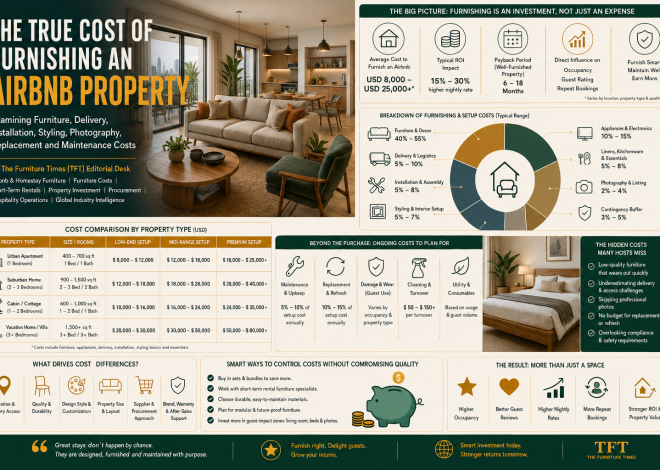
Furniture Downtime Has a Measurable Cost
A failed product can affect revenue immediately.
If a bed breaks, the bedroom may become unusable. If a sofa bed fails, the property may no longer accommodate the number of guests advertised. If outdoor furniture becomes unsafe, the listing photographs may promise an experience the property cannot deliver.
The cost can include:
- Emergency repair
- Replacement furniture
- Expedited delivery
- Staff labour
- Guest compensation
- Refunds
- Negative reviews
- Lost reservations
- Temporary closure
This is why furniture durability and replacement speed should be evaluated alongside initial price.
For professional operators, the best furniture is often the furniture that creates the least operational disruption over its full lifecycle.
Cleaning Efficiency Is a Major Commercial Factor
North American labour costs make housekeeping efficiency particularly important.
Furniture that is difficult to clean can increase turnover time across every reservation.
Operationally efficient products may include:
- Removable and washable covers
- Stain-resistant upholstery
- Bed frames with cleaning clearance
- Wipeable dining surfaces
- Open storage
- Modular sofa components
- Chairs with simple profiles
- Lightweight movable tables
- Replaceable cushions
- Moisture-resistant outdoor products
Cleaning teams should be involved in product evaluation because they see how furniture performs after every stay.
A visually appealing product may create hidden costs if it requires specialised cleaning or traps dust, hair and food debris.
Repair and Refurbishment Are Major Growth Opportunities
North America’s large installed short-term-rental furniture base creates demand for:
- Mobile furniture repair
- Sofa-mechanism repair
- Bed-frame reinforcement
- Chair-joint repair
- Surface refinishing
- Upholstery replacement
- Foam renewal
- Outdoor-furniture restoration
- Rattan repair
- Mattress replacement
- Hardware replacement
Repair and refurbishment can extend product life while reducing waste and replacement costs.
Property managers may benefit from regional repair partnerships capable of responding quickly between reservations.
Furniture companies can also create take-back programmes that recover, refurbish and redeploy products across different property tiers.
Furniture Leasing and Subscription Models
Furniture leasing may become increasingly relevant in North America, particularly for:
- New property managers
- Mid-term rentals
- Corporate accommodation
- Seasonal markets
- Rental-arbitrage businesses
- Developers launching furnished units
- Operators preserving capital
- Properties requiring regular design updates
A furniture subscription could include:
- Products
- Delivery
- Installation
- Maintenance
- Damage replacement
- Periodic refresh
- End-of-contract removal
The challenge lies in managing transport, wear and residual value. Nevertheless, a service-based model may appeal to operators who prefer predictable monthly costs over large initial purchases.
The 2026 World Cup as a Temporary Demand Catalyst
The 2026 FIFA World Cup across the United States, Canada and Mexico creates a significant but time-limited accommodation event.
Host cities and surrounding regions may experience increased demand for:
- Additional beds
- Sofa beds
- Dining seating
- Furnished apartments
- Suburban group accommodation
- Outdoor entertainment furniture
- Temporary furniture rental
- Rapid installation
- Replacement inventory
However, property owners should avoid overinvesting solely for a short event without a longer-term operating plan.
Furniture suppliers can reduce this risk through rental, leasing, temporary packages and products that can later be redeployed or resold.
The event also demonstrates the value of a continental supply network capable of serving three national markets.
Regulation Will Shape Where Demand Survives
North American short-term-rental regulation is highly localised.
Rules may involve:
- Registration
- Business licences
- Zoning
- Principal-residence requirements
- Limits on rental nights
- Occupancy restrictions
- Fire and safety standards
- Condominium rules
- Tax collection
- Insurance requirements
The effect on furniture demand is complex.
Restrictions can reduce new property launches, but they may also strengthen demand among professional, compliant operators. Properties leaving the short-term market may require furniture liquidation, relocation or conversion to long-term rental.
Furniture companies should monitor local regulations before investing in warehouses, showrooms or dedicated sales teams.
The most stable opportunities are generally connected to legal vacation-home markets, licensed operators, professional portfolios and purpose-built accommodation.
Sustainability and the Replacement Problem
The North American market can generate significant furniture waste because of frequent renovation, property conversion and low-cost product failure.
A more sustainable system should support:
- Durable construction
- Replaceable components
- Modular sofas
- Washable upholstery
- Repairable mechanisms
- Refinishable timber
- Furniture take-back
- Refurbishment
- Resale
- Donation
- Material recycling
- Accurate furniture inventories
The environmental and commercial goals are closely aligned.
Longer-lasting furniture reduces purchasing frequency, freight, installation, disposal and property disruption.
Suppliers should communicate sustainability through measurable durability, repairability and product-life information rather than broad claims.
The Searchability Problem Across a Vast Region
North America has thousands of furniture manufacturers, distributors, designers, installers, repairers and refurbishment businesses. Yet property managers often struggle to identify which suppliers understand short-term rentals.
A cabin operator in Tennessee, villa manager in Mexico, property manager in Florida or chalet owner in Canada may require entirely different products and services.
Furniture Industry Search Engine (FISE) can help organise the market by connecting buyers with suppliers according to:
- Product category
- Location
- Climate suitability
- Property type
- Commercial capacity
- Installation availability
- Repair services
- Replacement support
If you are not searchable, you do not exist in the moment the buyer needs you.
TFT tells their story. FISE helps the world find them. FurniReviewology helps the world trust them.
What Manufacturers Should Prepare For
Companies targeting North America’s short-term-rental market should consider developing:
- Urban apartment collections
- Suburban family packages
- Large vacation-home packages
- Cabin furniture
- Ski-property furniture
- Coastal outdoor collections
- Desert-rated outdoor furniture
- Bunk-bed systems
- Commercial mattresses
- Extended-stay workspaces
- Replaceable upholstery
- Rapid-replacement programmes
They should also provide:
- Clear weight capacities
- Commercial specifications
- Assembly instructions
- Product codes
- Spare parts
- Regional stock
- Installation
- Warranty support
- Repair partnerships
- Furniture asset information
The market does not simply need more furniture. It needs furniture designed around the operational reality of short-term accommodation.
Where the Strongest Opportunities Are Emerging
Urban Apartments
Compact, multifunctional and extended-stay furniture.
Suburban Homes
Family dining, multiple bedrooms, workspaces and outdoor living.
Large Vacation Properties
High-capacity seating, bunk systems, dining and portfolio-standard products.
Cabins
Timber aesthetics, equipment storage, durability and remote repairability.
Coastal Properties
Weather-resistant outdoor products and easy-clean interiors.
Desert Rentals
UV-resistant materials and premium poolside furniture.
Ski Chalets
Entryway organisation, wet-equipment storage and robust communal furniture.
Canadian Nature Markets
Climate-ready cabin and seasonal-property furniture.
Mexican Villas
Outdoor living, local craftsmanship and complete villa packages.
Mid-Term Rentals
Ergonomic workspaces, storage and residential comfort with commercial durability.
Conclusion
North America’s short-term-rental furniture economy is one of the world’s most varied and commercially important furnishing markets.
Its demand extends from compact urban apartments to suburban family homes, mountain cabins, lake properties, ski chalets, desert retreats, beach houses and large vacation villas.
The United States provides unmatched domestic-travel scale and a sophisticated property-management sector. Canada offers strong nature-based accommodation and climate-specific furnishing needs. Mexico combines international tourism, coastal development, villa demand and local craft traditions.
Across all three countries, the market is moving toward greater professionalisation.
Operators increasingly require furniture that is:
- Durable
- Attractive in listing photographs
- Easy to clean
- Appropriate for the advertised occupancy
- Fast to replace
- Repairable
- Consistent across portfolios
- Suitable for local climate conditions
- Financially efficient over its lifecycle
For manufacturers and suppliers, the greatest opportunity is not simply selling a bed, sofa or dining table. It is building a reliable furnishing system around the accommodation business.
North America’s short-term-rental furniture economy is already large. Its next phase will be defined by better products, stronger service networks, professional procurement, digital asset management and more circular approaches to repair and replacement.