Why LED Lighting Continues to Dominate the Global Lighting Industry
By The Furniture Times (TFT) | Indoor & Outdoor Lighting | Global Lighting Industry & Market
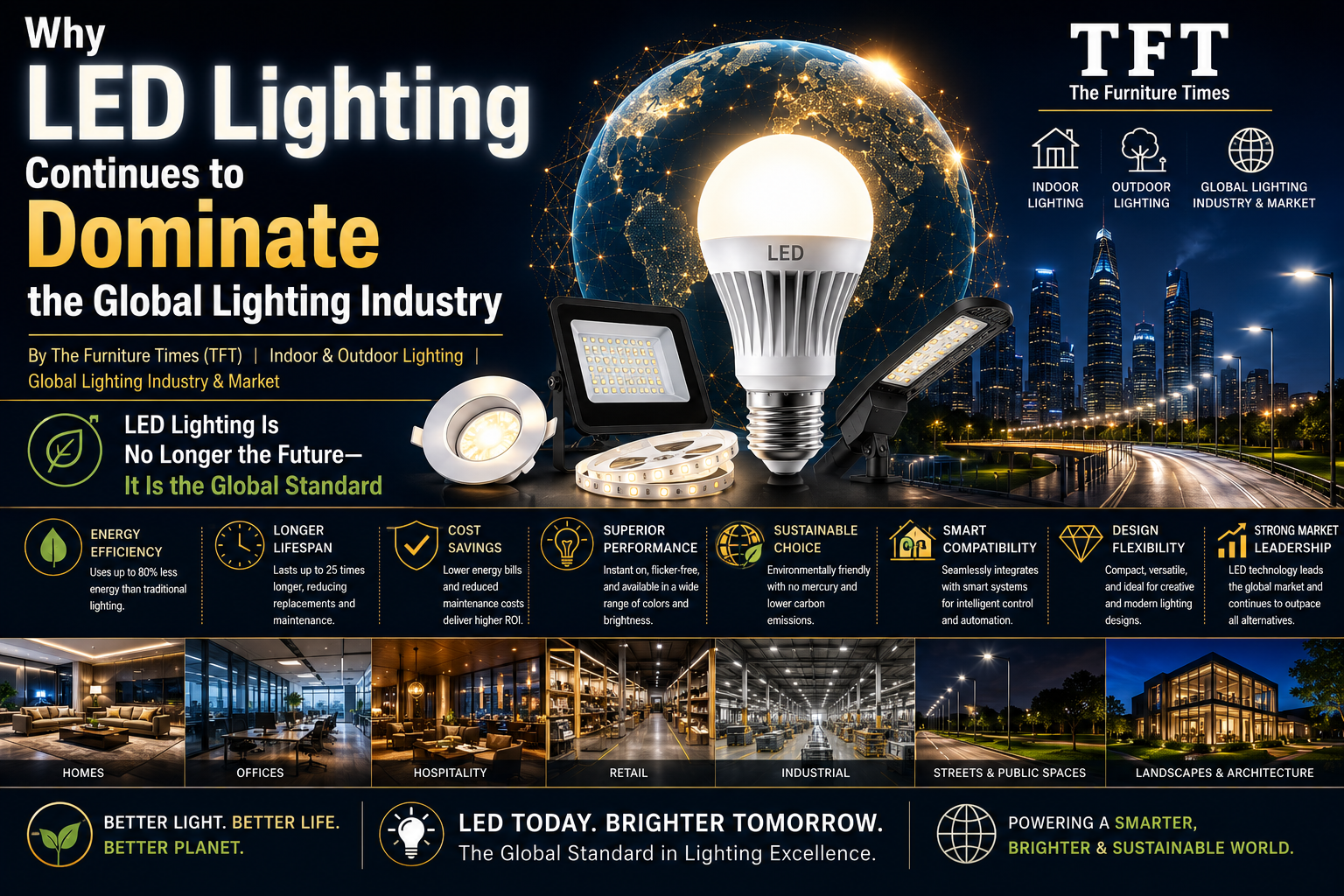
LED Lighting Is No Longer the Future—It Is the Global Standard
The global lighting industry has experienced one of the most remarkable technological transformations in modern manufacturing. Over the past two decades, Light Emitting Diode (LED) technology has evolved from an emerging innovation into the dominant lighting solution for residential, commercial, industrial, hospitality, healthcare, transportation, infrastructure, and smart city applications.
Today, LED lighting is far more than an energy-efficient alternative to traditional incandescent, halogen, fluorescent, and high-intensity discharge (HID) lighting. It has become the foundation of intelligent buildings, sustainable construction, digital infrastructure, and next-generation urban development.
Governments worldwide are encouraging the adoption of LED technology through energy-efficiency policies, environmental regulations, and sustainability initiatives. Businesses are replacing outdated lighting systems to reduce operating costs, while homeowners are embracing LEDs for their durability, aesthetics, safety, and compatibility with smart home technologies.
As the world moves toward net-zero carbon emissions, green buildings, artificial intelligence (AI), and connected living, LED lighting continues to dominate because it delivers measurable economic, environmental, and technological advantages that traditional lighting simply cannot match.
A Revolution That Changed the Industry
The lighting industry has undergone several major transitions throughout history—from candles and gas lamps to incandescent bulbs, fluorescent tubes, compact fluorescent lamps (CFLs), and now LEDs.
Unlike previous technologies, LEDs are semiconductor-based light sources that convert electrical energy into visible light with remarkable efficiency. They produce significantly less heat while generating higher-quality illumination, making them suitable for almost every lighting application.
Initially adopted for commercial and industrial projects due to higher costs, LEDs have become increasingly affordable through advances in manufacturing, automation, and global production capacity. Today, they are the preferred choice for homes, offices, factories, airports, hotels, retail stores, educational institutions, hospitals, warehouses, and outdoor public infrastructure.
Exceptional Energy Efficiency
One of the primary reasons LEDs dominate the market is their outstanding energy efficiency.
Compared with conventional lighting technologies, LEDs consume substantially less electricity while producing equal or superior brightness. This reduction in energy consumption translates into significant savings for households, businesses, and governments.
Large commercial buildings operating thousands of light fixtures can reduce annual electricity costs dramatically by transitioning to LED systems. Municipalities replacing conventional streetlights with LED technology often report substantial reductions in energy expenditure, enabling public funds to be redirected toward other infrastructure priorities.
For homeowners, the long-term reduction in electricity bills makes LED lighting one of the most cost-effective investments in modern living.
Longer Lifespan Means Lower Costs
LED lighting is designed to last significantly longer than traditional alternatives.
Where incandescent bulbs may require replacement after a relatively short operating period, quality LED fixtures can continue performing efficiently for many years under normal conditions.
This extended lifespan reduces:
- Replacement frequency
- Maintenance expenses
- Operational downtime
- Labor costs
- Inventory requirements
- Waste generation
Industries such as manufacturing, logistics, aviation, healthcare, and public infrastructure particularly benefit because maintenance interruptions can be costly and disruptive.
Lower Maintenance Improves Business Efficiency
Maintenance is often one of the largest hidden costs associated with large-scale lighting installations.
Shopping malls, airports, hotels, factories, hospitals, warehouses, office towers, universities, and public facilities contain thousands of lighting fixtures.
Frequent replacement requires technicians, equipment, operational shutdowns, and replacement inventory.
LED lighting minimizes these challenges by delivering reliable long-term performance, allowing facility managers to focus resources on strategic improvements rather than routine maintenance.
Sustainability Drives Global Adoption
Environmental sustainability has become a defining priority for governments, corporations, and consumers.
Lighting contributes significantly to electricity consumption worldwide, making energy-efficient technologies critical for reducing greenhouse gas emissions.
LED lighting supports sustainability by:
- Reducing electricity demand
- Lowering carbon emissions
- Producing less waste through longer service life
- Eliminating hazardous materials commonly found in older lighting technologies
- Supporting green building certifications
- Reducing cooling requirements through lower heat generation
Organizations pursuing Environmental, Social, and Governance (ESG) objectives increasingly view LED upgrades as one of the fastest and most cost-effective ways to improve environmental performance.
Superior Lighting Quality
Modern LED technology offers exceptional lighting performance across a wide range of applications.
Manufacturers now provide LEDs in numerous color temperatures, brightness levels, beam angles, and design formats, allowing architects and designers to tailor lighting precisely to each environment.
LED lighting enhances:
- Residential comfort
- Retail merchandising
- Hotel ambiance
- Restaurant experiences
- Museum exhibitions
- Office productivity
- Healthcare environments
- Educational spaces
- Industrial safety
- Outdoor visibility
High-quality LEDs also deliver improved color rendering, enabling people to perceive colors more accurately and naturally.
The Perfect Partner for Smart Lighting
Perhaps the greatest advantage of LED technology is its compatibility with intelligent lighting systems.
Unlike traditional lighting technologies, LEDs integrate seamlessly with:
- Artificial Intelligence (AI)
- Internet of Things (IoT)
- Motion sensors
- Occupancy detection
- Daylight harvesting
- Wireless controls
- Voice assistants
- Mobile applications
- Building automation systems
- Cloud-based monitoring platforms
Smart LED lighting continuously adapts to occupancy, weather conditions, daylight availability, user preferences, and operational requirements, improving both energy efficiency and user experience.
As smart homes and intelligent commercial buildings become increasingly common, LED technology forms the foundation of these connected ecosystems.
Transforming Residential Living
Consumers increasingly demand lighting solutions that combine convenience, aesthetics, and efficiency.
Modern LED products allow homeowners to:
- Control lighting remotely.
- Adjust brightness levels.
- Change color temperatures.
- Create personalized lighting scenes.
- Schedule automatic operation.
- Improve home security.
- Integrate lighting with entertainment systems.
- Enhance outdoor landscapes.
- Reduce monthly energy bills.
- Increase property value.
LED lighting has become an essential feature of modern home design rather than a simple utility.
Commercial Buildings Continue Leading Adoption
Commercial real estate developers are among the largest adopters of LED technology.
Office towers, shopping centers, hotels, convention centers, hospitals, educational campuses, airports, and logistics facilities require reliable lighting that balances performance with operational efficiency.
LED systems support:
- Reduced operating costs
- Improved employee comfort
- Better customer experiences
- Flexible workspace design
- Predictive maintenance
- Energy reporting
- Building automation
- Sustainability certifications
For commercial property owners, lighting upgrades often deliver attractive long-term financial returns through lower energy consumption and maintenance expenses.
Outdoor Infrastructure Benefits Enormously
Cities worldwide are replacing conventional streetlights with intelligent LED systems.
Outdoor LED lighting improves:
- Road safety
- Public security
- Energy efficiency
- Traffic management
- Smart city integration
- Environmental monitoring
- Infrastructure reliability
- Municipal operating budgets
LED streetlights also serve as platforms for cameras, environmental sensors, communication equipment, public Wi-Fi, and electric vehicle infrastructure, transforming lighting poles into multifunctional digital assets.
Manufacturing Innovation Keeps Improving LEDs
LED technology continues advancing rapidly through innovation.
Manufacturers invest heavily in:
- Higher luminous efficiency
- Improved optical performance
- Advanced thermal management
- Miniaturization
- OLED development
- Flexible lighting
- Tunable white lighting
- Human-centric lighting
- AI integration
- Sustainable manufacturing processes
These innovations continue expanding LED applications across new industries and environments.
Investment Opportunities Continue Growing
The LED sector offers attractive opportunities for manufacturers, distributors, investors, contractors, designers, and technology providers.
Growing demand is driven by:
- Urbanization
- Smart city development
- Infrastructure modernization
- Green building projects
- Hospitality expansion
- Industrial automation
- Healthcare investments
- Residential construction
- Digital transformation
- Renewable energy integration
Companies that focus on innovation, product quality, intelligent controls, and sustainable manufacturing are well positioned for long-term growth.
Opportunities for the Furniture Industry
The furniture industry increasingly relies on LED technology to enhance both functionality and aesthetics.
Furniture manufacturers now incorporate LED lighting into:
- Wardrobes
- Kitchen cabinets
- Display units
- Office furniture
- Retail fixtures
- Hotel furniture
- Entertainment centers
- Bedroom furniture
- Bathroom vanities
- Luxury storage systems
Integrated lighting improves user experience while creating higher-value furniture collections that meet evolving consumer expectations.
As furniture becomes smarter and more connected, LED technology will remain a critical design element.
Challenges Ahead
Despite overwhelming success, the LED industry continues addressing several challenges.
These include:
- Counterfeit products
- Price competition
- Electronic waste management
- Component supply chains
- Cybersecurity for connected lighting
- Standardization across smart platforms
- Skilled installation requirements
- Consumer awareness
- Product quality consistency
- End-of-life recycling
Addressing these issues will strengthen long-term confidence and accelerate global adoption.
Lighting the Path Forward
LED lighting has fundamentally transformed the global lighting industry by combining efficiency, intelligence, sustainability, reliability, and design flexibility into a single technology.
Its continued dominance is driven not only by lower operating costs but also by its ability to integrate seamlessly with AI, smart buildings, renewable energy systems, and connected urban infrastructure.
As governments invest in sustainable development, businesses modernize their facilities, and consumers embrace smarter lifestyles, LED lighting will remain the foundation of the next generation of intelligent illumination.
For manufacturers, architects, interior designers, property developers, furniture companies, retailers, technology providers, and investors, the LED revolution is far from over. It continues to create new markets, unlock innovation, and redefine how the world lights its homes, buildings, industries, and cities.
The future of lighting is efficient, connected, sustainable, and intelligent—and LED technology will continue leading the way.