
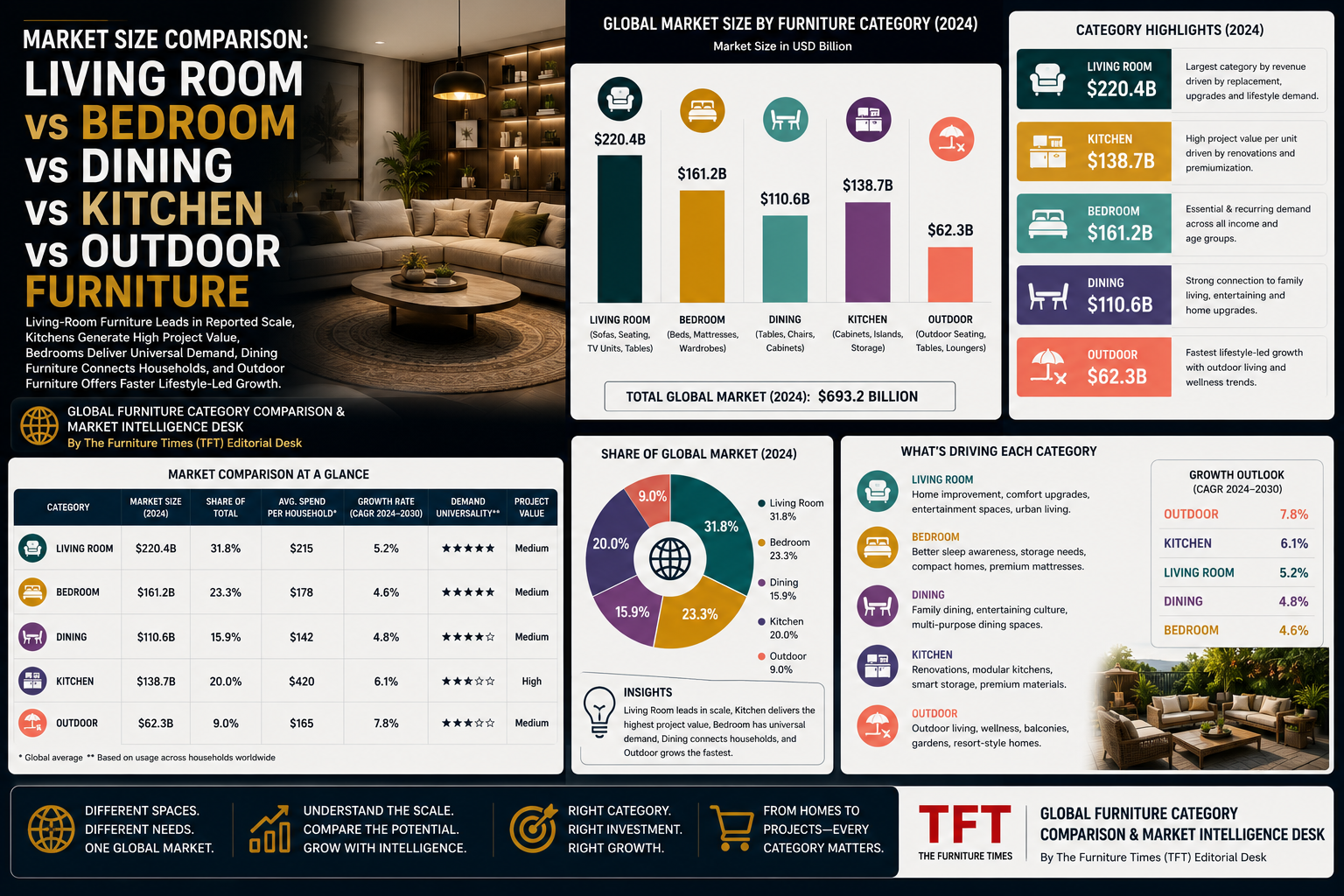
Market Size Comparison: Living Room vs Bedroom vs Dining vs Kitchen vs Outdoor Furniture
Living-Room Furniture Leads in Reported Scale, Kitchens Generate High Project Value, Bedrooms Deliver Universal Demand, Dining Furniture Connects Households, and Outdoor Furniture Offers Faster Lifestyle-Led Growth
Global Furniture Category Comparison & Market Intelligence Desk
By The Furniture Times (TFT) Editorial Desk
The global furniture industry is not one uniform market.
It consists of several powerful room-based economies, each influenced by different buying triggers, replacement cycles, property types, materials, distribution systems and customer expectations.
Living-room furniture is driven by comfort, social identity and household entertainment.
Bedroom furniture is supported by the universal need for sleep, privacy and clothing storage.
Dining furniture benefits from family gatherings, hospitality and increasingly multifunctional home living.
Kitchen furniture is tied closely to property construction, renovation, appliances, storage and long-term home value.
Outdoor furniture is expanding as gardens, balconies, rooftops, pool decks and hospitality terraces become fully furnished lifestyle environments.
A direct comparison is valuable, but it must be handled carefully.
Market-research organisations do not always define these categories in the same way. Some kitchen reports include cabinets, countertops and fixtures. Some living-room reports include dining furniture. Some bedroom estimates include mattresses, while others do not. Outdoor reports may include both residential and commercial products.
The available figures should therefore be viewed as market-size signals rather than perfectly comparable accounting categories.
Based on selected 2026 estimates:
- The global living-room furniture market is estimated at approximately US$240.4 billion.
- Kitchen furniture and fixtures are estimated at approximately US$182.7 billion.
- Bedroom furniture is estimated at approximately US$132.49 billion.
- Outdoor furniture is estimated at approximately US$56.1 billion under one broad definition.
- The dining-table market alone is estimated at approximately US$9.19 billion, although the total dining-furniture economy is much larger when chairs, benches, sideboards and kitchen-dining products are included.
Together, these categories demonstrate how furniture demand follows the way people live, sleep, gather, cook, entertain and connect with outdoor space.
Comparative Market Snapshot
Living-Room Furniture
Reported 2026 market estimate: approximately US$240.4 billion
Projected 2035 value: approximately US$339.6 billion
Estimated growth rate: approximately 3.9% annually.
Bedroom Furniture
Reported 2026 market estimate: approximately US$132.49 billion
Projected 2031 value: approximately US$165.07 billion
Estimated growth rate: approximately 4.49% annually.
Kitchen Furniture and Fixtures
Reported 2026 market estimate: approximately US$182.7 billion
Projected 2031 value: approximately US$213.16 billion
Estimated growth rate: approximately 3.13% annually.
Dining Furniture
A fully comparable global dining-furniture estimate is difficult to isolate because dining products are frequently grouped with living-room or kitchen furniture.
The narrower global dining-table market is estimated at approximately US$9.19 billion in 2026, with a projection of about US$16.01 billion by 2034, representing annual growth of approximately 7.19%.
A separate combined kitchen-and-dining furniture estimate valued that broader market at approximately US$132.5 billion in 2025, demonstrating how much the category expands when cabinetry, chairs, storage and related products are included.
Outdoor Furniture
Reported 2026 market estimate: approximately US$56.1 billion
Projected 2033 value: approximately US$86.6 billion
Estimated growth rate: approximately 6.4% annually.
Another current assessment places the 2026 outdoor market at US$58.91 billion and projects it to reach US$92.08 billion by 2034, illustrating the effect of different product definitions.
Overall Ranking by Reported Market Size
Using the selected estimates, the broad ranking is:
1. Living-Room Furniture
Living-room furniture leads the comparison because the category includes several high-value products purchased across almost every residential market:
- Sofas
- Sectionals
- Armchairs
- Recliners
- Coffee tables
- Side tables
- Television units
- Shelving
- Consoles
- Ottomans
- Sofa beds
The living room is often the most visible and socially important space in a home. Consumers may spend more on the sofa than on any other movable furniture item.
2. Kitchen Furniture and Fixtures
Kitchen furniture ranks second in the selected comparison.
The kitchen category benefits from:
- High project values
- Multiple cabinets per property
- Professional measurement
- Hardware
- Worktop coordination
- Appliance integration
- Installation
- Renovation spending
Unlike a chair or side table, a kitchen is usually purchased as a complete system.
3. Bedroom Furniture
Bedroom furniture ranks third in reported value but may be the strongest category by universal necessity.
Almost every household, hotel, hospital, care facility and student residence needs sleeping and storage furniture.
4. Outdoor Furniture
Outdoor furniture remains smaller than the major indoor categories, but it is growing faster under several market forecasts.
Its expansion is being driven by outdoor living, hospitality, tourism, balcony use and home-improvement spending.
5. Dining Tables as a Standalone Segment
The dining-table market appears much smaller because the figure covers tables rather than the complete dining environment.
A complete dining market would also include:
- Dining chairs
- Benches
- Bar stools
- Sideboards
- Buffets
- Display cabinets
- Breakfast counters
- Commercial restaurant furniture
The standalone dining-table figure should not be interpreted as representing the entire dining economy.
Living-Room Furniture: The Revenue and Emotional Leader
Living-room furniture occupies a powerful position because it combines high product value with strong emotional visibility.
The living room is where people:
- Relax
- Watch entertainment
- Receive visitors
- Spend time with family
- Work informally
- Create social-media content
- Accommodate guests
The sofa often determines the arrangement, comfort and visual identity of the entire room.
Major Revenue Drivers
Sofas and Sectionals
Large upholstered products generate substantial revenue because of their material use, labour, delivery complexity and average selling price.
Modular Seating
Modular systems allow households to add, remove or rearrange units.
This can increase both initial transaction values and future repeat purchases.
Recliners and Motion Furniture
Mechanisms, motors, electronics and additional engineering support higher prices.
Media Furniture
Television units, shelving and entertainment storage remain important as living rooms integrate larger screens, gaming and smart-home equipment.
Consumer Search Behaviour
Living-room searches frequently focus on:
- Sofa dimensions
- Fabric durability
- Comfort
- Cushion firmness
- Pet-friendly materials
- Modular arrangements
- Small apartment suitability
- Delivery access
- Reviews
Strengths
- High household visibility
- Strong average transaction values
- Emotional buying
- Large replacement market
- Significant e-commerce and showroom interest
- Strong customisation potential
Weaknesses
- Expensive delivery
- High return risk
- Comfort cannot be judged fully online
- Upholstery damage and warranty exposure
- Large storage requirements
Future Opportunity
Living-room furniture will remain one of the largest global categories, but growth will increasingly come from:
- Modular sofas
- Compact apartment seating
- Replaceable covers
- Performance textiles
- Sofa beds
- Recliners
- Smart and connected furniture
- Circular refurbishment services
Bedroom Furniture: The Universal Demand Leader
Bedroom furniture benefits from one of the most reliable foundations in the furniture economy: every person needs somewhere to sleep and store personal possessions.
The category includes:
- Bed frames
- Mattresses
- Headboards
- Bedside tables
- Wardrobes
- Dressers
- Vanity units
- Storage beds
- Bedroom benches
Why Bedroom Demand Is Resilient
Bedroom furniture is purchased during:
- Household formation
- Marriage
- Childbirth
- Relocation
- Renovation
- Hotel construction
- Student accommodation development
- Senior-living development
- Mattress replacement
Beds and Mattresses
Beds and mattresses are essential products rather than optional decorative purchases.
The sleep category also connects furniture with wellness, healthcare and technology.
Wardrobes and Storage
Smaller urban homes are increasing demand for:
- Floor-to-ceiling wardrobes
- Sliding doors
- Internal organisers
- Storage beds
- Modular closets
- Integrated dressing systems
Children’s Bedrooms
Children require repeated furniture purchases as they grow from cots to beds, bunk systems, desks and adult-sized storage.
Strengths
- Universal necessity
- Residential and commercial demand
- Complete-room package potential
- Strong storage demand
- Repeat mattress purchases
- Ageing-population opportunity
Weaknesses
- Price competition
- Large and bulky products
- Mattress returns and trials
- Wardrobe assembly complexity
- Material confusion
Future Opportunity
Bedroom growth will be shaped by:
- Smart sleep
- Adjustable beds
- Storage-integrated products
- Modular wardrobes
- Children’s systems
- Senior-friendly furniture
- Hospitality and care environments
Bedroom furniture may not always lead every market estimate, but it remains one of the most dependable long-term categories.
Kitchen Furniture: The Highest Project-Value Category
Kitchen furniture differs from most movable furniture because it is typically measured, designed, manufactured and installed as part of the property.
A kitchen purchase may involve:
- Base cabinets
- Wall cabinets
- Tall units
- Pantry systems
- Islands
- Drawer systems
- Hardware
- Lighting
- Work surfaces
- Appliance integration
- Installation
Why Kitchen Transactions Are Large
A sofa is usually one product or one coordinated set.
A kitchen may contain dozens of individual cabinet bodies, fronts, drawers, hinges, runners and accessories.
This creates higher average project values.
Demand Drivers
- New housing
- Residential renovation
- Property resale
- Rental-property upgrades
- Hospitality development
- Ageing housing stock
- Changing appliance requirements
- Desire for better storage
Search Behaviour
Kitchen buyers frequently search for:
- Kitchen cabinet prices
- Modular kitchen design
- Best kitchen materials
- Plywood versus MDF cabinets
- Moisture-resistant cabinetry
- Kitchen manufacturer near me
- Cabinet hardware
- Kitchen installation
- Small-kitchen storage
Strengths
- High transaction value
- Strong customisation
- Connection to property value
- Hardware and accessory revenue
- Professional installation
- Long customer engagement
Weaknesses
- Long decision cycle
- Measurement risk
- Installation failures
- Coordination with appliances and construction
- High cost of correcting errors
- Dependence on housing and renovation markets
Future Opportunity
Kitchen growth will increasingly centre on:
- Modular systems
- Tall and hidden storage
- Smart accessories
- Accessible kitchens
- Sustainable panels
- Durable hardware
- Compact urban kitchens
- Digital room planning
Kitchen furniture may grow more slowly than outdoor furniture in percentage terms, but its high project values make it one of the industry’s most economically important segments.
Dining Furniture: The Social and Multifunctional Leader
Dining furniture is economically larger than dining-table-only estimates suggest.
A complete dining environment may include:
- Table
- Chairs
- Benches
- Bar stools
- Sideboard
- Display cabinet
- Serving furniture
- Lighting and accessories
Dining furniture serves both residential and commercial markets.
Residential Demand
The household dining table may function as:
- Meal surface
- Workstation
- Study desk
- Meeting area
- Craft table
- Celebration space
This multifunctionality is supporting demand for:
- Extendable tables
- Drop-leaf designs
- Compact round tables
- Benches
- Durable surfaces
- Stackable seating
Commercial Demand
Restaurants, cafés, hotels, event venues, schools and workplaces purchase dining furniture in larger quantities.
Why the Standalone Market Estimate Appears Small
A dining-table report measures only one product.
It may exclude:
- Dining chairs
- Kitchen dining
- Restaurant furniture
- Sideboards
- Complete room packages
Therefore, the US$9.19 billion 2026 dining-table estimate should be viewed as a narrow product benchmark rather than the total value of dining furniture.
Strengths
- Universal cultural importance
- Residential and hospitality demand
- Strong material variety
- Multifunctional use
- Premium craftsmanship opportunity
- Commercial bulk-order potential
Weaknesses
- Long replacement cycles
- Price competition in basic sets
- Heavy tables create logistics costs
- Surface damage and maintenance concerns
- Category data is often grouped with kitchens or living rooms
Future Opportunity
The strongest growth areas include:
- Extendable tables
- Apartment dining
- Mixed work-and-dining furniture
- Restaurant furniture
- Outdoor dining
- Premium solid-wood tables
- Ceramic and sintered surfaces
- Repairable dining chairs
Outdoor Furniture: The Fastest Lifestyle-Growth Opportunity
Outdoor furniture remains smaller than the largest indoor categories, but it has one of the most attractive growth profiles.
One current forecast projects growth from US$56.1 billion in 2026 to US$86.6 billion by 2033, or approximately 6.4% annually.
This rate is higher than the selected estimates for living-room, bedroom and kitchen furniture.
Demand Drivers
- Outdoor living
- Home improvement
- Gardens
- Balconies
- Rooftops
- Pools
- Resorts
- Restaurants
- Wellness
- Tourism
Product Categories
- Outdoor sofas
- Dining sets
- Loungers
- Daybeds
- Balcony furniture
- Café furniture
- Parasols
- Pool furniture
- Outdoor kitchens
- Commercial terrace furniture
Why Outdoor Is Growing Faster
Outdoor space is being transformed from an occasional-use area into an extension of the home or commercial property.
Customers increasingly want indoor-level comfort outdoors.
Strengths
- Strong lifestyle demand
- Residential and hospitality markets
- Premium material opportunities
- Balcony and rooftop innovation
- Faster forecast growth
- Replacement cushion and component revenue
Weaknesses
- Weather exposure
- Seasonal demand in some regions
- Material failure risk
- Storage and inventory challenges
- Bulky logistics
- Climate-specific requirements
Future Opportunity
Outdoor furniture will expand through:
- Aluminium systems
- Teak and certified wood
- Performance textiles
- Small balcony products
- Modular sofas
- Rooftop hospitality
- Climate-specific collections
- Repairable components
Growth-Rate Comparison
Based on the selected reports:
- Dining tables: approximately 7.19% annually through 2034
- Outdoor furniture: approximately 6.4% annually through 2033
- Bedroom furniture: approximately 4.49% annually through 2031
- Living-room furniture: approximately 3.9% annually through 2035
- Kitchen furniture and fixtures: approximately 3.13% annually through 2031.
The dining-table percentage is calculated from a much smaller market base, while kitchen furniture begins from a far larger base.
A category can grow slowly in percentage terms while adding more absolute revenue.
For example:
- A 3% increase in a US$180 billion market creates more new annual value than a 7% increase in a US$9 billion market.
- Growth rate should therefore never be evaluated without market size.
Comparison by Purchase Frequency
Most Frequently Replaced
- Mattresses
- Sofas
- Dining chairs
- Outdoor cushions
- Lower-cost outdoor furniture
Moderately Replaced
- Beds
- Coffee tables
- Outdoor dining sets
- Dining tables
- Bedroom storage
Least Frequently Replaced
- Complete kitchens
- Built-in wardrobes
- Premium solid-wood dining tables
- Major fitted systems
Kitchen furniture may have the longest purchase cycle, but each project is valuable.
Comparison by Average Transaction Value
Highest Average Project Value
Kitchen furniture
A full kitchen may include cabinetry, hardware, countertops, accessories and installation.
Highest Movable-Furniture Transaction Value
Living-room and bedroom packages
Large sofas, bedroom sets and mattresses can generate significant orders.
Highest Potential Commercial Contract Value
Outdoor, dining and living-room furniture for hospitality projects
One resort or hotel may purchase hundreds of pieces.
Lowest Entry Transaction Value
Dining chairs, occasional tables and balcony furniture
These categories can attract first-time and e-commerce buyers.
Comparison by Search Behaviour
Living Room
Customers search around:
- Comfort
- Fabric
- sofa size
- modularity
- family use
- reviews
Bedroom
Customers search around:
- Mattress support
- bed dimensions
- storage
- wardrobes
- sleep quality
Dining
Customers search around:
- seating capacity
- table size
- shape
- material
- extendability
Kitchen
Customers search around:
- materials
- cost
- design
- storage
- installation
- local manufacturers
Outdoor
Customers search around:
- weather resistance
- climate
- rust
- UV exposure
- maintenance
- material comparisons
Comparison by Material Use
Living Room
- Timber frames
- Upholstery
- Foam
- Springs
- Metal mechanisms
- Engineered panels
Bedroom
- Solid wood
- Engineered wood
- Upholstery
- Metal
- Foam and mattress materials
Dining
- Wood
- Metal
- Glass
- Stone
- Ceramic
- Upholstery
Kitchen
- Plywood
- MDF
- Particleboard
- Laminates
- Veneers
- Metal hardware
- Stone and engineered surfaces
Outdoor
- Teak
- Aluminium
- Steel
- Synthetic weaving
- Rope
- Recycled plastic
- Performance textiles
Regional Category Leadership
North America
Strong demand for:
- Living-room furniture
- Mattresses
- Bedroom systems
- Kitchens
- Outdoor living
Europe
Strong demand for:
- Kitchens
- Dining furniture
- Compact living-room products
- Bedroom storage
- Sustainable outdoor furniture
Asia-Pacific
Strong demand for:
- Bedroom furniture
- Apartment storage
- Living-room seating
- Modular kitchens
- Compact dining
Asia-Pacific held approximately 38.5% of the overall global furniture market in 2025 under one current estimate.
Middle East
Strong demand for:
- Premium living rooms
- Dining and hospitality furniture
- Luxury bedrooms
- Kitchens
- Outdoor resort and villa furniture
Africa
High long-term need for:
- Beds and mattresses
- Storage
- Basic living-room furniture
- Dining products
- Affordable kitchens
Latin America
Strong opportunities in:
- Bedroom furniture
- Sofas
- Dining
- Kitchens
- Outdoor living
Which Category Is Most Attractive for Manufacturers?
The answer depends on manufacturing capability.
Upholstery Manufacturers
Best positioned for:
- Living-room furniture
- Bedroom headboards
- Dining chairs
- Outdoor sofas
- Hospitality seating
Panel-Furniture Manufacturers
Best positioned for:
- Kitchens
- Wardrobes
- Bedrooms
- Storage
- Media furniture
Solid-Wood Manufacturers
Best positioned for:
- Dining
- Bedrooms
- Premium living-room furniture
- Outdoor collections
Metal Manufacturers
Best positioned for:
- Dining chairs
- Table frames
- Kitchens and hardware
- Outdoor furniture
- Commercial products
Textile and Foam Suppliers
Best positioned for:
- Sofas
- Mattresses
- Upholstered beds
- Dining chairs
- Outdoor cushions
Which Category Is Most Attractive for Retailers?
Best for Large Average Orders
- Kitchens
- Bedroom packages
- Living-room sets
Best for Repeat Visits
- Mattresses
- Sofas
- Outdoor cushions
- Dining chairs
- Modular storage
Best for E-Commerce
- Dining chairs
- Side tables
- Compact outdoor furniture
- Flat-pack beds
- Modular storage
Best for Professional Services
- Kitchens
- Custom wardrobes
- Complete living rooms
- Outdoor space planning
Strategic Conclusions
Largest Reported Market
Living-room furniture
It leads the selected 2026 category estimates at approximately US$240.4 billion.
Highest Project Value
Kitchen furniture
Its combination of multiple cabinets, hardware, design and installation creates high-value transactions.
Most Universal Demand
Bedroom furniture
Every household and accommodation property needs sleep and storage products.
Strongest Social and Multifunctional Category
Dining furniture
Dining tables increasingly support meals, work, study and gatherings.
Fastest Major Lifestyle Growth
Outdoor furniture
Gardens, balconies, rooftops and hospitality spaces are expanding the market.
Fastest Percentage Growth in the Narrow Comparison
Dining tables
The category is forecast to grow rapidly, but from a substantially smaller and narrower market base.
Strategic Priorities for Furniture Businesses
Furniture companies should:
- Avoid comparing market reports without checking category definitions.
- Separate movable furniture from fitted furniture.
- Compare absolute revenue growth as well as CAGR.
- Analyse residential and commercial demand separately.
- Track transaction value and purchase frequency.
- Develop category-specific search content.
- Create modular and multifunctional products.
- Match materials to real usage and climate.
- Build replacement and repair programmes.
- Adapt category strategy by region.
- Measure delivery and installation costs.
- Create professional project divisions for kitchens and hospitality.
- Build complete-room packages where appropriate.
- Publish exact product specifications.
- Use customer search behaviour to guide product development.
Every Furniture Category Represents a Different Economy
Living-room furniture is the economy of comfort, identity and household connection.
Bedroom furniture is the economy of sleep, privacy, wellness and storage.
Dining furniture is the economy of food, gathering, hospitality and multifunctional living.
Kitchen furniture is the economy of property development, renovation, organisation and installation.
Outdoor furniture is the economy of lifestyle, climate, tourism and usable open space.
The category with the largest market is not automatically the category with the strongest growth.
The fastest-growing category is not automatically the most profitable.
The product with the highest selling price may also carry the highest delivery, installation and warranty risk.
Furniture businesses must therefore evaluate:
- Market scale
- Growth
- Competition
- Margins
- Logistics
- Skills
- Machinery
- Customer behaviour
- Regional suitability
Living rooms may lead in reported global scale, kitchens may command the largest project values, bedrooms may provide the most universal demand, dining may deliver the strongest social function, and outdoor furniture may offer the most dynamic lifestyle-growth opportunity.
