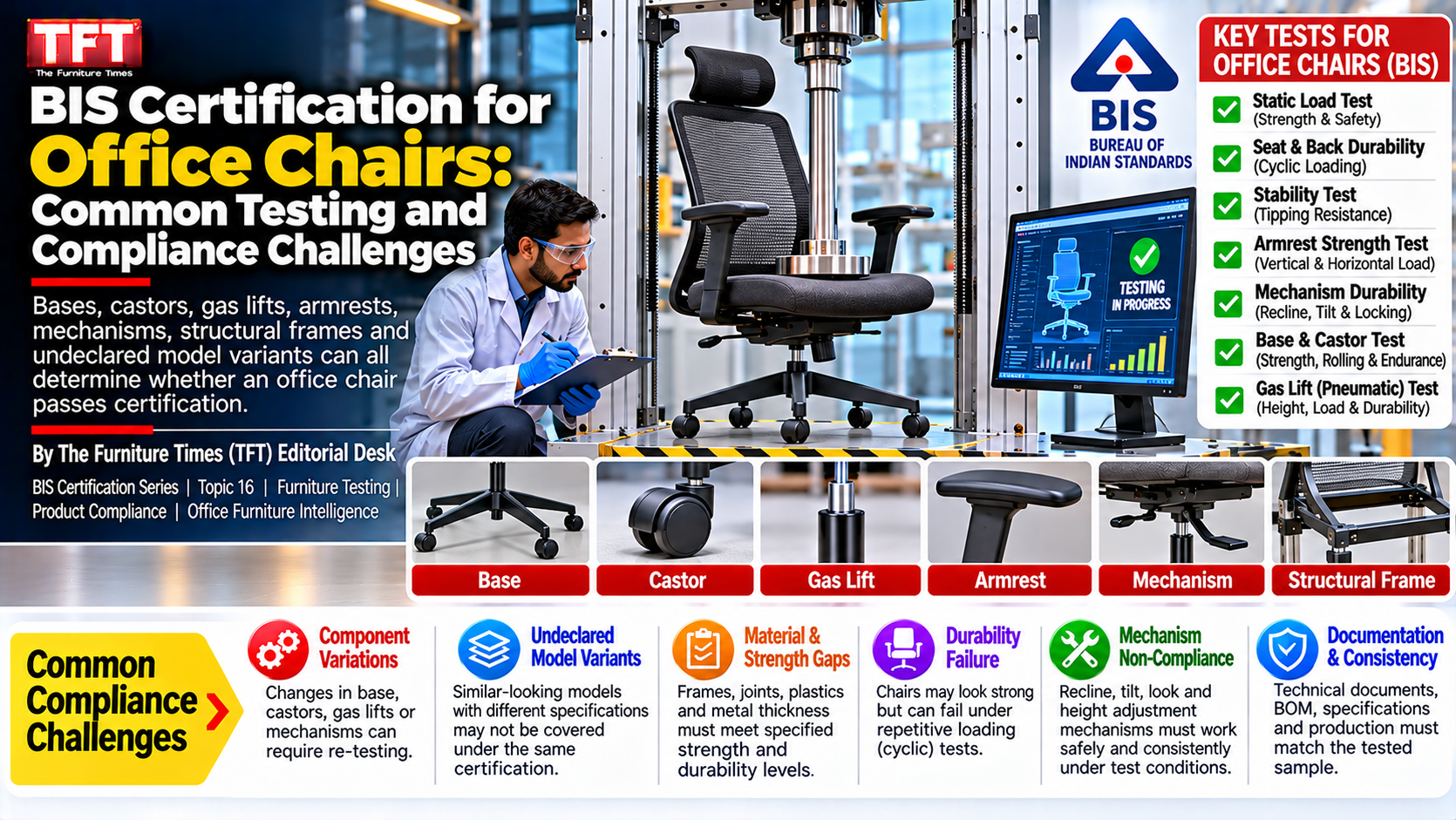
BIS Certification for Office Chairs: Common Testing and Compliance Challenges
Bases, castors, gas lifts, armrests, mechanisms, structural frames and undeclared model variants can all determine whether an office chair passes certification
By The Furniture Times (TFT) Editorial Desk | BIS Certification Series | Furniture Testing | Product Compliance | Office Furniture Intelligence
Office chairs may appear to be relatively simple furniture products, but they are among the most mechanically complex categories in the furniture industry.
A basic table or storage unit normally remains static during use. An office chair, by comparison, may swivel, roll, tilt, recline, rise, descend and support frequently changing loads. Adjustable armrests, sliding seats, headrests, footrests and synchronised mechanisms introduce additional forces and potential failure points.
The chair must remain stable while the user sits down, changes position, leans backwards, reaches sideways or moves across the floor. Its components must continue functioning after repeated use, not merely survive a brief visual inspection.
This makes office-chair certification a system-level engineering exercise.
A manufacturer cannot establish compliance simply by testing the upholstered seat or by submitting certificates for individual components. The finished chair—including its base, castors, column, mechanism, structural frame, backrest, armrests, fasteners and adjustment systems—must function safely as an integrated product.
Under the Bureau of Indian Standards framework, work chairs are covered by IS 17631:2022. The standard addresses areas including materials, design and workmanship, dimensions, surface performance, stability, static strength and durability. BIS describes its scope as covering fully manufactured and ready-to-assemble work chairs intended for office environments. bis.gov.in
BIS’s current compulsory-certification information lists Work Chairs—IS 17631:2022 under Scheme-I and identifies the Furniture (Quality Control) Order, 2025 together with several subsequent amendments, including amendments issued during 2026. Businesses should therefore verify the latest commencement provisions, exemptions and transition arrangements applicable to their products before manufacturing, importing or selling them. Bureau of Indian Standards
This report examines the principal technical and documentation challenges facing office-chair manufacturers, importers, brand owners and testing teams.
An office chair must be evaluated as one complete system
A modern office chair may contain dozens of interdependent components:
- Seat structure
- Seat foam and upholstery
- Backrest frame
- Backrest mesh or upholstery
- Lumbar-support assembly
- Headrest
- Armrests and armrest supports
- Seat plate
- Tilt or synchro mechanism
- Recline-locking components
- Tension-adjustment system
- Seat-slide mechanism
- Height-adjustment lever
- Pneumatic gas lift
- Telescopic column cover
- Star base
- Castors
- Footrest or leg support
- Brackets, welds and inserts
- Screws, bolts, rivets and retaining clips
The performance of the finished chair depends on the compatibility of all these parts.
A strong base cannot compensate for a weak castor socket. A high-quality gas lift does not make the chair safe if its connection to the mechanism is loose. A durable backrest can still fail when its mounting bracket deforms. A chair that remains stable in its lowest position may become vulnerable to overturning at maximum height or maximum recline.
For BIS purposes, compliance must therefore be connected to the declared design and model—not merely to the product’s commercial name.
What office-chair testing generally examines
The BIS product manual for work chairs identifies testing across design and workmanship, dimensions, surface performance, stability, static loading and durability. The official BIS laboratory listing for IS 17631 provides the following breakdown of chair-performance assessments. LIMS (Laboratory Information Management System)
| Assessment area | What it examines |
|---|---|
| Design and workmanship | Construction quality, accessible edges, components, finishing and overall product condition |
| Dimensions | Whether relevant chair measurements conform to the applicable requirements |
| Surface performance | Resistance and performance of finishes, fabrics, synthetic leather or natural leather, where applicable |
| Front-edge overturning | Stability when load acts near the front of the seat |
| Forward overturning | Resistance to tipping forwards under the prescribed condition |
| Footrest-related overturning | Forward stability where the chair incorporates a footrest |
| Sideways overturning | Lateral stability, with separate considerations for chairs with and without armrests |
| Rearward overturning | Stability under rearward loading, including configurations involving backrest inclination |
| Seat-front static load | Strength of the front portion of the seat |
| Combined seat-and-back load | Structural performance of the seat and backrest together |
| Armrest downward load | Strength under vertical loading at central and forward locations |
| Armrest sideways load | Resistance to lateral force on the armrest |
| Footrest static load | Structural strength of a fitted footrest |
| Seat-and-back durability | Resistance to repeated loading during simulated use |
| Armrest durability | Performance of armrests and connections under repeated loads |
| Swivel durability | Ability of the rotating assembly to withstand repeated movement |
| Footrest durability | Resistance to repeated use where a footrest is present |
| Castor-and-base durability | Performance of the mobile base assembly during repeated movement |
This list demonstrates why a visual assessment is insufficient. A chair can look impressive in a showroom yet fail when forces are repeatedly applied to its joints, mechanisms and supporting components.
The following sections explain the most common problem areas.
1. Chair bases: the foundation of stability and load transfer
The base receives loads from the seat and transfers them through the legs and castors to the floor. It also defines the chair’s support footprint.
Common base constructions include:
- Injection-moulded polymer bases
- Aluminium die-cast bases
- Fabricated steel bases
- Bases with reinforcing ribs
- Four-leg or five-leg configurations
- Star bases with replaceable castors
- Fixed glides substituted for castors
The visible similarity of two bases does not prove that they are structurally equivalent.
Critical base variables
Important variables include:
- Overall base diameter
- Number of legs
- Leg length and profile
- Material grade
- Wall thickness
- Reinforcement geometry
- Hub construction
- Gas-lift socket dimensions
- Castor socket dimensions
- Castor or glide position
- Manufacturing process
- Recycled-material content
- Weld or moulding quality
- Permitted dimensional tolerances
A reduction in base diameter can reduce the stability envelope. Changing from a five-star base to a four-star version changes load distribution. Substituting aluminium for reinforced nylon changes stiffness, fracture behaviour and manufacturing risks.
Even changing the supplier while retaining the same general appearance can affect performance.
Common base failures
Testing and repeated use may reveal:
- Cracking around the central hub
- Separation of reinforcing ribs
- Deformation of the legs
- Castor sockets becoming enlarged
- Castors pulling out of the base
- Excessive flexing under load
- Poor engagement with the gas lift
- Material brittleness
- Weld failure in fabricated bases
- Instability caused by insufficient footprint
The manufacturer’s bill of materials should identify the exact base, material, supplier reference and relevant dimensions. A statement such as “nylon five-star base” is often too broad for effective manufacturing control.
2. Castors: small components with significant compliance consequences
Castors allow the chair to move, but they are also part of the chair’s structural support system.
Each castor must maintain its connection with the base while carrying changing loads and rolling across the test surface. Performance depends on the castor, stem, socket and base working together.
Castor variables that require control
- Wheel diameter
- Wheel width
- Single-wheel or twin-wheel construction
- Wheel material
- Stem diameter and length
- Grip-ring or retaining design
- Brake or locking function
- Load capacity
- Housing material
- Bearing construction
- Compatibility with the base socket
- Suitability for hard or soft flooring
The substitution of one castor for another should not be treated as a cosmetic procurement decision.
A different stem tolerance may create looseness. A smaller wheel can alter mobility and obstacle behaviour. A change in wheel material may influence rolling resistance, wear and floor interaction. A heavier castor can also change dynamic loading during repeated movement.
Castor-and-base durability
IS 17631 includes a castor-and-chair-base durability assessment. The objective is not merely to confirm that the wheels rotate at the beginning of the test. The assembly must withstand repeated movement without unsafe breakage, excessive loosening or functional deterioration. LIMS (Laboratory Information Management System)
Typical causes of problems include:
- Incorrect stem-to-socket fit
- Weak castor housings
- Wheels separating from axles
- Base sockets cracking
- Castors becoming detached
- Excessive play after repeated movement
- Mixed castors installed on the same chair
- Uncontrolled supplier substitution
Incoming castor inspections should therefore include identity, dimensions, retention, appearance and agreed performance characteristics.
3. Gas lifts: a critical component that changes the chair’s geometry
The pneumatic gas lift controls seat height and connects the upper chair structure to the base.
It influences:
- Minimum and maximum seat height
- Centre of gravity
- Overall chair stability
- Connection with the mechanism
- Connection with the base
- Rotational performance
- User adjustment
- Long-term height retention
It is important to distinguish between component-level evidence and finished-chair compliance.
A supplier’s gas-lift certificate can support technical due diligence, but it does not automatically prove that the completed chair complies with IS 17631. The finished product’s behaviour depends on how the gas lift interfaces with the base and seat mechanism.
Gas-lift variables
Manufacturers should control:
- Supplier and component code
- Nominal class or performance specification
- Stroke length
- Extended and compressed dimensions
- Column diameter
- Taper or interface dimensions
- Rotation characteristics
- Actuation-pin geometry
- Weight range
- Surface finish
- Batch identification
- Traceability documentation
Why stroke length matters
A longer-stroke cylinder may allow a higher maximum seat position.
That may appear to be a useful product upgrade, but it can raise the user and seat assembly farther above the support footprint. The resulting chair may behave differently in lateral or rearward stability conditions.
A replacement gas lift should therefore not be approved only because it fits the same central opening.
Common gas-lift and interface problems
- Chair gradually loses height
- Actuation pin does not align correctly
- Height lever applies continuous pressure
- Excessive movement at the upper connection
- Inadequate engagement with the base
- Gas lift becomes difficult to remove or replace
- Wrong cylinder length changes the declared dimensions
- Unapproved supplier part is installed during production
- Column cover interferes with full adjustment
- Gas lift and mechanism tapers are incompatible
The technical file should link the approved gas lift to the precise chair model and mechanism.
4. Armrests: optional-looking components that alter the test programme
Armrests are frequently treated as accessories, but they can materially affect safety, stability, dimensions and certification scope.
The BIS test listing includes:
- Armrest downward static load at the central position
- Armrest downward static load at the front
- Armrest sideways static load
- Armrest durability testing
- A separate sideways-overturning consideration for chairs fitted with armrests LIMS (Laboratory Information Management System)
This means that an armless chair and an armchair should not automatically be treated as the same tested configuration.
Armrest variations
- No armrests
- Fixed armrests
- Height-adjustable armrests
- Width-adjustable armrests
- Pivoting arm pads
- Forward-and-back adjustable pads
- Multi-directional or “4D” armrests
- Armrests connected to the seat
- Armrests connected to the backrest
- Armrests forming part of the structural frame
Each design creates different load paths.
A seat-mounted armrest transfers force into the seat frame or mechanism. A backrest-mounted armrest may transfer it into the back structure. A multi-adjustable armrest contains additional slides, buttons and locking interfaces that can loosen during durability testing.
Common armrest failures
- Cracking around mounting holes
- Pull-out of threaded inserts
- Permanent downward deformation
- Excessive movement after repeated loading
- Adjustment button failure
- Failure of height-locking positions
- Separation of the arm pad
- Sideways bending
- Fastener loosening
- Breakage of plastic support covers
If armrests are offered as an optional purchase, the manufacturer must determine whether the armrest-equipped version is within the certified scope. “Optional” does not mean “irrelevant to certification.”
5. Tilt, recline and synchronised mechanisms
The mechanism beneath the seat is one of the most highly loaded assemblies in an office chair.
It may control:
- Seat-height actuation
- Swivelling
- Backrest recline
- Tilt tension
- Tilt locking
- Synchronised seat-and-back movement
- Seat-depth adjustment
- Forward tilt
- Memory position
- Recline limitation
A basic fixed plate and a multifunction synchro mechanism are not minor variations of the same part.
They change the movement, geometry and load transfer of the chair.
Rearward stability
The official test listing distinguishes between rearward-overturning assessments without backrest inclination and those involving backrest inclination. LIMS (Laboratory Information Management System)
A chair with a reclining backrest can move the supported load rearwards. Maximum recline, seat height, backrest position and base geometry may combine to create the most demanding configuration.
A chair that passes when upright must not be assumed to pass when fully reclined.
Mechanism-related failure points
- Cracked seat plate
- Broken tilt spring
- Locking pin disengagement
- Recline lock slipping
- Excessive play
- Seat-slide rails deforming
- Weld failure
- Lever breakage
- Rivets loosening
- Fasteners backing out
- Backrest mounting plate bending
- Swivel bearing deterioration
- Sharp edges exposed after cover failure
The mechanism drawing and bill of materials must identify the exact approved assembly. Substituting a lower-cost mechanism after testing can fundamentally change the certified construction.
6. Structural frames: where repeated loading exposes hidden weakness
The structural frame includes more than visible metal tubes.
Depending on the design, it may include:
- Seat pan
- Plywood seat shell
- Moulded polymer shell
- Steel under-seat plate
- Backrest spine
- Backrest support bracket
- Lumbar frame
- Welded tubes
- Threaded inserts
- Mechanism mounting plate
- Connecting fasteners
- Reinforcing ribs
Structural problems often emerge after repeated loading rather than during the first static assessment.
Frequent structural weaknesses
- Undersized fasteners
- Insufficient thread engagement
- Incorrect fastener grade
- Weak plastic bosses
- Poor-quality welding
- Inadequate weld penetration
- Missing reinforcement
- Excessive holes near high-stress regions
- Uncontrolled plywood thickness
- Weak adhesive bonding
- Stress concentrations around corners
- Material variation between batches
- Incorrect assembly torque
A chair can appear extremely solid during a brief showroom demonstration but still accumulate fatigue damage over thousands of movements.
Combined seat-and-back loading
The combined seat-and-back static assessment examines the interaction of the seating structure, back support and connecting system. Failure may occur in the component that appears least significant—for example, a small bracket, insert or fastener.
This is why declaring only major raw materials is inadequate. The bill of materials should control critical fittings and attachment components as well.
7. Seat, backrest and upholstery materials
Office-chair certification is not confined to the metal structure.
The BIS product manual indicates that, in addition to completed-chair samples, cut panels and pieces of relevant materials such as fabric and leather may be required for surface-performance testing. The manual identifies two completed chairs for dimensional and safety requirements and separate material pieces for applicable surface tests. bis.gov.in
Depending on the construction, assessments may address properties of:
- Finished surfaces
- Coatings
- Fabrics
- Synthetic leather
- Natural leather
- Adhesive systems
- Seat or back panels
The official laboratory listing includes surface resistance and material-performance assessments concerning matters such as mechanical damage, hardness, heat, liquids, oils, fabric strength, tear performance and selected leather properties. LIMS (Laboratory Information Management System)
Why upholstery changes matter
Replacing one upholstery material with another can change:
- Breaking strength
- Tear resistance
- Seam behaviour
- Stretch and dimensional stability
- Abrasion behaviour
- Adhesive performance
- Heat response
- Cleanability
- Long-term appearance
- Load distribution across the upholstered structure
A colour change within an identical, controlled material family may be relatively minor. A change from woven fabric to synthetic leather, or from one mesh construction to another, requires a much more serious technical evaluation.
Mesh backs deserve particular attention because the mesh itself may form part of the user-supporting structure.
8. Dimensions and adjustment ranges
Office chairs frequently contain adjustable dimensions rather than one fixed geometry.
Important characteristics may include:
- Seat height range
- Seat depth
- Seat width
- Backrest position
- Backrest height
- Armrest height and spacing
- Recline range
- Lumbar-support position
- Footrest position
- Headrest adjustment
Dimensional compliance must correspond to the model offered for sale.
Common documentation problems include:
- Catalogue dimensions differing from engineering drawings
- Minimum and maximum adjustment positions not recorded
- Measurement methods not defined
- Gas-lift stroke changed without revising drawings
- Armrest dimensions omitted
- One specification used for several physically different models
- Packaging labels carrying an incorrect model number
The certified configuration, laboratory report, factory drawing, product label and commercial catalogue should describe the same chair.
9. Model variants: where certification scope becomes difficult
The BIS product manual indicates that the licence scope for work chairs identifies the product and its design or model number. It also contains grouping guidance that should be consulted when models are proposed for inclusion under a licence. bis.gov.in
Certification of one chair does not automatically certify every chair sold under the same collection name.
Variations requiring formal evaluation
| Proposed change | Why it may matter |
|---|---|
| Five-star base to four-star base | Changes support geometry and load distribution |
| Smaller base diameter | May reduce stability |
| Polymer base to aluminium base | Changes stiffness, fracture behaviour and manufacturing process |
| Castors to fixed glides | Changes contact points and product configuration |
| Different castor size | Can affect mobility and assembly performance |
| Different gas-lift stroke | Changes height range and centre of gravity |
| Fixed back to reclining back | Changes rearward movement and mechanism loading |
| Basic tilt to synchro mechanism | Introduces different movement and structural interfaces |
| Armless to armrest version | Introduces armrest tests and changes lateral geometry |
| Fixed arms to adjustable arms | Adds locking systems and durability variables |
| No footrest to footrest model | Introduces additional stability, static-load and durability considerations |
| Upholstered back to structural mesh | Changes supporting material and frame interaction |
| Low back to high back | Changes leverage and load transfer |
| Addition of a headrest | May change dimensions and backrest forces |
| Different seat shell | Changes structural behaviour |
| Different fastener or insert | May affect joint strength and fatigue |
| Different mechanism supplier | May change steel grade, geometry, welds and performance |
| Different model name only | Creates a traceability risk if the underlying relationship is undocumented |
Some changes may be acceptable within an established grouping rationale. Others may require additional testing or separate inclusion in the licence scope.
The decision should be supported by drawings, specifications, risk analysis and the applicable BIS grouping provisions—not by commercial convenience.
Selecting the representative or worst-case chair
Where several models are proposed as a family, the representative sample should be chosen through technical comparison.
The most expensive or best-selling model is not necessarily the most demanding configuration.
Potential worst-case characteristics include:
- Smallest support footprint
- Highest maximum seat position
- Longest gas-lift stroke
- Maximum recline angle
- Largest or heaviest backrest
- Narrowest or least reinforced structural member
- Most complex mechanism
- Longest armrest projection
- Most adjustable armrest
- Footrest-equipped configuration
- Weakest material thickness
- Largest seat dimension
- Highest number of moving joints
- Most demanding castor-and-base combination
Different tests may have different worst cases.
For example:
- The smallest base with the highest seat position may be critical for stability.
- The largest backrest may be critical for structural loading.
- The most adjustable armrest may be critical for durability.
- The longest footrest may be critical for footrest loading.
- The least reinforced seat shell may be critical for static strength.
One sample should not be declared representative merely because it contains the greatest number of features.
Testing samples and laboratory preparation
The BIS product manual identifies a sample quantity of two chairs for applicable dimensional and safety requirements, alongside separate panels or material pieces for surface-performance assessment. Businesses should confirm the latest product manual and laboratory instructions before dispatch because sample requirements may depend on the construction and scope requested. bis.gov.in
Before sending a chair to the laboratory
The manufacturer should confirm:
- Model number matches the application
- Chair represents normal production
- Base is the declared type and diameter
- Castors match the approved code
- Gas lift matches the approved specification
- Mechanism is correctly identified
- Armrests match the declared version
- Backrest and seat frame match the drawings
- Upholstery and surface materials match the bill of materials
- All fasteners are production fasteners
- Assembly instructions are final
- Adjustment functions operate correctly
- Product labels are accurate
- Material panels have been prepared where required
- No sample-only reinforcement has been introduced
A specially prepared “golden sample” that differs from routine manufacturing can create serious problems during factory inspection and subsequent surveillance.
Documentation needed for office-chair certification
A defensible technical file should connect every test result to an identifiable production configuration.
Recommended document set
Product identity
- Brand
- Product name
- Design number
- Model number
- Variant code
- Manufacturing location
- Intended use
Engineering documentation
- General arrangement drawing
- Seat and backrest dimensions
- Minimum and maximum adjustment dimensions
- Base drawing and diameter
- Castor drawing
- Gas-lift specification
- Mechanism drawing or controlled supplier specification
- Armrest drawings
- Footrest drawing, if applicable
- Exploded assembly view
- Fastener schedule
- Revision history
Bill of materials
The bill of materials should record:
- Part name
- Internal part number
- Supplier part number
- Material
- Grade or specification
- Dimensions or thickness
- Approved supplier
- Quantity
- Critical characteristic
- Applicable inspection requirement
Supplier evidence
- Component certificates
- Material test certificates
- Coating specifications
- Fabric or leather reports
- Gas-lift technical documentation
- Mechanism specifications
- Castor specifications
- Traceability information
Manufacturing controls
- Incoming inspection
- Welding controls
- Moulding controls
- Assembly sequence
- Fastener-torque requirements
- Functional checks
- Final inspection
- Batch records
- Non-conformance procedure
- Change-control procedure
The most common reasons office chairs fail testing
1. The sample does not match the application
The model number, mechanism, base or upholstery differs from the submitted documents.
2. The base is too small for the chair’s maximum configuration
A high seat and reclining back can move the centre of gravity beyond the stable area.
3. Armrest mounts are inadequately reinforced
The visible armrest remains intact, but inserts or seat-frame connections fail.
4. The backrest bracket deforms
Repeated seat-and-back loading exposes insufficient thickness, weak welds or excessive leverage.
5. Castors and sockets are incompatible
The castor fits during assembly but loosens, pulls out or damages the base during durability testing.
6. The gas lift changes the tested geometry
An alternative cylinder may increase the seat height or change component engagement.
7. Mechanism fasteners loosen
Dynamic loading exposes insufficient torque, inadequate locking features or poor thread engagement.
8. The chair is tested only in a favourable adjustment position
Maximum height, maximum recline or extended adjustments may represent a more demanding configuration.
9. Production materials differ from prototype materials
Different plastic resin, metal thickness, plywood, mesh or fasteners can affect results.
10. The manufacturer assumes all variants are covered
A test report for one chair is used to support substantially different bases, arms, mechanisms or frame constructions without an approved grouping rationale.
Why passing once is not enough
Certification is not only a laboratory event.
After approval, the manufacturer must continue producing chairs that correspond to the certified design. This requires:
- Controlled suppliers
- Approved drawings
- Current bills of materials
- Production traceability
- Incoming inspection
- Process monitoring
- Final functional checks
- Calibration of measuring equipment
- Non-conformance controls
- Formal engineering-change approval
- Retention of relevant records
Cost reduction creates one of the greatest post-certification risks.
A purchasing team may replace a mechanism, gas lift, castor or fastener with an apparently equivalent lower-cost item. If the technical and certification teams are not consulted, routine procurement can silently create an undeclared product variant.
No critical component should be changed solely through a purchase-order decision.
Responsibilities of importers and private-label brands
Importers and brand owners should not assume that the overseas factory alone will manage Indian certification scope.
They should be able to establish:
- Which factory produces the chair
- Which exact model was tested
- Which components were used
- Which model numbers appear on invoices and labels
- Whether the Indian version differs from versions sold elsewhere
- Whether alternative components are used during shortages
- Whether packaging claims match certification scope
- Whether the supplier maintains revision control
- Whether imported shipments correspond to the licensed construction
A chair sold under several brands may originate from one platform, but branding relationships and model mapping must be documented clearly.
The importer should also monitor the latest Furniture Quality Control Order amendments and obtain product-specific legal advice where applicability or transition arrangements are uncertain.
Office-chair compliance checklist
Product configuration
- Exact model and design number declared
- Base material and dimensions controlled
- Castor code and stem interface recorded
- Gas-lift specification controlled
- Mechanism model identified
- Armrest configuration declared
- Backrest construction declared
- Footrest and headrest identified where present
- Upholstery materials controlled
- Fasteners and inserts specified
Representative sampling
- All proposed variants compared
- Worst-case stability configuration considered
- Maximum seat height considered
- Maximum recline considered
- Most demanding armrest considered
- Footrest version considered separately
- Structural and durability worst cases documented
- Selection rationale approved before testing
Documentation
- Drawings match the physical sample
- Bill of materials is complete
- Supplier part numbers are traceable
- Adjustment ranges are documented
- Laboratory report carries the correct model identity
- Labels and catalogues match the certified description
- Revision history is maintained
- Variant matrix is current
Production control
- Incoming components verified
- Assembly torque controlled
- Welding or moulding processes monitored
- Function checks performed
- Base and castor retention inspected
- Adjustment locks checked
- Supplier changes require approval
- Production records retained
The larger lesson for office-chair manufacturers
Office-chair certification cannot be managed through appearance, catalogue language or component assumptions.
Every major system contributes to the outcome:
- The base creates the support footprint.
- Castors connect that footprint to the floor.
- The gas lift determines height and helps establish the centre of gravity.
- The mechanism controls movement and transfers loads.
- The seat and backrest support the user.
- Armrests and footrests introduce new loading conditions.
- Fasteners, inserts and welds hold the entire structure together.
A small component change can influence the performance of the whole chair.
Manufacturers that build compliance into product development can avoid expensive redesign, repeated testing, delayed launches and disputes over certification scope. Those that treat certification as a final-stage paperwork exercise are far more likely to discover problems after samples reach the laboratory.
The best approach is to create a controlled product architecture before the application begins:
- Define every model and variant.
- Freeze critical components.
- Prepare accurate drawings and bills of materials.
- Compare configurations systematically.
- Select technically justified representative samples.
- Conduct pre-compliance testing.
- Align labels, catalogues and production records.
- Control every post-certification change.
BIS certification should not be viewed only as regulatory permission. Properly implemented, it becomes a product-engineering discipline that improves safety, consistency and customer confidence.
TFT Compliance Perspective
The growing regulation of furniture will require closer cooperation between:
- Furniture designers
- Product engineers
- Component suppliers
- Manufacturers
- Testing laboratories
- Certification consultants
- Importers
- Retailers
- Procurement teams
- Compliance authorities
The Furniture Times believes that technical knowledge must become more accessible throughout the furniture ecosystem.
TFT can explain regulatory developments and manufacturing challenges. The Furniture Industry Search Engine—FISE—can improve the discoverability of manufacturers, component suppliers, testing services and compliance specialists. FurniReviewology can help strengthen accountability and trust through verified market experience.
A safer furniture industry begins with clear standards, but it succeeds only when compliant design is reproduced consistently in every manufactured unit.
Important Compliance Note
This article provides general industry information and should not be treated as a substitute for the text of IS 17631:2022, the current BIS product manual, the latest Furniture Quality Control Order and amendments, an approved laboratory’s instructions or professional legal and certification advice.
Standards, product manuals, implementation provisions and exemptions may be revised. Manufacturers, importers and brand owners should confirm the requirements applicable to their product, enterprise category and effective date directly with BIS and qualified advisers before making compliance decisions.