
Why Undeclared Furniture Variants Can Put BIS Certification at Risk
Examining how alternative bases, frames, armrests, materials, mechanisms and dimensions can change product performance—and potentially fall outside the evaluated certification scope
By The Furniture Times (TFT) Editorial Desk | Furniture Compliance | BIS Certification | Product Variants | Certification Scope | Quality Assurance | Furniture Manufacturing | Testing & Inspection | Global Industry Intelligence
A furniture manufacturer may consider two products part of the same collection because they share a common appearance, brand name or model family.
For certification purposes, however, visual similarity is not enough.
A chair with a four-leg base may behave differently from the same seat shell installed on a cantilever frame. A table with a stone top may impose different loads on its support structure than a lighter wooden version. A cabinet with drawers may present different stability risks from a cabinet with doors. A fixed sofa and a reclining sofa may look similar, but their mechanisms, internal frames and potential failure modes can be substantially different.
This is why undeclared variants can create serious BIS certification risks.
If a manufacturer tests one configuration but sells multiple materially different versions under the same model family, the test evidence may not represent every product carrying the certification claim.
The issue is not whether the undeclared variant looks better, costs more or is marketed under the same collection name.
The fundamental question is:
Does the tested product technically represent the furniture that is being manufactured, marked and sold?
If the answer is uncertain, the scope of certification may also be uncertain.
What is a furniture variant?
A variant is a version of a product that differs from the tested or declared model in one or more characteristics.
These differences may include:
- Dimensions
- Materials
- Frame construction
- Base design
- Number of legs
- Jointing method
- Armrests
- Backrests
- Seat construction
- Upholstery
- Hardware
- Drawers
- Shelves
- Doors
- Castors
- Gas lifts
- Folding mechanisms
- Reclining mechanisms
- Extension systems
- Height adjustment
- Rated load
- Intended use
- Indoor or outdoor application
Some differences may be decorative and have little effect on compliance.
Others can change:
- Strength
- Stability
- Durability
- Deflection
- Load distribution
- Entrapment risk
- Pinch and shear points
- Corrosion resistance
- User interaction
- Product classification
- Applicable testing
A colour change may be non-structural in one product but significant in another if the pigment or additive alters material performance. A decorative armrest may appear minor but may affect lateral dimensions, user support, load application and structural forces.
No variation should be dismissed solely because the sales department considers it an “option.”
Certification scope is not the same as a commercial catalogue
A furniture catalogue may organise products by:
- Collection
- Style
- Price
- Room
- Designer
- Colour
- Target customer
- Marketing name
Certification documentation organises products by technical identity.
That identity may depend on:
- Applicable Indian Standard
- Product type
- Intended use
- Materials
- Dimensions
- Structure
- Mechanisms
- Safety characteristics
- Manufacturing process
- Test results
One commercial collection can contain several technically different products.
For example, an “Executive Seating Collection” may include:
- Fixed visitor chair
- Sled-base chair
- Cantilever chair
- Four-star swivel chair
- Five-star castor chair
- Height-adjustable chair
- Reclining chair
From a marketing perspective, these products may share upholstery and design language.
From a compliance perspective, they contain different:
- Support systems
- Load paths
- Stability characteristics
- Moving components
- Joints
- Mechanisms
- User interactions
A report on the fixed visitor chair should not automatically be assumed to cover every other configuration.
What does “undeclared” mean?
An undeclared variant is not necessarily a secret product.
It may simply be a product that was omitted, poorly described or incorrectly grouped during the certification process.
Common examples include:
- A base option shown in the catalogue but absent from the application
- An armchair version omitted from the model list
- A larger table introduced after testing
- A thinner board substituted during production
- A different wood species used for another market
- A recliner mechanism added to a fixed sofa range
- A new castor or gas lift introduced by procurement
- A wider bed carrying the same model code
- An outdoor finish applied to an indoor product
- A storage unit offered with drawers instead of doors
- A lower-cost frame sold under the same collection
- A model suffix not explained in certification documents
The omission may result from weak communication between departments rather than deliberate misconduct.
However, the certification risk remains.
Why every important variant must be evaluated
Furniture compliance depends on the product’s actual construction.
When the construction changes, the performance may change.
A proper evaluation should determine whether the variant:
- Remains technically equivalent to the tested model.
- Is represented by the selected worst-case sample.
- Requires supplementary testing.
- Belongs in a different product group.
- Needs separate treatment within the certification scope.
- Is incompatible with the existing certification evidence.
The final decision must be based on the applicable Indian Standard, BIS certification requirements, relevant product manual or scheme provisions, technical documentation and the competent authority’s determination.
BIS maintains official standards and conformity-assessment information through its standards portal, while recognised testing scopes can be reviewed through the BIS Laboratory Information Management System. Bureau of Indian Standards
Manufacturers should confirm current requirements directly with BIS and the appropriate recognised laboratory rather than relying on informal assumptions.
Alternative bases can create different products
The base is one of the most structurally important parts of a furniture product.
Chair bases
A seat shell may be installed on:
- Four wooden legs
- Four metal legs
- Sled base
- Cantilever base
- Pedestal base
- Four-star swivel base
- Five-star castor base
- Folding frame
- Rocking base
Each configuration distributes load differently.
Four-leg base
Loads are transferred through separate supports and joints. Performance depends on:
- Leg spacing
- Racking resistance
- Joint strength
- Cross-rails
- Floor contact
Sled base
The continuous tubular structure may behave differently under:
- Front loading
- Side loading
- Backward loading
- Fatigue
- Floor-level deformation
Cantilever base
The seat is supported through bending of the frame rather than direct vertical legs beneath every corner. Tube dimensions, metal grade, weld quality and frame geometry become critical.
Swivel and castor base
This version introduces:
- Central column
- Gas lift
- Star base
- Castors
- Swivel movement
- Height adjustment
- Different stability envelope
Testing a fixed four-leg chair does not adequately establish the performance of an adjustable five-star chair.
Table bases
A tabletop may be installed on:
- Four legs
- Trestles
- One pedestal
- Twin pedestals
- Cross base
- Folding frame
- Height-adjustable frame
- Wall-mounted system
Changing the base may affect:
- Overturning stability
- Top support
- Deflection
- Joint forces
- Leg clearance
- Movement
- Installation requirements
The same top should not be treated as proof that every base configuration is equivalent.
Frame changes affect load paths
The frame is the structural system that carries loads through the furniture product.
Frame variations may include:
- Wood versus metal
- Welded versus bolted
- Solid timber versus engineered board
- Thick tube versus thin tube
- Fully assembled versus knock-down
- Reinforced versus non-reinforced
- Fixed versus folding
- Cross-braced versus unbraced
- One-piece moulded versus multi-component construction
A visual design can remain almost unchanged while the internal frame changes substantially.
For upholstered furniture, the customer may never see:
- Rail dimensions
- Corner blocks
- Fasteners
- Springs
- Webbing
- Welds
- Brackets
- Reinforcement
- Adhesive joints
Yet these elements determine whether the product can withstand repeated use.
A premium sofa and a value-engineered sofa may share fabric, cushions and external shape while using different internal structures.
If they use the same model designation or certification claim, the documentation must clarify whether both were evaluated.
Armrests are not always cosmetic additions
Manufacturers sometimes treat armrests as accessories. In many products, they are part of the functional and structural design.
Armrests may:
- Support user weight during sitting and rising
- Receive lateral forces
- Connect the seat and backrest
- Change overall width
- Alter access
- Create openings or entrapment zones
- Affect stability
- Change the product’s intended user group
A chair without arms may not automatically represent a chair with arms.
Important differences include:
- Armrest material
- Attachment method
- Height
- Width
- Span
- Connection to frame
- Load rating
- Padding
- Adjustment mechanism
- Folding or removable function
An adjustable armrest introduces moving parts, locking positions and additional durability considerations that do not exist in a fixed version.
Material changes can invalidate assumptions
Materials determine more than appearance.
A material substitution can affect:
- Strength
- Stiffness
- Weight
- Impact resistance
- Screw retention
- Fatigue
- Moisture behaviour
- Corrosion
- Flammability
- Chemical performance
- Surface durability
Wood and engineered wood
Changes may include:
- Timber species
- Density
- Grade
- Moisture content
- Panel type
- Panel thickness
- Veneer system
- Lamination
- Adhesive
- Surface treatment
A hardwood chair may not represent a similar chair made from a lower-density timber. A plywood seat may not represent particleboard. A thicker panel used in the test sample may not represent thinner commercial variants.
Metals
Critical differences include:
- Metal grade
- Tube section
- Wall thickness
- Sheet thickness
- Welding process
- Heat treatment
- Fastener strength
- Protective coating
A reduction in tube-wall thickness may create a weaker frame even when external dimensions remain unchanged.
Plastics
Performance may change according to:
- Polymer type
- Grade
- Reinforcement
- Recycled content
- UV stabilisation
- Wall thickness
- Moulding conditions
- Additives
- Colour formulation
An unreinforced plastic shell should not automatically be grouped with a reinforced version, and virgin polymer may not represent every recycled-material formulation.
Upholstery
Changes in:
- Foam density
- Foam thickness
- Fabric
- Leather
- Webbing
- Springs
- Stitching
- Adhesive
- Padding arrangement
may affect performance, dimensions, comfort, durability and applicable safety considerations.
Mechanisms create new failure modes
Mechanisms are among the most significant variant differences because they introduce movement.
Examples include:
- Reclining systems
- Folding systems
- Extension systems
- Gas lifts
- Swivel mechanisms
- Tilt controls
- Height adjustment
- Drawer slides
- Bed-lifting systems
- Convertible sofa-bed mechanisms
- Powered actuators
- Locking devices
- Castor brakes
A mechanism may create risks related to:
- Pinching
- Shearing
- Entrapment
- Unexpected movement
- Locking failure
- Fatigue
- Detachment
- Instability
- Component breakage
- Electrical or powered operation
- Loss of adjustment
A fixed table cannot automatically represent an extendable table.
A fixed bed cannot automatically represent a storage bed with a lifting mechanism.
A standard sofa cannot automatically represent a recliner or sofa bed.
The mechanism may require its own sample, test programme or technical evaluation.
Dimensions can change performance dramatically
Dimension changes are often treated as simple customer options.
But width, height, depth and span affect engineering behaviour.
Longer tables
A longer unsupported span can increase:
- Bending
- Deflection
- Joint stress
- Vibration
- Load on aprons and rails
Wider chairs
A wider seat can increase forces on:
- Seat rails
- Seat panels
- Cross-members
- Joints
Taller backrests
A taller back can create greater leverage where it joins the frame.
Taller storage units
A higher centre of gravity can increase overturning risk.
Shallower cabinets
Reduced depth may decrease the base footprint and stability margin.
Larger drawers
Greater drawer mass and forward extension can shift the centre of gravity.
Wider beds
Increased spans may require additional centre supports, stronger rails or different slat systems.
A mid-sized model may not represent the smallest or largest version. Boundary configurations may need separate consideration.
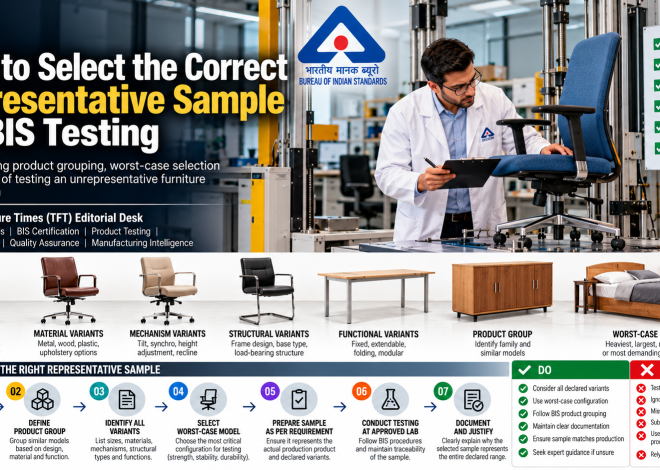
The smallest model can sometimes be the worst case
Manufacturers often assume that the largest model is always the most demanding.
This is not necessarily correct.
The largest table may be the worst case for bending, while a smaller pedestal table may be less stable.
The tallest cabinet may be critical for overturning, while the widest version may be critical for shelf deflection.
The narrowest chair base may create the least favourable stability condition even if the chair is physically smaller.
Worst-case selection must therefore be requirement-specific.
| Performance issue | Potentially critical variant |
|---|---|
| Top or shelf deflection | Longest unsupported span |
| Overturning stability | Tallest, shallowest or narrowest product |
| Joint strength | Largest leverage or weakest connection |
| Seat strength | Widest seat with unchanged frame section |
| Backrest performance | Tallest or most flexible back |
| Drawer stability | Heaviest, deepest or most extended drawer |
| Mechanism endurance | Most complex moving configuration |
| Castor performance | Heaviest mobile version |
| Folding safety | Version with locks and moving joints |
| Corrosion resistance | Outdoor or high-moisture version |
No single model may cover every worst case.
Intended use is itself a variant
A product’s claimed use influences the demands it may face.
Possible uses include:
- Domestic
- Office
- School
- Hospitality
- Restaurant
- Healthcare
- Public-area
- Outdoor
- Children’s
- Institutional
- Commercial
A residential dining chair sold for occasional household use may not represent the same-looking chair marketed for continuous restaurant use.
A home-office desk may not represent a desk promoted for intensive institutional use.
An indoor chair with an alternative outdoor finish may require more than a coating change. Outdoor exposure can affect:
- Material selection
- Fasteners
- corrosion resistance
- UV performance
- Water drainage
- Adhesives
- Upholstery
- Maintenance instructions
The intended environment should match the application, technical documents, test evidence, marking and marketing claims.
How undeclared variants enter production
Undeclared variants often arise after the initial application.
Sales creates a custom option
A customer requests:
- Larger dimensions
- Different legs
- Additional drawers
- Alternative material
- Higher load capacity
The order is accepted without compliance review.
Procurement substitutes a component
The approved supplier is unavailable, so purchasing introduces:
- A new hinge
- Different runner
- Alternative gas lift
- Thinner tube
- Different adhesive
- Lower-density foam
The change may be commercially convenient but technically significant.
Production simplifies the design
The factory reduces:
- Fastener quantity
- Reinforcement
- Material thickness
- Welding
- Edge treatment
The commercial model number remains unchanged.
Marketing expands the collection
New options are added to the catalogue, but the certification model list is not updated.
Management introduces cost engineering
A lower-cost version is launched under the existing family without confirming whether certification evidence remains applicable.
A second factory begins production
The product may use the same drawing but different machinery, suppliers, workers and controls.
Each route can produce a mismatch between certified documentation and actual market products.
Model suffixes can hide important differences
Furniture companies frequently use suffixes to manage variants.
For example:
CH-250-BLKCH-250-WDCH-250-ARMCH-250-SWCH-250-RCL
These suffixes may indicate:
- Colour
- Material
- Armrest
- Swivel mechanism
- Reclining mechanism
The company must define the coding system clearly.
A suffix representing colour may be non-structural. A suffix representing a mechanism or frame type may indicate a fundamentally different configuration.
Problems arise when the certification application lists only CH-250 while the market contains several technically different versions.
A model-code legend should explain:
- Base model
- Size code
- Material code
- Base type
- Mechanism
- Upholstery
- Finish
- Intended use
- Market or customer code
Model numbers must not conceal technical diversity.
The variant-control matrix
Manufacturers should maintain a controlled comparison matrix.
| Model | Base | Frame | Arms | Material | Mechanism | Dimensions | Intended use | Compliance decision |
|---|---|---|---|---|---|---|---|---|
| CH-100 | Four-leg | Steel | None | Plastic seat | Fixed | Standard | Domestic | Reference model |
| CH-110 | Four-leg | Steel | Fixed arms | Plastic seat | Fixed | Standard | Domestic | Evaluate armrest effect |
| CH-120 | Sled | Steel | None | Plastic seat | Fixed | Standard | Domestic | Different load path |
| CH-130 | Five-star | Steel/plastic | Adjustable | Upholstered | Gas lift/swivel | Standard | Office | Separate technical family |
| CH-140 | Four-leg | Wood | None | Wood seat | Fixed | Wide | Hospitality | Different structure, material and use |
The matrix should not merely identify differences. It should record the decision and technical basis for:
- Grouping
- Testing
- Exclusion
- Supplementary evaluation
- Separate certification treatment
The risk to laboratory reports
A laboratory report applies to the sample identified and evaluated.
If the report describes:
- A fixed four-leg chair
- Steel frame
- No armrests
- Standard dimensions
- Domestic use
it should not automatically be extended to:
- Cantilever chair
- Wooden frame
- Adjustable arms
- Wider seat
- Commercial use
Photographic similarity does not establish coverage.
The report should be traceable to:
- Model code
- Drawings
- Bill of materials
- Dimensions
- Materials
- Mechanisms
- Sample photographs
- Intended use
- Factory records
If the marketed product differs from those records, the relationship between the report and the product becomes difficult to defend.
The risk during factory inspection
During an inspection, officers may compare actual production with the declared technical file.
Potential findings include:
- Unlisted models carrying the Standard Mark
- Alternative base designs
- Different materials
- Reduced thickness
- New mechanisms
- Undeclared armrests
- Changed dimensions
- Different fasteners
- Missing reinforcement
- Alternative suppliers without control
- Products made from outdated drawings
- Commercial models absent from the scope
An undeclared variant may raise questions about:
- Scope
- Traceability
- Production control
- Testing adequacy
- Marking
- Internal change management
Even if the variant appears strong and well made, the manufacturer may still need to demonstrate that it is properly represented by the approved evidence.
The risk during market surveillance
A product collected from the market may not match the model originally evaluated.
Differences may be found in:
- Tube thickness
- Timber species
- Board grade
- Foam density
- Hardware
- Castors
- Fasteners
- Reinforcement
- Drawer runners
- Gas lift
- Dimensions
- Frame geometry
This creates a serious traceability issue.
A certification system depends on the assumption that products carrying the mark remain consistent with the certified design and production controls.
If customers can purchase variants that were never declared or evaluated, confidence in the certification claim is weakened.
The risk to importers and brand owners
The factory is not the only party exposed.
Importers and brand owners may specify products, control model names and make market claims.
They should verify:
- Which models are certified
- Which factory holds the relevant licence
- Which variants were declared
- Which model codes appear on labels
- Whether imported products match the test reports
- Whether custom options remain covered
- Whether the manufacturer has changed materials
- Whether new suppliers or factories have been introduced
- Whether marketing claims exceed the documented scope
A supplier’s statement that “the whole collection is BIS approved” should be supported by model-specific documentation.
The importer should not assume that one report covers every visually related product.
The role of change control
Every furniture factory seeking certification should operate a formal change-control system.
Before a change enters production, the organisation should ask:
- What is being changed?
- Why is it being changed?
- Which models are affected?
- Does the change alter a critical material?
- Does it alter dimensions or load paths?
- Does it introduce movement?
- Does it change stability?
- Does it change intended use?
- Does it affect the applicable standard?
- Is additional testing required?
- Must BIS be notified or approval obtained?
- Which documents require revision?
- How will old and new stock be distinguished?
The product should not be modified first and documented later.
Departments that must approve variants
Variant control requires cross-functional responsibility.
Design and engineering
Evaluate structural, dimensional and functional effects.
Quality assurance
Determine the impact on inspection, testing and certification.
Procurement
Ensure substitutes match approved specifications.
Production
Use only controlled drawings and bills of materials.
Sales
Avoid promising unreviewed custom configurations.
Marketing
List only products supported by appropriate certification evidence.
Certification team
Maintain model lists, reports, approvals and communication with BIS.
Senior management
Prevent commercial pressure from overriding compliance controls.
No department should independently introduce a certification-relevant variant.
A practical variant-declaration dossier
A strong dossier may contain:
Master model list
Include every model proposed for certification, with commercial and technical identifiers.
Variant matrix
Record every difference in construction, materials, size, mechanism and use.
Model-code legend
Explain every prefix, suffix and option code.
Controlled drawings
Show dimensions, sections, materials, joints, hardware and mechanisms.
Bills of materials
Identify critical components, grades, thicknesses and approved alternatives.
Worst-case justification
Explain which model represents each relevant performance risk.
Laboratory cross-reference
Connect each report and sample with the models it is intended to represent.
Product photographs
Include complete and detailed views of each configuration.
Marking plan
Show how each variant will be identified on the product or packaging.
Change-control procedure
Describe how future variants will be assessed before manufacture or sale.
Questions to ask before adding a new variant
Manufacturers should not launch a variant until they can answer:
- Does it remain within the same product category?
- Does the same Indian Standard apply?
- Is the intended use unchanged?
- Is the load-bearing structure identical?
- Are materials technically equivalent?
- Are dimensions within the evaluated range?
- Does it introduce a new mechanism?
- Does it change stability?
- Does it create new pinch or entrapment points?
- Does it change the rated load?
- Is it represented by the tested worst case?
- Is the model number clearly distinguishable?
- Have drawings and BOMs been updated?
- Has the laboratory or BIS provided necessary clarification?
- Is the certification claim still supportable?
If any answer is uncertain, the variant requires technical review before release.
Cosmetic versus certification-relevant changes
A useful internal classification can separate changes into three levels.
| Change level | Examples | Typical action |
|---|---|---|
| Level 1: Potentially cosmetic | Colour, decorative stitching, non-structural finish | Document and confirm no compliance impact |
| Level 2: Potentially performance-related | Upholstery, board thickness, armrest, hardware supplier, dimensions | Engineering review and possible supplementary evaluation |
| Level 3: Structurally or functionally significant | New base, new frame, mechanism, intended use, material system | Separate grouping, testing or certification treatment may be required |
This classification is only an internal screening tool.
BIS and the applicable standard determine the final compliance position.
Even a supposedly cosmetic change must be reviewed if it can affect the tested requirements.
What manufacturers should do with existing undeclared variants
If a company discovers that it is producing or selling variants not clearly addressed in its certification records, it should not ignore the issue.
A responsible corrective process may include:
- Identify every affected model and market.
- Review the applicable certification scope.
- Compare each product against the tested model.
- Quarantine questionable marking or claims where necessary.
- Gather drawings, BOMs and production records.
- Conduct an engineering risk assessment.
- Seek formal clarification from BIS or the appropriate authority.
- Arrange supplementary testing if required.
- Update technical documentation.
- Revise model codes and labels.
- Train sales, procurement and production teams.
- Prevent recurrence through change control.
The exact action depends on the circumstances and should be coordinated with competent regulatory and technical advisers.
Certification cannot operate on assumptions
Dangerous assumptions include:
- “It is only a different base.”
- “The frame looks almost identical.”
- “Armrests do not carry much weight.”
- “The material is similar.”
- “The size difference is small.”
- “The mechanism comes from a good supplier.”
- “The customer asked for the change.”
- “It is part of the same collection.”
- “The original model passed.”
- “Nobody will notice the difference.”
Certification decisions require evidence.
That evidence may include:
- Technical calculations
- Comparative specifications
- Controlled drawings
- Material declarations
- Component reports
- Additional tests
- Laboratory evaluation
- BIS clarification
Commercial confidence is not a substitute for compliance evidence.
The wider lesson for the furniture industry
Furniture companies often operate with hundreds or thousands of product combinations.
A single chair can be offered with:
- Five base systems
- Four arm options
- Ten fabrics
- Three seat widths
- Two load ratings
- Several mechanisms
That creates a large number of possible configurations.
The solution is not to test every decorative combination blindly.
The solution is a disciplined variant-management system that identifies:
- Which changes are cosmetic
- Which changes are technically equivalent
- Which variants represent worst cases
- Which require supplementary testing
- Which belong to separate product families
- Which cannot share the same certification evidence
This approach protects:
- Certification
- Customers
- Product safety
- Factory efficiency
- Brand reputation
- Market access
The TFT conclusion
Undeclared furniture variants can place BIS certification at risk because certification evidence must represent the products actually manufactured and sold.
Alternative bases, frames, armrests, materials, mechanisms and dimensions are not merely catalogue options. They can change:
- Load paths
- Strength
- Stability
- Durability
- User interaction
- Failure modes
- Product classification
- Testing requirements
Furniture manufacturers, importers and brand owners should therefore:
- Declare all technically relevant variants.
- Use clear and traceable model codes.
- Maintain controlled drawings and BOMs.
- Group products according to technical equivalence.
- Identify worst cases by individual requirement.
- Prevent unapproved component substitution.
- Review every design change before production.
- Confirm uncertain scope decisions with BIS.
- Ensure market products match the evaluated configuration.
- Apply the Standard Mark only within the authorised scope.
The most dangerous variant is not always the weakest product.
It is the product that nobody formally evaluated because everyone assumed it was already covered.
If a configuration is different enough to change performance, it is different enough to require compliance review.
Important Compliance Note
This report provides general industry guidance and is not a substitute for the applicable Indian Standard, amendment, Quality Control Order, BIS product manual, Scheme of Inspection and Testing, certification conditions or a formal decision from BIS.
The acceptability of product grouping, representative samples and variant coverage depends on the relevant product, construction, intended use and current regulatory requirements. Manufacturers should confirm the latest position directly with BIS and the appropriate recognised laboratory before manufacturing, marking or selling a variant.