
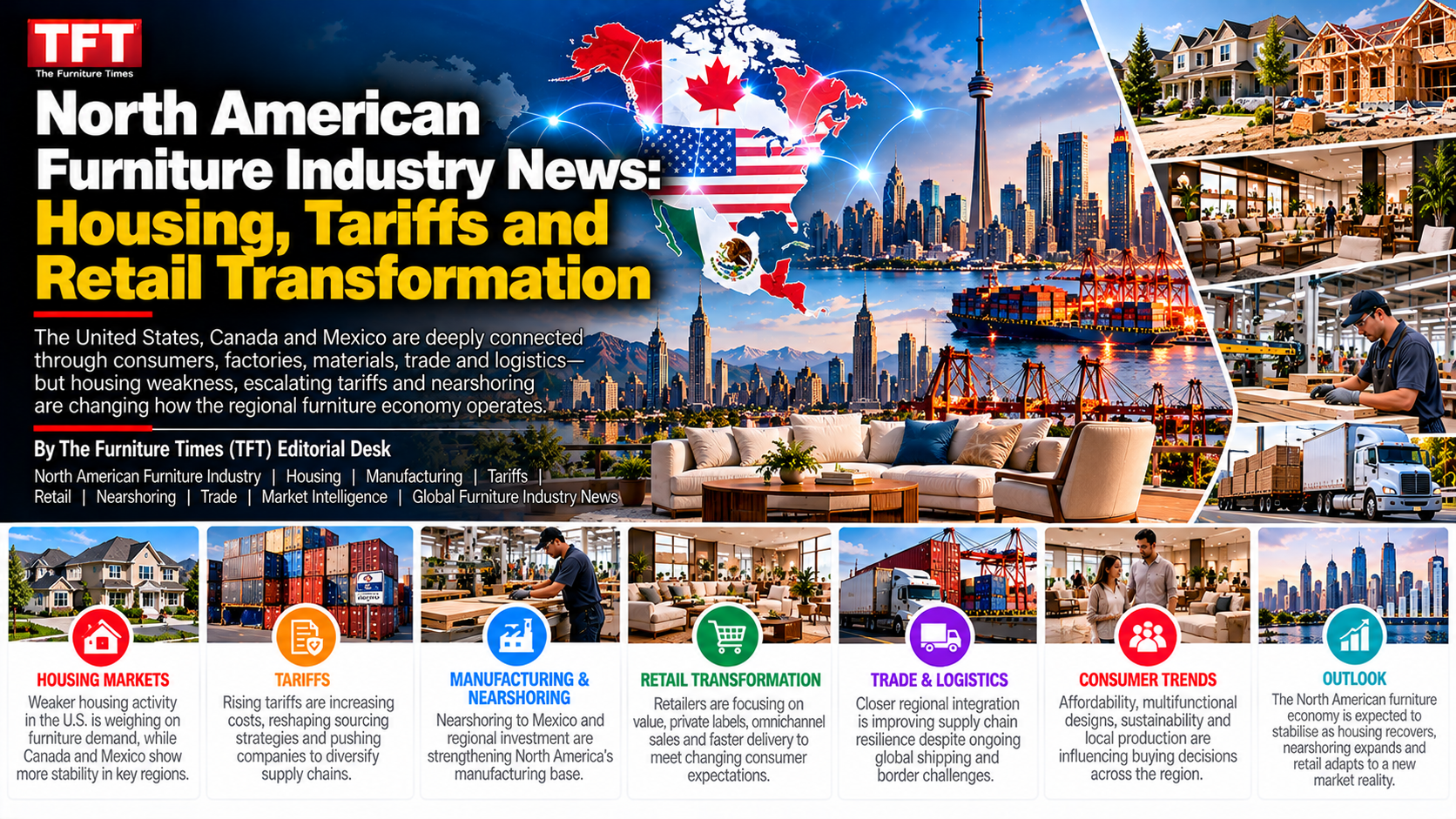
North American Furniture Industry News:
North American Furniture Industry News: Housing, Tariffs and Retail Transformation
The United States, Canada and Mexico are deeply connected through consumers, factories, materials, trade and logistics—but housing weakness, escalating tariffs and nearshoring are changing how the regional furniture economy operates
By The Furniture Times (TFT) Editorial Desk | North American Furniture Industry | Housing | Manufacturing | Tariffs | Retail | Nearshoring | Trade | Market Intelligence | Global Furniture Industry News
North America’s furniture industry is entering a period of major restructuring.
The United States remains the region’s largest consumer market, but weak housing transactions, expensive mortgages and persistent cost-of-living pressure are restricting residential furniture demand. New furniture and wood-product tariffs are raising import costs while encouraging manufacturers and retailers to reconsider domestic and regional production.
Canada’s furniture sector is caught between its reliance on the US market and an escalating trade dispute that has increased uncertainty for manufacturers, exporters and retailers. The Canadian economy has shown resilience, but smaller furniture companies with substantial US exposure face difficult decisions about pricing, production locations and workforce levels.
Mexico remains the region’s most important nearshoring opportunity. Its manufacturing base, labour force, location and access to the US market offer substantial advantages. However, uncertainty surrounding tariffs, rules of origin and the future of the United States–Mexico–Canada Agreement complicates investment decisions.
The three countries cannot be analysed separately.
A sofa sold in Chicago might be designed in Canada, use foam or fabric sourced from the United States, incorporate a mechanism manufactured in Asia, be assembled in Mexico and return to a US distribution centre before reaching the customer.
A cabinet manufactured in Ontario might use American hardware and Canadian timber but face a tariff when exported across the border.
A Mexican furniture factory may compete with Asian imports while depending on US customers, Chinese machinery and imported steel components.
North America is therefore one interconnected furniture ecosystem—but its policy environment is increasingly fragmented.
North American Furniture Industry Dashboard
| Indicator | Current direction | TFT assessment |
|---|---|---|
| US housing turnover | Subdued | Major constraint on residential furniture |
| US mortgage costs | Elevated | Reduces purchases and household formation |
| Furniture tariffs | Increasing | Supports some local producers but raises costs |
| US domestic production | Strategically more important | Capacity expansion takes time |
| Canadian furniture exports | Highly exposed | US dependence creates substantial risk |
| Canadian domestic demand | Resilient but cautious | Economic recovery offers some support |
| Mexican nearshoring | Strong strategic interest | Trade uncertainty limits investment confidence |
| Retail pricing | Upward pressure | Consumers remain resistant |
| Store traffic | Uneven | Housing-linked retailers remain vulnerable |
| E-commerce | Structurally important | Discovery is digital even when the sale is physical |
| Contract furniture | Selectively positive | Offices, hospitality, healthcare and education offer opportunities |
| Logistics costs | Elevated and volatile | Bulky furniture remains particularly exposed |
| Industry confidence | Cautious | Restructuring rather than broad recovery |
North America Is One Furniture Market With Three Different Roles
The United States, Canada and Mexico perform different but interconnected functions.
United States
The US provides:
- The region’s largest consumer market
- Major retail chains
- E-commerce platforms
- Furniture-design and branding companies
- Upholstery and casegoods manufacturing
- Large hospitality and office markets
- Distribution and logistics infrastructure
Canada
Canada contributes:
- Wood and timber resources
- Furniture manufacturing
- Upholstery
- Office furniture
- Outdoor products
- Design and premium production
- A sophisticated consumer market
Mexico
Mexico offers:
- Cost-competitive manufacturing
- Proximity to US consumers
- Skilled labour
- Wood and metalworking
- Upholstery
- Assembly
- Shorter transport routes than Asian sourcing
- Nearshoring potential
Together, the countries could form one of the world’s most resilient regional furniture networks. Trade disputes, however, threaten to weaken those advantages.
The United States: Housing Remains the Industry’s Most Important Demand Indicator
Furniture demand is deeply connected to housing activity.
Consumers typically purchase more furniture when they:
- Buy a home
- Move between properties
- Renovate
- Form a new household
- Refinance and improve their home
- Furnish an investment or rental property
The US housing market remains subdued.
Existing-home sales increased by 1.5% in September 2026 to an annualised rate of 3.99 million units. However, sales remained below four million for a second consecutive month and were 2.2% lower than a year earlier. Mortgage rates were around 7.4%, while the median home price reached US$417,500—the highest ever recorded for September.
Why the furniture industry should focus on transactions
High house prices do not automatically create furniture demand.
The furniture industry benefits when homes change ownership because property transactions trigger:
- New-room furnishing
- Replacement of unsuitable furniture
- Renovations
- Interior-design services
- Delivery and installation
- Outdoor-furniture purchases
When owners remain in place because moving is unaffordable, these purchases are postponed.
The affordability problem
First-time buyers accounted for approximately 31% of September transactions—below levels associated with a healthier housing market.
This matters because first-time buyers often require complete furniture packages rather than single replacement items.
They may need:
- Living-room seating
- Beds and mattresses
- Dining furniture
- Storage
- Home-office products
- Outdoor furniture
When younger households cannot enter homeownership, the industry loses an important demand trigger.
US Furniture Demand Is Dividing by Income
The American market is increasingly split between financially constrained and affluent households.
Value-conscious consumers
These buyers prioritise:
- Price
- Financing
- Free or affordable delivery
- Immediate availability
- Durability
- Compact products
- Promotional offers
They are vulnerable to inflation, rent increases, energy costs and high borrowing rates.
Premium consumers
Affluent buyers continue purchasing:
- Designer furniture
- Custom upholstery
- Premium mattresses
- Luxury outdoor furniture
- Bespoke cabinetry
- Home-office collections
- Interior-design services
Million-dollar home transactions have shown greater resilience than affordable segments, supporting premium furniture demand even while the mass market remains cautious.
The vulnerable middle market
Furniture priced above entry level but lacking strong differentiation faces the greatest difficulty.
It is neither cheap enough for the most price-sensitive buyer nor distinctive enough for premium customers.
Furniture Tariffs Are Reshaping US Sourcing
Tariffs are one of the most consequential developments affecting the North American furniture economy.
Official Canadian trade guidance dated September 2026 states that certain upholstered furniture, kitchen cabinets and vanities entering the United States face a 25% Section 232 tariff, without a CUSMA/USMCA-compliant exemption. Under the published schedule, tariffs are due to increase on 1 January 2027 to:
- 30% for covered upholstered furniture
- 50% for covered kitchen cabinets and vanities
The precise commercial effect depends on product classification, origin, material and any later policy changes. Companies should obtain current customs advice for each product rather than relying on general summaries.
Tariffs create winners and losers
Potential beneficiaries
- Existing US upholstery factories
- Domestic cabinet manufacturers
- American component suppliers
- Regional timber processors
- Automation companies
- Local logistics providers
- Repair and refurbishment companies
Businesses under pressure
- Import-dependent retailers
- Overseas factories
- US brands using foreign production
- Small businesses with low pricing power
- Consumers purchasing affected products
- Canadian exporters without exemptions
Tariffs do not create instant capacity
A tariff can increase the attractiveness of domestic production, but a factory requires:
- Industrial property
- Machinery
- Skilled labour
- Timber and panels
- Foam and textiles
- Hardware
- Working capital
- Quality systems
- Distribution
Domestic capacity cannot replace imports immediately.
In the transition period, the most common outcome may be higher costs rather than dramatically higher production.
Tariffs Can Also Raise Costs for US Manufacturers
A company manufacturing furniture in the United States may still depend on imported:
- Lumber
- Hardware
- Mechanisms
- Fabric
- Foam chemicals
- Steel and aluminium
- Machinery
- Packaging
Tariffs on these inputs can partially offset the advantage created by duties on finished furniture.
The National Association of Home Builders warns that tariffs on construction materials and household products are usually passed through to users, contributing to higher housing and consumer costs.
This produces a policy contradiction:
- Tariffs seek to support manufacturing.
- Higher input costs can make domestic production more expensive.
- Higher furniture prices can reduce demand.
- Weak demand can delay investment in new factories.
US Manufacturing Is Regaining Strategic Importance
Furniture production has become a supply-chain resilience issue rather than only a cost question.
Retailers and brands increasingly evaluate:
- Delivery speed
- Inventory risk
- Freight exposure
- Tariff risk
- Currency risk
- Customisation
- Replacement availability
- Market responsiveness
IKEA’s regional production strategy
IKEA has been increasing US production in response to tariffs and supply-chain pressure. Its strategy includes expanded domestic partnerships and a new North Carolina facility planned by Lithuanian supplier SBA Home, with intended capacity of approximately two million pieces annually.
The strategy illustrates an important shift.
Manufacturing closer to customers may carry higher labour costs, but it can reduce:
- Ocean freight
- Transit time
- Inventory requirements
- Exposure to international disruption
- Replenishment delays
The opportunity for regional suppliers
Growth in US production could support:
- Panel and lumber suppliers
- Hardware distributors
- Packaging companies
- Machinery providers
- Maintenance specialists
- Industrial real estate
- Workforce training
However, domestic manufacturing must be commercially sustainable after tariff protection, not only while tariffs remain high.
Mexico: The Centre of the Nearshoring Opportunity
Mexico is geographically positioned to become a larger furniture-manufacturing base for North America.
Its advantages include:
- Proximity to US customers
- Truck and rail access
- Shorter replenishment cycles
- Competitive labour
- Manufacturing experience
- Upholstery capability
- Wood and metal processing
- Established maquiladora infrastructure
- Participation in USMCA
Furniture brands are examining Mexico for upholstered furniture, cabinets, casegoods, outdoor products, metal furniture and components.
Industry sources expect Mexico’s furniture exports to continue growing, supported by companies seeking production closer to North American consumers.
Nearshoring is not simply relocating assembly
A successful furniture cluster needs:
- Component suppliers
- Foam
- Fabric
- Timber and panels
- Hardware
- Finishing services
- Packaging
- Testing
- Quality-control staff
- Export logistics
If most inputs are imported from Asia, nearshoring may reduce final-assembly distance without creating a fully resilient regional supply chain.
The border advantage
Compared with ocean freight from Asia, Mexican production can offer:
- Faster transit
- Smaller replenishment orders
- Lower inventory exposure
- Easier factory visits
- Greater customisation
- Faster replacement parts
These advantages are particularly valuable for furniture because products occupy large shipping volumes.
US–Mexico Tariff Negotiations Create New Uncertainty
Progress toward a broader US–Mexico tariff agreement has stalled.
Current disputes include US tariffs affecting Mexican steel, aluminium, vehicles and products made from those materials. Mexico continues negotiating, but the disagreement creates uncertainty ahead of future USMCA decisions. r
Why furniture companies should care
Furniture manufacturers use steel and aluminium in:
- Chair frames
- Table bases
- Outdoor products
- Storage systems
- Recliner mechanisms
- Bed frames
- Office furniture
- Cabinet components
Tariffs on metals or finished metal products can affect furniture costs even when furniture itself is not the principal subject of negotiations.
Rules-of-origin risk
Furniture businesses must understand:
- Where substantial transformation occurs
- Origin of frames and mechanisms
- Regional-value requirements
- Customs classification
- Recordkeeping
- Transshipment risks
Moving final assembly to Mexico does not automatically guarantee preferential treatment.
USMCA Uncertainty Could Slow Investment
The USMCA framework is central to North American manufacturing decisions.
Businesses invest in Mexican production based partly on the expectation of predictable access to the United States and Canada.
Frequent or uncertain reviews can make investors delay:
- Factory construction
- Equipment purchases
- Supplier commitments
- Industrial leases
- Workforce expansion
Reporting from Mexico has indicated that trade uncertainty has already affected private investment and cooled parts of the nearshoring property market.
North America cannot build regional manufacturing resilience without predictable rules.
Canada: Economic Resilience Meets Serious Trade Exposure
Canada’s economy rebounded during the second quarter of 2026, expanding at an annualised rate of 3.3%. Exports, household consumption and business investment contributed to the recovery.
Manufacturing shipments increased by 1.5% in August, although much of the improvement reflected higher prices rather than volume. New orders declined and manufacturing employment weakened in September, suggesting that the outlook remains cautious.
Canada’s furniture strengths
Canada possesses:
- Timber resources
- Furniture manufacturing
- Upholstery expertise
- Office-furniture production
- Outdoor furniture
- Cabinetry
- Premium craftsmanship
- Design talent
- Access to US consumers
Ontario and Quebec contain important manufacturing and commercial networks, while timber-producing provinces support the upstream supply chain.
The structural vulnerability
Canada remains highly dependent on the United States.
Approximately 71.7% of Canadian exports went to the US in 2025. The furniture industry shares this exposure because the neighbouring market provides scale and relatively efficient distribution.
When US trade policy changes, Canadian manufacturers cannot always redirect production quickly.
Canadian Furniture Exporters Face Difficult Choices
Some Canadian furniture manufacturers have encountered tariff rates capable of undermining their US business models.
Ontario-based DFC Woodworks, for example, reportedly considered moving most of its production to the United States after tariffs affected its exports. The company sells a large share of its products in the US and therefore faces limited options:
- Absorb the duty
- Raise prices
- Lose margin
- Reduce US sales
- Shift production
- Seek new export markets
This illustrates the disproportionate impact on SMEs.
A large company may be able to:
- Open a US facility
- Reallocate production
- Negotiate with distributors
- Invest in customs expertise
- Carry additional inventory
A smaller company may lack the capital to do so.
Export diversification
Canada is expanding efforts to reach non-US markets. Canadian exports to other destinations increased during 2025, but geography and infrastructure make rapid diversification difficult.
Potential furniture markets include:
- Europe
- Japan
- Australia
- The Middle East
- High-value hospitality projects
However, entering these markets requires marketing, certification, distribution and after-sales support.
Canadian Counter-Tariffs Add Complexity
Canada’s Department of Finance maintains an official list of US products subject to Canadian counter-tariffs, including applicable tariff items, rates and effective dates. The list was updated in October 2026.
Furniture businesses should review the official tariff schedule for every relevant product and material.
Potential effects include:
- Higher prices on US-origin components
- Supply-chain substitution
- More domestic sourcing
- Greater use of Asian suppliers
- Retaliatory pressure on cross-border retail
- Administrative costs
Tariff escalation can weaken the integrated supply chain both countries spent decades developing.
North American Furniture Retail Is Being Transformed
Retail transformation is occurring simultaneously across stores, digital platforms, logistics and customer service.
Consumers now expect:
- Online research
- Transparent prices
- Accurate inventory
- Multiple product images
- Verified reviews
- Fast delivery estimates
- Financing
- Easy communication
- Installation
- Responsive warranty support
The showroom is no longer the beginning
A customer may discover a sofa through:
- Social media
- An AI assistant
- A marketplace
- A designer
- An online review
- A retailer’s website
The showroom may be the final verification point rather than the starting point.
Retailers must become information companies
Furniture retailers need accurate data for:
- Dimensions
- Materials
- Colours
- Configurations
- Stock
- Packaging
- Delivery
- Assembly
- Care
- Warranty
If the website lacks reliable information, customers may eliminate the product before visiting the store.
E-Commerce Does Not Remove the Need for Physical Retail
Furniture remains a highly sensory category.
Consumers may want to evaluate:
- Comfort
- Cushion firmness
- Fabric texture
- Finish
- Mechanism quality
- Scale
- Construction
This supports an omnichannel model:
| Digital channel | Physical channel |
|---|---|
| Discovery | Product experience |
| Comparison | Comfort testing |
| Reviews | Sales consultation |
| Configuration | Material sampling |
| Order tracking | Collection or service |
| After-sales communication | Repair and installation |
The strongest retailers will connect the two experiences rather than treating them as separate businesses.
Tariffs Are Accelerating Retail Assortment Changes
Retailers may respond to higher landed costs by:
- Raising prices
- Reducing product variety
- Renegotiating with factories
- Changing materials
- Increasing private-label products
- Moving assembly closer to customers
- Ordering fewer containers
- Holding more regional stock
- Expanding domestic sourcing
The risk of silent quality reduction
When cost increases cannot be passed to consumers, suppliers may attempt to reduce specifications.
Possible changes include:
- Lower-density foam
- Lighter fabric
- Thinner panels
- Cheaper slides and hinges
- Reduced coating thickness
- Less protective packaging
Retailers must control substitutions carefully. A lower purchase price can create higher return, warranty and reputation costs.
Discounting Cannot Solve Structural Weakness
North American furniture retail has long relied on:
- Holiday sales
- Clearance events
- Financing promotions
- Permanent percentage discounts
- “Limited-time” pricing
When almost every week is a sale, the reference price loses credibility.
Excessive discounting can:
- Reduce margins
- Train customers to wait
- Damage premium positioning
- Hide weak product differentiation
- Leave less money for service and marketing
Retailers need clearer reasons to buy beyond price:
- Better design
- Faster delivery
- Verified quality
- Local production
- Customisation
- Reviews
- Warranty
- Repairability
- Professional installation
Logistics Remains a Critical North American Issue
Furniture logistics involves more than transporting a carton.
The full service may include:
- Import clearance
- Warehousing
- Appointment scheduling
- Room-of-choice delivery
- Assembly
- Installation
- Packaging removal
- Damage inspection
- Returns
- Repair coordination
Fuel costs and inflation are intensifying pressure across US freight and delivery networks. The Federal Reserve’s October Beige Book reported that higher fuel costs were compressing margins across freight-sensitive industries.
Why logistics matters more in furniture
Furniture is:
- Bulky
- Damage-prone
- Costly to return
- Difficult to store
- Dependent on customer availability
- Often assembled on-site
A damaged sofa does not merely create a refund. It may require collection, replacement, inspection, repair and disposal.
Retailers should measure logistics cost per successful installation—not only freight cost per shipment.
The Contract Furniture Market Offers an Alternative
Residential furniture remains closely tied to housing, but contract markets can provide more stable opportunities.
These include:
- Offices
- Hotels
- Restaurants
- Healthcare
- Education
- Senior living
- Student housing
- Public buildings
- Retail interiors
United States
The US provides significant demand through hospitality development, healthcare investment, university projects and office refurbishment.
Canada
Canadian opportunities include healthcare, government procurement, educational facilities, offices and senior living.
Mexico
Mexico’s tourism and industrial sectors create demand for hotels, resorts, restaurants, offices and workforce facilities.
Requirements
Contract suppliers need:
- Commercial testing
- Fire-performance evidence
- Precise specifications
- Project management
- Installation
- Replacement capacity
- Warranty systems
- Financial strength
A manufacturer should not enter contract markets simply by offering residential furniture in larger quantities.
Mexico Can Connect Manufacturing With Hospitality Demand
Mexico possesses an unusual combination of manufacturing and project demand.
Its tourism economy supports furniture procurement for:
- Coastal resorts
- Urban hotels
- Restaurants
- Vacation rentals
- Branded residences
- Wellness properties
This allows Mexican manufacturers to develop and test hospitality products domestically before expanding across North America.
Potential advantages include:
- Local project coordination
- Regional materials
- Shorter replacement times
- Customisation
- Reduced ocean freight
The industry should connect factory development with hotel and real-estate pipelines.
Sustainability Is Becoming a Commercial Requirement
North American sustainability policy is less unified than Europe’s, but buyers increasingly expect credible information about:
- Timber sources
- Material content
- Emissions
- Recycled inputs
- Durability
- Repairability
- Packaging
- End-of-life options
Canadian and US companies exporting to Europe may also face European requirements such as EUDR and future Digital Product Passports.
This means North American factories must prepare for multiple regulatory systems.
The circular opportunity
Repair, refurbishment and resale are commercially relevant because new furniture prices are rising.
Growth opportunities include:
- Office-furniture remanufacturing
- Sofa reupholstery
- Cabinet refinishing
- Mattress recycling
- Retail returns refurbishment
- Hotel furniture reuse
- Replacement components
- Trade-in programmes
Circularity can reduce waste while creating local jobs that cannot easily be moved offshore.
What North American Manufacturers Should Do Now
United States
- Identify products benefiting from regional production.
- Audit imported component exposure.
- Invest in automation and workforce skills.
- Avoid overexpansion based solely on temporary tariff protection.
- Develop flexible and made-to-order capacity.
- Strengthen repair and replacement services.
Canada
- Map US tariff exposure by product.
- Diversify customers gradually.
- Examine selective US production partnerships.
- Strengthen domestic sales.
- Improve international marketing.
- Protect SME manufacturing capabilities.
Mexico
- Build deeper component ecosystems.
- Verify USMCA origin requirements.
- Avoid dependence on final assembly alone.
- Invest in quality systems and documentation.
- Connect with US and Canadian buyers.
- Develop hospitality and contract capabilities.
What Retailers and Buyers Should Do
Retailers
- Recalculate margins by SKU.
- Identify tariff-sensitive categories.
- Diversify suppliers without creating uncontrolled complexity.
- Improve digital product information.
- Track damage and return costs.
- Maintain specification control.
- Build regional repair networks.
- Reduce dependence on permanent discounts.
Commercial buyers
- Evaluate total lifecycle cost.
- Verify the actual manufacturing location.
- Confirm country of origin.
- Review commercial-use warranties.
- Require spare-parts availability.
- Assess installation capability.
- Check supplier financial stability.
Importers
- Validate customs classifications.
- Maintain origin records.
- Monitor tariff changes.
- Review contract clauses.
- Separate product and freight assumptions.
- Build contingency plans.
The North American Industry Needs Better Connectivity
The region contains thousands of:
- Manufacturers
- Material suppliers
- Component companies
- Retailers
- Designers
- Architects
- Logistics providers
- Installers
- Repairers
- Technology companies
Yet many remain difficult to find outside existing networks.
A US buyer searching for a Mexican upholstery factory may rely on an agent or trade fair.
A Canadian manufacturer seeking an American component supplier may not know which businesses can meet its technical requirements.
A hotel developer may struggle to compare contract furniture suppliers across all three countries.
This is not only a sourcing problem. It is an information-infrastructure problem.
TFT, FISE and FurniReviewology: Connecting the Continental Ecosystem
North America needs a connected visibility, discovery and trust system.
The Furniture Times
TFT can report on:
- Factory investments
- Tariff developments
- Retail transformation
- Housing demand
- Company expansion
- Nearshoring
- Contract projects
- Sustainability
Furniture Industry Search Engine
FISE can help buyers search across the United States, Canada and Mexico by:
- Product category
- Manufacturing capability
- Material
- Location
- Certification
- Market segment
- Service
FurniReviewology
FurniReviewology can build trust through structured reviews of:
- Products
- Manufacturers
- Retailers
- Delivery providers
- Installers
- Repair companies
- Customer service
Together:
The Furniture Times tells their story.
Furniture Industry Search Engine helps the world find them.
FurniReviewology helps the world trust them.
Editorial Conclusion
North America has the potential to build a more regional, responsive and resilient furniture economy.
The United States offers scale, consumers, brands and investment.
Canada offers materials, manufacturing, design and technical capability.
Mexico offers proximity, labour, industrial capacity and nearshoring potential.
But opportunity depends on policy stability and genuine regional cooperation.
Tariffs may encourage local investment, yet they can also raise prices, disrupt integrated supply chains and damage smaller exporters. Nearshoring may reduce transport risk, but it must develop beyond final assembly. Housing remains the most important constraint on residential demand, while contract furniture and circular services offer alternative growth.
The companies most likely to succeed will be those that can:
- Understand tariff exposure
- Control product origin and documentation
- Produce closer to customers where commercially sensible
- Operate across digital and physical retail
- Deliver reliably
- Support repair and replacement
- Remain visible across the continent
North America is not three separate furniture industries.
It is one interconnected ecosystem navigating increasingly divided trade policies.
Its future will depend on whether businesses can preserve the advantages of integration while adapting to the new reality of tariffs, regional production and cautious consumers.
The Global Furniture Ecosystem
The Furniture Industry is a $1 Trillion USD Ecosystem in the world.
Furniture Industry Search Engine – FISE helps the world find them.
The Furniture Times – TFT tells their story.
FurniReviewology helps the world trust them.
If you are not searchable, you do not exist.
Be the next one. Be part of the movement.
Sources:
National Association of Home Builders—Tariffs and Housing, Government of Canada—Counter-Tariff List, Canadian Trade Commissioner Service—US Tariff Support, Innovation, Science and Economic Development Canada—Furniture Manufacturing