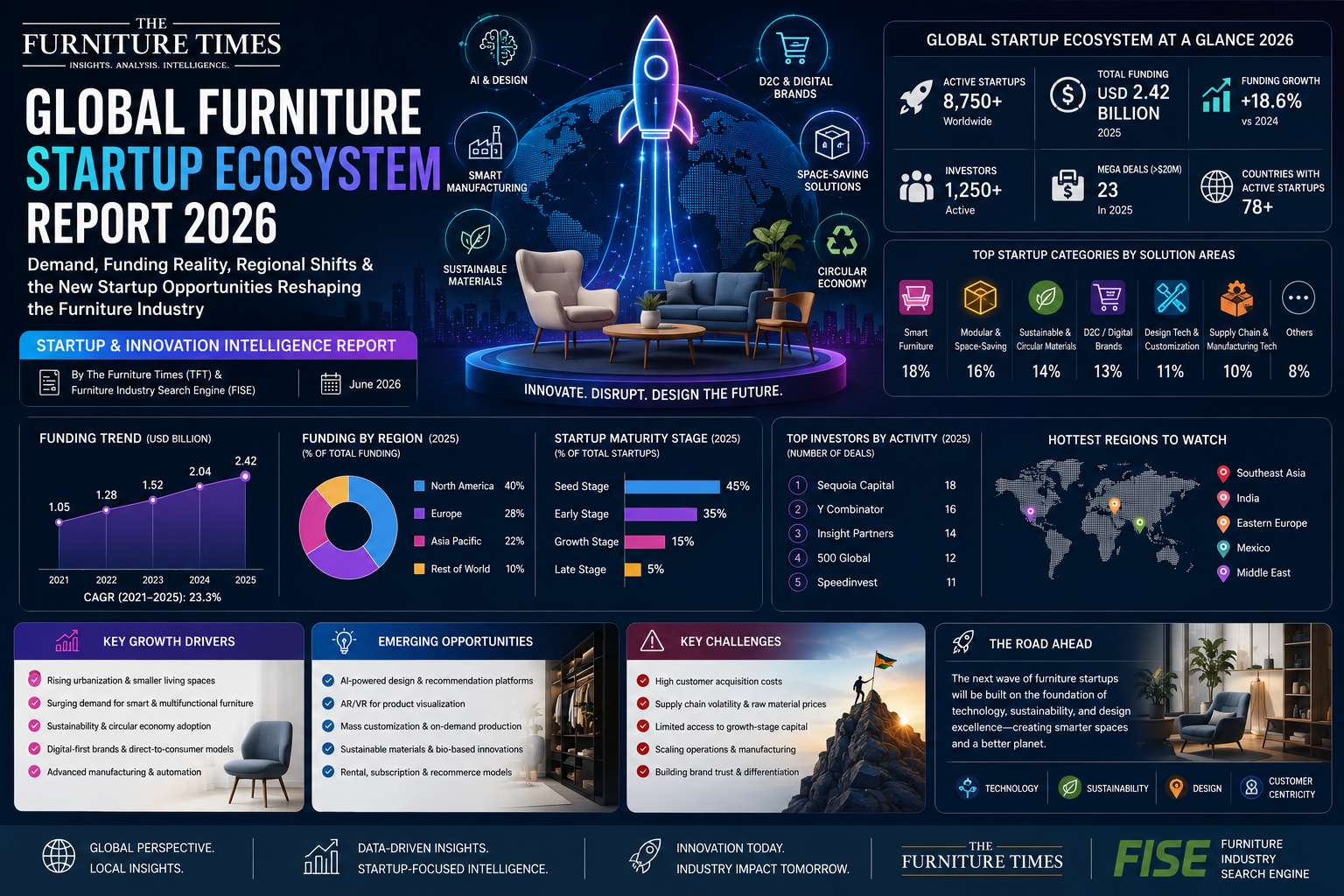
Global Furniture Startup Ecosystem Report 2026
Demand, Funding Reality, Regional Shifts & the New Startup Opportunities Reshaping the Furniture Industry
Startup & Innovation Intelligence Report | By The Furniture Times (TFT) & Furniture Industry Search Engine (FISE) | June 2026
The global furniture startup ecosystem is entering a new phase. After years of rapid e-commerce growth, pandemic-era home improvement spending, supply chain shocks, and digital transformation, the furniture industry is no longer attracting only traditional manufacturers and retailers. It is now attracting startups in AI design, furniture e-commerce, circular furniture, logistics, rental furniture, modular interiors, smart manufacturing, B2B sourcing, digital showrooms, review intelligence, and industry search platforms.
The wider home furnishing market is projected to grow from about US$803.32 billion in 2026 to US$1.02 trillion by 2034, while other furniture market estimates place the global furniture market at around US$829.08 billion in 2026, rising toward US$1.24 trillion by 2035. These figures show that the industry remains large, but growth is becoming more selective, technology-driven, and regionally uneven.
Executive Summary
Furniture startups are not disappearing. They are changing direction.
The easy-money era of furniture startups is over. Investors are no longer excited by simple online furniture stores with high advertising costs, heavy inventory, expensive returns, and weak margins. The new startup opportunity is shifting toward infrastructure, data, AI, supply chain, verified sourcing, circular economy, B2B platforms, and tools that help the furniture ecosystem become faster, smarter, and more searchable.
The strongest startup opportunities in 2026 are in:
AI-powered interior design
Furniture discovery platforms
B2B supplier search engines
Furniture logistics optimization
Circular furniture resale and repair
Modular kitchen and wardrobe systems
Hospitality and contract furniture procurement
Digital showrooms and 3D visualization
Sustainable materials and low-carbon furniture
Smart manufacturing and factory automation
The weakest startup models are those depending only on discounting, heavy inventory, paid ads, and slow delivery.
Global Startup Ecosystem Health Check 2026
Furniture E-Commerce Startups: 6.5 / 10
AI & Design-Tech Startups: 8.4 / 10
B2B Furniture Platforms: 8.6 / 10
Sustainable Furniture Startups: 8.1 / 10
Furniture Rental & Circular Economy: 7.5 / 10
Manufacturing-Tech Startups: 8.0 / 10
Logistics & Supply Chain Startups: 7.8 / 10
Traditional D2C Furniture Startups: 5.8 / 10
Overall Startup Ecosystem Score: 7.6 / 10
The market is not falling. It is maturing.
The Rise: Where Furniture Startups Are Growing
The rise is happening in startups that solve real industry pain points.
Furniture is a large, fragmented, physical-product industry. That means startups must solve hard problems, not only create beautiful websites.
The fastest-growing areas are those that reduce friction between buyers and sellers.
1. AI Interior Design & Visualization
AI design tools are becoming one of the strongest startup categories in furniture. Consumers, designers, retailers, and manufacturers need faster ways to visualize rooms, test layouts, compare products, and generate design concepts.
AI can help with:
Room planning
Style matching
Product recommendations
Virtual staging
Kitchen and wardrobe planning
Retail sales support
Customer consultation
3D product visualization
This is a strong area because furniture is visual. People want to see before they buy.
2. Furniture Search & Discovery Platforms
The furniture industry is highly fragmented. Buyers struggle to find trusted manufacturers, suppliers, exporters, retailers, designers, and contractors.
This creates major opportunity for platforms like FISE.
Furniture discovery startups can solve:
Supplier visibility
Category search
Verified listings
B2B matching
Regional sourcing
Review intelligence
Trade data organization
Buyer-supplier communication
In the new furniture economy, search is becoming the new marketplace.
3. B2B Furniture Procurement
Hotels, offices, developers, schools, hospitals, restaurants, resorts, and government projects all need furniture procurement systems.
B2B furniture procurement startups can support:
RFQs
Supplier comparison
Bulk purchasing
Project timelines
Contract furniture sourcing
Installation coordination
Warranty tracking
Compliance documents
This area is more attractive than basic consumer e-commerce because order values are higher and buyers are more professional.
4. Circular Furniture & Resale
Sustainability is pushing furniture startups toward resale, refurbishment, repair, rental, and lifecycle management.
Furniture waste is a growing issue worldwide. Startups that can extend furniture life may become important players in the next decade.
Opportunities include:
Used office furniture resale
Hotel furniture liquidation
Furniture repair networks
Refurbished furniture marketplaces
Circular design certification
Rental furniture for students and expats
Subscription furniture for flexible living
5. Modular Interiors
Demand for modular kitchens, wardrobes, storage, compact furniture, and ready-to-install interior systems is rising globally.
This is especially strong in Asia, the Middle East, and urban markets where apartment living is expanding.
Startups in this space can combine:
Online design consultation
Material selection
Instant quotation
Factory production
Professional installation
After-sales service
This model works best when digital convenience is connected with strong execution.
The Fall: Where Furniture Startups Are Struggling
Not every furniture startup category is healthy.
Many startups are struggling because furniture is expensive to store, ship, return, and replace.
1. Pure D2C Furniture Without Differentiation
Many direct-to-consumer furniture brands face high customer acquisition costs, logistics issues, product damage, returns, and low repeat purchase frequency.
Selling sofas online is not the same as selling fashion or cosmetics.
Furniture has:
High shipping costs
Large packaging needs
Long replacement cycles
Complex returns
Installation issues
Damage risk
Inventory pressure
Without strong differentiation, many D2C furniture startups struggle.
2. Discount-Based E-Commerce
Startups competing only on low price face margin pressure. They compete with large retailers, marketplaces, local suppliers, and imports.
Low price alone is not a sustainable startup moat.
3. Inventory-Heavy Startups
Furniture inventory consumes cash. Warehousing is expensive. Unsold inventory becomes a serious risk.
Startups must avoid becoming warehouses before they become brands.
4. Weak Logistics Models
Delivery is one of the hardest parts of furniture. Customers expect careful handling, fast delivery, installation, and clear communication.
Startups that fail in logistics lose trust quickly.
Regional Analysis
Asia: The Biggest Growth Engine
Asia is the most important growth region for furniture startups.
The region has massive population, rising middle-class income, urbanization, new housing, real estate development, and manufacturing strength.
Key markets include:
China
India
Indonesia
Vietnam
Malaysia
Thailand
Philippines
Japan
South Korea
India is becoming especially important. IKEA’s decision to establish a product development center in India shows that the country is moving beyond sourcing and becoming a design, development, and growth hub.
Asia’s strongest startup opportunities are:
Modular kitchens
Built-in wardrobes
Furniture e-commerce
B2B sourcing
Export platforms
AI interior design
Furniture manufacturing software
Hospitality furniture platforms
Outdoor furniture marketplaces
Asia’s challenge is execution. Many customers still need installation, trust, financing, and after-sales service.
Europe: Sustainability, Circular Economy & Design-Tech
Europe is a mature furniture market, but it is one of the best regions for circular furniture, sustainable materials, digital retail, and design innovation.
The European retail furniture market has been estimated at around €165 billion, and pandemic-era home investment increased the base of market activity compared with 2019.
Strong startup areas in Europe include:
Circular furniture
Furniture resale
Repair networks
Sustainable materials
Design-tech
B2B procurement
Digital showrooms
Office furniture reuse
Low-carbon supply chain tools
Europe’s challenge is slower consumer growth, high regulation, and high operating costs. But the market rewards trust, sustainability, and quality.
North America: Big Market, High Competition
North America remains one of the most important regions for furniture startups, especially the United States.
The region has strong demand, high online purchasing behavior, a large home renovation culture, and deep venture capital networks.
However, it is also highly competitive.
Wayfair’s move to open additional physical stores shows an important shift: even digital-first furniture players are recognizing the value of omnichannel retail. Its new Ohio store is designed as a smaller-format physical experience supported by the company’s delivery network.
This tells startups one thing clearly:
The future is not online only.
The future is online plus offline, search plus showroom, digital plus delivery.
Strong startup opportunities in North America include:
AI room design
Furniture logistics
Returns management
Used furniture resale
Office furniture liquidation
Kitchen and closet systems
Smart home furniture
B2B procurement
Local manufacturing marketplaces
Africa: Early-Stage But High-Potential
Africa is still an emerging furniture startup region, but the long-term opportunity is significant.
Urbanization, housing demand, young population, retail modernization, hospitality investment, and local manufacturing potential are creating room for growth.
Important markets include:
Nigeria
South Africa
Kenya
Ghana
Egypt
Morocco
Tanzania
Ethiopia
Startup opportunities include:
Affordable modular furniture
Local carpentry platforms
Furniture marketplaces
Kitchen cabinet networks
Hospitality furniture sourcing
Furniture financing
B2B supplier directories
Urban apartment furniture
Africa’s challenges include logistics, affordability, fragmented supply, financing, and formalization. But startups that solve local problems can build strong regional positions.
Middle East: Premium, Hospitality & Project Furniture
The Middle East is one of the most attractive regions for premium furniture and project-based startups.
Key markets include:
UAE
Saudi Arabia
Qatar
Kuwait
Bahrain
Oman
Demand is driven by hotels, villas, apartments, commercial projects, luxury interiors, and government-backed development.
Startup opportunities include:
Hospitality furniture procurement
Luxury interior sourcing
Project furniture platforms
Fit-out marketplaces
Custom furniture networks
Outdoor furniture for resorts
Smart procurement tools
The Middle East rewards speed, quality, trust, and premium execution.
Oceania: Digital Retail & Cross-Border Opportunity
Australia and New Zealand are strong markets for digital furniture retail, renovation, outdoor living, and premium home improvement.
Bunnings’ launch of a global e-commerce platform for Fiji shows how digital-first expansion can reach smaller island markets without relying on physical stores. The model uses existing supply chain infrastructure and transparent pricing, including shipping and customs.
This is important for furniture startups because island and smaller markets can be served through smart logistics and digital commerce.
Opportunities include:
Outdoor furniture
Renovation furniture
Sustainable materials
Digital home improvement platforms
Cross-border e-commerce
Compact living solutions
Latin America: Growing Middle Class & Nearshoring
Latin America has strong potential, especially in Mexico, Brazil, Colombia, Chile, Peru, and Argentina.
Mexico is particularly important due to nearshoring opportunities for North America.
Startup opportunities include:
Affordable furniture e-commerce
Modular kitchens
Local manufacturing platforms
B2B furniture sourcing
Urban apartment furniture
Furniture finance and installment models
Hospitality furniture procurement
The region’s challenge is currency volatility, logistics, and uneven purchasing power.
Demand Map: What Buyers Want Now
Global demand is shifting toward:
Affordable quality
Fast delivery
Clear pricing
Customization
Sustainable materials
Compact furniture
Built-in storage
Home office furniture
Outdoor furniture
Hospitality furniture
Verified suppliers
Digital convenience
Reviews and trust
The old buyer asked: “What is the price?”
The new buyer asks: “Can I trust it, see it, compare it, customize it, receive it on time, and get support after purchase?”
Startup Focus Areas for 2026–2030
The most attractive startup areas are:
Furniture Industry Search Engines
Because the industry is fragmented and buyers need discovery.
AI Design Assistants
Because furniture buying is visual and emotional.
Modular Interior Platforms
Because urban housing needs smarter storage and kitchens.
Circular Furniture Platforms
Because sustainability and cost-saving are rising.
B2B Procurement Systems
Because hotels, offices, and developers need organized sourcing.
Furniture Logistics Technology
Because delivery remains one of the biggest pain points.
Verified Review Platforms
Because trust is becoming a major buying factor.
Smart Manufacturing Tools
Because factories need productivity and visibility.
Investment Outlook
Furniture startups will still attract investment, but investors will be more selective.
They will prefer startups with:
Clear unit economics
Low inventory risk
Strong margins
Scalable technology
B2B revenue
Data advantage
Network effects
Operational discipline
They will be more cautious with:
Heavy inventory models
Discount-based brands
High-return products
Slow delivery models
Weak differentiation
Paid-ad dependent businesses
The next generation of furniture startups must be smarter, leaner, and more infrastructure-focused.
TFT & FISE Analysis
The furniture startup ecosystem is not dead.
It is becoming more serious.
The next winners will not simply sell furniture online.
They will organize the industry.
They will make suppliers searchable.
They will make buyers more confident.
They will reduce logistics friction.
They will improve design decisions.
They will use data to connect demand with supply.
They will build trust.
This is why platforms such as FISE, FurniLinkology, FurniReviewology, and FISE.live can become important. The industry does not only need more sellers. It needs structure, discovery, verification, intelligence, and connection.
Final Verdict
The global furniture startup ecosystem is moving from hype to maturity.
Some startup categories are falling because they were built on weak economics.
But stronger categories are rising because they solve real furniture industry problems.
The future belongs to startups that understand one truth:
Furniture is not only a product.
It is a supply chain, a design decision, a trust decision, a logistics challenge, a lifestyle choice, and increasingly, a data-driven discovery journey.
The furniture startups that win the next decade will not simply be digital stores.
They will be the platforms, tools, and ecosystems that help the global furniture industry become visible, searchable, connected, trusted, and intelligent.
By The Furniture Times (TFT) & Furniture Industry Search Engine (FISE)
Startup & Innovation Intelligence Desk | June 2026
“TFT tells their story. FISE helps the world find them.”

Related Posts
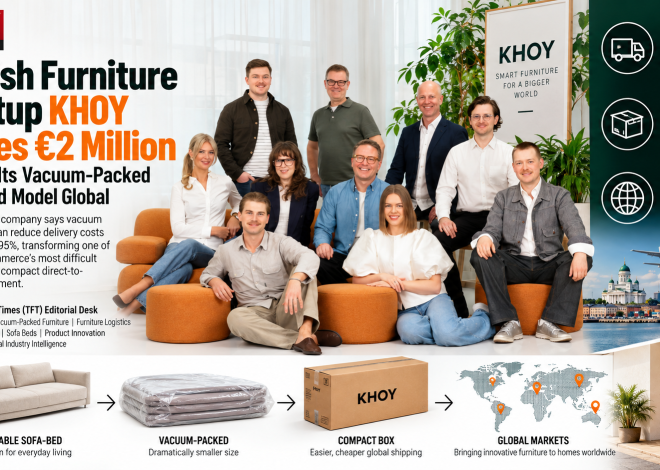
Finnish Furniture Startup KHOY Raises €2 Million to Take Its Vacuum-Packed Sofa-Bed Model Global
Malaysia’s Furniture & Furnishing Industry — Size, Opportunities, and Why Now Is the Time to Build