
Furniture Mechanical Testing Explained for Manufacturers
Understanding Strength, Stability, Durability, Impact, Structural Integrity and Product-Specific Assessments Under BIS Furniture Certification
By The Furniture Times (TFT) Editorial Desk
BIS Furniture Certification | Mechanical Testing | Product Safety | Quality Control | Manufacturing Compliance | India Furniture Industry
Furniture may appear safe when it leaves the production line, but appearance alone cannot establish whether a chair, table, storage cabinet, bed or bunk bed will remain safe after months or years of repeated use.
A chair may look stable but tip when a user leans toward one side. A desk may support a computer under normal conditions but permanently deflect after prolonged loading. A cabinet may stand upright while empty but overturn when its drawers are opened. A bed joint may survive a single static load yet loosen after thousands of repeated cycles. A bunk bed may be structurally strong but still create a fall, entrapment or access hazard.
Mechanical testing is intended to uncover these risks under controlled and repeatable conditions.
For furniture manufacturers preparing for Bureau of Indian Standards certification, mechanical testing should not be regarded as a final obstacle faced by the finished product. It should be integrated into design, material selection, component approval, prototype development, production control and change management.
The critical lesson is:
A product does not pass because it looks strong. It passes when the declared construction, materials, joints and mechanisms demonstrate the required performance under the applicable test conditions.
Furniture Quality Control Order and applicable standards
The Furniture (Quality Control) Order, 2025 identified six furniture categories and their corresponding Indian Standards:
| Furniture category | Indian Standard |
|---|---|
| Work chairs | IS 17631:2022 |
| General-purpose chairs and stools | IS 17632:2022 |
| Tables and desks | IS 17633:2022 |
| Storage units | IS 17634:2022 |
| Beds | IS 17635:2022 |
| Bunk beds | IS 17636:2022 |
The order states that the latest version of the standards, including amendments notified by BIS, applies. The regulatory position has also been affected by subsequent amendment and transition orders, so manufacturers should confirm the currently applicable implementation provisions and exemptions directly from the latest official notifications rather than relying on an old compliance summary.
BIS currently lists these six standards under the Scheme-I Standard Mark framework for furniture.
Mechanical requirements are not identical across all six categories. A revolving work chair, four-legged dining chair, folding table, wheeled pedestal, double bed and bunk bed have different functions and failure risks.
Manufacturers must therefore obtain and study:
- The applicable Indian Standard
- Its latest amendments
- The current BIS product manual
- The Scheme of Inspection and Testing
- Applicable grouping guidelines
- Relevant Quality Control Order notifications
- Any official BIS clarification affecting the product
This article explains the engineering logic behind the tests. It does not replace the official standard or product manual.
What is furniture mechanical testing?
Mechanical testing evaluates how a finished furniture product or critical assembly behaves when forces, loads, movements, impacts or repeated operating cycles are applied.
Testing may investigate whether a product:
- Carries the intended load
- Remains stable during foreseeable use
- Resists overturning
- Survives repeated loading
- Withstands impact
- Maintains structural integrity
- Continues functioning after repeated operation
- Avoids dangerous deformation
- Prevents sudden collapse
- Retains safe joints and connections
- Performs properly on castors
- Maintains acceptable deflection
- Protects users from product-specific hazards
A mechanical test is not simply a test of the raw material.
A steel tube may meet the manufacturer’s material specification, but the completed chair can still fail because of a weak weld. A board may have adequate mechanical properties, but a cabinet can fail because the fastener has insufficient withdrawal resistance. A bed rail may be strong, but the rail-to-post connection can loosen under cyclic loading.
The finished product is a system. Its performance depends on the interaction of:
- Materials
- Dimensions
- Section thicknesses
- Joinery
- Fasteners
- Adhesives
- Welding
- Brackets
- Reinforcement
- Hardware
- Mechanisms
- Manufacturing tolerances
- Assembly instructions
- Workmanship
Mechanical testing evaluates this combined system.
Six concepts every manufacturer must understand
Although individual methods differ by product, six terms appear repeatedly in furniture engineering.
1. Strength
Strength testing examines whether furniture can withstand specified forces or loads without failure, dangerous damage or unacceptable permanent deformation.
The applied force may be:
- Vertical
- Horizontal
- Downward
- Upward
- Forward
- Rearward
- Sideways
- Concentrated
- Distributed
- Applied through a prescribed loading pad
Strength testing generally represents occasional high loading or foreseeable misuse rather than ordinary continuous use alone.
For example, a chair may experience a high seat load when someone drops heavily into it. A table may experience an unusual load when a person leans or sits on its edge. A bed may experience concentrated forces when a user sits abruptly in one location.
Possible strength failures include:
- Broken rails
- Cracked boards
- Buckled metal sections
- Pulled-out screws
- Failed welds
- Separated adhesive joints
- Broken brackets
- Detached armrests
- Collapsed bases
- Permanent frame distortion
Passing a strength test does not necessarily mean the furniture will survive years of use. That is why durability testing is also required.
2. Stability
Stability testing evaluates whether furniture is likely to overturn under specified conditions.
A product may be structurally strong yet unstable.
The risk depends on:
- Base dimensions
- Centre of gravity
- Product height
- Product depth
- Load distribution
- Open doors and drawers
- Reclining or tilting positions
- Castor placement
- User movement
- Floor contact
- Extension elements
Stability is especially important for:
- Tall storage cabinets
- Drawer units
- Bookcases
- Work chairs
- Stools
- Tables with narrow bases
- Folding furniture
- Products with doors or pull-out elements
- Height-adjustable products
- Bunk beds
Manufacturers frequently make the mistake of increasing material thickness while ignoring geometry. More material may increase strength, but it can also raise the centre of gravity or add weight in the wrong location.
Stability must be designed through proportion, base configuration and load distribution—not assumed from the product’s weight.
3. Durability
Durability testing applies a specified load or motion repeatedly to simulate the accumulated effect of normal use.
A product may survive one high load but fail after repeated smaller loads.
Repeated testing can expose:
- Joint loosening
- Fastener movement
- Fatigue cracking
- Weld failure
- Glue-line deterioration
- Excessive play
- Mechanism wear
- Castor failure
- Seat-base damage
- Progressive deflection
- Noise development
- Loss of adjustment
- Frame distortion
Durability is particularly important because many furniture failures are progressive.
A chair may not collapse immediately. Its rear joints may loosen slightly during each use until the backrest suddenly separates. A drawer runner may function when new but wear after thousands of cycles. A height-adjustment system may hold initially but gradually lose its ability to maintain position.
Durability testing attempts to reveal such weaknesses before the product reaches the user.
4. Impact resistance
Impact tests assess the product’s response to sudden dynamic forces.
Static loading and impact loading are not equivalent. A product that safely supports a gradually applied load may crack when the same amount of energy is delivered suddenly.
Furniture can experience impact when:
- A user drops heavily into a chair
- An object falls onto a tabletop
- A product is dropped during handling
- A bed receives a sudden concentrated load
- A chair back is struck
- A mobile unit hits an obstruction
- A table is moved and set down forcefully
Impact testing can expose brittleness, weak joints, inadequate reinforcement and poor energy distribution.
Glass, engineered board, plastic components, cast parts and welded connections may each respond differently to impact. The product must be assessed in its complete declared configuration.
5. Structural integrity
Structural integrity is the ability of the complete product to remain safe, connected and functional throughout the required tests.
It is broader than the strength of an individual component.
A chair may use strong steel tubing but possess weak welded joints. A wooden table may have strong legs but insufficient corner-block reinforcement. A cabinet carcass may carry vertical weight but rack sideways because the back panel does not provide adequate bracing.
Structural integrity depends on whether loads can travel safely through the entire product:
Applied load → Surface → Supporting member → Joint → Frame → Base → FloorA weakness anywhere along this load path can cause failure.
Manufacturers should examine:
- Where the load enters the product
- How the load is transferred
- Where stress is concentrated
- Whether joints can rotate
- Whether repeated motion will loosen hardware
- Whether tolerances allow uneven loading
- Whether one failed component can trigger complete collapse
6. Functional performance
Furniture with moving elements must continue operating safely after testing.
Functional assessments may apply to:
- Swivel mechanisms
- Tilting systems
- Height-adjustment devices
- Reclining mechanisms
- Folding parts
- Drawer runners
- Door hinges
- Extension tables
- Castors
- Locking mechanisms
- Pull-out beds
- Adjustable supports
The product may remain standing but still fail if its mechanism jams, slips, unlocks unexpectedly or develops unsafe movement.
Strength testing in practical terms
A strength test normally applies a defined force at a prescribed point, direction and duration.
The laboratory may use:
- Loading pads
- Test masses
- Pneumatic or hydraulic actuators
- Restraints
- Force-measuring devices
- Impact bodies
- Reference surfaces
- Deflection gauges
The exact load, number of applications, loading position and acceptance criteria come from the applicable standard.
Manufacturers should never estimate these values from memory or substitute figures from another product category.
What the laboratory may examine after loading
Depending on the applicable requirement, the examination may consider:
- Breakage
- Collapse
- Joint separation
- Cracks
- Loose fasteners
- Weld damage
- Permanent deformation
- Loss of function
- Unsafe sharp edges
- Instability
- Failure to support the test load
- Changes affecting continued safe use
A slight visual mark and a structural crack do not have the same significance. The standard and laboratory procedure determine the acceptance assessment.
Why products fail strength tests
Common causes include:
- Material sections thinner than the drawing
- Low-density or weak board
- Inadequate edge distance for fasteners
- Short screw engagement
- Insufficient insert depth
- Missing reinforcement
- Undersized brackets
- Weak weld penetration
- Inconsistent adhesive application
- Incorrect grain orientation
- Excessive unsupported span
- Poor corner-joint design
- Production tolerances creating uneven contact
The correct response is not simply to make every component heavier. The manufacturer must determine where and why the load path failed.
Stability testing: the overlooked safety issue
Manufacturers often focus on collapse, but overturning can be equally dangerous.
Seating stability
A chair or stool may be evaluated under forward, rearward or sideways conditions depending on its design and the applicable standard.
The outcome can be affected by:
- Seat height
- Seat depth
- Backrest angle
- Armrest configuration
- Footprint
- Leg splay
- Swivel base diameter
- Castor arrangement
- Reclining position
- User loading point
A high stool with a narrow footprint may require particular attention. A chair with a reclining back may become least stable at maximum recline rather than in its upright position.
Storage-unit stability
Storage furniture can become unstable when:
- One or more drawers are extended
- A door is opened
- Loads are placed in upper compartments
- Pull-out elements shift the centre of gravity
- The floor is uneven
- A child climbs on the unit
Manufacturers must understand whether wall attachment, interlocks or other protective provisions form part of the product’s intended safety system.
If anchoring is essential, the instructions, hardware, installation method and product declaration must be consistent. A laboratory assumption cannot compensate for missing or unclear installation information.
Table stability
Table stability can depend on:
- Top dimensions
- Pedestal position
- Leg spacing
- Folding geometry
- Extension configuration
- Height setting
- Castors
- Uneven loading at the edge
The largest tabletop is not automatically the worst case. A smaller product with a narrower base can be less stable.
Durability testing and repeated-use fatigue
Durability testing may involve thousands of repeated cycles. The purpose is not to reproduce every movement made by a user but to apply a standardised sequence that makes products comparable.
Why cyclic tests are demanding
Every cycle can create minute changes:
- A screw rotates slightly
- A hole enlarges
- An adhesive bond begins to separate
- A weld develops a small fatigue crack
- A plastic fitting creeps
- A tube flexes
- A bracket shifts
- A mechanism wears
These changes accumulate.
The product may appear normal for much of the test and fail near the end. This is why informal factory checks involving only a few manual movements cannot replace standardised durability testing.
Typical durability concerns by product
| Product | Important durability concerns |
|---|---|
| Work chair | Seat and back loading, swivel, tilt, height adjustment, armrests, castors and base |
| General chair | Seat, backrest, side-frame joints, armrests and leg connections |
| Stool | Seat-to-frame connection, leg spread and footrest |
| Table or desk | Vertical loading, horizontal racking, joints, height adjustment and castors |
| Storage unit | Drawers, doors, hinges, runners, shelves, locks and carcass rigidity |
| Bed | Side rails, end structures, mattress supports, centre supports and connections |
| Bunk bed | Frame joints, sleeping surfaces, guardrails, ladder and access structure |
The actual required tests must be confirmed from the applicable Indian Standard.
Impact testing: simulating sudden loading
Impact testing is often misunderstood as intentional destruction. Its purpose is to examine whether foreseeable sudden loading creates unsafe damage.
For a tabletop, an impactor may be applied at specified locations. The result can reveal:
- Surface fracture
- Glass breakage behaviour
- Substrate cracking
- Joint separation
- Local crushing
- Permanent indentation
- Loss of support
For seating, impact may reveal:
- Seat-base weakness
- Insufficient flexural capacity
- Poor connection between seat and frame
- Brittle plastic failure
- Weak upholstery support
- Sudden joint separation
For beds, impact-type loading may reveal weaknesses in:
- Mattress supports
- Slats
- Side rails
- Centre beams
- Slat holders
- Rail-to-post fittings
IS 17633’s current BIS product manual identifies separate testing provisions for vertical impact on glass tabletops and on other tabletops, illustrating why material and construction variants must be declared accurately. The same product manual also identifies strength, durability, stiffness, tabletop deflection, castor durability and drop testing among the assessments for tables and desks.
Deflection, stiffness and permanent deformation
A product does not always need to break to become unfit or unsafe.
Deflection
Deflection is movement under load.
A desktop may bend downward when loaded. Some elastic movement may be expected, but excessive deflection can affect safety, appearance, function and user confidence.
Tabletop deflection may depend on:
- Material stiffness
- Panel thickness
- Unsupported span
- Direction of reinforcement
- Edge construction
- Underframe design
- Load position
- Material moisture
- Temperature
- Connection rigidity
Stiffness
Stiffness concerns resistance to deformation.
A table that racks sideways may remain intact but feel unstable. A cabinet carcass may distort enough to prevent doors from closing. A chair back may flex more than its design permits.
Permanent deformation
If a product returns substantially to its original position after the load is removed, its response may be elastic. If it remains bent, twisted or displaced, permanent deformation has occurred.
Manufacturers should not confuse “did not break” with “passed.”
A severely deformed product may no longer be safe or functional.
Product-specific testing considerations
Work chairs — IS 17631:2022
Work chairs can incorporate multiple interactive mechanisms:
- Swivel bases
- Castors
- Gas-lift or height-adjustment units
- Tilting mechanisms
- Reclining backrests
- Adjustable armrests
- Sliding seats
- Headrests
- Lumbar mechanisms
Testing must reflect the declared configuration.
Important engineering concerns can include:
- Seat and back strength
- Repeated seat-and-back loading
- Armrest performance
- Base strength
- Castor and wheel performance
- Swivel durability
- Height-adjustment retention
- Stability in relevant positions
- Mechanism security
- Structural integrity after cycling
Changing a five-star base to another diameter, replacing castors, increasing seat height or using a different tilt mechanism can alter both structural performance and stability.
General-purpose chairs and stools — IS 17632:2022
This category may include fully manufactured, fabricated and ready-to-assemble products. BIS grouping guidance states that the manufacturer must declare the design or model, and that each design/model is to be tested to cover that particular design/model.
Important concerns can include:
- Seat strength
- Backrest strength
- Leg and side-frame performance
- Armrest strength
- Forward, rearward or sideways stability
- Footrest strength on stools
- Impact resistance
- Durability of joints
- Safe performance after testing
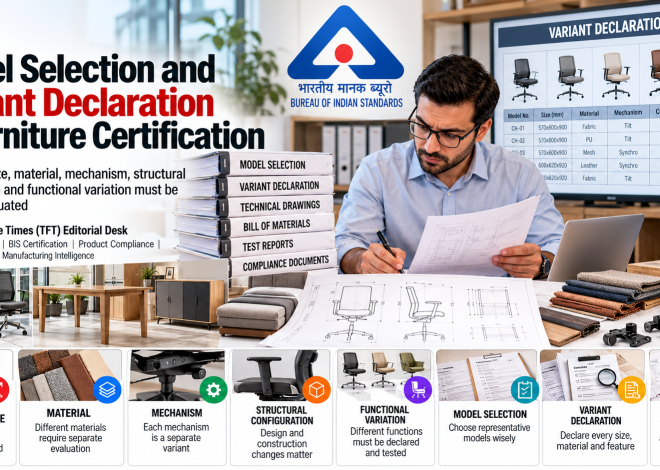
Seemingly minor differences can create a mechanically different product:
- With or without armrests
- Four legs versus sled base
- Solid wood versus tubular metal frame
- Upholstered seat versus rigid shell
- Fixed versus folding construction
- Low chair versus bar-height stool
- Fully welded versus knock-down assembly
Tables and desks — IS 17633:2022
The BIS product manual for this category identifies test areas including:
- Strength
- Durability
- Durability and stiffness under horizontal force
- Vertical impact
- Deflection of tabletops
- Durability of tables with castors
- Drop testing
It also describes control units in relation to the same performance category and model, demonstrating the connection between testing and production control.
Manufacturers should examine:
- Top span and thickness
- Frame-to-top connections
- Leg joints
- Cross-bracing
- Pedestal footprint
- Extension mechanisms
- Height-adjustment systems
- Folding locks
- Castors
- Glass-top support
- Cable-management cut-outs that weaken the top
Storage units — IS 17634:2022
Storage furniture introduces risks that may not appear in tables or chairs.
Important issues may include:
- Unit stability
- Drawer-extension effects
- Door loading
- Shelf strength
- Shelf-support security
- Carcass rigidity
- Drawer-stop performance
- Hinge and runner durability
- Mobile-unit performance
- Wall-anchoring provisions
- Locking or interlocking mechanisms
Changing the number, height or depth of drawers can materially alter the overturning risk. Changing the runner can change the extension distance and therefore the centre of gravity.
Beds — IS 17635:2022
Beds must transfer user loads through the mattress-support system, side rails, centre supports and end structures.
Mechanical concerns can include:
- Vertical static strength
- Repeated loading
- Impact on the sleeping surface
- Side-rail performance
- Joint security
- Slat strength
- Slat retention
- Centre-beam support
- Structural integrity of knock-down fittings
A bed tested with one slat system may not represent another version using fewer slats, wider spacing or different holders.
Bunk beds — IS 17636:2022
Bunk beds combine structural testing with significant user-safety considerations.
Potential assessments may address:
- Sleeping-surface strength
- Frame durability
- Guardrail strength and security
- Ladder or access performance
- Stability
- Openings and entrapment risks
- Gaps around the mattress
- Connection integrity
- Safe access
- Fall-prevention provisions
Mattress thickness can affect the effective height of the upper guardrail. It must therefore be controlled through product information and instructions where required.
A bunk bed should never be treated merely as two ordinary beds placed vertically.
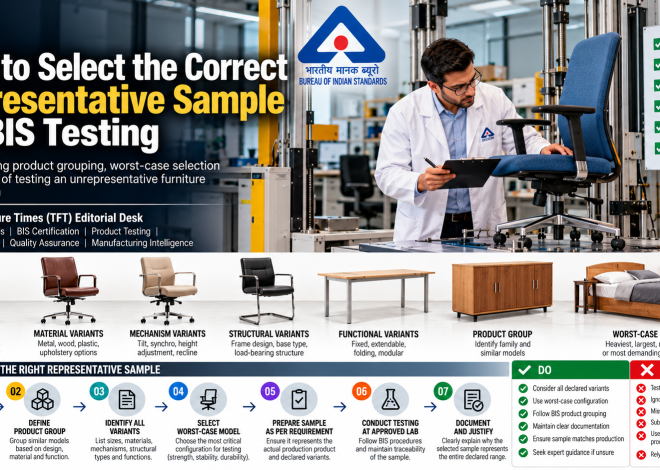
Testing the worst-case representative sample
A test result relates to the sample and the product scope it legitimately represents.
The strongest or most convenient model should not be selected simply because it is likely to pass.
Worst-case selection may need to consider:
- Largest unsupported span
- Highest configuration
- Narrowest base
- Greatest drawer extension
- Heaviest movable component
- Thinnest material
- Weakest joint arrangement
- Maximum load-bearing size
- Most complex mechanism
- Least favourable castor position
- Largest tabletop
- Tallest storage unit
- Longest bed rail
- Most demanding armrest configuration
The largest model is not always the worst case. A smaller base, taller seat, more extensive mechanism or less favourable geometry may create greater risk.
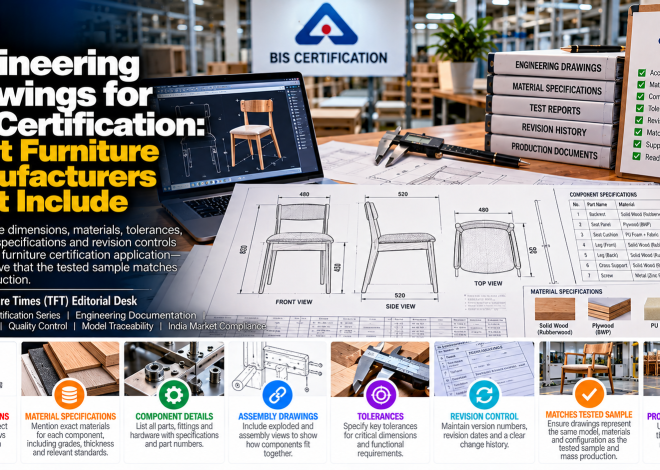
Representative-sample selection must be connected to the manufacturer’s grouping rationale, drawings, bill of materials and declared scope.
Before sending a sample to the laboratory
Manufacturers should complete an internal readiness review.
Product identity
Confirm:
- Product name
- Model number
- Variant code
- Intended use
- Performance category
- Dimensions
- Declared materials
- Mechanisms
- Assembly format
- Production location
Documentation
Prepare:
- Controlled engineering drawing
- Current bill of materials
- Component specifications
- Assembly instructions
- User instructions
- Model and variant declaration
- Internal inspection records
- Calibration records
- Supplier documentation
- Revision history
Physical sample
Verify that the sample:
- Comes from controlled production or a properly documented representative process
- Matches the submitted drawings
- Uses declared materials and hardware
- Contains no unapproved reinforcement
- Has the normal production finish
- Includes all components
- Uses the actual production assembly method
- Carries the correct model identification
- Is packaged to prevent transport damage
Pre-compliance testing
Where practical, conduct internal or third-party preliminary testing before the formal submission.
A basic pre-test can identify obvious weaknesses in:
- Joints
- Stability
- Fastener retention
- Welds
- Castors
- Mechanisms
- Slats
- Shelves
- Drawer runners
- Assembly instructions
Pre-testing should not be used to fabricate a special laboratory sample. Its purpose is to improve the production design.
What should happen after a failure?
A failed test should trigger structured engineering analysis.
Step 1: Preserve the evidence
Do not immediately dismantle or discard the sample.
Record:
- Failure location
- Test stage
- Applied condition
- Cycle number, where relevant
- Photographs
- Deformation
- Crack direction
- Joint movement
- Component lot
- Material batch
- Sample identity
Step 2: Determine the failure mode
Ask whether the failure resulted from:
- Material fracture
- Fatigue
- Buckling
- Fastener pull-out
- Thread stripping
- Adhesive separation
- Weld failure
- Excessive deflection
- Mechanism failure
- Geometric instability
- Assembly error
- Manufacturing variation
- Transport damage
- Incorrect conditioning
- Documentation mismatch
Step 3: Conduct root-cause analysis
Do not assume that the visibly broken component was the original cause.
A bolt may break because the frame was misaligned. A panel may crack because the fastener was positioned too close to the edge. A weld may fail because the load path created unexpected bending.
Step 4: Implement corrective action
Possible actions include:
- Redesigning the joint
- Increasing engagement length
- Changing section geometry
- Adding reinforcement
- Improving weld procedure
- Controlling adhesive quantity
- Revising tolerances
- Changing fastener specification
- Improving material grade
- Correcting assembly instructions
- Adding a production inspection
- Retraining operators
Step 5: Update controlled documents
Any design change must be reflected in:
- Drawings
- Bill of materials
- Specifications
- Work instructions
- Inspection plans
- Model declarations
- Revision records
Step 6: Retest the correct configuration
A modified sample should be tested under the applicable requirements. The manufacturer should not assume that a local repair solves every performance issue.
Why a laboratory pass is not the end
Certification depends on continuing conformity, not only one successful test report.
The factory must repeatedly manufacture products equivalent to the approved and tested construction.
Manufacturers should control:
- Incoming materials
- Component suppliers
- Material thickness
- Board density and grade
- Hardware specifications
- Weld quality
- Adhesive application
- Drilling positions
- Assembly torque
- Mechanisms
- Castors
- Critical dimensions
- Product identification
- Inspection records
- Nonconforming products
- Engineering changes
If the tested sample contains a 1.5 mm metal section but routine production uses a thinner section, the report does not validate the altered product.
If the tested chair uses one certified mechanism but purchasing later substitutes another without technical evaluation, the mechanical behaviour may change.
A test report is evidence of a particular configuration. Production control is what keeps that evidence relevant.
Common mechanical-testing mistakes
Furniture manufacturers should avoid the following:
- Sending the strongest variant rather than the correct representative model.
- Providing a handmade sample that does not reflect normal production.
- Adding hidden reinforcement only to the laboratory unit.
- Using different fasteners from those declared in the bill of materials.
- Ignoring stability because the product appears heavy.
- Treating one static load as proof of durability.
- Assuming a material certificate proves finished-product performance.
- Testing one model and informally extending the result to unrelated variants.
- Changing mechanisms, bases, castors or dimensions after testing.
- Failing to retain drawings and sample traceability.
- Treating cosmetic survival as proof of structural conformity.
- Repairing the sample during testing without proper reporting.
- Using an incorrect assembly method.
- Omitting wall-anchoring or installation provisions.
- Selecting a laboratory without confirming the relevant scope.
BIS maintains information on recognised laboratories and standard-wise testing scope. Manufacturers should verify that the selected laboratory is appropriate for the applicable standard and required tests.
A factory-level mechanical readiness checklist
Before applying for testing, management should be able to answer “yes” to the following:
Design control
- Is every model uniquely identified?
- Are drawings approved and revision-controlled?
- Are critical dimensions and tolerances defined?
- Have load paths and stress concentrations been reviewed?
- Are variants formally assessed?
Material control
- Are structural materials specified?
- Are alternative materials prohibited unless approved?
- Are component suppliers controlled?
- Are thickness, grade and dimensions verified?
- Can batches be traced?
Process control
- Are welding, drilling, gluing and assembly procedures documented?
- Are jigs and fixtures maintained?
- Are critical joints inspected?
- Are fastener type and torque controlled?
- Are nonconformities recorded?
Testing readiness
- Has the applicable standard been reviewed?
- Has the correct performance category been identified?
- Has the representative or worst-case model been justified?
- Has internal pre-testing been completed?
- Does the sample exactly match the submitted documents?
Change management
- Is engineering approval required before substitutions?
- Are revised drawings issued before production?
- Are suppliers prevented from making unauthorised changes?
- Is retesting considered when a critical feature changes?
- Can the factory distinguish current and obsolete documents?
Mechanical testing should improve the business
Mechanical testing is often viewed only as a regulatory expense. Used correctly, it can improve the commercial performance of the manufacturer.
A disciplined testing programme can help reduce:
- Product returns
- Warranty claims
- On-site repairs
- Customer complaints
- Structural failures
- Replacement costs
- Dealer disputes
- Product-liability exposure
- Reputational damage
It can also support:
- Better engineering
- Consistent production
- More reliable sourcing
- Stronger product information
- Longer furniture life
- Improved buyer confidence
- Export readiness
- Institutional procurement
- Hospitality and commercial projects
Compliance should therefore not be separated from product development. The factory that understands why its furniture performs safely gains knowledge that can improve future designs.
The final message for manufacturers
Strength, stability, durability, impact resistance and structural integrity are related, but they are not interchangeable.
A product can be:
- Strong but unstable
- Stable but insufficiently durable
- Durable under normal use but vulnerable to impact
- Made from strong materials but weakened by poor joints
- Mechanically sound in one size but unsafe in another
- Compliant as tested but nonconforming after an uncontrolled component change
That is why furniture certification requires disciplined control of the entire product configuration.
Manufacturers should begin with the applicable standard, design the product around its requirements, test representative configurations, investigate failures scientifically and ensure that routine production remains equivalent to the approved construction.
Mechanical testing should not be the moment when a manufacturer discovers how its product is built.
It should be the verification of engineering decisions already understood and controlled.
Test the declared product. Control the production product. Never assume that visual similarity guarantees mechanical equivalence.
Important Compliance Note
This report provides general industry education and does not constitute legal advice, certification approval or a substitute for an official Indian Standard. Requirements, test loads, cycles, conditioning procedures, acceptance criteria, implementation dates and exemptions must be confirmed from the latest BIS standard, product manual, Scheme of Inspection and Testing and applicable government notifications.