
The AI Visibility Risk: What Happens When Your Brand Stops Publishing?
The AI Visibility Risk: What Happens When Your Brand Stops Publishing?
Why outdated websites, incomplete product data, limited reviews and prolonged digital silence can make a business harder for search engines, AI assistants and potential customers to discover, understand and trust
By The Furniture Times (TFT) Editorial Desk
AI Visibility | Searchology | Brand Discovery | Product Data | Digital Reputation | Business News | Furniture Industry Intelligence
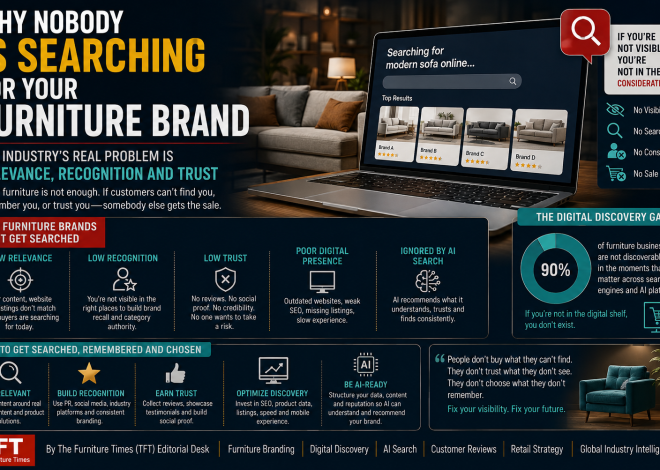
A business does not disappear when it stops publishing.
Its factory may continue producing. Its showroom may remain open. Its employees may continue working. Its products may still be available, and its sales team may continue contacting customers.
But digitally, the business can begin to fade.
An outdated website, incomplete product catalogue, abandoned newsroom, inconsistent business listings and lack of current reviews create an information vacuum. Customers encounter old information, search engines discover fewer useful updates and AI systems have limited public evidence from which to understand the company.
The risk is not merely losing website traffic.
The larger risk is becoming difficult to identify, classify, verify and recommend across an increasingly AI-assisted discovery environment.
Customers now ask systems questions such as:
- Which furniture manufacturers produce hotel furniture in Malaysia?
- Who supplies outdoor furniture for resorts?
- Which companies manufacture BIS-compliant furniture for India?
- Where can I find a commercial furniture installer?
- Which furniture brands have reliable customer reviews?
- Who produces repairable or sustainable office furniture?
- Which supplier can deliver replacement components?
To appear meaningfully in such discovery journeys, a business needs more than a company name and homepage.
AI systems need accessible information that explains:
- Who the business is
- What it sells
- Where it operates
- Which markets it serves
- What its products contain
- What evidence supports its claims
- Whether the information is current
- What customers and independent sources say about it
When a brand stops publishing, that information may become incomplete, outdated or absent.
Digital silence does not prove that a business is inactive—but it gives search engines, AI systems and customers less current evidence that the business remains relevant.
What is AI visibility?
AI visibility is the extent to which a business, product, expert, publication or source can be discovered, understood, retrieved, referenced or cited within AI-assisted experiences.
These may include:
- Google AI Overviews
- Google AI Mode
- Microsoft Copilot
- Bing AI summaries
- Conversational assistants
- AI-powered search tools
- Shopping assistants
- Procurement platforms
- Recommendation systems
- Industry-specific intelligence platforms
AI visibility is not a single ranking.
A business might:
- Rank in conventional search but rarely appear in AI answers.
- Be cited as a source without receiving many clicks.
- Be mentioned as a brand but not recommended.
- Have products indexed without having its company identity understood.
- Appear for branded questions but remain invisible for category searches.
Therefore, AI visibility should be evaluated across several outcomes.
| Visibility layer | Core question |
|---|---|
| Discovery | Can systems find the business and its pages? |
| Understanding | Can they identify what the company does? |
| Relevance | Is the business connected with the right topics and markets? |
| Retrieval | Can its information be selected for a relevant query? |
| Citation | Is its content referenced as a supporting source? |
| Recommendation | Is the brand presented as a possible option? |
| Verification | Can claims be supported by other credible information? |
| Conversion | Can the user take a meaningful next step? |
Publishing supports these layers by creating accessible information. It does not guarantee inclusion, citation or recommendation.
AI visibility still begins with search fundamentals
Businesses are frequently told that AI discovery requires a completely new optimisation system.
The reality is more grounded.
Google states that the same foundational SEO practices remain relevant for AI Overviews and AI Mode. To be eligible as a supporting link, a page must be indexed, technically accessible and eligible to appear in conventional Google Search with a snippet. developers.google.com
Google’s current generative-search guidance also emphasises:
- Helpful and reliable content
- Original experience and viewpoints
- Crawlability
- Clear technical structure
- Useful text
- Accurate structured data
- Strong page experience
- Relevant images and videos
- Non-duplicative information
It explicitly discourages producing large quantities of low-value pages designed mainly to manipulate search or AI responses. developers.google.com
The conclusion is important:
AI visibility is not created by adding the letters “AI” to an old SEO strategy. It is created by making the business technically accessible, factually understandable and genuinely useful.
What happens when a brand stops publishing?
Stopping publication does not trigger an automatic penalty.
Search engines do not require every company to publish daily news. A stable technical reference or product page may remain useful for years.
The risk develops when silence is combined with changing business reality.
If the company changes but its public information does not, a gap appears between:
- What the business currently does
- What the internet says it does
That gap can grow over time.
The website gradually becomes a historical document
An outdated website may show:
- Discontinued products
- Old prices
- Former locations
- Previous employees
- Expired promotions
- Obsolete certifications
- Closed showrooms
- Incorrect telephone numbers
- Old delivery coverage
- Services no longer offered
- No evidence of recent activity
Customers cannot confidently determine whether the information remains valid.
AI systems may retrieve the outdated page because no newer source exists. This can produce an inaccurate or incomplete representation of the business.
Competitors create more retrievable evidence
While one company remains silent, competitors may publish:
- New products
- Case studies
- Customer reviews
- Technical guides
- Company news
- Videos
- Project reports
- Product specifications
- Frequently asked questions
The silent company has not necessarily become less capable.
Its competitors have simply created more accessible evidence of relevance.
The brand becomes visible mainly for old information
A search for the company may return:
- A five-year-old news article
- An abandoned social profile
- An outdated directory listing
- Old customer complaints
- An expired job advertisement
- A discontinued product
When current information is absent, older material can disproportionately shape perception.
Sales teams must explain everything manually
Customers arrive with less understanding of:
- Products
- Experience
- Capabilities
- Projects
- Market coverage
- Differentiation
Salespeople must rebuild the information foundation during each conversation.
Brand memory weakens
Customers repeatedly encounter companies that remain active across:
- Search
- News
- Reviews
- Professional networks
- Industry platforms
- Social media
A silent brand receives fewer opportunities to be remembered.
Risk One: The outdated website
An outdated website is one of the clearest AI-visibility risks.
The website is often treated as the company’s primary source of official information. If it is incomplete, external systems and users have difficulty identifying the current truth.
Common warning signs
- Copyright year is several years old.
- Latest news is from before the pandemic.
- Products are unavailable.
- Images are broken.
- Contact forms do not work.
- The address is incorrect.
- Management profiles are outdated.
- Certifications have expired.
- Pages are not mobile-friendly.
- Important information exists only inside inaccessible PDFs.
- The site has no author, date or revision information.
- Structured data conflicts with visible content.
An attractive homepage does not solve these problems.
The website must provide current, machine-readable and human-understandable information.
What should be updated first?
Prioritise:
- Company identity
- Address and contact details
- Products and services
- Markets served
- Leadership
- Certifications
- Delivery and installation coverage
- Warranty and after-sales terms
- Current projects
- News and developments
The goal is not to change every page weekly. It is to ensure that important information reflects current reality.
Risk Two: Missing product data
Many furniture companies publish little more than product photographs.
A photograph may attract attention, but it does not fully explain the product.
AI systems and customers benefit from structured, descriptive information such as:
- Product name
- Model number
- Category
- Dimensions
- Materials
- Finish
- Colour options
- Intended use
- Indoor or outdoor suitability
- Load or performance information where appropriate
- Assembly requirements
- Commercial or residential application
- Care instructions
- Warranty
- Country of origin
- Availability
- Delivery region
- Replacement components
Without this information, the product becomes difficult to:
- Compare
- Filter
- Classify
- Retrieve
- Recommend responsibly
- Match to buyer requirements
Furniture images cannot carry the entire information burden
Consider an outdoor chair.
The image may not reveal whether it uses:
- Aluminium or steel
- Natural or synthetic rattan
- Outdoor-rated fabric
- UV stabilisation
- Stackable construction
- Replaceable components
- Residential or commercial specifications
A customer—and an automated system—should not have to guess.
Risk Three: Inconsistent product information
Missing data creates uncertainty. Conflicting data creates distrust.
A product may have:
- One model number on the website
- Another in the catalogue
- Different dimensions on a marketplace
- Different material claims on social media
- An old price in search results
- Different warranty terms from the salesperson
These inconsistencies can affect:
- Customer decisions
- Search indexing
- Marketplace feeds
- AI summaries
- Returns
- Warranty disputes
- Dealer confidence
Every important product should have one controlled source record.
That record can then supply:
- Website
- Catalogue
- Marketplace
- Sales system
- Dealer portal
- Structured data
- Customer support
- Advertising
Product information management is becoming part of AI visibility.
Risk Four: Limited customer reviews
A business can describe itself, but customers also want evidence from people who have purchased, received or used its products.
Reviews may provide information about:
- Product quality
- Comfort
- Delivery
- Installation
- Communication
- Warranty
- Repairs
- Durability
- Value
- Problem resolution
A company with few reviews creates a verification gap.
This is particularly significant for:
- High-value furniture
- Custom furniture
- Online purchases
- Cross-border sourcing
- Hospitality procurement
- Installation services
- New or unfamiliar brands
Review quantity is not enough
A trustworthy review system should consider:
- Authenticity
- Recency
- Specificity
- Relevance
- Customer photographs
- Business responses
- Resolution of complaints
- Platform transparency
Fake or incentivised reviews may create short-term appearance but long-term reputational risk.
Negative reviews do not automatically destroy visibility
A credible review profile will rarely be perfect.
Thoughtful responses to complaints can demonstrate:
- Accountability
- Customer service
- Willingness to solve problems
- Operational maturity
A business with no reviews can be harder to evaluate than one with a realistic mixture of experiences and professional responses.
Risk Five: No independent coverage
Owned channels are essential, but they are not the whole digital reputation.
A company’s website naturally presents the company’s own view.
Independent references can provide additional context through:
- Industry news
- Interviews
- Project coverage
- Association profiles
- Exhibition listings
- Partner references
- Customer case studies
- Government or institutional programmes
- Awards from credible organisations
A business with no independent references may still be excellent, but outsiders have fewer sources through which to verify it.
News coverage can create a public record of:
- Investment
- Product development
- Market expansion
- Certification
- Leadership
- Projects
- Industry contribution
The purpose is not to manufacture artificial praise. It is to document genuine activity.
Risk Six: Abandoned newsrooms
A company newsroom that ends several years ago can create the wrong signal.
Customers may wonder:
- Has the company stopped growing?
- Is it still operating?
- Did the management change?
- Are its products still available?
- Has it completed anything recently?
An abandoned newsroom can be worse than a modest but current one.
A company does not need to publish every week. It can maintain credibility through meaningful updates such as:
- Quarterly company news
- Completed projects
- Product improvements
- Industry commentary
- Technical guides
- Annual business reviews
- Certifications
- Appointments
- Partnerships
The publication frequency should match the organisation’s capacity.
Consistency is more sustainable than a burst of 50 articles followed by two years of silence.
Risk Seven: Weak business identity
AI systems and search engines may encounter different versions of the same company across the web.
Problems include:
- Trading name differs from legal name.
- Old address remains online.
- Founder name is written inconsistently.
- Website uses different descriptions on different pages.
- Social accounts link to old domains.
- Business listings have duplicate profiles.
- Parent company and brand relationship is unclear.
- Company categories are inconsistent.
This can fragment the organisation’s digital identity.
A clear business profile should specify:
- Official business name
- Brand name
- Parent company
- Founding date
- Founder or leadership
- Physical location
- Service areas
- Product categories
- Website
- Official contact channels
- Relevant registration information where appropriate
Consistency makes the company easier to understand.
Risk Eight: Thin and generic content
Publishing frequently does not help if the content adds little value.
Generic articles such as:
- Ten Furniture Trends
- Five Reasons to Buy a Sofa
- Best Furniture for Your Home
- Why Quality Matters
may be useful when written with original expertise, but they are often created from widely available information.
Google’s guidance for generative search encourages distinctive, experience-based and non-commodity content rather than material that simply restates what already exists. developers.google.com
A furniture company can contribute more useful content based on its actual experience:
- Why outdoor cushions fail in tropical climates
- What a hotel should inspect before accepting furniture delivery
- Five recurring failure points in commercial parasols
- How installation access changes sofa selection in condominiums
- What 1,000 warranty cases reveal about furniture hardware
- How different drawer runners affect storage-unit stability
Original experience creates stronger authority than generic volume.
Risk Nine: Important information hidden from crawlers
A company may have excellent information, but store it in formats that are difficult to discover.
Examples include:
- Product details only inside images
- Catalogues available only through WhatsApp
- Text embedded in graphics
- JavaScript interfaces that fail to render
- Password-protected product pages
- Unlinked pages
- PDF-only specifications
- Social-media posts with no website equivalent
Google advises site owners to make important content available as text, ensure internal links make pages findable and confirm that crawling is permitted. developers.google.com
A digital catalogue should not replace searchable website information.
The two should support one another.
Risk Ten: Old information can become the AI answer
AI systems may retrieve information available on the web at the time of the user’s question.
If the company does not publish current facts, the most accessible source may be outdated.
This can result in answers that contain:
- Old addresses
- Discontinued products
- Previous executives
- Expired promotions
- Incorrect market coverage
- Old business models
- Obsolete certifications
The system may be working with the available evidence. The company simply has not supplied a clearer current record.
Businesses should not assume that AI platforms “know” what changed internally.
If a change matters publicly, it should be documented publicly.
Freshness does not mean publishing daily
A furniture manufacturer is not a breaking-news organisation. It does not need to update every page every day.
Freshness should be applied according to information type.
| Information | Suggested review cycle |
|---|---|
| Contact details | Immediately after any change |
| Product availability | Continuous or frequent |
| Prices and promotions | Whenever changed |
| Certifications | Before expiry and upon renewal |
| Leadership | Immediately after changes |
| Delivery areas | Quarterly |
| Product specifications | Whenever revised |
| Warranty information | Whenever terms change |
| Company profile | Every six to twelve months |
| Technical guides | Annually or when standards change |
| Case studies | After meaningful projects |
| Newsroom | At least quarterly where practical |
| Customer reviews | Monitored continuously |
The objective is not publication for its own sake. It is information accuracy.
The compound effect of prolonged silence
Digital silence creates a gradual rather than immediate risk.
Month 1
Little may change. Existing pages and rankings continue.
Month 6
Product information becomes less competitive. Competitors publish more current material.
Year 1
The company’s newest searchable evidence may appear old. New products and capabilities remain undocumented.
Year 2
Customers may encounter outdated addresses, products and leadership information. Competitors possess a much richer content footprint.
Year 3
The business may be accurately known only within its existing network. Search and AI discovery reflect an outdated version of the company.
This progression is not guaranteed, but it illustrates why rebuilding visibility after a long absence can be difficult.
Competitors have not only published more articles. They have accumulated:
- More indexed pages
- More internal links
- More media references
- More reviews
- More brand searches
- More current product data
- More opportunities for citation
This is the visibility debt created by silence.
What AI systems need from a furniture brand
A furniture company should provide information at several levels.
Company level
- Who are you?
- Where are you located?
- What do you manufacture or sell?
- Which markets do you serve?
- What is your history?
- Who leads the business?
Product level
- What is the product?
- What materials are used?
- What are the dimensions?
- Where is it intended to be used?
- What options are available?
- How is it maintained?
Capability level
- Can you customise?
- What is your production capacity?
- Can you export?
- Do you install?
- Do you provide replacement parts?
- What standards or certifications apply?
Trust level
- Are customer reviews available?
- Are claims independently supported?
- Are warranties explained?
- Are complaints addressed?
- Are completed projects documented?
Transaction level
- How can a buyer contact the company?
- Where can the product be purchased?
- Is it in stock?
- Where can it be delivered?
- Can buyers request a quotation?
AI visibility without transaction readiness may create awareness without revenue.
A practical AI-visibility recovery plan
Phase 1: Correct the foundation
Audit:
- Business name
- Address
- Contact details
- Website security
- Indexability
- Mobile performance
- Broken links
- Duplicate listings
- Old profiles
Phase 2: Rebuild product information
For every priority product, publish:
- Name
- Model
- Category
- Dimensions
- Materials
- Options
- Applications
- Care
- Warranty
- Images
- Availability
- Contact or purchase action
Phase 3: Publish evidence
Create:
- Company profile
- Founder or leadership profile
- Factory information
- Project case studies
- Product-testing information
- Certifications
- Customer stories
- Industry news
Phase 4: Strengthen trust
Develop:
- Review collection
- Review responses
- Warranty transparency
- Customer-service information
- Complaints procedures
- Independent references
Phase 5: Build authority
Publish:
- Original research
- Technical guides
- Expert commentary
- Market analysis
- Experience-based insights
- Useful tools and checklists
Phase 6: Distribute and measure
Use:
- Industry publications
- Search Console
- Bing Webmaster Tools
- Business listings
- Professional networks
- Newsletters
- Sales channels
Track:
- Indexation
- Search impressions
- Branded searches
- Referral traffic
- Enquiries
- AI citations where measurable
- Product-page engagement
- Review growth
A 90-day publishing recovery programme
Days 1–30: Accuracy
- Correct company information.
- Remove expired promotions.
- Update products.
- Repair broken pages.
- Confirm indexing.
- Standardise brand descriptions.
- Update leadership and contact details.
Days 31–60: Evidence
- Publish two project case studies.
- Update the company profile.
- Add product specifications.
- Create a current capabilities page.
- Document certifications.
- Request genuine customer reviews.
Days 61–90: Authority
- Publish an expert guide.
- Release genuine company news.
- Contribute commentary to relevant media.
- Create internal links between related pages.
- Add structured data matching visible content.
- Measure search and referral performance.
After 90 days, adopt a sustainable monthly schedule.
Do not solve silence with content flooding
A company that has been inactive for years may try to publish hundreds of articles quickly.
This is rarely the best response.
The risks include:
- Repetitive content
- Weak fact-checking
- Generic AI-generated pages
- Conflicting information
- Poor indexing
- Low reader value
- Scaled-content spam concerns
A smaller number of accurate, original and commercially relevant pages is more useful.
Begin with the information customers need most.
Reviews, news and listings must work together
AI visibility is not built through one channel.
A complete system includes:
- Official website: the company’s controlled information
- News coverage: documented developments and independent context
- Industry listing: structured discovery
- Reviews: customer experience and reputation
- Product data: detailed understanding and comparison
- Technical SEO: crawlability and indexation
- Sales readiness: a clear path to contact or purchase
Each layer answers a different question.
| Layer | Question answered |
|---|---|
| Website | What does the company say about itself? |
| News | What has the company done recently? |
| Listing | Where does the company belong in the industry? |
| Reviews | What have customers experienced? |
| Product data | What exactly is being offered? |
| Technical SEO | Can systems access the information? |
| Sales process | What should the customer do next? |
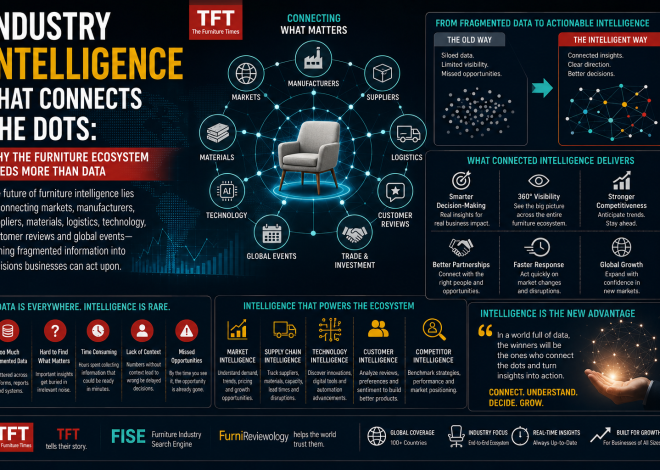
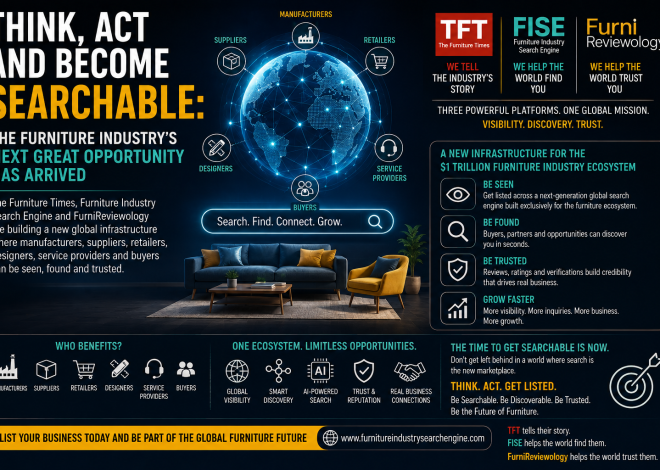
The TFT, FISE and FurniReviewology answer
The furniture industry ecosystem is enormous but digitally fragmented.
Thousands of capable companies remain absent from structured search, industry news and credible review systems.
The Furniture Times ecosystem is designed around three connected visibility needs.
The Furniture Times (TFT) publishes stories, market intelligence, company news and industry developments.
Furniture Industry Search Engine—FurnitureIndustrySearchEngine.com provides structured discovery for manufacturers, retailers, suppliers, designers, installers, logistics providers, artisans and other ecosystem participants.
FurniReviewology—Review. Trust. Decide. provides the reputation and customer-experience layer.
The Furniture Times—TFT tells their story.
Furniture Industry Search Engine—FISE helps the world find them.
FurniReviewology helps the world trust them.
Publishing creates current evidence. Structured listings create discoverability. Reviews create confidence.
Together, they reduce the risk of a capable furniture business becoming digitally invisible.
The final verdict
When a brand stops publishing, it does not instantly disappear from search or AI systems.
But over time, silence can create serious weaknesses:
- The website becomes outdated.
- Product information becomes incomplete.
- Reviews become old or remain absent.
- Competitors create more current evidence.
- Search results reflect the company’s past.
- AI systems have fewer reliable pages to retrieve.
- Customers find it harder to verify the business.
- Sales teams face colder conversations.
- Brand memory declines.
- Visibility debt accumulates.
The answer is not constant self-promotion.
The answer is a disciplined public-information system built around:
- Accurate business facts
- Complete product data
- Genuine news
- Original expertise
- Current reviews
- Independent references
- Technical accessibility
- Regular maintenance
A company should not publish merely to appear active.
It should publish because customers, search engines and AI systems need current evidence to understand what the business is capable of today.
A silent business may still be operating—but an AI system can only work with the information it can find, process and verify.
Keep the website current.
Keep product data complete.
Keep reviews growing.
Keep the company’s real progress documented.
Visibility is the new currency.
If you are not searchable, you do not exist.