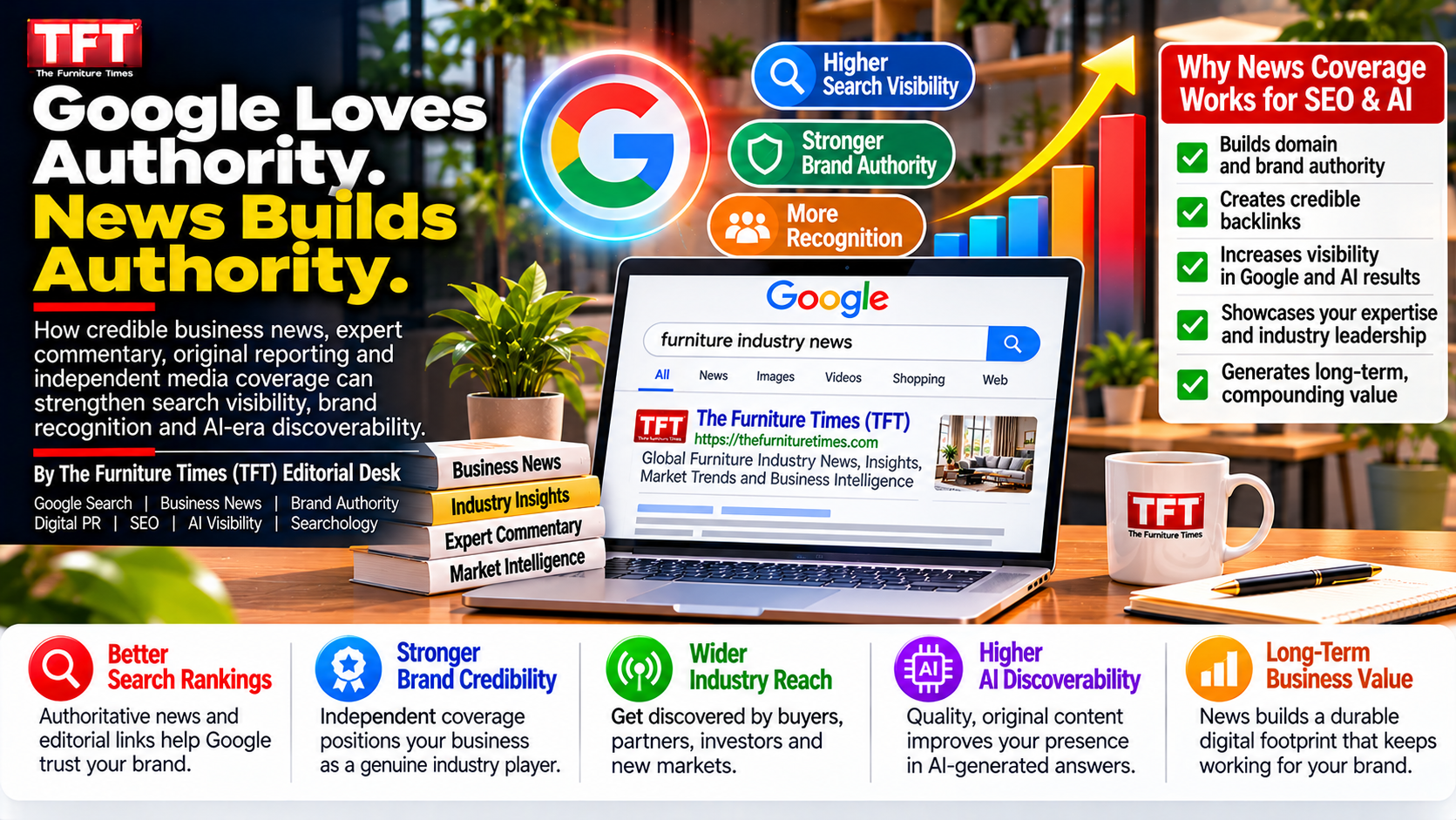
Google Loves Authority. News Builds Authority.
How credible business news, expert commentary, original reporting and independent media coverage can strengthen search visibility, brand recognition and AI-era discoverability
By The Furniture Times (TFT) Editorial Desk
Google Search | Business News | Brand Authority | Digital PR | SEO | AI Visibility | Searchology
“Google loves authority” is a popular expression in digital marketing.
It is memorable—but it requires explanation.
Google does not award rankings merely because a business calls itself an authority, publishes frequent press releases or displays logos from media websites. Nor does one news article automatically transform an unknown company into a trusted source.
Google’s systems examine many signals to determine which pages appear useful, relevant and reliable for a particular search. Its official guidance emphasises helpful, dependable, people-first content, technical accessibility, descriptive links and clear information that satisfies the searcher’s needs. developers.google.com
Authority is therefore not a badge that a company attaches to itself.
It is a reputation built through:
- Demonstrated experience
- Specialist knowledge
- Accurate information
- Original evidence
- Consistent identity
- Independent recognition
- Relevant links and citations
- Customer trust
- Useful public contributions
- A reliable history over time
Credible news coverage can support many of these elements.
News documents what a business has done, explains why it matters, connects the organisation with relevant topics and creates publicly accessible evidence that customers, search engines and AI systems can discover.
The principle is better expressed as:
Google seeks useful and reliable sources. Genuine news can help businesses build the public evidence, recognition and context associated with authority.
What authority means in search
Search authority is often confused with third-party SEO scores such as:
- Domain Authority
- Domain Rating
- Authority Score
- Trust Flow
- Citation Flow
These can be useful comparative indicators, but they are not official Google scores.
Google uses multiple automated ranking systems and evaluates many signals across hundreds of billions of pages. Its own guidance warns that site-level strength does not mean every page on a website will perform well. developers.google.com
A strong website can publish a weak article. A small website can publish the best answer to a specialised question.
Authority is therefore contextual.
A furniture-testing laboratory may be authoritative about mechanical testing but not about fashion. A manufacturer may be credible regarding its own production processes but less independent when reviewing its products. An industry publication may be authoritative about furniture-market developments while possessing little relevance to medical advice.
Search systems attempt to identify which source is useful for the specific topic and query.
Authority is earned through evidence
A business cannot establish authority simply by repeating:
- We are the best.
- We are industry leaders.
- We offer world-class quality.
- We are the number-one manufacturer.
- We provide unmatched service.
These statements are promotional and frequently unsupported.
Stronger evidence includes:
- A documented factory investment
- Original product testing
- Named completed projects
- Verified certifications
- Customer case studies
- Research methodology
- Transparent product specifications
- Expert commentary
- Independently reported developments
- Consistent customer reviews
- A history of useful publications
News can transform internal achievements into publicly accessible evidence.
Instead of saying:
“We are a leading sustainable furniture manufacturer.”
A credible report might explain:
The manufacturer installed a material-tracking system, reduced a measured category of waste, introduced repairable components and published the methodology used to calculate the results.
The second version gives readers something they can evaluate.
How news builds authority
1. News creates a public record
Many businesses possess real capabilities but leave almost no digital evidence.
Their experience exists in:
- The founder’s memory
- Private customer relationships
- Factory records
- Old catalogues
- Exhibition conversations
- WhatsApp messages
- Internal presentations
Search engines and prospective customers cannot reliably access this information.
News moves relevant facts into the public domain.
A series of credible reports can document:
- When the company was founded
- What it manufactures
- Where it operates
- Which markets it serves
- Who leads it
- Which projects it completed
- What investments it made
- Which certifications it obtained
- How its capabilities developed
Over time, these reports become a searchable corporate history.
2. News creates independent recognition
A company’s website is an owned channel. It is necessary, but customers understand that the company controls its content.
Independent media coverage adds another layer.
It does not automatically prove that every company claim is correct, but it can show that:
- The business is identifiable.
- Its activity has been reported publicly.
- Named people are associated with it.
- Its developments can be examined outside its website.
- Other sources recognise its relevance.
Independent recognition is stronger when the publication performs real editorial work rather than reproducing promotional copy without verification.
3. News creates contextual relationships
A well-written news article does more than mention a company name.
It connects the business to:
- An industry
- A location
- A product category
- A market development
- A technical specialisation
- A project type
- A business problem
- A leadership subject
For example, repeated credible references might connect a company with:
- Outdoor furniture
- Hospitality procurement
- Malaysia
- Resort projects
- Commercial parasols
- Furniture maintenance
- Tropical-climate materials
These contextual relationships help people—and potentially machines—understand what the company is known for.
4. News can earn relevant links
Search engines use links to discover pages and understand relationships between content.
Google states that links can help it find pages and assess relevance. It recommends crawlable HTML links, concise anchor text and sufficient surrounding context. developers.google.com
A genuine news report may link to:
- The company website
- A product page
- An original research report
- A project case study
- A certification
- A founder profile
- A technical resource
The strongest editorial links exist because they help the reader—not because someone purchased an exact-match keyword anchor.
5. News generates branded searches
A person who discovers a company through media coverage may later search for its name.
This can expand awareness and create further engagement with:
- The official website
- Business listings
- Product pages
- Interviews
- Reviews
- Social profiles
Branded search demand is a commercial asset because it indicates that people are looking for a specific organisation rather than only a generic product.
News does not guarantee a permanent increase in branded searches, but meaningful exposure gives audiences a reason to remember and investigate the brand.
6. News supports trust during customer verification
Before contacting an unfamiliar company, buyers frequently search:
- Company name
- Founder
- Reviews
- Projects
- Location
- Complaints
- Certifications
- News
- Products
A credible media footprint gives the buyer more information to evaluate.
An empty search result creates uncertainty.
A well-developed search presence may show:
- Official website
- Industry coverage
- Interviews
- Reviews
- Project reports
- Business profiles
- Technical articles
This does not remove the need for due diligence. It makes the company easier to understand and verify.
The authority chain
News can create a chain of reinforcing signals:
| Stage | What happens |
|---|---|
| Business activity | The company does something meaningful |
| Documentation | Facts, photographs and evidence are prepared |
| Editorial coverage | A publication explains the development |
| Discovery | Readers and crawlers encounter the story |
| Recognition | The company becomes associated with a topic |
| Verification | Buyers find supporting information |
| Engagement | Visits, searches, enquiries or references occur |
| Reputation | Repeated credible evidence accumulates |
| Authority | The company becomes a recognised source or participant |
The chain can break at any stage.
If there is no genuine business activity, the story lacks substance. If evidence is poor, the article becomes promotional. If the publication is inaccessible, discovery is limited. If the company website is weak, traffic does not convert.
News works best as one component of a complete authority system.
Not every news article builds authority
Publishing something called “news” does not automatically create credibility.
Weak coverage may contain:
- No genuine development
- Unsupported superlatives
- No named sources
- No dates or locations
- Duplicate text
- Artificial quotations
- Misleading statistics
- Paid links disguised as editorial references
- No useful information
- No clear publisher identity
A low-quality article may create a URL, but not meaningful authority.
A stronger article should answer:
- What happened?
- Who was involved?
- When did it happen?
- Where did it happen?
- Why does it matter?
- What evidence supports the claims?
- Who is affected?
- What happens next?
Authority grows through substance, not publication volume alone.
News must be written for people first
Businesses sometimes publish news mainly to target keywords.
This produces unnatural headlines and repetitive writing such as:
Best furniture manufacturer Malaysia launches the best Malaysian furniture products from the best furniture factory in Malaysia.
This does not establish expertise. It undermines it.
Google’s Search Essentials advises publishers to create helpful, reliable, people-first content and use relevant search language naturally in prominent places such as titles and headings. developers.google.com
A strong news article should prioritise:
- Accuracy
- Clarity
- Originality
- Relevance
- Readability
- Evidence
- Audience value
SEO should help people discover the story. It should not distort the story.
Original reporting is an authority asset
The internet contains enormous quantities of generic content.
Businesses and publications can distinguish themselves through information that others cannot easily reproduce.
Examples include:
- Original export data analysis
- Manufacturer surveys
- Customer-behaviour research
- Factory productivity studies
- Furniture-failure investigations
- Market interviews
- Procurement case studies
- Regional industry mapping
- Product-lifecycle analysis
- First-hand event reporting
- Local market observations
Google’s guidance for generative AI search recommends original, non-commodity content, distinctive points of view and first-hand experience rather than summaries that merely repeat what is already available. developers.google.com
A publication that consistently produces original industry intelligence can become a source that others:
- Quote
- Cite
- Link to
- Discuss
- Retrieve
- Reference in future reporting
This is how media authority compounds.
Expert commentary builds topical authority
News does not always require a large corporate announcement.
A knowledgeable professional can contribute authority through informed commentary on:
- Market conditions
- Regulation
- Product safety
- Materials
- Manufacturing
- Design
- Sustainability
- Retail
- Logistics
- Customer behaviour
- Technology
- Skills development
The commentary should offer more than a prediction.
Strong expert commentary contains:
- Direct experience
- Clear reasoning
- Practical implications
- Specific examples
- Acknowledged limitations
- Actionable recommendations
When experts explain industry developments consistently and accurately, they can become recognisable sources for journalists, customers and search audiences.
Founder profiles can build personal and company authority
In SMEs, the founder is often closely connected to the brand.
A credible founder profile can establish:
- Identity
- Experience
- Industry history
- Business philosophy
- Achievements
- Challenges
- Future vision
However, founder coverage should remain factual.
A profile that describes every founder as “visionary,” “world-renowned” and “leading” without evidence can weaken credibility.
The strongest founder stories include:
- Verifiable milestones
- Real lessons
- Difficult decisions
- Failures and recovery
- Specific contributions
- A clear mission
People trust stories that feel human and supported—not manufactured.
Authority is broader than backlinks
Backlinks remain useful, but authority cannot be reduced to link quantity.
A complete authority profile may include:
- Relevant editorial links
- Unlinked brand mentions
- Customer reviews
- Original research
- Searchable company information
- Consistent business details
- Author profiles
- Technical documentation
- Project case studies
- Expert citations
- Industry participation
- Business listings
- Awards from credible organisations
- Accurate structured data
- Strong internal linking
The objective is to build a coherent public identity.
If one article says the company is a manufacturer, another describes it as a retailer and a third uses a different business name and location, authority becomes fragmented.
Consistency matters.
Google News visibility and Google Search authority are not identical
A story appearing in Google News-related surfaces and a company ranking in ordinary Google Search are different outcomes.
A news publisher must establish:
- Clear editorial identity
- Original reporting
- Transparent authorship
- Publication dates
- Contact information
- Accessible article pages
- Consistent publishing practices
- Technical crawlability
A business featured in an eligible publication gains exposure, but the feature does not automatically cause its website to rank for competitive commercial keywords.
News coverage contributes to a broader authority strategy; it is not a shortcut around product quality, technical SEO or useful website content.
Paid news coverage: value and limitations
Businesses often pay for:
- Sponsored content
- Advertorials
- Press-release distribution
- Native advertising
- Media production
- Public-relations services
These can create legitimate benefits:
- Audience reach
- Brand awareness
- Searchable coverage
- Referral traffic
- Sales material
- Message control
However, commercial coverage should be transparent.
Google’s spam policies classify links created primarily to manipulate rankings as link spam. Paid or sponsored links should be appropriately qualified, and companies should avoid keyword-rich advertorial links intended to pass ranking credit. developers.google.com
A responsible media service should promise:
- Professional storytelling
- Publication
- Relevant audience access
- Distribution
- Brand visibility
It should not guarantee:
- Number-one Google rankings
- Permanent ranking improvement
- Guaranteed AI citations
- Automatic “domain authority” transfer
- Specific sales results
Authority cannot be purchased as a guaranteed ranking outcome.
How news supports AI visibility
Search is becoming more conversational.
People now ask AI systems:
- Which furniture manufacturers serve the hospitality sector?
- Who supplies outdoor furniture in Malaysia?
- Which businesses specialise in BIS furniture compliance?
- What companies manufacture sustainable furniture?
- Which publications cover global furniture-industry news?
AI-powered search systems need retrievable source material.
Google says its AI Overviews and AI Mode use existing Search systems, retrieve supporting pages and may perform multiple related searches to answer complex questions. A page must be indexed and eligible for a search snippet to appear as a supporting link. developers.google.com
News coverage can support AI visibility by creating:
- Crawlable information
- Current company developments
- Topic associations
- Named entities
- Original quotations
- Verifiable facts
- Source pages
- Supporting links
But the distinction is important:
News creates the possibility of being retrieved or cited. It does not guarantee that an AI system will select the article or recommend the business.
AI citations are becoming measurable
Microsoft introduced AI Performance reporting in Bing Webmaster Tools in 2026. It allows publishers to examine how their content is cited across Microsoft Copilot, Bing’s AI-generated summaries and selected partner experiences.
The reporting includes:
- Referenced URLs
- Citation counts
- Grounding-query phrases
- Visibility trends
Microsoft also clarifies that citation counts do not represent ranking, placement or page importance. blogs.bing.com
This signals an important change.
Digital visibility is no longer measured only through:
- Search positions
- Blue-link clicks
- Backlinks
- Website traffic
Businesses and publishers must increasingly examine whether their information is being used as a source in AI-mediated discovery.
Building an authority newsroom
Every serious company should consider maintaining an organised newsroom.
It should include:
- Company announcements
- Founder and leadership profiles
- Media coverage
- Project case studies
- Research
- Product developments
- Certifications
- Awards
- High-resolution photographs
- Media contact details
- Fact sheets
Each page should have:
- A descriptive title
- A visible publication date
- An author or responsible organisation
- Accurate information
- Useful supporting links
- Clear images
- Mobile accessibility
- A logical URL
- Internal links to related content
The newsroom becomes the company’s factual public record.
A 12-part authority-building news plan
A company can build an annual editorial programme around real developments.
- Company Profile — Who the business is and what it does
- Founder Interview — Experience, mission and leadership
- Factory or Facility Feature — Capacity and production systems
- Product Innovation — What is new and why it matters
- Project Case Study — Evidence of practical capability
- Customer Experience — Service and measurable outcomes
- Certification Story — Compliance and quality systems
- Market Commentary — Expert view on industry conditions
- Sustainability Report — Specific environmental actions
- Partnership Announcement — Commercial or technical collaboration
- Community or Workforce Story — Skills and local contribution
- Annual Review — Progress, lessons and future priorities
A company should not invent news merely to fill the calendar. If no major announcement exists, it can publish useful analysis, education or first-hand expertise.
Measuring whether news is building authority
Authority develops gradually, so measurement should extend beyond immediate orders.
Search indicators
- Branded search growth
- Search impressions
- Indexed articles
- Non-branded keyword visibility
- Search-result coverage
- New referring domains
- Relevant backlinks
- Improved crawl discovery
Audience indicators
- Article readership
- Engaged time
- Newsletter registrations
- Social sharing
- Direct traffic
- Returning visitors
Commercial indicators
- Enquiries mentioning media coverage
- Shorter trust-building cycles
- Higher proposal response
- Distributor enquiries
- Investor interest
- Partnership requests
- Recruitment applications
Reputation indicators
- Journalist requests
- Expert-quote invitations
- Citations by other publications
- Conference invitations
- Customer reviews
- Industry recognition
AI-discovery indicators
- AI citations where measurable
- Referral traffic from AI platforms
- Brand inclusion in relevant AI answers
- Questions for which the company appears
- Source pages frequently retrieved
No single metric establishes authority. The pattern matters.
Common mistakes that weaken authority
Publishing only promotional claims
Readers require information, not repeated praise.
Creating duplicate articles
Publishing identical releases across many low-quality sites adds little insight.
Using inconsistent business information
Different names, addresses and descriptions create confusion.
Hiding authorship
Readers should know who produced the content.
Neglecting the destination website
Media traffic is wasted when the official website is outdated.
Buying manipulative backlinks
Artificial link schemes can violate search policies.
Ignoring negative reviews
Authority requires credible customer experience, not only publicity.
Publishing without evidence
Unsupported statistics and achievements damage trust.
Stopping after one article
Authority is cumulative. One appearance provides exposure, not a complete reputation.
Expecting instant rankings
News coverage is a long-term visibility asset, not a guaranteed ranking switch.
Why this matters to the furniture industry
The global furniture industry remains fragmented.
Thousands of companies possess:
- Manufacturing capability
- Craftsmanship
- Design knowledge
- Material expertise
- Export experience
- Project records
- Local customer trust
But many remain digitally invisible.
Their websites contain little information. Their projects are undocumented. Their founders have no public profiles. Search engines cannot clearly categorise them. AI systems have little source material through which to understand them.
Consequently, the companies most frequently discovered are not always the most capable. They are often the companies with the strongest public information footprint.
The industry must close this visibility gap.
The Furniture Times as an authority-building infrastructure
The Furniture Times (TFT) exists to bring furniture brands, manufacturers, retailers, suppliers, designers, service providers and industry developments into the global spotlight.
TFT news coverage can help document:
- Business developments
- Manufacturing investment
- Product innovation
- Market intelligence
- Leadership
- Compliance
- Sustainability
- Retail transformation
- Furniture tourism
- Technology
- Customer experience
But news alone is only one layer.
Furniture Industry Search Engine—FurnitureIndustrySearchEngine.com provides the structured discovery layer.
FurniReviewology—Review. Trust. Decide. provides the reputation and customer-experience layer.
The relationship is straightforward:
The Furniture Times—TFT tells their story.
Furniture Industry Search Engine—FISE helps the world find them.
FurniReviewology helps the world trust them.
Storytelling creates understanding. Search creates discovery. Reviews strengthen confidence.
Together, they help furniture companies move from invisible to identifiable, searchable and trusted.
The final verdict
Google does not “love authority” as an abstract label.
Google’s systems attempt to surface pages that appear relevant, useful and reliable for the searcher’s particular need.
News can contribute to authority when it:
- Documents genuine developments
- Provides original information
- Uses identifiable sources
- Earns relevant recognition
- Creates useful contextual links
- Strengthens brand identity
- Supports customer verification
- Remains crawlable and accessible
- Adds knowledge to the industry
News does not build authority when it consists of:
- Unsupported claims
- Fake achievements
- Manipulative backlinks
- Repetitive promotional text
- Mass-distributed low-value articles
- Misleading sponsorship
- Content created only for search engines
The real formula is not:
Publish anything + receive a link = become authoritative.
The more accurate formula is:
Real expertise + documented evidence + useful news + independent recognition + consistent public information = stronger authority over time.
A company should not ask only:
“How do we make Google think we are an authority?”
It should ask:
“What valuable work have we done, what evidence can we publish, and how can we become genuinely useful to our market?”
Do the work.
Document the evidence.
Publish the story.
Earn the recognition.
Build the authority.
Visibility is the new currency.
If you are not searchable, you do not exist.