
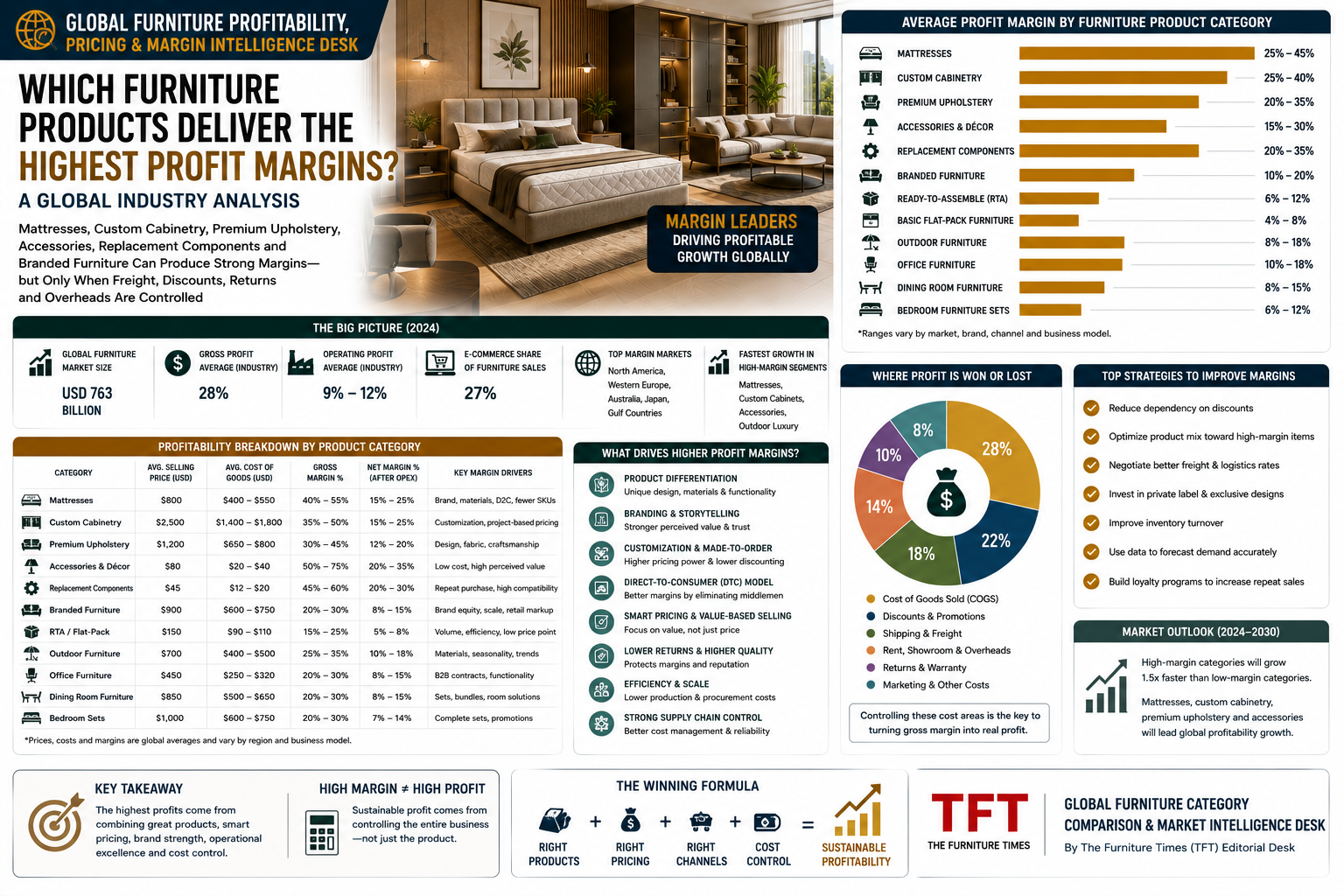
Which Furniture Products Deliver the Highest Profit Margins? A Global Industry Analysis
Mattresses, Custom Cabinetry, Premium Upholstery, Accessories, Replacement Components and Branded Furniture Can Produce Strong Margins—but Only When Freight, Discounts, Returns and Overheads Are Controlled
Global Furniture Profitability, Pricing & Margin Intelligence Desk
By The Furniture Times (TFT) Editorial Desk
Which furniture product delivers the highest profit margin?
There is no single answer that applies to every manufacturer, retailer, country or business model.
A vertically integrated mattress brand may achieve high gross margins because it manufactures, brands and sells directly to the consumer. A custom kitchen company may earn strong project margins through design, measurement and installation. A luxury furniture brand may command premium prices because customers value design, heritage and service. A factory producing standard wooden tables for export may operate on much thinner margins because buyers control the price and several competing factories can supply similar products.
The same product can also produce very different profitability for different businesses.
A sofa sold directly through a branded showroom may carry a higher gross margin than the same sofa supplied wholesale to a retailer. However, the direct seller must pay for:
- Showroom rent
- Sales staff
- Marketing
- Warehousing
- Home delivery
- Customer service
- Returns
- Warranty claims
The wholesale manufacturer receives less revenue per sofa but may avoid many of those costs.
This makes it essential to distinguish among several financial measures.
Gross Margin Is Not the Same as Net Profit
Furniture businesses frequently discuss markup, gross margin and net profit as though they mean the same thing. They do not.
Markup
Markup measures how much is added to the product’s cost.
If a chair costs US$100 and is sold for US$200, the markup is 100%.
Gross Margin
Gross margin measures gross profit as a percentage of the selling price.
Using the same example:
- Selling price: US$200
- Product cost: US$100
- Gross profit: US$100
- Gross margin: 50%
Operating Margin
Operating margin deducts operating expenses such as:
- Marketing
- Showroom rent
- Salaries
- Administration
- Warehousing
- Technology
- Customer service
Net Profit Margin
Net margin deducts nearly all business expenses, including interest and taxes.
A furniture business can report a strong gross margin and still earn little net profit if operating expenses are too high.
Current public-company results illustrate this difference. Ethan Allen reported a consolidated gross margin of 59.9% and an adjusted operating margin of 9.7% for the quarter ended June 30, 2025. Sleep Number reported a fourth-quarter 2025 gross margin of 55.6%, or 58.4% excluding an inventory-obsolescence charge, while Mattress Firm reported a gross margin of 30.8% and an operating margin of 4.4% for the same quarter. These figures come from different business models and cannot be compared as product-level margins, but they demonstrate how much profit can be absorbed after the initial gross profit is calculated.
The Furniture Profitability Equation
A product’s real profitability depends on more than factory cost.
A practical calculation should include:
Selling price
minus materials
minus direct labour
minus manufacturing overhead
minus packaging
minus freight
minus warehousing
minus sales commissions
minus discounts
minus returns
minus installation
minus warranty costs
minus marketing and administration.
Furniture companies often calculate a product margin before delivery and warranty costs are fully understood.
This can make an apparently profitable category economically weak.
For example, a large sofa may show a high gross margin at the warehouse, but profitability can fall because of:
- Large storage requirements
- Expensive last-mile delivery
- Failed delivery attempts
- Damage
- Customer returns
- Cushion complaints
- Fabric claims
- Disposal costs
A small furniture accessory may generate a lower gross profit in dollars but require little storage, simpler delivery and fewer warranty services.
Profit should therefore be measured through several perspectives:
- Gross profit per item
- Gross margin percentage
- Gross profit per cubic metre
- Gross profit per production hour
- Gross profit per showroom square metre
- Gross profit after delivery
- Gross profit after warranty
- Return on inventory investment
A Practical Ranking of High-Margin Furniture Categories
Under well-managed conditions, the following categories can offer some of the strongest margin opportunities:
- Branded mattresses and sleep systems
- Custom kitchens, wardrobes and built-in cabinetry
- Premium upholstered furniture
- Designer and luxury furniture
- Furniture accessories and decorative add-ons
- Replacement components and after-sales products
- Custom commercial and hospitality furniture
- Ergonomic and specialist office chairs
- Children’s convertible and specialised furniture
- Outdoor replacement cushions, covers and components
- Flat-pack and modular furniture sold directly
- Refurbishment, repair and reupholstery services
This is a strategic ranking rather than a universal published league table. Profitability depends on channel, scale, location and operating discipline.
1. Branded Mattresses and Sleep Systems
Mattresses are among the furniture industry’s most attractive margin categories because the physical product can be differentiated through:
- Brand
- Comfort technology
- Foam composition
- Spring systems
- Cooling materials
- Health and wellness positioning
- Trial periods
- Warranties
- Direct-to-consumer distribution
A current market estimate places the global mattress market at approximately US$57.31 billion in 2026, with projected growth to US$78.06 billion by 2031.
Why Mattress Margins Can Be Strong
High Perceived Value
Customers connect mattresses with sleep, health, comfort and wellbeing.
They may be willing to pay more when they believe the product will improve sleep quality.
Product Differentiation
Two mattresses may contain similar basic materials but be positioned very differently through:
- Construction
- Comfort
- Brand
- Certification
- Packaging
- Trial terms
Direct-to-Consumer Potential
Mattress brands can sell through:
- Branded stores
- Websites
- Marketplaces
- Hotel partnerships
- Healthcare channels
Vertically integrated direct sales can capture manufacturing and retail margins.
Sleep Number’s reported fourth-quarter 2025 gross margin of 55.6% shows the margin potential of a branded, vertically controlled sleep business, although it also shows that inventory decisions and operating expenses can materially affect results.
Margin Risks
- Heavy discounting
- Free delivery
- Long trial periods
- Returns
- Mattress disposal
- Store costs
- Customer-acquisition expenses
- Warranty claims
- Inventory obsolescence
Mattress Firm’s 30.8% gross margin and 4.4% operating margin in the fourth quarter of 2025 demonstrate that a high-volume mattress retail business may produce much thinner profitability than a premium vertically integrated brand.
Highest-Margin Mattress Opportunities
- Premium hybrid mattresses
- Adjustable sleep systems
- Smart beds
- Hospitality mattresses
- Senior and healthcare mattresses
- Custom-size mattresses
- Replacement toppers
- Pillows and sleep accessories
The accessory layer can be especially attractive because pillows, protectors and toppers are easier to store and deliver than mattresses.
2. Custom Kitchens, Wardrobes and Built-In Cabinetry
Custom cabinetry can produce strong margins because the customer is purchasing more than boards and hardware.
The complete offer may include:
- Consultation
- Measurement
- Design
- Visualisation
- Material selection
- Manufacturing
- Delivery
- Installation
- Project coordination
- Warranty
The supplier is paid for problem-solving and project management, not only manufacturing.
Why Custom Cabinetry Can Be Profitable
High Transaction Value
A kitchen or complete wardrobe system may include dozens of individual cabinets, drawers, doors, hinges and accessories.
Limited Direct Price Comparison
Custom projects differ in size, material and layout, making exact price comparisons difficult.
Local Service Advantage
Measurement, installation and after-sales service create a local competitive advantage that overseas online sellers cannot easily provide.
Upgrade Revenue
Customers may upgrade:
- Door finishes
- Worktops
- Drawer systems
- Lighting
- Handles
- Internal organisers
- Premium hardware
Custom cabinetry reportedly represents a rapidly growing part of the kitchen-cabinet market, with industry estimates indicating that premium custom builders can command materially stronger gross margins than commodity cabinet producers. However, the precise margin depends heavily on labour, installation efficiency and project control.
Margin Risks
- Incorrect measurements
- Site changes
- Delayed construction
- Installation errors
- Material wastage
- Remakes
- Customer change requests
- Slow payment
- Hardware failures
A single incorrectly measured cabinet can consume the profit from several correctly produced units.
Highest-Margin Cabinetry Opportunities
- Luxury custom kitchens
- Walk-in wardrobes
- Premium apartment fit-outs
- Home offices
- Entertainment walls
- Hotel joinery
- Retail fixtures
- Accessible kitchens and storage
- Refacing and renovation services
Cabinet refacing and door replacement can also be attractive because they improve an existing kitchen without reproducing every cabinet body.
3. Premium Upholstered Furniture
Sofas, sectionals, armchairs, recliners and upholstered beds can produce strong gross profit when supported by:
- Distinctive design
- High-quality fabrics
- Custom options
- Strong brand identity
- Direct retail
- Efficient manufacturing
Ethan Allen’s 59.9% consolidated gross margin in its fiscal 2025 fourth quarter illustrates the potential of a vertically integrated, design-led furniture company operating across manufacturing and retail. It should not be interpreted as the margin of every sofa or chair, but it shows the value of brand, channel control and product mix.
Why Upholstery Can Carry High Margins
Emotional Value
Customers are purchasing comfort, style and identity—not only timber, foam and fabric.
Fabric Upgrades
Fabric grades can increase the selling price substantially while the incremental material cost may be comparatively limited.
Modular Configurations
Customers may purchase several modules, increasing transaction value.
Customisation
Choices in:
- Fabric
- Colour
- Cushion firmness
- Configuration
- Leg finish
can support higher prices.
Margin Risks
Upholstery also carries serious hidden costs:
- Skilled labour
- High product volume
- Fabric wastage
- Delivery
- Damage
- Comfort complaints
- Sagging claims
- Returns
- Custom-order cancellations
Higher freight costs have directly pressured furniture-retailer margins, demonstrating that product markup alone does not protect profitability.
Most Attractive Upholstery Niches
- Modular sofas
- Performance-fabric family sofas
- Luxury armchairs
- Recliners and motion seating
- Upholstered beds
- Hotel lounge furniture
- Replacement covers
- Reupholstery
Replacement covers and cushions may generate stronger margin percentages than the original furniture because the customer already owns the frame and has fewer compatible alternatives.
4. Designer and Luxury Furniture
Luxury furniture can deliver high gross margins because pricing is driven by more than production cost.
The customer may pay for:
- Design authorship
- Brand heritage
- Scarcity
- Craftsmanship
- Premium materials
- Limited production
- Personal service
- Status
- Authenticity
Why Luxury Pricing Works
Luxury buyers do not compare every product using a cost-per-kilogram calculation.
They may select a piece because it represents:
- Artistic value
- Social identity
- Interior prestige
- Collectability
- Cultural meaning
High-Margin Luxury Categories
- Statement chairs
- Sculptural tables
- Limited-edition furniture
- Handcrafted solid-wood pieces
- Marble and stone furniture
- Luxury outdoor collections
- Bespoke hotel furniture
- Designer lighting and accessories
Margin Risks
Luxury products require expensive brand infrastructure:
- Flagship showrooms
- Interior designers
- Photography
- Exhibitions
- Public relations
- Samples
- White-glove delivery
- After-sales service
Luxury prices can produce strong gross margins but do not guarantee high net margins.
A brand that spends excessively to maintain prestige can remain financially weak.
5. Furniture Accessories and Decorative Add-Ons
Some of the furniture industry’s highest margin percentages can come from smaller complementary products rather than major furniture pieces.
Examples include:
- Cushions
- Furniture covers
- Throws
- Trays
- Small mirrors
- Organisers
- Chair pads
- Drawer dividers
- Replacement handles
- Table protectors
- Furniture-care products
Why Accessories Can Be Highly Profitable
- Lower material use
- Smaller packaging
- Easier e-commerce
- Lower freight
- Faster purchase decision
- Impulse-buy potential
- Fewer delivery failures
- Strong add-on selling
A customer buying a sofa may also purchase cushions, fabric protection, a care kit and a side table.
The additional products can improve the profitability of the entire order.
Margin Risks
- Easy imitation
- High competition
- Low selling price
- Trend sensitivity
- Inventory fragmentation
Accessories are most profitable when connected to a strong furniture brand or installed product base.
6. Replacement Components and After-Sales Products
Replacement parts can be among the most strategically profitable categories because customers already own the product and require compatible components.
Examples include:
- Sofa cushions
- Outdoor cushions
- Fabric covers
- Chair glides
- Drawer runners
- Hinges
- Handles
- Table leaves
- Lounger slings
- Parasol canopies
- Furniture feet
- Recliner mechanisms
Why Replacement Components Can Carry Strong Margins
Captive Compatibility
The customer may need a part that fits one particular product.
Lower Acquisition Cost
The company does not need to convince the buyer to purchase an entirely new furniture category.
Smaller Logistics
Many replacement components are easier to store and ship.
Brand Loyalty
Supporting older products can create trust and future purchases.
Strategic Opportunity
Furniture companies often focus on selling new products while ignoring the installed base.
A brand with 100,000 sofas in customer homes may possess a significant future market for:
- Covers
- Cushions
- Repairs
- Cleaning
- Replacement modules
After-sales products can transform one-time sales into recurring revenue.
7. Custom Commercial and Hospitality Furniture
Commercial furniture projects can deliver high gross-profit dollars because individual contracts may cover hundreds or thousands of products.
Examples include:
- Hotel rooms
- Restaurants
- Resort furniture
- Corporate offices
- Retail interiors
- Branded residences
- Healthcare spaces
Why Commercial Projects Can Be Profitable
Large Quantities
One approved design can be repeated across many rooms or locations.
Custom Design
Specialised products are harder to compare directly.
Additional Services
Revenue may include:
- Design development
- Prototypes
- Project management
- Logistics
- Installation
- Replacement stock
Long-Term Relationships
A successful hotel or corporate project can lead to:
- Renovation cycles
- New properties
- Replacement orders
- Regional expansion
Margin Risks
Commercial furniture can also be one of the most dangerous categories for cash flow and profitability.
Risks include:
- Competitive tendering
- Retention payments
- Long payment periods
- Prototypes
- Site delays
- Design changes
- Storage
- Installation
- Liquidated damages
- Defect claims
Office-furniture manufacturers may generate substantial revenue but operate at moderate profitability. S&P Global reported adjusted trailing EBITDA margins of approximately 9.3% for Steelcase and 15% for HNI in 2025, highlighting how commercial scale does not automatically create luxury-level margins.
Highest-Margin Commercial Opportunities
- Bespoke hotel public-area furniture
- Branded hotel room packages
- Luxury resort furniture
- Custom executive offices
- Healthcare specialist seating
- Acoustic booths
- Retail experience furniture
- Replacement and renovation programmes
The strongest commercial margin usually comes from specialised knowledge and project certainty, not basic commodity desks and chairs.
8. Ergonomic and Specialist Office Chairs
A standard office chair is highly competitive.
A specialist ergonomic chair can support higher margins because customers value:
- Adjustability
- Lumbar support
- Long-hour comfort
- Weight capacity
- Design
- Warranty
- Brand reputation
Attractive Segments
- Premium ergonomic chairs
- Executive chairs
- Healthcare seating
- Bariatric chairs
- Laboratory seating
- Industrial task chairs
- Gaming and creator chairs
Margin Advantages
- Technical differentiation
- Compact shipping relative to sofas
- Replacement components
- Corporate repeat orders
- Premium warranty positioning
Margin Risks
- Mechanism failures
- Warranty claims
- Copycat products
- Online price comparison
- Certification and testing costs
The US office-furniture market is projected by one estimate to grow from approximately US$17.5 billion in 2026 to US$27.7 billion by 2033, supported by hybrid-workplace redesign.
9. Children’s Convertible and Specialised Furniture
Children’s furniture can provide attractive margins when it combines safety, adaptability and strong design.
Examples include:
- Cots that convert into beds
- Adjustable study desks
- Bunk beds with storage
- Montessori-style furniture
- Modular children’s wardrobes
- Themed furniture
Why It Can Be Profitable
Parents may pay more for products they believe are:
- Safer
- Durable
- Adaptable
- Developmentally appropriate
- Made from trusted materials
Convertible products can be positioned around longer useful life.
Margin Risks
- Strict safety requirements
- Liability
- Product recalls
- Short trend cycles
- Changing child dimensions
- High customer expectations
Safety testing and honest age guidance are essential. High margin must never be pursued by reducing structural quality.
10. Outdoor Cushions, Covers and Replacement Systems
Outdoor furniture frames can remain usable long after cushions, slings or canopies deteriorate.
This creates a valuable replacement market.
Attractive Products
- Replacement cushion sets
- Performance-fabric covers
- Protective covers
- Lounger slings
- Parasol canopies
- Rope replacement kits
- Teak-care products
- Furniture glides and feet
Why Margins Can Be Strong
- Customers already own the main product
- Shipping is easier than complete furniture
- Climate exposure creates recurring demand
- Custom colours can support premium prices
- Hospitality properties require replacements regularly
The business becomes even more attractive when the original manufacturer maintains standard dimensions and product records.
11. Flat-Pack and Modular Furniture Sold Directly
Flat-pack furniture is often associated with low prices, but a well-designed direct-to-consumer system can be profitable because it reduces:
- Shipping volume
- Warehouse space
- Handling
- Assembly labour before delivery
IKEA recorded retail sales of €44.6 billion in FY2025, with higher sales volume following price reductions. Inter IKEA reported that lower wholesale prices reduced its gross margin, demonstrating that flat-pack scale can be powerful but remains sensitive to affordability strategy, raw materials and pricing.
Higher-Margin Flat-Pack Opportunities
- Modular shelving
- Home-office furniture
- Storage systems
- Children’s furniture
- Compact dining
- Apartment furniture
- Expandable wardrobes
Margin Risks
- Price competition
- Customer assembly complaints
- Missing hardware
- Damaged panels
- High return rates
- Commodity positioning
Flat-pack products become more profitable when the business combines logistics efficiency with good design, clear instructions and replacement parts.
12. Repair, Reupholstery and Refurbishment Services
Service-based furniture businesses can generate strong margins because they add labour and expertise to an existing product rather than manufacturing everything from new materials.
Services include:
- Sofa reupholstery
- Timber refinishing
- Cushion replacement
- Cabinet refacing
- Hotel furniture refurbishment
- Office furniture reconfiguration
- Antique restoration
- Outdoor furniture repair
Why Services Can Be Profitable
- Lower raw-material requirements
- Local-service advantage
- Difficult price comparison
- Sustainability value
- Existing customer relationship
- Premium craftsmanship
Margin Risks
- Skilled-labour shortages
- Uncertain condition of old products
- Difficult quotations
- Site transport
- Customer expectations
- Time overruns
A repair business must inspect products carefully before committing to a fixed price.
Products That Often Produce Lower Margins
Some furniture categories can generate large revenue but remain highly competitive.
Commodity Dining Chairs
Margins can be pressured by:
- Many suppliers
- Easy visual comparison
- Bulk retail negotiations
- High damage risk
- Low product differentiation
Basic Flat-Pack Cabinets
Large retailers can use purchasing scale and automated production to reduce prices.
Small manufacturers may struggle to compete.
Standard Office Desks
Corporate tenders often focus heavily on price, especially when specifications are similar.
Basic Metal Beds
Competition is intense and products are easy to compare.
Low-Cost Plastic Furniture
High-volume moulding can be profitable at scale, but smaller producers face:
- Tooling costs
- Commodity pricing
- Raw-material volatility
- Low brand loyalty
Bulky Low-Value Furniture
A product can become unprofitable when its freight and storage costs are too high relative to its selling price.
Examples may include:
- Low-cost sofas
- Large budget wardrobes
- Fully assembled low-price tables
- Oversized promotional furniture
The Margin Difference Between Manufacturing and Retail
Manufacturer Economics
Manufacturers must manage:
- Materials
- Labour
- Machinery
- Factory overhead
- Quality
- Packaging
- Wholesale pricing
They may operate on thinner margins but larger volume.
Retailer Economics
Retailers can apply larger markups but must pay for:
- Showrooms
- Advertising
- Sales staff
- Warehousing
- Delivery
- Returns
- Customer service
Vertically Integrated Economics
A company that designs, manufactures and retails its own furniture may capture more of the value chain.
It also carries more operational risk.
The strong reported gross margins of businesses such as Ethan Allen and Sleep Number reflect, in part, the value of vertical integration and brand control, but their operating margins remain much lower than gross margins after selling and administrative expenses.
Direct-to-Consumer Versus Wholesale Margins
Wholesale
Advantages:
- Larger orders
- Lower marketing cost per unit
- Fewer individual customers
- Simpler customer service
Disadvantages:
- Lower selling price
- Retailer bargaining power
- Payment delays
- Limited customer data
Direct-to-Consumer
Advantages:
- Higher selling price
- Customer relationship
- Product data
- Upselling
- Brand control
Disadvantages:
- Marketing expense
- Showroom or e-commerce investment
- Last-mile delivery
- Returns
- Customer support
A manufacturer should not assume that removing the retailer automatically creates more profit.
The manufacturer must replace every function previously performed by the retailer.
The Products With the Best Gross Profit per Cubic Metre
Furniture companies should consider space efficiency.
A product occupying a large warehouse volume may generate less profit per cubic metre than a compact accessory.
Potentially strong categories include:
- Furniture hardware
- Cushions
- Covers
- Small side tables
- Flat-pack shelving
- Decorative furniture accessories
- Replacement parts
- Premium office chairs in efficient packaging
Products with weak profit per cubic metre may include:
- Low-cost assembled sofas
- Large low-priced wardrobes
- Oversized display furniture
- Bulky outdoor products
This measure is especially important where warehouse and container costs are high.
The Products With the Best Profit per Labour Hour
Labour efficiency also matters.
A handcrafted product may carry a premium price, but it can still be unprofitable if production consumes too many hours.
Potentially strong labour-return categories include:
- CNC-produced modular cabinetry
- Standardised upholstered beds
- Flat-pack furniture
- Moulded chairs
- Repeat commercial products
- Replacement components
Potentially weak categories include:
- One-off custom pieces with poor pricing
- Complex upholstery
- Low-priced handwoven furniture
- Highly customised projects with repeated revisions
Craftsmanship should be priced according to the real labour required.
How Discounts Destroy Furniture Margins
Furniture retailers often use discounts to create urgency.
However, discounting has a disproportionate effect on profit.
Consider a product priced at US$1,000 with a cost of US$600:
- Gross profit: US$400
- Gross margin: 40%
A 10% discount reduces the selling price to US$900:
- Gross profit: US$300
The selling price fell by 10%, but gross profit fell by 25%.
A 20% discount reduces the price to US$800:
- Gross profit: US$200
The selling price fell by 20%, but gross profit fell by 50%.
Furniture companies should therefore calculate how many additional units must be sold to recover the profit lost through discounts.
Hidden Costs That Reduce Furniture Profitability
Freight
Bulky products may be expensive to move internationally and locally.
Damage
Glass, stone, panels and finished surfaces can be damaged during delivery.
Returns
Furniture returns can require collection, inspection, repair, repackaging and resale at a discount.
Warranty
Mechanisms, upholstery and hardware can generate claims years after the sale.
Inventory
Slow-moving sizes, colours and styles tie up cash.
Samples and Displays
Retailers may need showroom models that cannot later be sold at full price.
Customer Acquisition
Online furniture sales may require substantial advertising because buyers compare many brands.
Installation
Incorrect site information can make installation unprofitable.
Regional Differences in High-Margin Products
North America
Strong opportunities include:
- Premium mattresses
- Upholstery
- Recliners
- Kitchens
- Home offices
- Outdoor furniture
- Senior-friendly furniture
Europe
Potentially attractive categories include:
- Kitchens
- Certified wood furniture
- Designer furniture
- Modular storage
- Repair and refurbishment
- Circular office furniture
Asia-Pacific
Strong opportunities include:
- Apartment storage
- Mattresses
- Modular furniture
- Custom cabinetry
- Hospitality furniture
- Children’s furniture
- Smart furniture
Middle East
High-value opportunities include:
- Luxury residential furniture
- Custom joinery
- Hotel furniture
- Outdoor collections
- Stone and metal furniture
- Bespoke interiors
Africa
Potential opportunities include:
- Mattresses
- Durable affordable furniture
- Institutional furniture
- Local custom production
- Repair and refurbishment
Profitability depends on affordability and local supply chains.
Latin America
Promising categories include:
- Upholstery
- Mattresses
- Kitchens
- Local solid-wood furniture
- Hospitality products
- Custom residential furniture
The Most Profitable Furniture Business Models
Brand-Led Vertical Integration
The company controls design, production, marketing and retail.
Potential advantage:
- Higher gross margin
- Stronger customer relationship
- Better product control
Custom Project Model
The company sells design, manufacturing and installation together.
Potential advantage:
- Higher transaction value
- Lower direct price comparison
- Service revenue
Platform and Marketplace Model
The business earns commissions without owning every product.
Potential advantage:
- Lower inventory exposure
- Broad catalogue
Furniture-as-a-Service
The provider retains ownership and earns recurring payments.
Potential advantage:
- Recurring revenue
- Refurbishment value
- Long-term customer relationship
After-Sales Model
The business earns from replacement parts, repair and refurbishment.
Potential advantage:
- Lower customer-acquisition cost
- Strong installed-base value
How to Identify a High-Margin Product Opportunity
Furniture companies should ask:
- Can the product be differentiated?
- Does the customer perceive high value?
- Is exact price comparison difficult?
- Can it be customised efficiently?
- Is the product expensive to store?
- Is delivery difficult?
- What is the return rate?
- What warranty claims are likely?
- Can replacement parts create future revenue?
- Can the product be sold directly?
- Does it require expensive customer acquisition?
- Is production repeatable?
- Can materials be purchased consistently?
- Is the product seasonal?
- Does the business have the skills required?
A Practical Profitability Scorecard
Every product should be scored across:
Revenue Potential
- Selling price
- Annual unit demand
- Repeat purchase
Gross-Margin Potential
- Material cost
- Labour cost
- Pricing power
Operational Cost
- Packaging
- Storage
- Delivery
- Installation
Risk
- Returns
- Damage
- Warranty
- Fashion obsolescence
Strategic Value
- Brand visibility
- Cross-selling
- Replacement parts
- Customer retention
A product with moderate gross margin and low risk may be more valuable than a product with high theoretical margin and frequent claims.
Strategic Priorities for Manufacturers
Manufacturers should:
- Calculate margin after packaging and freight.
- Track labour hours by product.
- Measure material yield and wastage.
- Identify the most profitable configurations.
- Reduce unprofitable custom options.
- Standardise hidden components.
- Build replacement-part programmes.
- Price prototypes and samples properly.
- Separate commercial and residential costs.
- Avoid low-margin projects that block factory capacity.
- Improve product packaging.
- Analyse warranty claims by model.
- Develop direct-sales channels carefully.
- Create accessory and service revenue.
- Stop measuring success through sales revenue alone.
Strategic Priorities for Retailers
Retailers should:
- Measure gross profit after delivery.
- Track showroom productivity.
- Identify products with high return rates.
- Reduce unnecessary discounting.
- Build profitable add-on sales.
- Offer furniture-care products.
- Develop replacement-cover and cushion services.
- Train sales teams to sell value.
- Remove slow-moving variants.
- Improve customer measurement guidance.
- Negotiate supplier warranty support.
- Track profit per cubic metre.
- Develop private-label products.
- Use financing without hiding its cost.
- Measure customer lifetime value.
Highest-Margin Categories by Strategic Measure
Highest Potential Gross-Margin Percentage
- Branded mattresses
- Luxury furniture
- Accessories
- Replacement parts
- Specialist furniture
Highest Gross Profit per Transaction
- Custom kitchens
- Complete wardrobes
- Hotel room packages
- Luxury sofas
- Executive offices
Highest Repeat-Revenue Potential
- Mattress accessories
- Replacement cushions
- Covers
- Hardware
- Repair services
- Furniture subscriptions
Highest Profit per Cubic Metre
- Accessories
- Replacement parts
- Flat-packed products
- Care products
- Small premium furniture
Highest Service-Margin Potential
- Design
- Installation
- Cabinet refacing
- Reupholstery
- Refurbishment
- Space planning
The Highest Selling Price Does Not Guarantee the Highest Profit
A marble dining table may sell for a high price, but it also requires expensive stone, reinforcement, packaging, freight and installation.
A luxury sofa may have an impressive markup, but showroom and delivery costs can be substantial.
A custom hotel project may generate millions in revenue, but delays and payment retention can place severe pressure on cash flow.
A replacement cushion may appear commercially small, but it can offer:
- Low material cost
- Easy shipping
- Strong customer need
- Limited compatible alternatives
- Low marketing cost
The most profitable furniture product is therefore not always the most expensive product.
The Future of Furniture Profitability
Future margin growth will increasingly come from business models that combine products with services.
Examples include:
- Furniture plus installation
- Mattress plus sleep accessories
- Sofa plus replaceable covers
- Outdoor furniture plus replacement cushions
- Kitchen plus maintenance and refacing
- Office furniture plus reconfiguration
- Hotel furniture plus renovation support
- Furniture plus take-back and resale
Manufacturers will also need to manage margin pressure from:
- Freight volatility
- Tariffs
- Raw-material costs
- Wage growth
- Online price transparency
- Sustainability requirements
- Longer warranty expectations
Inter IKEA’s FY2025 reporting noted that lower wholesale prices reduced gross margin even as volume increased, while furniture businesses in other markets reported freight and tariff pressures. This shows that revenue growth and unit growth do not automatically produce stronger profitability.
Profit Is Created Before the Product Is Sold
Furniture profit begins during product development.
It is influenced by:
- Number of components
- Material yield
- Production time
- Packaging dimensions
- Repairability
- Product weight
- Variant complexity
- Replacement availability
A poorly designed product can create hidden costs throughout its life.
A well-designed product can:
- Use fewer materials
- Produce less waste
- Pack efficiently
- Install quickly
- Generate fewer claims
- Support replacement sales
The product-development team is therefore part of the profitability team.
The Most Profitable Furniture Companies Sell Confidence and Continuity
Mattresses can deliver strong margins because customers value sleep and trust.
Custom kitchens can deliver strong margins because customers value design, measurement and installation.
Luxury furniture can deliver strong margins because customers value identity and craftsmanship.
Replacement parts can deliver strong margins because customers value compatibility and continuity.
Refurbishment can deliver strong margins because customers value extending the life of existing products.
Across all these categories, the common factor is not the material.
It is the ability to provide value that customers cannot easily obtain from the cheapest competing product.
The strongest furniture margins are created when a company possesses:
- Brand authority
- Product knowledge
- Design differentiation
- Operational efficiency
- Direct customer relationships
- After-sales capability
- Pricing discipline
The furniture products with the highest profit margins are not necessarily those made from the most expensive materials. They are the products whose design, brand, service and lifecycle value allow the company to charge confidently while controlling every hidden cost behind the sale.
