Why Furniture Components Are Becoming a Strategic Industry
The Small but Essential Products Determining Furniture Quality, Performance, and Value
By The Furniture Times (TFT) Editorial Desk | Furniture Components & Accessories | Global Industry Intelligence
The global furniture industry is often judged by what consumers can immediately see: the shape of a sofa, the finish of a table, the fabric on a chair, the colour of a wardrobe, or the visual elegance of a kitchen. Yet the true quality of furniture is frequently determined by what remains hidden beneath the surface.
Inside every cabinet, sofa, bed, office chair, kitchen, wardrobe, recliner, workstation, or outdoor furniture product is a network of components that controls how the furniture functions, moves, supports weight, withstands daily use, and performs over time.
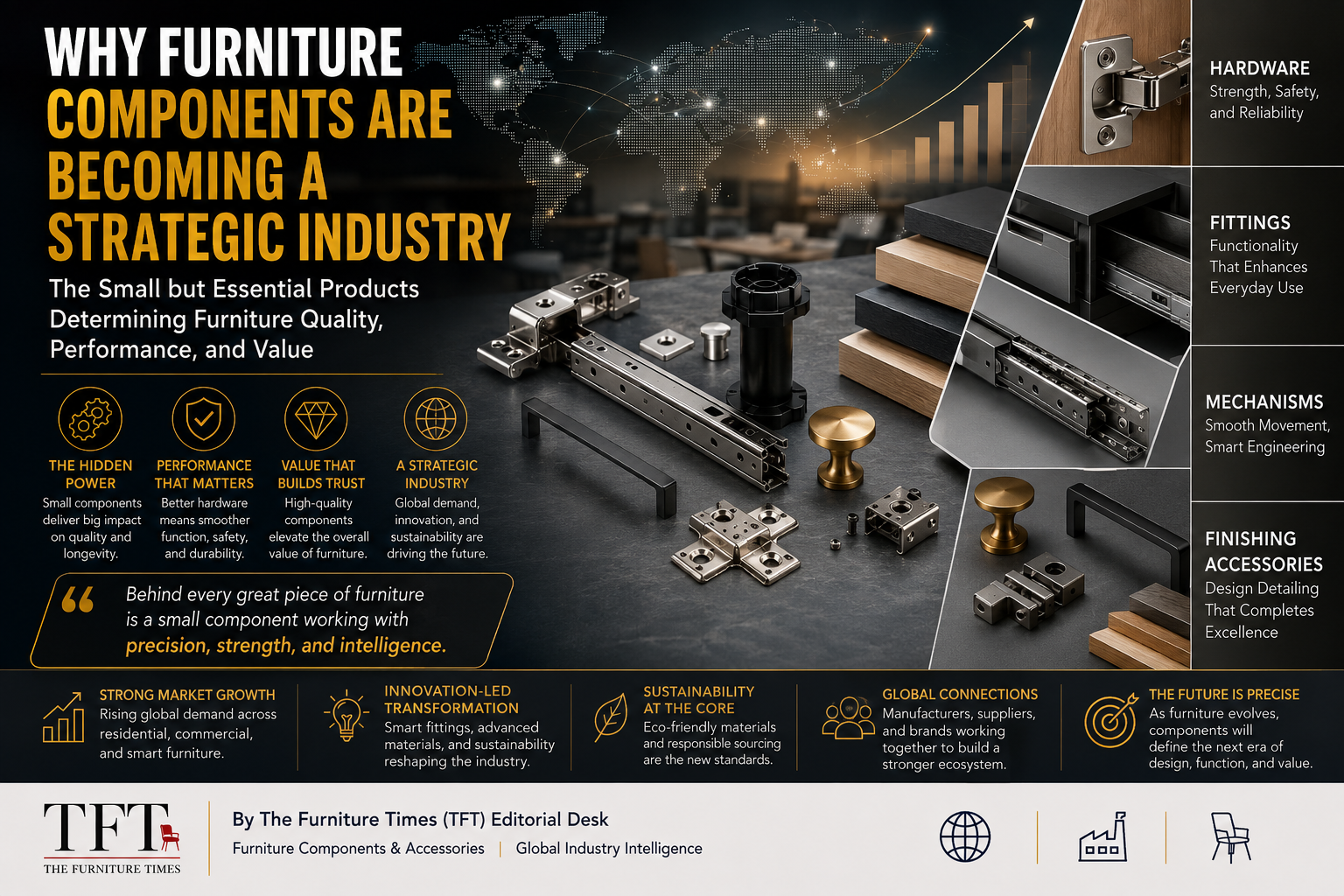
Hinges determine whether cabinet doors remain aligned. Drawer slides influence how smoothly storage units open and close. Connectors hold panels and frames together. Castors control mobility. Gas lifts adjust seating height. Recliner mechanisms create movement and comfort. Furniture legs and bases provide stability. Upholstery foam, springs, and webbing shape the seating experience. Handles, profiles, trims, and decorative fittings define the final visual identity.
These products may be small, but their economic and technical significance is enormous.
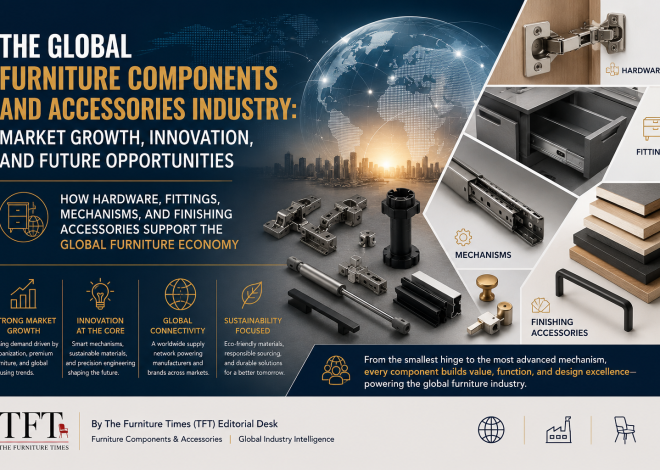
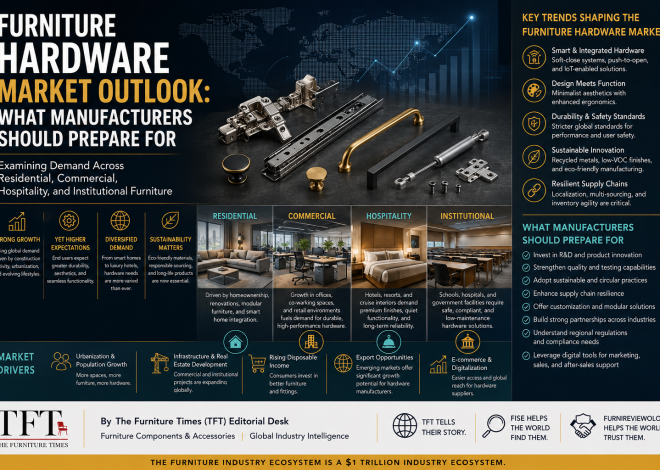
Furniture components and accessories are becoming a strategic industry because they connect almost every major priority facing the global furniture ecosystem: quality, productivity, automation, sustainability, customisation, e-commerce, repairability, safety, smart technology, supply-chain resilience, and customer trust.
The future of furniture will not be shaped by finished products alone. It will also be shaped by the engineering intelligence hidden inside them.
From Supporting Products to Strategic Infrastructure
For decades, many furniture businesses treated hardware, fittings, fasteners, mechanisms, and internal accessories primarily as procurement items. Purchasing teams were often instructed to find acceptable components at the lowest possible cost.
That approach is becoming increasingly risky.
A furniture component is not merely another item on a factory’s purchasing list. It can directly affect:
- Product durability
- Manufacturing speed
- Assembly accuracy
- Installation time
- User safety
- Furniture movement
- Structural stability
- Comfort and ergonomics
- Product appearance
- Maintenance requirements
- Warranty expenses
- Customer satisfaction
- Online reviews
- Brand reputation
- Repairability and recyclability
When a component performs well, the customer may never think about it. When it fails, the entire furniture product can appear defective.
A customer does not usually separate the hinge from the cabinet brand or the drawer slide from the kitchen manufacturer. If a wardrobe door falls out of alignment, the customer blames the wardrobe. If the castors on an office chair break, the chair brand carries the reputational damage. If a recliner mechanism becomes unreliable, the finished furniture brand receives the complaint.
This makes component selection a strategic brand decision.
Every Furniture Category Depends on Specialised Components
The furniture components industry is not confined to conventional cabinet hardware. It supports a vast range of residential, commercial, institutional, and specialised furniture.
Kitchen Furniture
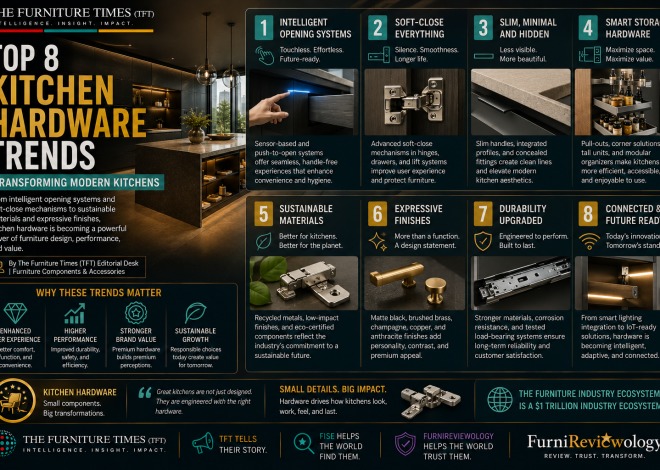
Modern kitchens depend on hinges, runners, lift-up systems, handles, profiles, pull-out baskets, corner mechanisms, pantry units, waste-management systems, adjustable legs, plinths, seals, organisers, integrated lighting, and electrical accessories.
The value of a kitchen is increasingly influenced by how efficiently its internal components use space.
Wardrobes and Storage Systems
Wardrobes require sliding-door tracks, rollers, hinges, hanging rails, drawer systems, pull-down wardrobe lifts, shelving supports, locks, internal lighting, shoe racks, trouser racks, jewellery organisers, and modular storage accessories.
These internal products turn an empty cabinet into a personalised storage system.
Office Furniture
Office chairs require castors, bases, gas lifts, tilt mechanisms, armrests, headrests, lumbar-support systems, seat controls, upholstery components, and structural frames.
Height-adjustable desks add motors, lifting columns, control panels, anti-collision systems, cable-management accessories, and power modules.
Upholstered Furniture
Sofas and chairs depend on frames, springs, webbing, foam, fibres, adhesives, stitching materials, legs, connectors, reclining mechanisms, headrest systems, fabrics, leather, and protective finishes.
Comfort is not created by fabric alone. It is created by the coordinated performance of every internal layer.
Hospitality and Contract Furniture
Hotel, restaurant, airport, educational, healthcare, and public-space furniture must tolerate frequent and intensive use. It requires durable connectors, high-performance finishes, reliable mobility systems, stronger mechanisms, fire-compliant materials, and components that are easy to maintain or replace.
Outdoor Furniture
Outdoor furniture requires corrosion-resistant fasteners, ultraviolet-resistant plastics, moisture-tolerant components, durable glides, weather-resistant connectors, adjustable feet, outdoor fabrics, and coatings capable of performing in harsh environments.
A fitting designed for an indoor cabinet may fail quickly when exposed to rain, coastal air, humidity, heat, or temperature changes.
This diversity is encouraging component manufacturers to move away from generic products and develop application-specific solutions.
Components Determine the Real Quality of Furniture
Furniture quality is often communicated through visible materials: solid wood, premium veneer, genuine leather, high-performance fabric, stainless steel, aluminium, stone, or glass.
However, premium external materials cannot compensate for weak internal engineering.
A luxury cabinet fitted with low-quality hinges will not deliver a luxury experience. A beautiful office chair with an unreliable gas lift will lose its value. A designer table supported by unstable connectors may become unsafe. An expensive sofa containing low-density foam may lose its shape prematurely.
The quality of furniture should therefore be evaluated as a complete system.
That system includes:
- The primary materials
- The internal structure
- The connection methods
- The movement systems
- The surface finishes
- The installation quality
- The replaceability of vulnerable parts
- The product’s performance under repeated use
Furniture manufacturers that invest in better components can improve the entire user experience without necessarily changing the external design.
A smooth drawer, silent cabinet door, stable table, supportive chair, or easily adjustable workstation communicates quality through action. The customer can feel the difference.
The Economics of a Small Component Failure
The initial cost of a furniture component can be small compared with the total price of the finished product. However, the financial consequences of component failure can be far greater than the amount saved during procurement.
A defective fitting can create costs across the value chain:
- Production workers may need to stop and replace it.
- Quality-control teams may need to inspect an entire batch.
- Installers may need to return to the project site.
- Retailers may need to manage a complaint.
- Replacement parts may need to be packed and delivered.
- Customer-service teams may spend hours resolving the problem.
- The manufacturer may face warranty claims or product returns.
- Negative reviews may discourage future customers.
- Contractors may remove the brand from future specifications.
A component that saves a small amount at the factory can therefore create a much larger cost after the furniture enters the market.
Strategic manufacturers are beginning to consider the total cost of ownership rather than the purchase price alone.
The evaluation should include:
- Installation speed
- Rejection rate
- Product consistency
- Operating lifespan
- Maintenance needs
- Availability of replacement parts
- Warranty performance
- Technical support
- Supply reliability
- Compliance documentation
The cheapest component is not always the most economical component.
Furniture Components Are Driving Product Differentiation
Furniture categories are becoming increasingly competitive. Many products have similar designs, materials, colours, and price points. Components provide manufacturers with another way to differentiate their collections.
A standard cabinet can be upgraded through soft-close hinges, concealed runners, internal lighting, integrated organisers, or handle-free opening systems.
A basic desk can be transformed through height adjustment, cable management, wireless charging, and power connectivity.
A conventional sofa can gain value through reclining functions, adjustable headrests, replaceable covers, modular connectors, charging ports, or storage mechanisms.
These improvements create functional differences that customers can understand and experience.
This is especially important in markets where visual designs are quickly copied. While the appearance of a product may be reproduced, a complete system of tested hardware, precise engineering, reliable movement, and after-sales component support is more difficult to imitate.
Soft-Close Systems Changed Consumer Expectations
Soft-close hinges and drawer systems offer a clear example of how component innovation can change an entire market.
Once positioned mainly as a premium feature, soft-close technology has become increasingly common in kitchens, wardrobes, bathroom cabinets, office storage, and residential furniture.
It provides several benefits:
- Quieter operation
- More controlled movement
- Reduced impact on doors and frames
- Improved safety for fingers
- Lower structural stress
- A stronger perception of quality
As consumers become familiar with controlled movement, ordinary slamming doors and drawers can feel outdated.
This demonstrates how a component can move from an optional accessory to an expected industry standard.
Similar transitions may occur with integrated charging, sensor lighting, adjustable mechanisms, repairable connections, and traceable materials.
Space-Saving Furniture Is Expanding the Mechanisms Market
Urbanisation and smaller living spaces are increasing demand for furniture that can perform more than one function.
Consumers are seeking:
- Extendable dining tables
- Foldable desks
- Wall-mounted beds
- Storage beds
- Modular sofas
- Sliding partitions
- Transformable coffee tables
- Nesting furniture
- Pull-out work surfaces
- Convertible seating
- Hidden kitchen systems
These products depend on carefully engineered mechanisms.
The mechanism must operate smoothly, support the required load, remain stable in different positions, and prevent accidental movement. It must also fit inside a limited space and survive repeated use.
As multifunctional furniture becomes more common, mechanism suppliers will become increasingly important partners in product development.
The competitive advantage will belong to companies capable of combining mechanical engineering with furniture design, safety, ergonomics, and manufacturability.
The Growth of Customisation and Modular Design
The furniture market is moving away from a rigid one-size-fits-all model.
Consumers, interior designers, architects, developers, and commercial buyers increasingly expect products that can be configured according to room dimensions, lifestyle, storage needs, accessibility requirements, brand identity, and project budgets.
Modular furniture makes this possible, but modularity requires compatible components.
Connectors, tracks, mounting systems, internal fittings, frame profiles, and adjustable accessories must work across multiple configurations. Product dimensions must be controlled accurately. Replacement and expansion must remain possible after installation.
For component suppliers, this creates an opportunity to provide platforms rather than single products.
A complete component platform could include:
- Compatible hinges and runners
- Standard drilling patterns
- Modular storage accessories
- Integrated lighting profiles
- Digital configuration data
- Installation templates
- Technical drawings
- Replacement-part codes
- Design software integration
Suppliers that make manufacturing and customisation easier can become deeply connected to their customers’ production systems.
Smart Furniture Is Creating a New Component Category
Furniture is increasingly interacting with electricity, software, sensors, and digital services.
This is particularly visible in office furniture, healthcare furniture, hospitality interiors, bedrooms, kitchens, and smart-home environments.
New component categories include:
- Wireless charging modules
- USB and electrical power units
- Electronic locks
- Occupancy sensors
- Motorised lifting systems
- Touch-free opening mechanisms
- Position-memory controllers
- Integrated speakers
- Motion-activated lighting
- Temperature and comfort controls
- Safety and collision sensors
- Furniture usage-monitoring systems
The growth of smart components will bring new responsibilities.
Furniture manufacturers will need to consider electrical safety, software compatibility, cybersecurity, repairability, data protection, power efficiency, and the availability of electronic replacement parts.
A connected desk or intelligent chair cannot be managed in exactly the same way as a conventional wooden table.
This will encourage partnerships between furniture manufacturers, hardware specialists, electronics companies, software developers, and after-sales service providers.
Sustainability Begins With Better Components
Sustainability in furniture is often discussed in terms of certified timber, recycled materials, low-emission production, efficient factories, and responsible packaging. These areas are important, but furniture components also determine whether the finished product can support a circular economy.
A durable furniture product should be maintainable and repairable.
If one worn component cannot be replaced, an otherwise usable item may be discarded. If furniture is assembled with inaccessible fittings or permanent joining methods, separating its materials can become difficult. If components are not labelled, repairers may struggle to identify compatible replacements.
Circular furniture therefore requires:
- Durable components
- Reversible connectors
- Accessible fixing points
- Replaceable movement systems
- Standardised parts
- Disassembly instructions
- Material identification
- Spare-parts availability
- Upgradeable technologies
- Recycling guidance
The strategic value of a component will increasingly include what happens at the end of its first operating life.
The Replacement-Parts Economy
One of the most promising opportunities is the development of an organised replacement-parts economy for furniture.
Today, consumers often face difficulty finding a matching hinge, wheel, handle, connector, gas lift, drawer runner, table leg, recliner cable, or wardrobe roller.
The problem may not be serious enough to justify replacing the whole product, but without the correct component, the furniture can become inconvenient, unstable, or unusable.
Digital replacement systems could change this.
A future furniture owner could scan a QR code, open the product record, identify the damaged component, verify compatibility, order the replacement, and access clear installation instructions.
This model could benefit:
- Consumers
- Furniture brands
- Component manufacturers
- Repair businesses
- Retailers
- Refurbishment companies
- Second-hand furniture platforms
- Insurance and facility-management providers
Replacement components can extend furniture life, reduce waste, create recurring revenue, and protect customer relationships.
The industry needs searchable component databases that connect product models with compatible parts.
Digital Product Passports Will Increase Component Traceability
Furniture is moving toward a future in which products, materials, and components may carry more structured digital information.
The European Union’s Ecodesign for Sustainable Products Regulation creates a framework through which requirements may be developed concerning durability, repairability, recycled content, resource efficiency, and product information. Furniture is included among the priority product groups in the European Commission’s 2025–2030 working plan.
Digital Product Passports are also intended to improve access to lifecycle information for businesses, consumers, repairers, recyclers, and public authorities.
For component suppliers, the direction is strategically important.
Future buyers may expect information such as:
- Manufacturer identity
- Product and component codes
- Material composition
- Recycled content
- Country of production
- Chemical and compliance information
- Performance classifications
- Installation instructions
- Repair procedures
- Compatible replacements
- Disassembly guidance
- End-of-life options
This means component data will become almost as important as the physical product.
Suppliers with structured, reliable, and accessible information may gain an advantage over companies that rely on unorganised catalogues or incomplete technical descriptions.
Supply-Chain Resilience Has Elevated the Industry
A furniture factory may use hundreds or thousands of different components. Some are standard products, while others are customised for a specific model.
If one essential part is delayed, the factory may be unable to finish, pack, or deliver the furniture.
Recent disruptions involving shipping routes, material prices, energy costs, port congestion, trade restrictions, and geopolitical uncertainty have shown how vulnerable concentrated supply chains can be.
Manufacturers are reconsidering their sourcing strategies through:
- Multiple approved suppliers
- Regional sourcing
- Local component production
- Higher inventory for critical items
- Standardised component specifications
- Better demand forecasting
- Supplier-performance monitoring
- Long-term technical partnerships
- Digital supply-chain visibility
Component availability is now part of production security.
A supplier that delivers consistently, communicates clearly, maintains quality, and provides technical assistance may be more valuable than a lower-priced supplier with unpredictable performance.
Local Component Manufacturing Can Strengthen Furniture Clusters
Countries seeking to develop competitive furniture industries often concentrate on finished-product factories. However, a strong manufacturing ecosystem also requires nearby suppliers of hardware, foam, textiles, metal frames, plastics, packaging, adhesives, coatings, glass, stone, and other components.
Local component production can provide several advantages:
- Shorter lead times
- Reduced dependence on imports
- Faster product development
- Easier quality problem-solving
- Smaller minimum orders
- Greater customisation
- Reduced inventory pressure
- More industrial employment
- Stronger technical knowledge
- Greater export potential
Furniture-producing regions can become more competitive when factories and suppliers work as an interconnected cluster.
Malaysia, Vietnam, Indonesia, India, Türkiye, Poland, Mexico, China, and other manufacturing economies have opportunities to strengthen specialised component capabilities alongside finished furniture production.
The goal should not be to replace every imported product. It should be to identify strategically important components that can be manufactured competitively, reliably, and at the required quality.
Quality Standards and Testing Will Separate Serious Suppliers
Furniture components must perform under real conditions, not only appear attractive in a catalogue.
A hinge may need to complete thousands of opening cycles. A castor must carry weight while moving over different surfaces. An outdoor fitting may face moisture, salt, heat, and ultraviolet exposure. A drawer runner must remain stable under repeated loading. A gas lift must operate safely over an extended period.
Testing may evaluate:
- Static and dynamic loads
- Operating cycles
- Fatigue resistance
- Impact performance
- Corrosion resistance
- Dimensional consistency
- Surface adhesion
- Abrasion resistance
- Temperature performance
- Fastener strength
- Electrical safety
- Chemical compliance
Component suppliers should provide understandable technical data. Furniture manufacturers should verify that test conditions match the intended application.
The demand for documented quality will grow as furniture enters international markets and institutional procurement systems.
Counterfeit and Unverified Components Threaten Trust
The expansion of global sourcing and online trade has increased the availability of products that look similar but may differ significantly in material quality, tolerances, coatings, load performance, or operating life.
Counterfeit or unverified components create several risks:
- Premature failure
- Safety concerns
- Inconsistent production
- Invalid certifications
- Warranty disputes
- Brand damage
- Difficulty obtaining replacements
- Legal and compliance exposure
Furniture manufacturers should verify supplier identity, product specifications, test documentation, and traceability.
Price alone cannot establish whether a component is suitable.
This is where industry-specific review and verification systems can contribute. Trust must be built through evidence, transparent information, documented performance, and credible customer experience.
The Role of Automation and Precision Manufacturing
Furniture production is becoming more automated through CNC machining, robotic handling, drilling systems, digital cutting, edge-banding machinery, and computer-controlled assembly.
Components must match this precision.
Inconsistent dimensions can interrupt automated production. Misaligned holes, variable thickness, or poorly controlled tolerances can create assembly problems and waste.
Future component suppliers will increasingly provide digital assets alongside physical products, including:
- CAD files
- CNC drilling data
- 3D models
- Machine settings
- Installation templates
- Configurator compatibility
- Product lifecycle data
- Automated ordering information
This integration can reduce design time, prevent errors, and help furniture manufacturers move more quickly from concept to production.
The component industry is therefore becoming part of the furniture sector’s digital infrastructure.
Decorative Accessories Are Creating Emotional Value
Not every component is hidden. Handles, knobs, legs, trims, profiles, castors, decorative brackets, nailheads, and visible frames contribute directly to furniture style.
Changing a handle or leg can transform the appearance of a cabinet, table, sofa, or wardrobe without changing its primary structure.
Decorative accessories respond quickly to design trends such as:
- Matte black finishes
- Brushed brass
- Bronze and copper tones
- Minimalist profiles
- Industrial metalwork
- Natural timber details
- Ceramic and stone-inspired finishes
- Soft-touch surfaces
- Custom colours
- Vintage and handcrafted styles
These products allow furniture brands to refresh collections at a lower development cost.
For SMEs, decorative accessories offer an entry point into the industry because custom designs, smaller production batches, craft-based finishes, and regional design identities can create differentiation.
Components Influence Online Ratings and Customer Trust
Furniture reviews frequently discuss problems involving assembly, hardware, drawers, doors, mechanisms, missing parts, stability, and durability.
A product can receive negative feedback even when its primary materials are acceptable if the component experience is poor.
Common customer concerns include:
- Missing screws or fittings
- Confusing assembly instructions
- Doors that do not align
- Drawers that become stuck
- Handles that loosen
- Castors that do not move smoothly
- Components damaged during delivery
- No access to spare parts
- Slow warranty support
Manufacturers should analyse reviews at the component level. Recurring complaints may reveal a hardware, packaging, tolerance, or installation problem.
Reviews are no longer only reputation signals. They are product-development data.
Digital Visibility Remains a Major Weakness
Many capable component manufacturers remain invisible to global buyers because their products are not presented clearly online.
A supplier may operate a strong factory but provide little searchable information about its capabilities. Its catalogue may exist only as a PDF. Product codes may not be indexed. Technical specifications may be incomplete. Applications may not be explained. Images may not show how the component is used.
For international discovery, component suppliers should publish:
- Clear product names
- Detailed specifications
- Dimensions and load ratings
- Materials and finishes
- Application categories
- Installation instructions
- Test information
- Certifications
- Compatible products
- Manufacturing capabilities
- Export markets
- Minimum order information
- Downloadable technical files
- Replacement-part references
Search engines and AI systems cannot accurately recommend a supplier they cannot understand or verify.
The future belongs not only to companies capable of manufacturing excellent components, but also to companies capable of making those components searchable, understandable, comparable, and trustworthy.
Strategic Opportunities for the Industry
The transformation of furniture components creates major opportunities across the ecosystem.
For Component Manufacturers
Move from selling isolated parts to offering complete technical systems, design support, data, testing, and after-sales solutions.
For Furniture Brands
Use components to strengthen quality, functionality, repairability, and product differentiation.
For Retailers
Educate customers about internal quality rather than focusing entirely on visible materials and price.
For Designers and Architects
Specify components early in the design process instead of treating them as last-minute purchasing decisions.
For Technology Companies
Develop smart mechanisms, digital catalogues, configuration systems, product passports, compatibility databases, and predictive maintenance tools.
For Repair and Refurbishment Businesses
Build services around component identification, replacement, upgrading, and furniture-life extension.
For Governments and Industrial Agencies
Support component clusters, testing laboratories, skills development, export programmes, and circular manufacturing.
For Digital Industry Platforms
Make suppliers, product specifications, reviews, compatibility information, and replacement parts easier to discover.
The Next Competitive Advantage Will Be Inside the Furniture
The furniture components and accessories industry is entering a new strategic era.
Its importance is being elevated by changing consumer expectations, smart technology, sustainability policies, modular furniture, urban living, e-commerce, automation, supply-chain risks, and the growing need for repairable products.
The question for furniture companies is no longer simply: “How much does this component cost?”
The more valuable questions are:
- How long will it perform?
- How does it improve the customer experience?
- Can it be repaired or replaced?
- Is it compatible with automated production?
- Can its quality be verified?
- Is its supply chain reliable?
- Does it support circular design?
- Can buyers, installers, and repairers access its information?
- Will it protect or damage the furniture brand’s reputation?
The finished product receives the attention, but the component often determines the experience.
A reliable hinge protects a cabinet. A precision connector strengthens a structure. A quality mechanism improves comfort. A replaceable fitting extends product life. A smart module introduces new functionality. A traceable component supports compliance. An accessible spare part can prevent furniture from becoming waste.
These are strategic contributions to the global furniture economy.
Furniture components may be small in size, but they are becoming enormous in importance.
The Furniture Times (TFT) & Furniture Industry Search Engine (FISE)
“TFT tells their story. FISE helps the world find them.”
FurniReviewology helps the world trust them.
The furniture industry ecosystem is a $1 trillion industry ecosystem.