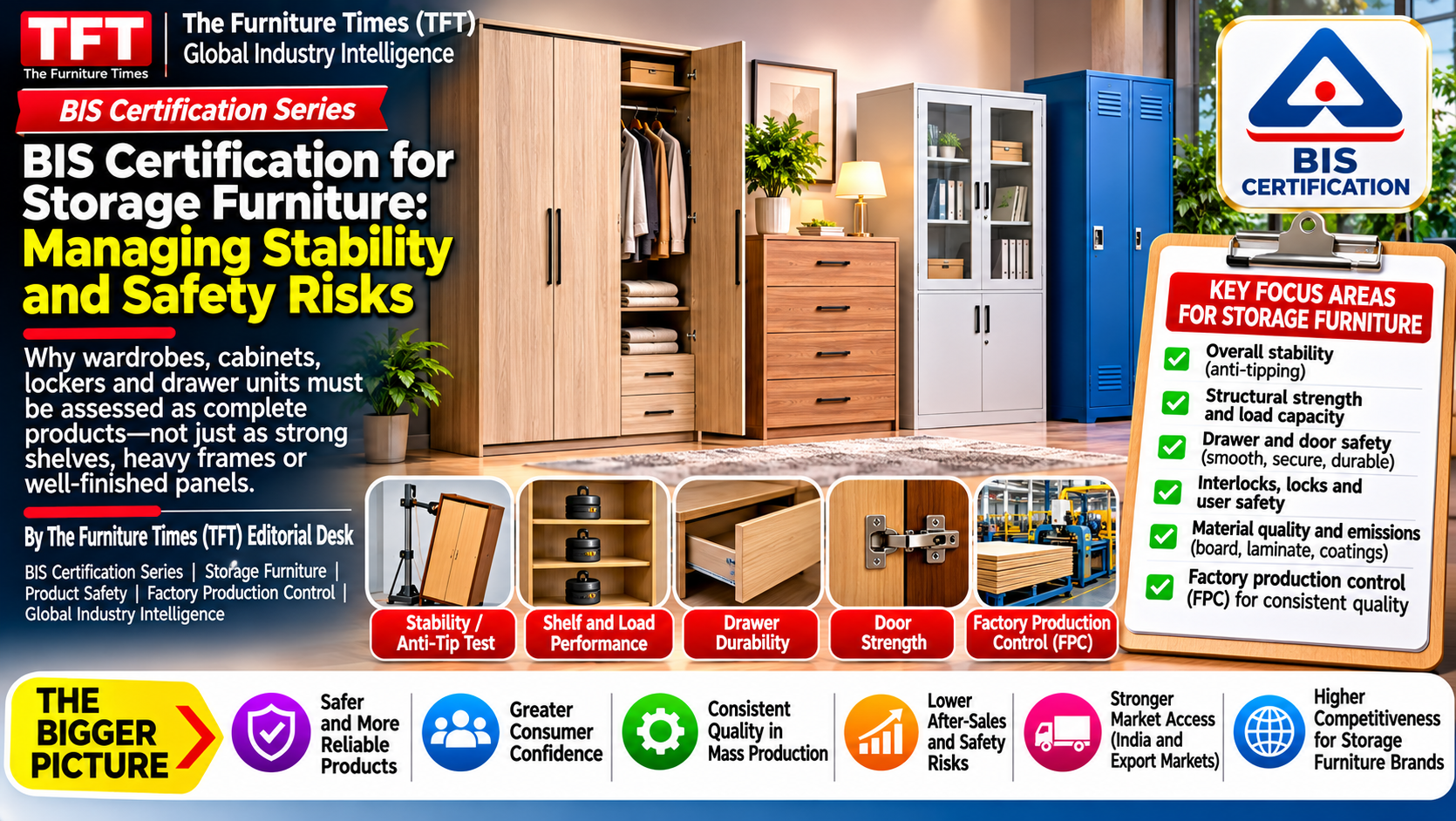
BIS Certification for Storage Furniture: Managing Stability and Safety Risks
Why wardrobes, cabinets, lockers and drawer units must be assessed as complete products—not just as strong shelves, heavy frames or well-finished panels
By The Furniture Times (TFT) Editorial Desk | BIS Certification Series | Storage Furniture | Product Safety | Factory Production Control | Global Industry Intelligence
A cabinet can stand firmly with its doors closed and still become unstable when a loaded drawer is pulled forward. A wardrobe can carry the intended shelf load and still develop movement at its back-panel joints. A wall-mounted unit can have a strong cabinet body but fail where the hanging bracket connects to the carcass or the building.
These are different failure modes. Stability is about whether the unit overturns. Strength is about whether its parts and connections withstand loads. Durability is about what happens after repeated use. Passing one assessment does not answer the others.
For manufacturers, the practical challenge is to identify which configurations create the greatest risks, supply samples that represent what customers actually receive, and keep the tested construction consistent through routine production.
The BIS starting point: IS 17634:2022, as amended
The Bureau of Indian Standards lists Storage Units — IS 17634:2022 under its Scheme-I compulsory-certification listing for furniture. BIS guidance describes the standard as addressing the performance and safety of both fully manufactured and ready-to-assemble storage units. Its safety provisions distinguish between non-movable parts, movable parts, units mounted to a building or other structure, and stability. Manufacturers should confirm that each proposed product falls within the standard’s scope rather than relying on commercial labels such as wardrobe, locker, cabinet or storage bench. Bureau of Indian Standards
There are two separate questions. The Furniture (Quality Control) Order, 2025, as amended, governs whether the order applies to the product and transaction. The amended Indian Standard and applicable BIS product manual govern the technical and certification preparation. Manufacturers and importers should verify applicability, dates and any exemptions against the current orders before committing to production, shipment or sale. Bureau of Indian Standards
What Amendment No. 1 changed
BIS’s January 2026 implementation circular identifies PM/IS 17634/3/Dec 2025 as the revised product manual and says the grouping guidelines and Scheme of Inspection and Testing were modified. The circular also identifies additional on-product marking, a clarification to the potential-energy calculation in the stability test, changes to certain clothes-rail deflection provisions, and the removal of the resistance-to-mechanical-damage test from Clause 6.1(a). Clause 6 was renamed Raw Material Requirements. The amendment permits applicable tests to be performed on a series of units rather than requiring them all on the same sample. That provision is not a substitute for agreeing on sample quantities, model representation and specimen identification. services.bis.gov.in
Do not build a test plan from the original 2022 manual or assume that the June 2025 grouping rules still apply unchanged. Confirm the latest applicable manual, marking particulars, specimens and configuration requirements with BIS and the laboratory before dispatch. Bureau of Indian Standards
1. Stability: assess the unit in use, not just with everything closed
A tall wardrobe may feel solid on a showroom floor. But a shallow base, raised feet, a heavy door or storage concentrated high in the cabinet can change how it behaves under load. In a drawer unit, extending a loaded drawer moves its weight forward. The cabinet may still feel rigid right up to the point where it begins to overturn.
The design review should look at changing load positions, not just the total weight stored:
| Configuration or change | Why it deserves review |
|---|---|
| Tall unit with a shallow footprint | The combination can leave less margin against forward overturning |
| Full-extension drawer or pull-out basket | Contents move forward as the element opens |
| Multiple drawers that can open together | The combined forward loading may differ from a one-drawer condition |
| Heavier door, including a mirrored variant | Door movement can change weight distribution and increase demands on hinges and joints |
| Castors or alternative legs | Support positions, unit height or movement can change |
| Anti-tip bracket or drawer interlock | The outcome depends on the actual hardware, correct installation and consistent operation |
These are engineering review points, not a list of mandatory BIS test configurations. Use the amended standard to determine which conditions apply. A manufacturer should not assume that a closed, empty display sample represents the storage unit as sold or used. services.bis.gov.in
2. Shelves and clothes rails: check the load path
A shelf does not carry a load independently. It transfers that load through pins, brackets or fixed joints into the cabinet sides, then through the base or mounting system. A shelf that bends is one problem; a shelf pin that pulls out, a side panel that spreads or a support that disengages is another.
Start with the longest relevant span, the intended loading and the hardware fitted in production. A narrow shelf and a wide shelf of the same material and thickness should not be treated as equivalent by default. Check the position and engagement of supports, hole quality, edge distances and whether adjustable shelves fit securely in every declared position.
The same principle applies to wardrobe rails. A stronger metal tube will not correct weak end sockets or poor fixing retention in an engineered-wood side panel. Identify the rail, span, end fittings, fasteners and supporting panel as one assembly. If the catalogue states a shelf or rail capacity, document what that claim means: which configuration it covers and how the load is distributed. Do not convert a laboratory test load into a blanket product capacity claim.
3. Doors, drawers and lockers: repeated use exposes weak connections
Moving parts can reveal a problem that a static inspection misses. A wardrobe door may operate smoothly at dispatch but later sag as hinge fixings loosen. A loaded filing drawer may travel cleanly in a prototype yet bind or develop uneven movement when production tolerances change. A bank of steel lockers may appear rigid until repeated door closure exposes movement at a hinge, latch or frame joint.
Inspect the connection as well as the fitting. In a drawer assembly, look at the runner and its fixing points on both the drawer and carcass. In a wardrobe, review the hinge, mounting plate, screw retention and the panel carrying the door. Where an interlock is part of the declared design, check that it works after normal assembly and is not defeated by adjustment, misalignment or a hardware substitution.
When a trial reveals movement, record where it started. Replacing a runner will not fix a weak panel fixing. Adjusting a hinge will not solve a cabinet body that twists out of square.
4. Freestanding, wall-restrained and wall-mounted units are not interchangeable
A freestanding cabinet with an anti-tip restraint is different from a wall-mounted cabinet whose weight and contents are supported by the building. Do not use the same installation assumptions for both. BIS identifies units mounted to a building or other structure as a separate area of safety assessment. services.bis.gov.in
For a restrained or wall-mounted model, document which hardware ships with the product, what the installer must supply, where the load enters the cabinet body, and what wall or substrate conditions the installation instructions assume. For a project installation, make clear who verifies the site conditions. Do not quietly add a restraint to a laboratory sample to compensate for instability if the restraint is not part of the declared product and installation method.
The same consistency matters in ready-to-assemble furniture. If a back panel keeps a cabinet square, or an attachment bracket is essential to installation, the relevant part and instructions need to reach the customer. A trial assembly using an unopened production carton can reveal missing fittings, confusing fasteners or steps that are clear to factory staff but not to an installer.
5. Model variants: identify what changes the risk
A collection may include a hinged-door wardrobe, a mirrored version, a shallow variant and a drawer-equipped model under one trade name. That does not establish that one sample covers all four. Build a model-by-model matrix and record:
- Intended use, model identity and requested licence coverage.
- Overall dimensions, base footprint, panel or metal specifications and structural joints.
- Shelves, clothes rails, door types, drawers and other pull-outs.
- Hinges, runners, stops, interlocks, feet, castors and mounting or restraint hardware.
- Assembly method, installation assumptions and drawing revision.
Then explain which configuration is most demanding for each assessment. The tall, shallow cabinet may be a candidate for stability review. The widest shelf may be more demanding for deflection. The heaviest door may be more demanding for its hinges and fixings. There may be no single model that answers every question. Use those comparisons to propose representative samples, then confirm what the applicable BIS grouping rules permit. The January 2026 circular expressly notes that those rules were revised. services.bis.gov.in
6. Factory controls: keep the production unit aligned with the tested design
The most consequential change may not appear in the catalogue. A purchasing team might replace a drawer runner with one that fits the same holes but extends farther. A production team might change a back-panel fixing pattern to speed up assembly. Either decision can alter a performance characteristic without changing the product name.
| Factory stage | What to control | Evidence to retain |
|---|---|---|
| Incoming inspection | Panel or sheet specifications, shelf supports, hinge and runner codes, restraint and mounting hardware | Approved part specifications and supplier or batch records |
| Fabrication | Hole positions, frame squareness, joint construction and bracket locations | Controlled drawings, jig checks and inspection records |
| Assembly and packing | Runner engagement, drawer stops, back-panel fixings, hardware completeness and installation instructions | Work instructions, functional checks and packed-unit audits |
| Final release | Model identity, workmanship, operation and applicable marking | Release records, approved labels and lot identification |
| Engineering changes | Material substitutions, larger spans, heavier doors or revised mounting arrangements | Change approval and a recorded decision on testing or licence scope |
This is a practical control framework, not a replacement for the applicable BIS Scheme of Inspection and Testing. Assign an owner to compare proposed changes with the assessed construction before a substitute part is released into production. services.bis.gov.in
What to prepare before booking the laboratory
- A declared model list and variant matrix that match the application, drawings and intended licence scope.
- Drawings and a controlled bill of materials showing the carcass, supports, joints, moving hardware and restraint or mounting arrangements.
- A production-representative sample plan covering the agreed models, applicable specimens and sample identification.
- The actual packed hardware and instructions for ready-to-assemble or installation-dependent products.
- Proposed marking and traceability records aligned with the amended requirements.
- Written confirmation of laboratory scope and test arrangements, including the applicable amendment and how samples will be allocated. BIS offers a laboratory search by standard number. LIMS (Laboratory Information Management System)
The TFT takeaway
Start with the storage unit as the customer receives it, installs it, loads it and uses it. Open the drawers, check the doors, follow the load through the supports and identify which hardware prevents movement or overturning. Then ask whether the production floor, the approved supplier list and the packed hardware all reflect that same design.
That is the difference between passing on a carefully prepared sample and consistently supplying a product supported by the same evidence.
Compliance note: This article provides general industry guidance. Use the amended IS 17634:2022, the applicable BIS product manual, and the current Furniture Quality Control Order for formal decisions on scope, testing, marking and certification.