
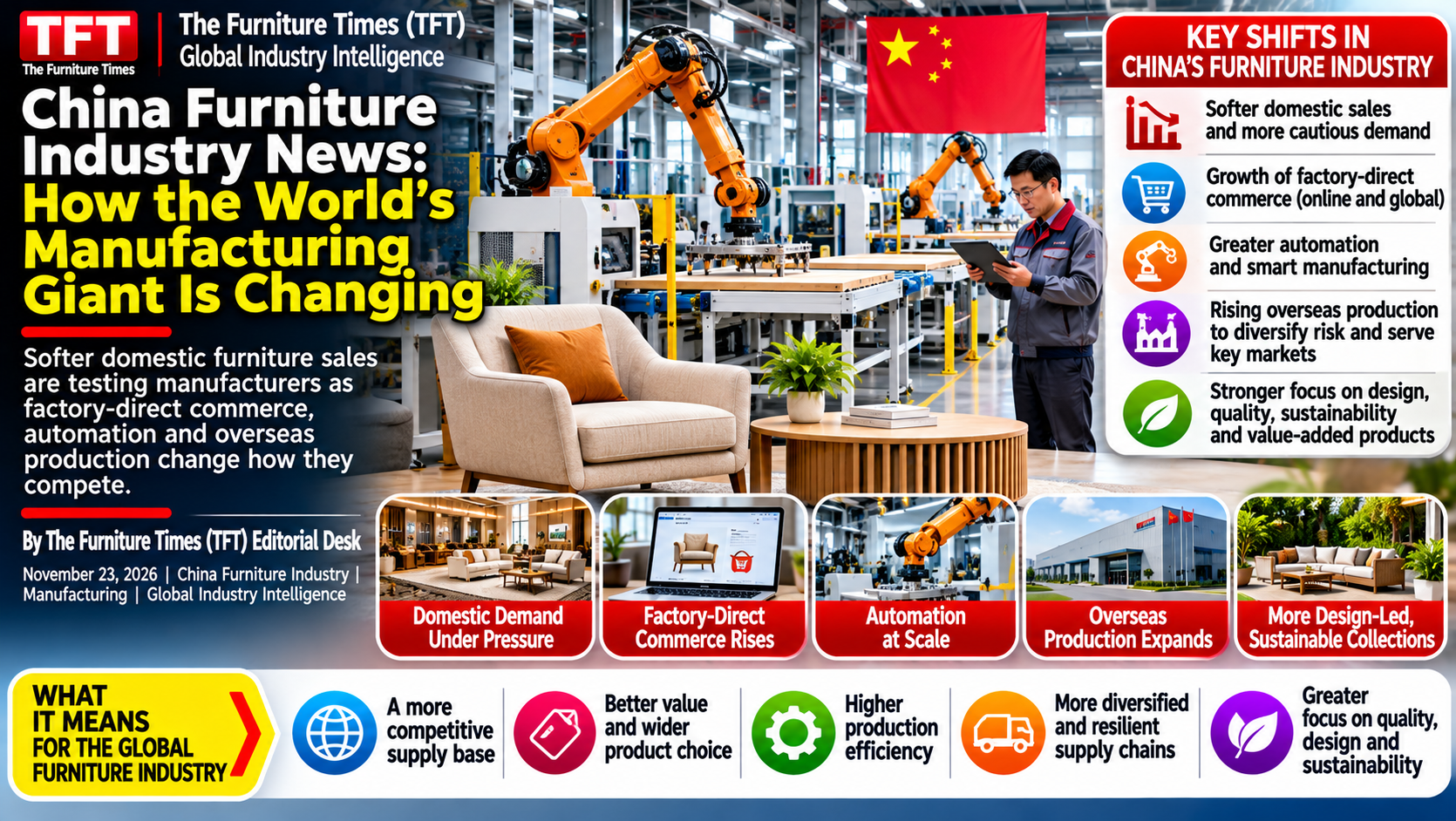
China Furniture Industry News: How the World’s Manufacturing Giant Is Changing
Softer domestic furniture sales are testing manufacturers as factory-direct commerce, automation and overseas production change how they compete
By The Furniture Times (TFT) Editorial Desk | November 23, 2026 | China Furniture Industry | Manufacturing | Global Industry Intelligence
China’s furniture manufacturers are entering 2027 with a weaker domestic retail backdrop. Furniture sales at the businesses covered by the National Bureau of Statistics’ category-level reporting fell 2.6% year on year in October 2026 and 4.5% over the first ten months of the year. Overall Chinese retail sales of consumer goods, by contrast, grew 0.4% in October and 1.0% over January–October. The figures do not cover every furniture seller, but they show that the reported furniture category is under more pressure than retail overall. stats.gov.cn
The response is not simply to make more furniture at lower prices. In clusters such as Foshan, factories are reaching buyers through closer links between production and showrooms, while original designs and smart features give importers reasons to visit beyond price comparison. Overseas, companies such as Man Wah already operate manufacturing networks spanning China, Vietnam, Mexico and Europe. These are different responses to the same commercial question: How can manufacturers keep the advantages of China’s supplier network while getting closer to the customer? bastillepost.com
Domestic demand: A slower market rewards selective selling
China’s reported furniture retail sales reached RMB16.2 billion in October and RMB145.1 billion in January–October 2026. These are reported sales values for businesses above the applicable reporting threshold, not a count of items sold, a measure of factory output or a complete tally of China’s furniture market. A fall in value can reflect fewer purchases, a shift towards lower-priced products, discounting or a combination of those factors. The headline figures do not tell manufacturers which explanation applies to their own category.
Housing also needs a more careful reading. China’s latest property release distinguishes between new commercial housing sales and registered second-hand transactions. The two matter to furniture sellers in different ways. A new apartment handover may prompt a household to furnish several rooms at once. A purchaser of an existing home may keep usable furniture and spend first on storage, seating, mattresses or fitted interiors. Neither type of transaction guarantees a furniture sale, and showroom visits are not the same as orders.
For domestic retailers, one response is to build offers around specific jobs: replacing a worn sofa, adding bedroom storage, furnishing a small apartment, or upgrading a home office. For factories, the operational question is whether those orders can be fulfilled from a manageable range of common frames, boards and fittings. A wider catalogue may attract enquiries, but it can also tie up cash in finishes and components that rarely sell.
Factory-direct commerce: Removing a middleman does not remove the work
“Factory-direct” can describe several routes to market. A household might order from a factory showroom. An importer might negotiate directly with a manufacturer. A brand might sell online while outsourcing production. These are not equivalent, and the label alone does not establish who owns the factory, whether the price includes delivery, or who will resolve a defect.
Foshan offers a useful example of why buyers are interested. August 2026 reporting from the Guangdong furniture cluster described overseas buyers examining smart products and original designs in a market that connects manufacturers, material suppliers and sales outlets. A sourcing trip can give buyers a chance to compare finished pieces, ask about customisation and establish who actually makes the product. The report illustrates what is happening in one major cluster; it does not establish nationwide growth in factory-direct sales. bastillepost.com
The direct model changes the economics on both sides of the order:
| Sales route | What the buyer may gain | What still needs to be agreed |
|---|---|---|
| Factory showroom or sourcing visit | Side-by-side product comparison and direct specification discussions | Which facility makes the product, what is subcontracted, and whether production matches the display sample |
| Factory-operated online store | Direct product information and access to configurable options | Delivery, assembly, returns, warranty and who handles complaints |
| Direct B2B order | More control over packaging, finishes, hardware and repeat orders | Minimum quantities, approved samples, inspection rights, defect resolution and spare parts |
| Dealer or local distributor | Local stock, installation and a point of contact after sale | Which service is included in the price and how replacement stock is maintained |
A factory price is not necessarily a lower delivered price. Freight, inspection, duties, warehousing, installation and warranty support still have to be paid for. For an independent retailer, that is also a competitive opening: demonstrate the value of those services instead of trying to match a quote that excludes them.
Automation: The biggest gain may be making the same product twice
Factory automation and smart furniture are separate developments. A motorised recliner is a product feature. Digitally controlled cutting, drilling, routing or scheduling changes how a factory makes the product. A manufacturer can have one without the other, and a showroom full of powered furniture does not prove what equipment or controls are in use on the production floor.
The strongest case for automation is where the factory has a recurring, measurable problem. In panel furniture, linking approved drawings to cutting and drilling can reduce the opportunity for dimensions to be re-entered incorrectly. In upholstery, digitised cutting can be evaluated against material yield and consistency. In packing, tying labels and hardware kits to the exact model revision can help prevent a correct cabinet from leaving the factory with the wrong fittings. These are examples of where investment can pay off, not estimates of adoption across China.
The harder work is often standardising the information that feeds the machines. If sales approves one finish, engineering issues another revision and purchasing substitutes a fitting without recording it, faster production can deliver the wrong specification faster. A buyer assessing an automated factory should ask to see how an approved sample becomes a repeat order: which file controls the dimensions, how material changes are authorised and how the finished batch is traced.
For factory owners, the investment test should include changeover time, rework, material waste and repeat-order accuracy, not just units produced per hour. A line that performs well on a single large order may be less suitable for frequent changes in size, finish or hardware.
Overseas expansion: Selling abroad and manufacturing abroad are different decisions
A Chinese furniture business can expand overseas through a distributor, a showroom, a fulfilment warehouse, local assembly or full manufacturing. Each option solves a different problem. A warehouse can shorten delivery without changing where a product is made. A local assembly site can bring final configuration closer to customers without necessarily making the full product locally. A factory involves a deeper commitment to labour, suppliers, quality control and ongoing investment.
Man Wah illustrates the multi-country manufacturing model. The Hong Kong-headquartered furniture group says it has factories in China, Vietnam, Mexico and several European countries. This is evidence of one large company’s manufacturing footprint, not proof of a broad departure from China. The useful question for the industry is which work moves and which stays: product development, component sourcing, assembly, inventory and after-sales service do not all need to be in the same country. Man Wah
The trade-offs are practical. Production closer to the customer can make replenishment or service easier, but a new plant must be able to match finishes, maintain tolerances and source or import the right components. Moving final assembly also does not, by itself, determine the customs origin or tariff treatment of a product. Importers should verify those particulars for the finished goods and destination market before pricing a programme around them.
For smaller exporters, the more practical first step may be a dependable local distributor, a stock of replacement parts or a qualified service partner—not a new factory. That is particularly relevant for motorised products: a warranty is worth less if no one can identify or replace a failed actuator, control box or power supply in the market where it was sold.
What the industry should watch in 2027
- Domestic demand: Track whether furniture sales improve beyond promotional periods, and distinguish volume from sales value. A discount-led recovery can look stronger in units than in margin.
- Factory-direct performance: Compare the full delivered cost, return rates and repeat orders with the dealer model. Direct sales are only an advantage if the company can serve customers at the promised price.
- Automation results: Ask whether investment reduces errors and improves repeatability across a mix of small and large orders. Equipment ownership is less useful evidence than consistent output.
- Overseas operations: Distinguish an announced facility from one that is producing and shipping at the required quality. For buyers, local inventory and spare parts can matter as much as the factory address.
- Original design and smart features: Watch whether customers reorder the designs and whether suppliers can service the added functions. A feature that generates showroom interest but creates costly repairs may not survive the second buying season.
The TFT takeaway: China’s furniture industry is better understood by looking at how an order moves—from design and components to production, delivery and service—than by asking whether manufacturing is simply staying or leaving. Domestic retail figures show pressure. Foshan shows what direct access to a dense supplier network can offer. Man Wah shows how a major producer can manufacture across several markets. The companies best placed to turn those changes into durable business will be those that can repeat the approved product, at the agreed cost, and support it where it is sold.
TFT tells their story. FISE helps the world find them. FurniReviewology helps the world trust them.