
The Global Indoor Furniture Economy: Market Size, Consumer Demand, and Future Growth by Region
Indoor Furniture Is No Longer Simply a Household Purchase—It Is a Powerful Economic Sector Connecting Housing, Construction, Design, Manufacturing, Retail, Technology, Finance and Global Trade
Global Furniture Market Intelligence Desk
By The Furniture Times (TFT) Editorial Desk
Indoor furniture forms the economic foundation of the global furniture industry ecosystem. Every home, apartment, hotel, office, hospital, school, restaurant, retail outlet and public building requires furniture to become functional.
A building may be structurally complete, but it cannot fully serve its occupants until it is furnished.
This makes indoor furniture far more than a collection of beds, sofas, tables, chairs, cabinets and storage units. It is a vast economic network supporting manufacturers, material suppliers, machinery producers, craftspeople, interior designers, architects, logistics companies, retailers, online marketplaces, installers, repair specialists and technology providers.
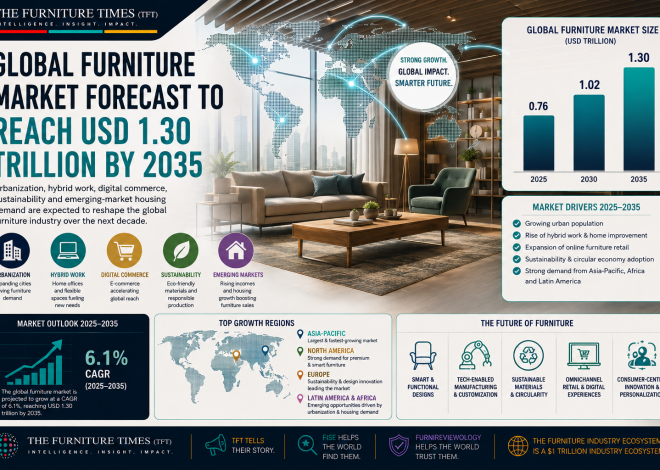
The broader global furniture market was valued at approximately US$786.1 billion in 2025, according to one major market estimate. It is projected to rise from about US$831.6 billion in 2026 to US$1.33 trillion by 2033, representing a compound annual growth rate of approximately 7%. Other research organisations publish lower or higher estimates because they use different definitions, geographic coverage and product classifications.
What remains consistent across the available research is the enormous importance of indoor furniture. One market assessment projects that indoor products will represent approximately 89.5% of the total furniture market in 2026, demonstrating that most global furniture revenue continues to originate from products used inside residential and commercial buildings.
The indoor furniture economy is therefore one of the world’s largest consumer, manufacturing and lifestyle markets.
What Is Included in the Indoor Furniture Economy?
Indoor furniture includes products designed primarily for use within enclosed residential, commercial, institutional and public spaces.
Residential Indoor Furniture
The residential market includes:
- Living-room furniture
- Bedroom furniture
- Dining-room furniture
- Kitchen furniture and cabinets
- Home-office furniture
- Children’s and nursery furniture
- Study-room furniture
- Entryway and hallway furniture
- Storage and organisation systems
- Entertainment units
- Modular and multifunctional furniture
- Upholstered furniture
- Mattresses and bedroom systems
- Custom-built furniture and joinery
Residential furniture remains the largest demand base because almost every household requires multiple furniture categories.
One industry estimate placed home furniture at approximately 58% of total furniture revenue in 2025, supported by housing development, household formation, renovations and replacement purchases.
Commercial and Institutional Indoor Furniture
The commercial market includes furniture for:
- Corporate offices
- Hotels and resorts
- Restaurants and cafés
- Hospitals and clinics
- Schools and universities
- Retail stores and shopping centres
- Airports and transport terminals
- Government buildings
- Libraries and cultural institutions
- Co-working spaces
- Assisted-living facilities
- Entertainment venues
- Staff accommodation and worker housing
Commercial furniture purchasing differs from household purchasing. It normally involves architects, developers, contractors, interior designers, procurement managers, facility managers and project owners.
Orders are often larger, more specification-driven and dependent on safety, durability, compliance, installation and after-sales service.
The Size of the Global Indoor Furniture Opportunity
The absence of a single universally accepted definition makes it difficult to assign one exact value to the indoor furniture market.
Some market reports count mattresses, kitchen cabinets and built-in products. Others exclude them. Some include commercial fixtures, while others focus only on movable household furniture. Currency movements and differences between factory-gate, wholesale and retail values also create major variations.
For that reason, market numbers should be treated as directional estimates rather than exact measurements.
Nevertheless, the available evidence shows that indoor furniture accounts for the overwhelming majority of the global furniture economy. With the total furniture market estimated by different sources at roughly US$737 billion to more than US$830 billion in 2026, indoor furniture represents a market worth several hundred billion dollars annually.
The sector’s importance becomes even greater when the surrounding ecosystem is considered.
Furniture sales generate economic activity in:
- Timber and wood-based panels
- Metal and aluminium processing
- Foam and mattress production
- Textiles and upholstery
- Leather and synthetic coverings
- Glass, stone and ceramics
- Hardware and fittings
- Adhesives, coatings and chemicals
- Manufacturing machinery
- Packaging and warehousing
- Shipping and last-mile delivery
- Interior design and architecture
- Furniture installation
- Repair, restoration and refurbishment
- Digital advertising and e-commerce
- Financial services and consumer credit
The true economic footprint of indoor furniture is therefore substantially larger than the retail value of furniture products alone.
Major Forces Driving Indoor Furniture Demand
1. Urbanisation and Household Formation
Urbanisation is creating millions of new households and commercial spaces.
As people move into cities, they require beds, sofas, dining sets, wardrobes, storage solutions and workspaces. At the same time, smaller urban homes are increasing demand for compact and multifunctional furniture.
Expandable dining tables, sofa beds, nesting tables, wall-mounted desks, modular wardrobes and storage-integrated beds are becoming important solutions for apartments where every square metre must perform multiple functions.
Asia-Pacific is expected to remain a primary furniture-growth engine because of population expansion, urbanisation, rising incomes and continued property development.
2. Residential Construction
Furniture demand follows the property cycle.
Every newly completed apartment, house, condominium, serviced residence or student accommodation project represents a potential furniture requirement.
Developers increasingly offer partly or fully furnished units, creating opportunities for manufacturers capable of supplying large quantities with consistent quality, reliable installation and predictable delivery schedules.
However, new construction is not the only source of demand. Renovation, relocation, marriage, childbirth, divorce, retirement and changing household structures all create furniture-purchasing occasions.
3. The Replacement Economy
Furniture is not purchased only when buildings are constructed.
Products are replaced because they:
- Become damaged
- Lose comfort or structural performance
- No longer suit the interior design
- Become too small or too large
- Fail to meet changing lifestyle needs
- Cannot accommodate new technology
- Are difficult to move or maintain
- No longer reflect the consumer’s identity
Replacement demand is especially important in mature markets where housing construction may be slower but consumers have greater purchasing power.
Retailers and brands that depend only on first-time buyers may miss the much larger lifecycle opportunity created by upgrading, renovation, repair and replacement.
4. Growth of the Middle Class
Rising incomes allow households to move from basic, purely functional furniture toward better design, improved materials, greater comfort and stronger brand preferences.
As purchasing power increases, consumers often progress through several stages:
Essential ownership → coordinated rooms → improved quality → personalised design → premium or luxury purchases.
This progression creates opportunities across affordable, mass-market, mid-range, premium and luxury segments.
The global luxury furniture market alone was valued at approximately US$31.1 billion in 2024, with Asia-Pacific accounting for the largest regional share in that particular estimate.
5. Renovation and Interior Personalisation
Social media, property platforms and interior-design content have increased consumer exposure to global design ideas.
Customers no longer want furniture merely to fill a room. They increasingly want products that express identity, culture, lifestyle, status and personal values.
This is encouraging demand for:
- Custom dimensions
- Personalised finishes
- Modular configurations
- Statement pieces
- Mixed materials
- Locally made furniture
- Artisanal craftsmanship
- Vintage and restored furniture
- Sustainable products
- Smart and technology-enabled furniture
Personalisation creates opportunities for local manufacturers and independent creators that cannot always compete with large companies on production volume but can compete through flexibility, craftsmanship and emotional value.
6. Hybrid Work and Home Offices
The expansion of remote and hybrid work has permanently changed the function of residential interiors.
Dining tables and bedrooms were initially converted into temporary workplaces. Consumers are now searching for more permanent solutions such as ergonomic chairs, compact desks, acoustic products, integrated storage and furniture that can transition between work and personal use.
The office furniture market is also evolving. Companies are redesigning offices around collaboration, flexible occupancy, employee wellbeing and shared work settings rather than rows of fixed individual desks.
One market analysis expects office furniture to register faster growth through 2035 as organisations reconfigure workplaces and place greater emphasis on environmental, social and governance considerations in procurement.
7. Hospitality and Tourism Development
Hotels, resorts, restaurants, cafés and serviced apartments require substantial quantities of indoor furniture.
Hospitality projects create demand for:
- Guest-room furniture
- Lobby seating
- Restaurant tables and chairs
- Banquet furniture
- Reception counters
- Wardrobes and luggage benches
- Conference furniture
- Decorative and statement pieces
- Staff and back-of-house furniture
Hospitality furniture must meet stricter requirements than ordinary household furniture. Products must withstand intensive daily use while complying with project specifications, fire-safety requirements, brand standards and maintenance expectations.
The reopening and expansion of hotel-development pipelines, particularly in Asia-Pacific and the Middle East, are supporting continued project-furniture demand.
Indoor Furniture Demand by Product Category
Living-Room Furniture
The living room remains one of the highest-value furniture spaces because it often contains multiple products:
- Sofas
- Sectionals
- Armchairs
- Coffee tables
- Side tables
- Television units
- Display cabinets
- Shelving
- Consoles
- Ottomans
Consumers typically place considerable importance on appearance and comfort because the living room is both a private relaxation space and a social area visible to guests.
The segment is moving toward modular seating, stain-resistant fabrics, deeper comfort, flexible configurations and furniture suitable for smaller homes.
Bedroom Furniture
Bedroom furniture benefits from universal demand and repeat replacement cycles.
The category includes beds, mattresses, bedside tables, wardrobes, dressers, benches and storage systems.
Growth is supported by increased awareness of sleep quality, demand for storage-integrated beds, ageing populations and expanding hospitality accommodation.
Mattresses and bed systems are increasingly marketed through health, wellness, ergonomic support and material-performance claims rather than design alone.
Dining Furniture
Dining spaces are becoming more flexible.
In smaller homes, the dining table may also function as a workplace, study area, meeting space and family activity centre.
This is creating demand for extendable tables, stackable chairs, benches, compact dining sets and easily maintained materials.
Meanwhile, premium buyers are returning to statement dining tables made from solid wood, stone, glass, ceramic and mixed materials.
Kitchen Furniture
Kitchen cabinets represent one of the most technically demanding indoor furniture categories.
The sector connects furniture manufacturing with interior design, appliances, hardware, countertops, lighting and renovation services.
Demand is moving toward modular systems, concealed storage, durable surfaces, ergonomic planning, smart accessories and personalised layouts.
Because kitchens are difficult and costly to replace, consumers place high importance on material quality, moisture resistance, hardware durability, warranties and installation expertise.
Storage Furniture
Urban living is making storage one of the fastest-growing functional requirements.
Customers need wardrobes, cabinets, shelves, drawers, shoe storage and wall systems that use vertical and hidden spaces efficiently.
Manufacturers that understand storage behaviour—not simply furniture design—will be better positioned to serve compact homes.
Home-Office Furniture
Home-office furniture is developing into a permanent category rather than a temporary trend.
Consumers increasingly seek compact desks, supportive chairs, cable-management systems, mobile pedestals and furniture that can be hidden or transformed after working hours.
Demand is particularly strong among professionals, freelancers, entrepreneurs, students and independent creators.
Furniture Materials Shaping the Indoor Market
Wood and Wood-Based Panels
Wood remains the most widely recognised indoor furniture material.
The category includes:
- Solid hardwood
- Softwood
- Plywood
- Medium-density fibreboard
- Particleboard
- Veneered panels
- Laminated boards
- Engineered wood products
One industry forecast expects wood-based furniture to account for approximately 62% of the market in 2026, reflecting its versatility, familiarity and broad use across different price categories.
Solid wood is associated with durability, repairability, craftsmanship and premium value. Engineered wood products support affordability, consistency, scalability and modern modular production.
The future is unlikely to be a simple competition between solid and engineered wood. The strongest products may combine appropriate materials according to function, budget, environmental performance and expected lifespan.
Metal
Steel, stainless steel, aluminium and other metals are used in frames, table bases, shelving, cabinets, office systems and mixed-material products.
Metal is valued for strength, precision, recyclability and suitability for slim structural forms.
It is particularly important in office, education, healthcare, hospitality and industrial-style residential furniture.
Upholstery Materials
Upholstered furniture relies on a complex material ecosystem that includes frames, springs, webbing, foam, fibre, fabric, leather, synthetic leather, adhesives and mechanisms.
Consumers increasingly evaluate upholstery according to comfort, cleaning, stain resistance, pet suitability, durability and environmental impact.
Performance fabrics are becoming more significant as households seek products that balance visual appeal with practical everyday use.
Glass, Stone and Ceramics
Glass, marble, granite, engineered stone, sintered surfaces and ceramics are widely used in tables, countertops, consoles and premium furniture.
These materials support luxury positioning but can increase product weight, logistics costs and installation complexity.
Manufacturers must consider not only appearance but also packaging, edge protection, transport risk and repairability.
Plastics and Composites
Plastic and composite materials support affordability, moulded forms, colour variety and mass production.
However, environmental concerns are creating pressure for recycled content, improved recyclability and longer product lifespans.
The industry’s challenge is to move away from low-quality disposable products and toward responsible material use supported by durability and circular design.
Bamboo, Rattan and Natural Fibres
Bamboo, rattan, cane and woven natural fibres are gaining attention because of their tactile appearance, cultural value and connection to nature.
Their use is expanding beyond traditional furniture into contemporary residential, hospitality and lifestyle collections.
Growth will depend on responsible sourcing, consistent quality, treatment methods, skilled craftsmanship and the ability to scale production without destroying authenticity.
Regional Indoor Furniture Market Analysis
Asia-Pacific: The Largest Production and Consumption Engine
Asia-Pacific held the largest regional share of the global furniture market in several recent estimates. Depending on the research methodology, its 2025 share was placed between approximately 38.5% and 49%.
The region’s strength comes from both production and consumption.
China remains a central manufacturing, export, supply-chain and retail market. India is gaining importance through population growth, housing development, urbanisation, organised retail and online commerce.
Southeast Asian countries—including Vietnam, Indonesia, Malaysia and Thailand—play important roles in wood furniture, upholstery, hospitality projects, components and export manufacturing.
Japan, South Korea, Australia and Singapore represent more mature, design-conscious markets with strong demand for quality, compact living solutions and premium products.
An estimate for the Asia-Pacific home furniture market placed its value at US$148.2 billion in 2025, rising to a projected US$209.99 billion by 2031.
Major regional opportunities include:
- Affordable furniture for first-time households
- Modular urban furniture
- Hospitality and serviced-residence projects
- Premium imported brands
- Locally designed furniture
- E-commerce and live-commerce sales
- Custom residential interiors
- Sustainable and certified products
The region’s major challenges include intense price competition, fragmented markets, uneven quality standards and rising labour, compliance and logistics costs.
North America: Replacement, Renovation and Convenience
North American demand is supported by large residential spaces, relatively high purchasing power, renovation activity and established replacement cycles.
Consumers frequently prioritise comfort, delivery speed, financing, easy returns, warranties and product reviews.
The United States home furniture market alone has been forecast to add approximately US$11 billion between 2024 and 2029, although actual performance will depend heavily on housing activity, borrowing costs and consumer confidence.
Key opportunities include:
- Upholstered furniture
- Mattresses and sleep products
- Home-office furniture
- Ready-to-assemble products
- Storage and organisation
- Sustainable furniture
- Senior-friendly furniture
- Custom and locally produced products
The region is also moving toward greater supply-chain localisation. High transport costs and changing tariff conditions are encouraging some international companies to manufacture bulky products closer to consumers.
Europe: Design, Sustainability and Regulatory Influence
Europe combines mature consumer markets with globally respected design, manufacturing and craftsmanship traditions.
Germany, Italy, France, the United Kingdom, Spain, Poland and the Nordic countries each serve different positions in the ecosystem—from luxury design and machinery to mass production and retail.
European consumers increasingly value:
- Product durability
- Repairability
- Certified materials
- Traceability
- Low-emission finishes
- Circular design
- Local and regional production
- Timeless aesthetics
Economic weakness, housing affordability and cautious consumer spending may slow short-term growth in parts of Europe. Industry analysis has described the region’s recovery as fragile, with uneven improvement expected across individual countries.
However, Europe’s regulatory direction may shape furniture design and production far beyond the region. Manufacturers exporting to European markets will increasingly need to demonstrate material transparency, responsible sourcing, product safety and environmental performance.
Middle East: Property, Hospitality and Premium Interiors
The Middle East is a major growth opportunity for residential, hospitality, office and luxury furniture.
Saudi Arabia, the United Arab Emirates, Qatar, Bahrain and Oman continue investing in tourism, mixed-use development, urban transformation and branded residential projects.
Demand is particularly strong for:
- Hotel and resort furniture
- Luxury residential interiors
- Custom-made furniture
- Office and co-working furniture
- Restaurant and café furniture
- Majlis and culturally relevant seating
- Imported designer collections
- Turnkey interior packages
Customers in the region frequently expect high-quality visual presentation, customisation, fast project coordination and strong installation support.
The market is attractive but demanding. Suppliers must understand tendering, specification, approvals, logistics, site conditions and project deadlines.
Africa: A Long-Term Urban Growth Market
Africa’s indoor furniture economy remains highly fragmented, but its long-term potential is significant.
Population growth, urbanisation, housing demand, hospitality development and education infrastructure will create increasing furniture requirements.
South Africa, Egypt, Morocco, Nigeria, Kenya, Ghana and several East African markets are important regional centres.
Opportunities include:
- Affordable household furniture
- School and institutional furniture
- Hospitality furniture
- Locally manufactured products
- Flat-pack and transport-efficient designs
- Furniture for rental housing
- Informal-sector upgrading
- Skills and machinery development
Purchasing power remains uneven, making affordability, repairability and flexible payment options important.
Local production could reduce import dependence while creating employment and developing domestic material-processing industries.
Latin America: Local Manufacturing and Expanding Urban Demand
Brazil and Mexico are major furniture-producing and consuming markets, while Colombia, Argentina, Chile, Peru and other countries offer growing opportunities.
Regional demand is supported by urban households, housing development, tourism and the expansion of modern retail.
Furniture businesses must navigate currency volatility, import costs, financing conditions and differences in purchasing power.
Companies that manufacture locally, offer flexible payment plans and adapt products to regional housing sizes may gain an advantage.
How Consumers Search for Indoor Furniture
Furniture is a high-consideration purchase.
Unlike low-cost everyday products, buyers often spend considerable time comparing dimensions, materials, colours, prices, delivery conditions, reviews and warranties.
Research into e-commerce search describes high-consideration queries as shopping missions requiring careful decision-making and substantial information gathering. Furniture fits this pattern because products are expensive, physically large and expected to remain in use for years.
The modern furniture journey may begin through:
- Google Search
- AI assistants
- Furniture marketplaces
- Social media
- Image-search platforms
- Interior-design websites
- Brand websites
- Property showrooms
- Designer recommendations
- Online reviews
- Video content
- Physical retail stores
Typical residential searches include:
- Best sofa for a small apartment
- Solid wood dining table near me
- Affordable bedroom furniture
- Modern wardrobe design
- Furniture for a studio apartment
- Pet-friendly sofa fabric
- Ergonomic home-office chair
- Sustainable furniture brands
- Custom kitchen cabinets
- Furniture with monthly payments
Commercial searches are generally more specification-driven:
- Hotel furniture manufacturer
- Office furniture supplier
- Restaurant furniture contractor
- Healthcare furniture with certification
- School furniture bulk supplier
- Custom joinery company
- Furniture supplier with installation
- Sustainable contract furniture
- Furniture tender supplier
- Commercial furniture warranty
Brands must therefore optimise their visibility not only around product names but also around problems, spaces, materials, locations, budgets, buyer types and project requirements.
Being searchable at the moment of need is becoming as important as having a physical showroom.
Digital Commerce Will Reshape Furniture Distribution
Furniture e-commerce is growing faster than the broader furniture market, although published estimates differ considerably.
One estimate valued online furniture commerce at US$68.4 billion in 2025 and projected it to reach approximately US$168.9 billion by 2034. Another placed the 2025 market above US$120 billion. These differences again reflect varying market definitions, but both indicate strong long-term digital growth.
Consumers are increasingly comfortable discovering and comparing furniture online, but physical validation remains important.
Furniture buyers want to know:
- Is the colour accurate?
- Is the product comfortable?
- Will it fit through the door?
- How difficult is assembly?
- What happens if it arrives damaged?
- Is the material description trustworthy?
- How long will delivery take?
- Can replacement parts be obtained?
The future will therefore be omnichannel rather than purely online.
Winning companies will combine digital convenience with physical trust through showrooms, samples, virtual room planning, augmented reality, video demonstrations, detailed specifications, transparent reviews and dependable after-sales service.
AI will increasingly assist with discovery and comparison, but consumers are still likely to validate recommendations through familiar trust signals such as reviews, brand reputation and secure marketplaces.
Age Groups and Their Furniture Priorities
Gen Z
Younger consumers are more likely to live in rented, shared or compact accommodation.
Their priorities may include:
- Affordability
- Portability
- Multifunctionality
- Visual individuality
- Online availability
- Flexible payment
- Sustainability
- Resale potential
Gen Z may discover furniture through social and visual platforms before visiting a retailer or marketplace.
Millennials
Millennials represent an important home-formation, renovation and young-family market.
Their purchases may include first sofas, dining sets, children’s furniture, home-office systems and storage.
They often balance design ambition with mortgage, childcare and household expenses, creating strong demand for mid-market value.
Generation X
Generation X generally has greater purchasing power and may be renovating established homes or investing in higher-quality replacements.
This group can be attractive for premium, ergonomic, durable and custom furniture.
Baby Boomers and Older Consumers
Older consumers may seek comfort, accessibility, stability, easy maintenance and products that support ageing at home.
Demand is likely to grow for:
- Higher seating positions
- Supportive chairs
- Adjustable beds
- Rounded edges
- Easy-grip handles
- Accessible storage
- Lightweight movable products
- Furniture supporting mobility and care
Age-inclusive design should not appear medical or institutional. The greatest opportunity lies in creating attractive furniture that quietly provides additional comfort, safety and accessibility.
Risks Facing the Indoor Furniture Economy
Housing Affordability
When people postpone buying or moving into homes, major furniture purchases can also be delayed.
Renters may prefer lower-cost, portable and multifunctional products rather than heavy, permanent furniture.
Inflation and Interest Rates
Furniture is often a deferrable purchase.
When household budgets become tight, consumers may delay replacement, trade down to lower-priced products or use financing.
Raw-Material Volatility
Changes in timber, panels, foam, fabric, metal, energy and chemical prices can quickly affect manufacturing costs.
Businesses with poor cost visibility may struggle to maintain margins.
Trade Disruption
Tariffs, port congestion, geopolitical conflicts and shipping interruptions can delay products and increase costs.
Furniture is especially exposed because it is bulky and expensive to transport relative to its value.
Fast Furniture and Waste
Low-cost disposable furniture may generate short-term sales but creates environmental and reputational risks.
The industry will face increasing pressure to improve durability, repairability, recycling and responsible material sourcing.
Digital Invisibility
Thousands of capable manufacturers remain difficult to discover online.
They may possess excellent machinery, craftsmanship and production capacity but lack detailed websites, verified listings, digital catalogues, product data and search visibility.
In the emerging furniture economy, invisible capacity cannot easily become commercial opportunity.
Future Growth Areas
The strongest indoor furniture opportunities through the next decade are likely to include:
Multifunctional Furniture
Products capable of serving more than one purpose will grow alongside compact housing and flexible living.
Modular Furniture
Modular systems allow customers to expand, reconfigure, repair and relocate products more easily.
Sustainable and Circular Furniture
Demand will increase for certified materials, recycled content, lower-emission finishes, repair services and take-back programmes.
Smart Furniture
Integrated charging, lighting, sensors, movement mechanisms and workplace technology will become more common.
Senior-Friendly Furniture
Ageing populations will create demand for inclusive furniture combining attractive design with comfort and accessibility.
Customisation at Scale
Digital manufacturing and configurable systems will allow companies to offer greater personalisation without depending entirely on manual, one-off production.
Furniture-as-a-Service
Rental, subscription, leasing and refurbishment models may grow among students, renters, offices, hotels and temporary projects.
Verified Digital Discovery
Buyers will increasingly rely on detailed listings, reviews, certifications and searchable supplier profiles before making contact.
Manufacturers that structure their product information for search engines, marketplaces and AI systems will be easier to discover and evaluate.
Strategic Priorities for Furniture Businesses
To compete successfully in the evolving indoor furniture economy, manufacturers and retailers should:
- Identify the customer segment they serve most effectively.
- Develop products for specific rooms, lifestyles and property types.
- Publish transparent information about materials and construction.
- Improve digital catalogues and searchable product data.
- Offer accurate dimensions, care instructions and warranties.
- Build omnichannel sales and customer-service capabilities.
- Invest in compact, modular and multifunctional design.
- Reduce packaging damage and delivery failures.
- Strengthen repair, replacement-part and after-sales services.
- Prepare for sustainability, traceability and compliance requirements.
- Build relationships with designers, architects and project buyers.
- Use customer search behaviour to guide product development.
Furniture companies must stop thinking only in terms of producing objects.
They must understand the entire customer journey—from inspiration and search to comparison, purchase, delivery, installation, use, maintenance, repair and eventual replacement.
The Future Belongs to Furniture Businesses That Understand the Economy Around the Product
Indoor furniture will remain the economic centre of the global furniture industry ecosystem.
Its future will be shaped by housing, urbanisation, purchasing power, demographic change, digital discovery, sustainability, flexible work, hospitality development and new expectations of comfort.
Asia-Pacific will remain a powerful production and consumption engine. North America will continue to benefit from replacement and renovation demand. Europe will influence sustainability and design standards. The Middle East will create opportunities through hospitality, property development and premium interiors. Africa and Latin America will offer long-term growth through urbanisation, local manufacturing and expanding consumer markets.
However, growth will not be distributed equally.
The businesses that win will be those that understand where demand is emerging, which age groups are buying, what materials customers trust, how people search, what problems they need solved and which services reduce the risks of purchasing furniture.
The indoor furniture economy is not simply about filling rooms.
It is about enabling people to live, sleep, work, learn, recover, meet, create and connect.
Every indoor space requires furniture. Every furniture requirement creates economic activity. Every economic connection creates an opportunity for the global furniture industry ecosystem.
The future of indoor furniture belongs to manufacturers, retailers, designers, suppliers and innovators that become visible, trustworthy, adaptable and ready to serve the changing needs of the world.