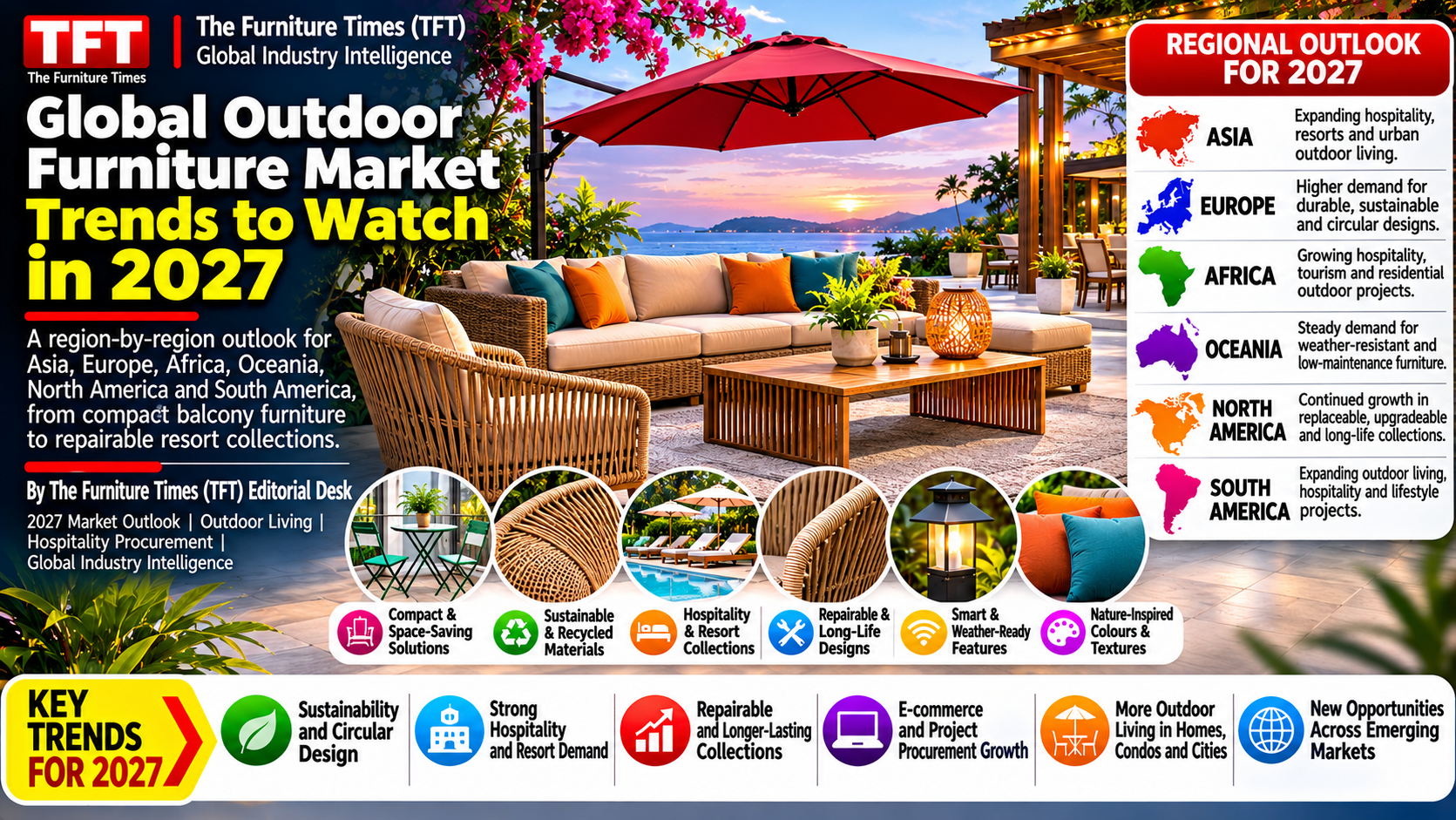
Global Outdoor Furniture Market Trends to Watch in 2027
A region-by-region outlook for Asia, Europe, Africa, Oceania, North America and South America, from compact balcony furniture to repairable resort collections
By The Furniture Times (TFT) Editorial Desk | 2027 Market Outlook | Outdoor Living | Hospitality Procurement | Global Industry Intelligence
The outdoor furniture opportunity in 2027 will depend less on whether people want to spend time outdoors and more on what makes a particular outdoor space usable. A condominium owner needs furniture that fits through the lift and leaves room to move. A resort needs loungers it can repair between seasons. A café needs seating that staff can stack quickly when the weather turns. Those buyers may all shop under the same category, but they are buying different solutions.
That distinction matters in a market where even the headline numbers are contested. Commercial research firms project growth, but differ widely on the sector’s size and regional leadership. Tourism, meanwhile, has grown in some destinations and weakened in others. A bullish global forecast is not enough reason to commit to a container of oversized lounge sets or count a hotel announcement as an order. Industry Report, 2026-2033
TFT’s assessment: The strongest 2027 opportunities will be in products that fit a specific space, can be delivered at a viable cost and can be serviced after the sale. For manufacturers, retailers and contract suppliers, that means planning by climate, use and sales channel—not simply adding more styles to the catalogue.
Source note: The supplied 2025 article could not be retrieved. This is an independently sourced 2027 outlook, not a summary of that article. The opportunities below are editorial assessments unless identified as published data or forecasts.
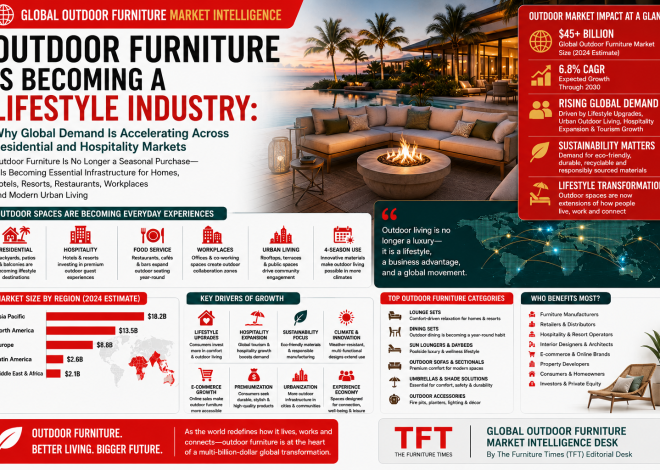
How big is the global outdoor furniture market?
Two published studies illustrate both the growth case and the limits of headline market sizing.
| Research publisher | 2026 global estimate | Published forecast | Forecast annual growth |
|---|---|---|---|
| Grand View Research | US$56.1 billion | US$86.6 billion by 2033 | 6.4% for 2026–2033 |
| Mordor Intelligence | US$20.5 billion | US$24.98 billion by 2031 | 4.04% for 2026–2031 |
These are commercial research estimates, not official sales totals. The publishers also identify different regional leaders: Grand View Research puts North America first in 2025, while Mordor puts Asia-Pacific first. Both project growth, but their market sizes and rankings should not be treated as interchangeable. An exporter deciding where to invest should define the product category, customer and geography first, then validate demand with local sales, import data, distributor orders and project procurement. Industry Report, 2026-2033
Hospitality gives a similarly mixed signal. UN Tourism reported that international arrivals rose 0.4% worldwide in the first half of 2026. Africa rose 4%, Europe 3%, the Americas 2%, and Asia and the Pacific 1%, while the Middle East fell 22%. These are tourism figures, not furniture sales. A visitor increase may support room rates or occupancy without producing an immediate furniture order; hotel refurbishment budgets and awarded contracts are much stronger procurement signals. Global Tourism Statistics
Asia: Compact urban furniture, tropical performance and a two-track sourcing market
The 2027 opportunity: Sell smaller, better-specified collections to urban households while competing for hospitality contracts on service and replacement availability.
Asia is both a sourcing region and a collection of very different end markets. In China, buyers can evaluate suppliers for metal fabrication, woven products, textiles, hardware and ready-to-assemble designs without assuming that manufacturing depth tells them anything about current domestic patio demand. In Vietnam, Indonesia and Malaysia, the sourcing question is increasingly whether a factory can reproduce finishes, document material changes and supply matching parts for repeat orders. Moving a product from one factory or country to another is not a complete diversification strategy if the new supplier cannot match the original specification.
Within Southeast Asia, a Malaysian condominium balcony and a coastal resort need almost opposite buying propositions. The balcony customer may prefer a two-seat dining set, folding table or narrow bench; the resort may need stackable pool loungers, washable covers and parasols with serviceable mechanisms. For Thailand, Indonesia, Malaysia and other hospitality markets, suppliers should target named properties with funded renovations rather than assume that regional tourism growth translates into orders. The World Bank’s November tourism briefing, for instance, found that estimated passenger arrivals across East Asia and the Pacific rose 1% in Q2 2026, even as Thailand and Indonesia recorded declines in that measure. worldbank.org
Japan and South Korea are markets in which compact, visually restrained collections are worth testing through the right retail partners. In India, distinguish between apartment terraces, premium private gardens, restaurant rooftops and hotel procurement. A product suitable for a shaded terrace should not be sold as equivalent to one intended for a fully exposed rooftop.
West Asia and the Gulf deserve a separate strategy. Heat, UV exposure, dust and coastal conditions can shape the product specification, while travel disruption and project timing can shape the order book. Shade, commercial dining and pool furniture are categories to watch, but suppliers should differentiate a confirmed purchase order from a hospitality development announcement. Confirm the delivery window, storage responsibility and installation access before reserving factory capacity. UN Tourism’s first-half figures show why a single growth narrative is particularly risky here. Global Tourism Statistics
Europe: Design and comfort still matter, but buyers need clearer specifications
The 2027 opportunity: Pair modular design and attractive finishes with materials documentation, replaceable parts and products suited to short or variable outdoor seasons.
The 2026 spoga+gafa trade fair showcased outdoor living as an extension of the home, with modular lounge pieces, comfort features and coordinated accessories. That is a useful signal of what exhibitors are developing, not evidence that shoppers across Europe are buying the same products. In 2027, the test will be whether those features justify the space, price and upkeep they require. spoga+gafa
A range designed for northern European households might emphasise covers, stackability and storage through colder months. In Mediterranean markets, the more useful commercial offer may be terrace dining, shade and seating that staff can move daily. Premium buyers may still care most about silhouette and finish, but a dealer will also want to know whether a cushion, tabletop or connector can be reordered when a customer needs it.
Wood-furniture exporters should resolve material documentation before a European buyer asks for it. Identify species and component suppliers, keep records linking the finished model to its inputs, and confirm whether the specific product and operator fall within applicable EU rules. Do not treat all outdoor furniture the same way for compliance purposes: a metal frame with a wooden top and an all-metal chair should be reviewed by their actual materials and product classification, not by a shared catalogue heading.
The commercial watchpoint is repeat orders. A collection can make an impression at a trade fair and still struggle if a retailer must carry too many colour variants, cannot get replacement covers or cannot reorder in modest quantities.
Africa: Target individual projects and build service capacity close to the buyer
The 2027 opportunity: Supply lodges, coastal hotels, restaurants and premium residential projects with furniture that can be installed, maintained and repaired locally.
Africa should not be treated as one market. In South Africa, private patios, restaurants and hospitality can support distinct retail and contract offers. In East Africa, safari lodges and coastal properties may need products that tolerate dust, sun or humid conditions and can be serviced away from a major city. In North Africa, Morocco offers a different mix of hotel courtyards, roof terraces and design-led hospitality. In West Africa, urban hotels, food-service venues and private developments may be more useful targets than a continent-wide consumer campaign.
Tourism data support that project-by-project approach. UN Tourism reported first-half growth for Africa overall, while the World Bank found wide variation across countries in Q2, even within subregions that recorded positive growth. The industry implication is to use arrivals as an early signal and verify refurbishment budgets, buyer credit and delivery access separately. Global Tourism Statistics
Local and regional workshops can compete on more than purchase price. A supplier that can make a matching table, re-cover a cushion or replace damaged hardware without an international shipment can solve a serious problem for a remote property. Importers can compete on the same terms by choosing standard components, keeping spare stock in-country and arranging local assembly and repairs. For overseas suppliers, the first question should be who supports the product after installation, not just who clears the container.
Oceania: Coastal exposure, seasonal stock and parts availability
The 2027 opportunity: Build climate-specific ranges for Australia and New Zealand, and treat Pacific Island resort procurement as a distinct logistics and service business.
Australia and New Zealand offer opportunities in garden dining, decks, balconies and outdoor hospitality, but serving both markets does not mean shipping the same assortment everywhere. A covered suburban deck, an exposed coastal courtyard and a windy apartment balcony have different requirements. Retailers should ask suppliers to distinguish protected outdoor use from full exposure, and to explain how fabrics, finish systems, hardware and shade products should be maintained.
Seasonality changes the inventory decision. Southern Hemisphere buying and delivery windows do not line up neatly with Northern Hemisphere merchandising calendars. A delayed summer assortment can tie up stock well past the selling season. Forecast by region and use, keep the core range narrower, and order extra covers and small hardware alongside finished pieces rather than trying to source them after a failure.
For Pacific Island resorts, the challenge is different again. Freight frequency, onward handling and access to parts can matter more than the showroom price. A lounger with standard fixings and a replaceable sling may be a better purchase than a lower-priced model that becomes unusable when a proprietary part fails. Suppliers should quote the cost of getting furniture to the property, not only to the nearest port.
North America: Replacement demand, channel discipline and bulky-delivery economics
The 2027 opportunity: Serve renovation and replacement demand with modular collections that can be bought in stages, delivered reliably and expanded later.
In the United States, the customer replacing a worn patio sofa is not necessarily planning a full backyard renovation. A matching chair or replacement cushion can win business without requiring the customer to commit to a large set. Retailers can build around a few dependable frame and fabric combinations, then offer dining, lounge and shade pieces that work together. The 2026 Casual Market Atlanta programme brought furniture, shade, lighting, fabrics and accessories into a broader outdoor living offer. The business test is whether the bundle solves the customer’s needs without creating slow-moving inventory. Casual Market Atlanta
In Canada, focus on seasonal storage, replaceable textiles and delivery promises that reflect local conditions. In Mexico, distinguish domestic resort and restaurant procurement from sourcing for North American retailers. A contract supplier to a coastal property has different requirements from a factory producing flat-packed retail goods for export.
Across the region, online sellers should model the cost of cartons, delivery appointments, damage and returns before expanding a range. A product can sell well online and still produce a poor margin if two-person delivery, breakage or return freight is underestimated. For cross-border sourcing, verify tariff treatment by product classification and origin before setting prices. Compare suppliers on landed cost, fill rates and repeatability, not factory price alone.
South America: Match the assortment to the country, not the continent
The 2027 opportunity: Combine regionally appropriate design and selective imports with practical dealer support and spare-parts availability.
Brazil is worth assessing separately for residential patios and balconies, hospitality projects and locally made collections. In a coastal project, the decision may turn on finish performance and cleaning requirements. For urban apartments, the better offer may be a compact collection that can be moved and stored easily. Colombia and Peru warrant city- and project-level analysis for rooftops, hospitality and food service, while Chile and Argentina require particular attention to seasonality, exposure and the economics of imported lines.
The current tourism picture does not support a single regional demand forecast. The World Bank found that estimated passenger arrivals in its Latin America and Caribbean grouping declined slightly overall in Q2 2026 even as countries including Paraguay, Ecuador and Argentina posted increases. Those figures identify places worth investigating; they do not establish outdoor furniture growth in those markets. worldbank.org
For distributors, a practical starting point is a short range of tables, stackable chairs and modular pieces with common finishes. Add larger or more expensive imported collections once dealers can show repeat demand, workable payment terms and a reliable service route. Keep Mexico in the North American analysis rather than using a broad Latin America statistic as a proxy for South America.
Eight outdoor furniture trends to watch in 2027
| Trend | What it means for the industry | Signal worth tracking |
|---|---|---|
| 1. Smaller spaces get products designed for them | Balcony sets, nesting tables and folding chairs need usable clearances, not just smaller dimensions. | Sales and returns linked to fit, access and storage |
| 2. Modularity becomes an inventory decision | A few compatible frames and components can create several layouts without stocking every configuration as a separate set. | Repeat component orders and availability of matching finishes |
| 3. Climate performance becomes part of the specification | Buyers should distinguish ordinary outdoor use from coastal, poolside, rooftop or other exposed applications. | Warranty claims by climate, finish and installation setting |
| 4. Shade becomes part of the purchase | Dining and lounge layouts can be planned with parasols, bases and circulation space from the outset. | Orders for coordinated furniture and shade, plus demand for replacement parts |
| 5. Refurbishment competes with full replacement | Hotels and restaurants may replace slings, covers, glides or tabletops instead of discarding intact frames. | Funded refresh projects, repair orders and repeat purchases |
| 6. Material claims face closer scrutiny | Buyers will want to know what is recyclable, repairable or replaceable, and which component a claim actually covers. | Tenders asking for material records, test evidence and parts commitments |
| 7. Fulfilment shapes product design | Carton dimensions, protection, assembly steps and delivery access can determine whether a range is profitable online. | Damage rates, re-deliveries, assembly complaints and margin after fulfilment |
| 8. Better product data becomes a sales tool | Model numbers, drawings, exposure limits, care instructions and commercial warranty terms help buyers shortlist with fewer calls. | Qualified enquiries and fewer specification errors in quotations |
The trade fairs support the direction of travel on modular comfort and coordinated outdoor living. The remaining questions—whether buyers will pay for repairability, which formats they reorder, and what service they expect—have to be answered in each market. spoga+gafa
Materials: Compare the finished construction, not the label
The material debate is often framed as teak versus aluminium, or natural rattan versus synthetic wicker. For a buyer, the more useful comparison is between two finished products intended for the same use.
- Aluminium can reduce the weight staff must move, but buyers still need to check frame joints, coating, fasteners and maintenance. A light chair suitable for a sheltered café is not automatically the right choice for an exposed site.
- Steel may be appropriate where rigidity or weight is beneficial. Examine coating coverage, weld areas, exposed edges, feet and how water can enter or drain from the frame.
- Timber should be specified by species, source, construction and finish. Decide whether natural colour change is acceptable and how the owner will maintain or refurbish it.
- Synthetic wicker and moulded plastics should be evaluated by material evidence, service conditions and whether individual pieces can be repaired. A broad label such as “all-weather” tells a buyer little about how the product was assessed.
- Fabrics, slings and cushions deserve their own line in the specification. Ask how water drains, how covers are cleaned, whether mildew-prone moisture can be trapped, and whether the original finish can be reordered. Do not use water-resistant and waterproof interchangeably.
For hospitality procurement, request the spare-parts list before approving the chair or lounger. Confirm prices, lead times, minimum quantities and interchangeability across model revisions. A promise that parts are “available” is of little use if a resort cannot obtain them in time for its next high season.
What manufacturers, retailers and buyers should do before 2027
Manufacturers: Pick a small number of combinations you can make consistently. For each, document the frame, finish, fasteners, textile, pack dimensions, intended use and spare parts. Quote a residential version and a contract version separately if the specification differs. Stress-test the economics with a higher freight quote and a modest reorder, not just an ideal full-container shipment.
Retailers and distributors: Separate sales by use case—balcony, garden dining, lounge, shade and commercial replacement. Track profit after delivery, returns and service rather than relying on product markup. Keep fast-moving parts in stock and clear discontinued finishes separately from the core range so customers know what they can reorder.
Hotels, resorts and restaurants: Separate purchases for new sites from replacement and refurbishment. Inspect what is failing now: frames, coatings, fabrics, mechanisms or simply unavailable parts. Then compare quotations on installed cost, maintenance, storage, replacements and downtime. A lower unit price is not necessarily a saving if it forces a venue to close part of a terrace while it waits for replacements.
Export teams: Build a pipeline around named accounts, active tenders and confirmed buying windows. Track enquiry-to-quote and quote-to-order conversion by country. Use tourism and trade show activity to decide where to investigate, then use actual orders and contribution margins to decide where to commit stock.
The TFT outlook: Watch reorders, not just launches
The 2027 growth case is credible, but it does not justify the same inventory bet across all six regions. The more useful indicators are repeat orders for core models, funded hospitality refurbishment, delivery-adjusted margins and the availability of replacement parts. Those measures tell a business whether customers can buy the product, use it and stay with the supplier.
For a small furniture company, there is a clear starting point: choose one market, one use case and one collection you can deliver and support. Make its specifications easy to find. Show where it has been installed. Make it easy to order the part most likely to wear out. That is a stronger proposition than a catalogue full of products described as suitable for everywhere.
TFT tells their story. FISE helps the world find them. FurniReviewology helps the world trust them.