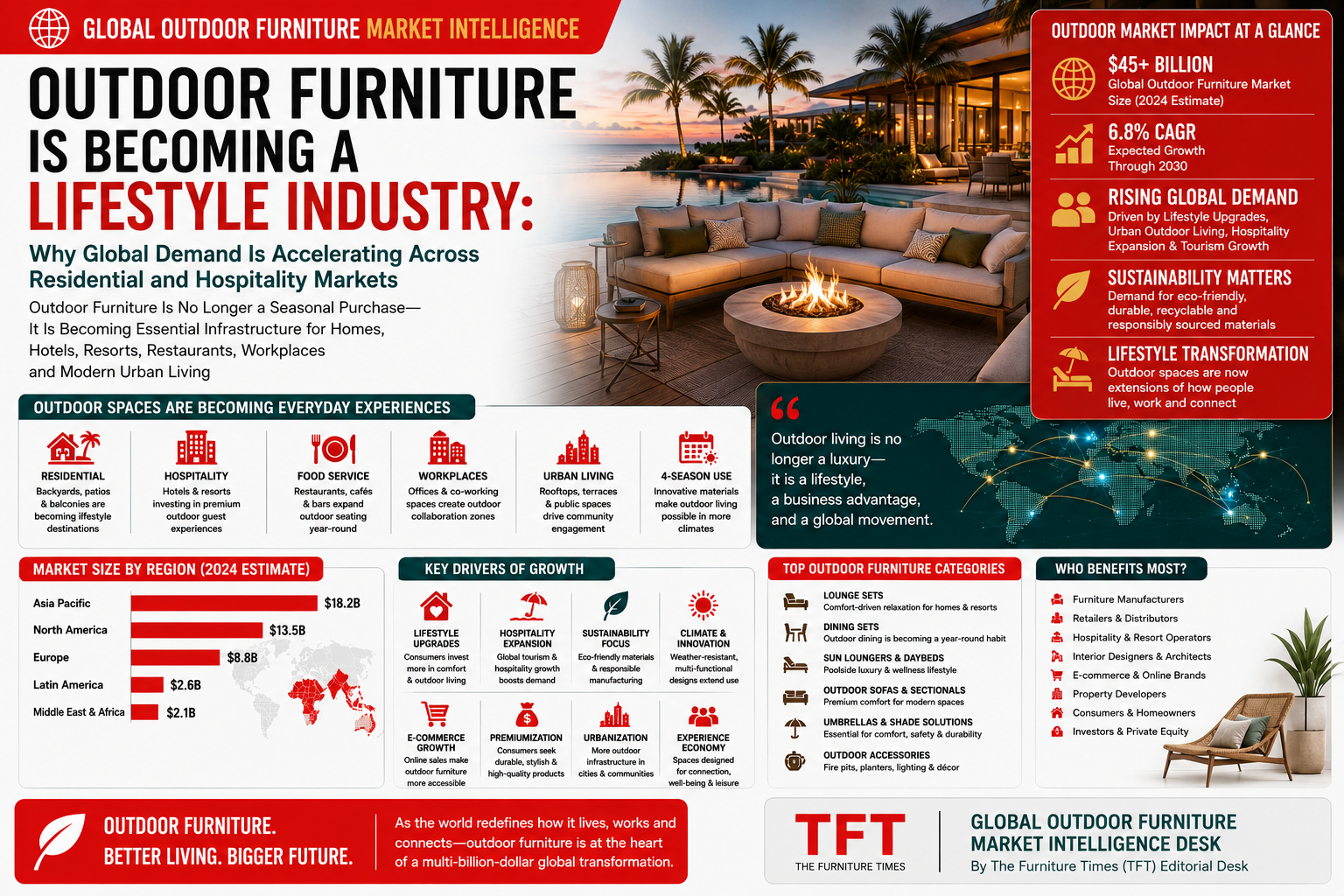
Outdoor Furniture Is Becoming a Lifestyle Industry: Why Global Demand Is Accelerating Across Residential and Hospitality Markets
Outdoor Furniture Is No Longer a Seasonal Purchase—It Is Becoming Essential Infrastructure for Homes, Hotels, Resorts, Restaurants, Workplaces and Modern Urban Living
Global Outdoor Furniture Market Intelligence Desk
By The Furniture Times (TFT) Editorial Desk
Outdoor furniture has moved far beyond the traditional garden chair, picnic table or occasional patio set.
Across residential and commercial markets, outdoor spaces are being transformed into fully functional extensions of indoor environments. Balconies are becoming compact living rooms. Gardens are becoming entertainment areas. Rooftops are turning into restaurants, lounges and social spaces. Hotel poolsides are being designed as revenue-generating destinations. Office terraces are becoming informal meeting and wellness zones.
This transformation is turning outdoor furniture into a global lifestyle industry.
The category now connects furniture manufacturing with architecture, landscaping, property development, hospitality, tourism, wellness, home improvement, textiles, lighting, shade systems, flooring, construction, digital commerce and environmental design.
One current market estimate values the global outdoor furniture market at approximately US$56.1 billion in 2026, with projected growth to about US$86.6 billion by 2033, representing a compound annual growth rate of approximately 6.4%. North America accounted for an estimated 34% of market revenue in 2025 under this methodology.
Another estimate places the 2026 market at approximately US$59.2 billion, rising to nearly US$89.9 billion by 2033.
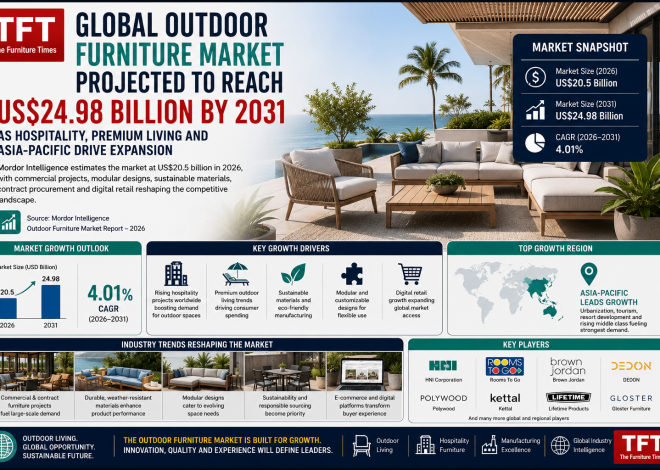
Other research organisations publish considerably lower values because they use narrower product definitions, exclude certain accessories or structures, or calculate revenue at different points in the distribution chain. For example, one estimate places the 2026 outdoor furniture market at approximately US$20.5 billion.
These differences demonstrate why outdoor furniture market values should be treated as directional estimates rather than a single universally accepted figure.
What is not disputed is the direction of the market.
Outdoor living is becoming a permanent component of residential design, hospitality development and commercial property planning. Consumers are investing more in patios, balconies, gardens, terraces and pool areas, while hotels and restaurants increasingly recognise outdoor environments as commercially valuable spaces.
What Is Included in the Outdoor Furniture Economy?
The outdoor furniture economy includes products manufactured for use in open, semi-open or weather-exposed environments.
Residential Outdoor Furniture
Residential products include:
- Outdoor sofas and sectionals
- Garden chairs and armchairs
- Outdoor dining tables and chairs
- Benches
- Sun loungers and daybeds
- Balcony furniture
- Bistro sets
- Swings and hanging chairs
- Rocking chairs
- Coffee and side tables
- Outdoor bars and stools
- Storage benches and boxes
- Poolside furniture
- Outdoor kitchens
- Parasols and umbrellas
- Gazebos, pergolas and shade systems
- Outdoor cushions and accessories
- Fire-pit seating arrangements
- Modular outdoor furniture
- Children’s garden furniture
These products serve apartments, condominiums, villas, landed homes, holiday properties, retirement communities and residential developments.
Hospitality Outdoor Furniture
Hospitality demand includes furniture for:
- Hotels
- Resorts
- Restaurants
- Cafés
- Beach clubs
- Rooftop lounges
- Pool decks
- Golf clubs
- Spas and wellness centres
- Theme parks
- Cruise facilities
- Wedding venues
- Tourism attractions
- Serviced residences
- Glamping destinations
- Private clubs
Hospitality furniture must combine visual identity with intensive commercial performance. A chair that appears attractive in a catalogue may fail quickly when used every day by hundreds of guests.
Commercial buyers must therefore assess durability, structural strength, colour stability, cleanability, replacement availability, safety, maintenance and total lifecycle cost.
Institutional and Workplace Outdoor Furniture
Outdoor furniture is also being installed in:
- Corporate campuses
- Co-working environments
- Schools and universities
- Hospitals
- Senior-living facilities
- Public parks
- Transport terminals
- Government buildings
- Shopping centres
- Mixed-use developments
- Community facilities
These applications expand the category beyond leisure. Outdoor environments are increasingly used for work, learning, dining, rehabilitation, social connection and mental wellbeing.
Why Outdoor Furniture Is Becoming a Lifestyle Industry
The outdoor furniture category was once strongly associated with warm weather, gardens and seasonal home improvement.
Today, it reflects how people want to live.
Consumers increasingly expect outdoor spaces to provide the same comfort, visual coordination and functionality as their interiors. The boundary between indoor and outdoor design is becoming less distinct.
An outdoor space may now include:
- Deep upholstered seating
- Decorative lighting
- Rugs and cushions
- Dining furniture
- Weather-resistant storage
- Charging points
- Outdoor televisions
- Fans and heaters
- Cooking facilities
- Shade systems
- Fire features
- Planters and landscape elements
This is not simply a furniture purchase. It is the creation of a lifestyle environment.
The wider outdoor-living structures market—including products such as pergolas and related installations—was estimated at US$2.5 billion in 2025 and is projected to reach approximately US$4 billion by 2033. Growing expenditure on patios, backyard entertainment spaces and outdoor home improvement is identified as a central growth driver.
Outdoor furniture benefits directly from this investment. When consumers construct a deck, terrace, pergola, pool or outdoor kitchen, furniture is required to make that space usable.
The Major Forces Accelerating Global Demand
1. Outdoor Space Is Becoming an Extension of the Home
A growing number of homeowners view gardens, terraces and balconies as additional rooms.
A patio may function as:
- A dining room
- A living room
- A home office
- A children’s play area
- An entertainment space
- A wellness zone
- A reading space
- A place for social gatherings
This creates demand for furniture that looks refined enough to resemble indoor products while remaining durable enough to survive outdoor exposure.
The desire to create an indoor atmosphere outdoors is one of the leading factors supporting market growth.
Customers are therefore seeking more than basic weather resistance. They want comfort, coordinated design, tactile materials and personal expression.
2. Home Improvement Has Become a Lifestyle Priority
Outdoor improvements can increase the usability and perceived value of a property.
Instead of undertaking major structural additions, households can improve their living experience through a landscaped terrace, furnished balcony or upgraded garden.
Outdoor furniture is often part of a wider investment involving:
- Landscaping
- Paving
- Decking
- Swimming pools
- Lighting
- Shade
- Outdoor kitchens
- Garden structures
- Water features
- Security and privacy screens
The furniture industry must understand that it is competing not only with other furniture brands but also for a share of the total home-improvement budget.
3. Smaller Homes Are Increasing the Importance of Balconies
Urbanisation is reducing average residential space in many major cities.
In apartments and condominiums, a balcony may be the only private outdoor environment available. Even a small balcony can become a breakfast area, reading corner or workspace when furnished correctly.
This creates demand for:
- Foldable tables
- Stackable chairs
- Wall-mounted furniture
- Narrow benches
- Compact bistro sets
- Vertical storage
- Lightweight furniture
- Modular seating
- Railing-mounted surfaces
The balcony-furniture market is not simply a smaller version of the garden market. It requires specialised products designed around restricted floor area, weight limitations, wind exposure, privacy and building-management rules.
4. Hospitality Operators Are Monetising Outdoor Areas
Hotels, resorts and restaurants increasingly recognise that outdoor areas can generate direct revenue.
A hotel lawn can become an event venue. A rooftop can become a destination restaurant. A pool deck can support food and beverage sales. A previously unused courtyard can become a café or social lounge.
Outdoor furniture allows hospitality businesses to increase their usable capacity without always constructing additional enclosed space.
A well-designed outdoor environment may support:
- Higher room rates
- Increased food and beverage spending
- Longer guest stays
- Events and weddings
- Social-media exposure
- Stronger brand differentiation
- Improved customer satisfaction
- Additional seating capacity
This makes outdoor furniture a revenue-enabling asset rather than a decorative expense.
5. Global Tourism and Resort Development
Tourism investment supports demand for resort, poolside, beach, café and restaurant furniture.
Warm-weather destinations require large quantities of sun loungers, daybeds, dining sets, bar furniture, parasols and outdoor lounge seating.
Cities also increasingly use rooftops, pavements, courtyards and mixed-use developments to create outdoor hospitality environments.
Demand is particularly important in:
- Southeast Asia
- The Middle East
- Southern Europe
- The Caribbean
- North America
- Australia
- Indian Ocean destinations
- Emerging African tourism markets
Suppliers entering hospitality markets must be capable of managing specifications, samples, approvals, production schedules, installation and replacement requirements.
6. Wellness, Nature and Social Connection
Outdoor spaces support relaxation, movement, fresh air and social interaction.
Homes, workplaces, healthcare facilities and senior-living communities are increasingly creating outdoor environments where people can rest, meet or recover.
Furniture plays a central role in determining whether those areas are genuinely accessible and comfortable.
A beautiful garden without suitable seating may remain underused. A carefully planned environment with shade, supportive furniture, tables and accessible pathways becomes a functioning social space.
7. Hybrid Work Is Creating Outdoor Workspaces
Remote and flexible work have expanded the meaning of the workplace.
People may work from balconies, gardens, cafés, hotel terraces or shared outdoor areas. Corporate campuses are also installing outdoor tables, benches, power access and informal meeting spaces.
This creates opportunities for outdoor furniture that supports:
- Laptop use
- Short meetings
- Individual concentration
- Group collaboration
- Charging access
- Shade and weather protection
- Ergonomic sitting
- Flexible layouts
Commercial outdoor work furniture must balance durability with a professional visual identity.
8. Social Media Is Increasing Design Awareness
Consumers are exposed to outdoor environments through social media, travel content, hotel imagery, property listings and design platforms.
A guest may experience a premium poolside environment while travelling and later want to recreate a similar feeling at home.
Outdoor spaces are highly visual and frequently shared online. This increases the commercial importance of distinctive furniture, coordinated colour schemes and memorable design.
Hospitality operators understand that an attractive terrace, rooftop or poolside area can become part of their marketing.
Residential and Hospitality Demand Compared
Residential Buyers
Residential customers generally purchase smaller quantities and place greater emphasis on:
- Price
- Comfort
- Appearance
- Available space
- Ease of maintenance
- Delivery
- Assembly
- Storage
- Reviews
- Warranties
They may replace furniture gradually and can be strongly influenced by seasonal promotions.
Hospitality and Commercial Buyers
Hospitality buyers normally purchase larger volumes and place greater importance on:
- Commercial-grade durability
- Structural testing
- Fire and safety requirements
- UV resistance
- Moisture resistance
- Project consistency
- Replacement availability
- Customisation
- Lead times
- Installation
- Warranty support
- Lifecycle costs
The cheapest product is rarely the least expensive option over the full operating period.
A hotel chair that must be replaced after one season can cost more than a better-quality product that performs reliably for several years.
Commercial suppliers must therefore explain value in terms of cost per year, cost per guest, maintenance requirements and operational risk.
Outdoor Furniture by Product Category
Outdoor Seating
Seating is one of the largest and most diverse categories.
It includes:
- Dining chairs
- Lounge chairs
- Sofas
- Sectionals
- Benches
- Armchairs
- Stools
- Rocking chairs
- Hanging chairs
- Adirondack chairs
Current demand favours deeper comfort, modular configurations, removable cushions and designs that connect visually with indoor furniture.
Outdoor Dining Furniture
Outdoor dining is central to both residential and hospitality markets.
Consumers want dining furniture for family meals, celebrations and entertaining. Hospitality buyers need products capable of supporting frequent table turnover and cleaning.
Important considerations include:
- Table stability
- Chair stacking
- Leg positioning
- Surface maintenance
- Heat resistance
- Stain resistance
- Weight
- Storage efficiency
- Compatibility with umbrellas
Sun Loungers and Daybeds
Loungers and daybeds are central to resorts, hotels, beach clubs and private pools.
Important product requirements include:
- Adjustable backrests
- Wheels or mobility
- Quick-drying materials
- Replaceable components
- Comfortable dimensions
- Stackability
- Easy cleaning
- Resistance to chlorine, salt and sunlight
Premium hospitality properties increasingly use large daybeds and cabanas to create bookable or revenue-generating guest experiences.
Outdoor Sofas and Modular Systems
Outdoor sofas have helped move the category toward indoor-style comfort.
Modular systems allow users to rearrange seating according to the size of a gathering or the shape of a space.
However, manufacturers must ensure that modules remain stable, drainage is effective and cushions are easy to store or protect.
Balcony and Bistro Furniture
Compact tables and chairs are particularly important in urban residential markets and street-side hospitality.
Foldability and stackability can be major selling points, but frequent folding introduces wear at hinges and connection points. Product engineering must therefore match the intended intensity of use.
Parasols, Umbrellas and Shade Systems
Shade is essential in hot climates.
The parasol is increasingly treated as both a functional product and a visual focal point. Recent design coverage highlights greater use of decorative patterns, trims and statement umbrellas as part of coordinated outdoor environments.
Commercial buyers must evaluate wind resistance, base weight, opening systems, replacement canopies and safe operating conditions.
Outdoor Kitchens and Bar Furniture
Outdoor cooking and dining are encouraging demand for bar stools, counters, serving units, storage, dining sets and weather-resistant cabinets.
This brings furniture businesses into closer collaboration with appliance manufacturers, countertop suppliers, builders and landscape designers.
Materials Driving the Outdoor Furniture Industry
Outdoor furniture materials must perform under conditions that indoor products rarely face.
These may include:
- Intense sunlight
- Rain
- Humidity
- Frost
- Salt air
- Chlorinated water
- Temperature changes
- Wind
- Insects
- Mould
- Pollution
- Frequent cleaning
No material is universally best. Suitability depends on climate, design, maintenance, budget and intended use.
Teak
Teak remains one of the most respected outdoor furniture woods because of its natural oils, dimensional stability and established reputation.
It is widely used in premium residential, marine, resort and hospitality furniture.
Advantages include:
- Natural outdoor durability
- Strong premium positioning
- Repairability
- Attractive ageing
- Compatibility with classic and contemporary design
Challenges include:
- Cost
- Weight
- Sourcing concerns
- Colour change when untreated
- Need for responsible certification
- Variations in quality and maturity
Manufacturers must communicate whether teak is legally and responsibly sourced and explain realistic maintenance expectations.
Acacia and Other Hardwoods
Acacia and other hardwoods provide natural appearance at more accessible prices.
Performance depends strongly on wood species, drying, construction quality, finishing and maintenance.
Products marketed only as “hardwood” provide insufficient information. Buyers need clarity about species, treatment and expected outdoor performance.
Aluminium
Aluminium is widely used because it is lightweight, does not rust in the same way as ordinary steel and can support modern profiles.
It is suited to:
- Dining furniture
- Sofas
- Loungers
- Café furniture
- Modular seating
- Commercial applications
Quality depends on alloy, wall thickness, welding, structural design, surface preparation and powder coating.
Lightweight aluminium is easy to move but may require careful planning in windy environments.
Steel and Stainless Steel
Steel provides strength and can create slim structural forms.
Ordinary steel requires effective corrosion protection. Stainless steel offers stronger resistance but may still require maintenance, particularly in coastal locations.
Buyers should not assume that all stainless steel grades provide identical performance.
Synthetic Rattan and Wicker
Synthetic rattan became popular because it combines woven appearance with outdoor usability.
Quality can vary significantly. Lower-grade material may fade, crack or become brittle after prolonged UV exposure.
Important factors include:
- Resin composition
- UV stabilisation
- Frame quality
- Weaving tension
- Repairability
- Colour consistency
Recent design commentary suggests that generic modular rattan collections may be losing some appeal as consumers seek more individual, curated and material-rich outdoor spaces.
This does not mean woven furniture will disappear. It indicates that design differentiation and material quality are becoming more important.
Rope
Outdoor rope furniture is growing because it offers a lighter, softer and more contemporary appearance than many conventional woven products.
Modern outdoor rope is commonly engineered to resist moisture and sunlight, although performance varies by product quality. Proper drying, cleaning and seasonal protection remain important.
Plastic and Resin
Plastic and moulded-resin furniture can offer:
- Affordability
- Low weight
- Colour variety
- Easy cleaning
- Stackability
- Mass-production efficiency
The category ranges from disposable low-cost products to sophisticated premium designs using recycled and UV-stabilised materials.
The future opportunity lies in improving durability, recycled content, repairability and end-of-life recovery.
Concrete, Stone and Ceramic Materials
Concrete, natural stone, sintered stone and ceramics are increasingly used for outdoor tables and architectural furniture.
They can provide visual permanence and resistance to wind, but they may also create challenges involving:
- Weight
- Delivery
- Surface staining
- Cracking
- Installation
- Floor loading
- Relocation
Product design must account for the complete logistics and installation journey.
Outdoor Fabrics and Cushions
Textiles are central to the transition from basic garden furniture to lifestyle-oriented outdoor living.
Outdoor fabrics must resist:
- UV fading
- Moisture
- Mould
- Staining
- Abrasion
- Frequent cleaning
Cushion performance depends not only on the cover but also on foam, fibre, seams, ventilation and drainage.
“Water-resistant” does not necessarily mean that a cushion can remain exposed continuously without maintenance.
Transparent product information is essential to prevent disappointment.
Regional Market Analysis
North America
North America was estimated to hold approximately 34% of global outdoor furniture revenue in 2025 under one major market assessment.
Demand is supported by:
- Suburban homes
- Patios and decks
- Backyard entertainment
- Home renovation
- Pool ownership
- Outdoor kitchens
- Large-format retail
- E-commerce
Customers frequently expect fast delivery, easy returns and clear warranties.
The region offers opportunities across value, mass-market and premium categories, although high competition and seasonal inventory risks can pressure margins.
Europe
European demand varies greatly by climate, housing type and national lifestyle.
Southern Europe has strong terrace, hospitality and outdoor-dining cultures. Northern Europe requires products that tolerate changing weather and are easy to store or cover.
European customers are increasingly attentive to:
- Responsible timber sourcing
- Durability
- Recycled materials
- Repairability
- Timeless design
- Compact urban furniture
- Product traceability
Cafés, restaurants and public spaces are important commercial markets, particularly in tourism-driven cities.
Asia-Pacific
Asia-Pacific combines major manufacturing capacity with rapidly expanding consumption.
China, Vietnam, Indonesia and Malaysia play important roles in global outdoor furniture production. Australia has a mature outdoor-living culture, while India and Southeast Asia offer expanding residential, hospitality and property-development opportunities.
Major growth drivers include:
- Urban residential development
- Resorts and tourism
- Condominiums
- Rooftop hospitality
- Branded residences
- Growing middle-class demand
- E-commerce
- Tropical lifestyle development
Humidity, heat, monsoon rain and strong sunlight make material selection especially important.
Middle East
The Middle East represents a major premium and project-furniture opportunity.
Hotels, resorts, villas, restaurants, tourism developments and large mixed-use projects require outdoor products capable of handling intense heat, ultraviolet exposure, dust and, in coastal locations, salt air.
The region has strong demand for:
- Poolside loungers
- Resort daybeds
- Outdoor dining
- Rooftop furniture
- Luxury villa collections
- Shade products
- Custom hospitality furniture
Suppliers must understand project specifications, approval processes, installation coordination and demanding delivery schedules.
Africa
Africa offers long-term potential through urbanisation, hospitality, tourism and public-space development.
Markets vary substantially in purchasing power and infrastructure. Affordable, repairable and locally appropriate products may outperform designs copied directly from other regions.
Local production using suitable timber, metal, recycled materials and craft traditions could create employment while reducing reliance on imports.
Latin America and the Caribbean
Warm climates, tourism and outdoor social culture support demand across residential and hospitality markets.
Brazil and Mexico are major markets, while Caribbean destinations require large quantities of resort and pool furniture.
Suppliers must account for:
- Coastal corrosion
- Humidity
- Hurricanes and strong winds
- Import costs
- Replacement availability
- Seasonal tourism demand
Furniture that is difficult to repair or replace can become an operational problem for remote properties.
Age Groups and Outdoor Furniture Buying Behaviour
Gen Z
Gen Z buyers may have limited private outdoor space, but they are important users of balconies, cafés, shared rooftops and social hospitality environments.
They are influenced by:
- Visual design
- Affordability
- Portability
- Social-media appeal
- Sustainability
- Compact sizing
- Flexible use
Millennials
Millennials are an important home-improvement and young-family segment.
Their purchases may include:
- Outdoor dining sets
- Modular sofas
- Children’s garden furniture
- Balcony furniture
- Barbecue-area furniture
- Home-entertainment seating
They often seek a balance between style, durability and price.
Generation X
Generation X may possess greater purchasing power and larger outdoor spaces.
This group can be attractive for premium dining, lounge, poolside and outdoor-kitchen furniture.
Older Consumers
Older customers may prioritise:
- Supportive seating
- Appropriate seat height
- Stable armrests
- Easy entry and exit
- Shade
- Low maintenance
- Lightweight movement
- Safe pathways around furniture
Age-inclusive outdoor furniture should offer comfort and accessibility without looking institutional.
How Consumers Search for Outdoor Furniture
The outdoor furniture search journey is highly problem-oriented.
Residential searches may include:
- Best outdoor furniture for rain
- Outdoor sofa for a small balcony
- Teak outdoor dining set
- Rustproof patio furniture
- Furniture for hot weather
- Outdoor furniture for coastal homes
- Weather-resistant garden chairs
- Luxury poolside furniture
- Easy-maintenance outdoor furniture
- Outdoor furniture with storage
- Pet-friendly outdoor cushions
- Furniture that can stay outside all year
Commercial searches may include:
- Hotel outdoor furniture manufacturer
- Resort furniture supplier
- Commercial pool lounger supplier
- Restaurant terrace furniture
- Outdoor furniture for coastal hotels
- Stackable café chairs in bulk
- Custom outdoor furniture manufacturer
- Hospitality furniture with warranty
- Outdoor furniture project supplier
- Replacement cushions for hotel furniture
Businesses should optimise product information around climate, location, application, material, space, maintenance and buyer type—not merely around product names.
A customer may not begin by searching for “aluminium sectional sofa.” The search may begin with the problem: “What outdoor furniture will not rust near the sea?”
The company that provides the clearest answer has a greater chance of entering the purchasing journey.
The Rise of Omnichannel Outdoor Furniture Retail
Outdoor furniture is well suited to visual online discovery, but customers still value physical inspection.
They want to evaluate:
- Comfort
- Scale
- Finish
- Fabric texture
- Colour accuracy
- Product weight
- Construction quality
- Cushion support
Successful retailers are combining digital and physical commerce through:
- Detailed online specifications
- Lifestyle photography
- Product videos
- Augmented-reality placement
- Material samples
- Showrooms
- Pop-up displays
- Virtual consultations
- Customer reviews
- Delivery tracking
- Assembly and installation
E-commerce allows customers to discover a much wider product range, but logistics remain difficult because outdoor furniture is bulky and vulnerable to damage.
Packaging, delivery communication and after-sales support are therefore part of the product experience.
Key Risks Facing the Outdoor Furniture Economy
Climate Exposure
Products may fail prematurely when materials are not matched to the climate.
A product suitable for a covered European terrace may perform poorly beside a tropical pool or on a coastal rooftop.
Seasonal Demand
Retailers can face major inventory risks when sales depend heavily on weather and seasonal promotions.
Low-Quality Material Claims
Terms such as “weatherproof,” “all-weather,” “rustproof” and “maintenance-free” are often used too broadly.
Unrealistic claims damage customer trust.
Logistics Costs
Outdoor furniture is often large relative to its value. Freight, storage, packaging and last-mile delivery can significantly affect profitability.
Counterfeiting and Design Copying
Successful outdoor designs can be copied quickly, placing pressure on original designers and premium manufacturers.
Environmental Concerns
Low-quality plastic, synthetic weaving, mixed materials and unrecyclable cushions can contribute to waste.
The industry must improve material transparency, component separation, repairability and collection systems.
Hospitality Replacement Problems
Hotels may purchase furniture for a major project and later discover that replacement parts, cushions or matching products are unavailable.
Suppliers must plan for continuity beyond the initial order.
Future Growth Opportunities
Climate-Specific Furniture
Products designed specifically for tropical, coastal, desert, cold or high-wind environments will gain importance.
Modular Outdoor Systems
Customers want products that can adapt to different spaces, events and household needs.
Small-Space Outdoor Furniture
Compact balconies and urban terraces represent a major design opportunity.
Sustainable Outdoor Materials
Recycled aluminium, responsibly sourced timber, recycled plastics and repairable components will become more important.
Smart Shade and Climate Management
Outdoor furniture will increasingly be integrated with umbrellas, pergolas, lighting, fans, heaters and automated shade.
Senior and Healthcare Outdoor Furniture
Ageing populations and wellness-oriented facilities will require accessible, supportive and safe products.
Furniture Rental and Leasing
Hotels, events, offices, temporary developments and rental properties may adopt furniture-as-a-service models.
Replacement Components
Brands can build long-term revenue through replacement cushions, covers, slings, tabletops, feet, hardware and repair services.
Commercial Outdoor Workspaces
Outdoor meetings, learning environments and collaborative spaces will create new institutional product categories.
Strategic Priorities for Outdoor Furniture Businesses
Manufacturers, retailers and hospitality suppliers should:
- Design products for specific climates and applications.
- Clearly identify residential and commercial-grade collections.
- Provide accurate material and maintenance information.
- Test structural, UV, corrosion and weather performance.
- Offer replacement components and cushions.
- Strengthen packaging and damage-prevention systems.
- Build searchable digital catalogues.
- Publish dimensions, weights and technical specifications.
- Develop products for balconies and compact spaces.
- Offer modular and configurable systems.
- Build relationships with architects, landscapers and hospitality designers.
- Improve project-management and installation capabilities.
- Explain total lifecycle value rather than only purchase price.
- Prepare for sustainability and traceability requirements.
- Create regional collections suited to local climate and culture.
The Future of Outdoor Furniture Is About How People Want to Live
Outdoor furniture is becoming one of the most important lifestyle categories within the global furniture industry ecosystem.
Its growth is being driven by more than population or construction. It is being shaped by the human desire for space, comfort, nature, wellness, hospitality, entertainment and social connection.
Residential buyers want outdoor areas that perform like real rooms.
Hotels and resorts want outdoor environments that strengthen guest experiences and generate revenue.
Restaurants want terraces that increase seating capacity.
Property developers want attractive amenities that improve the value and marketability of their projects.
Workplaces, schools and healthcare facilities want outdoor environments that support wellbeing and interaction.
The market will reward businesses that understand these different needs.
The strongest outdoor furniture companies will not simply manufacture chairs, tables and loungers. They will provide complete solutions for climate, comfort, space, maintenance, visual identity and long-term performance.
Future competition will increasingly depend on material knowledge, product testing, sustainability, replacement support, digital visibility and the ability to serve both residential and professional buyers.
Outdoor furniture is no longer a seasonal accessory placed outside a building.
It is becoming the infrastructure of a global outdoor lifestyle economy.
The manufacturers, designers, retailers and hospitality suppliers that recognise this transformation today will be best positioned to shape the outdoor environments of tomorrow.