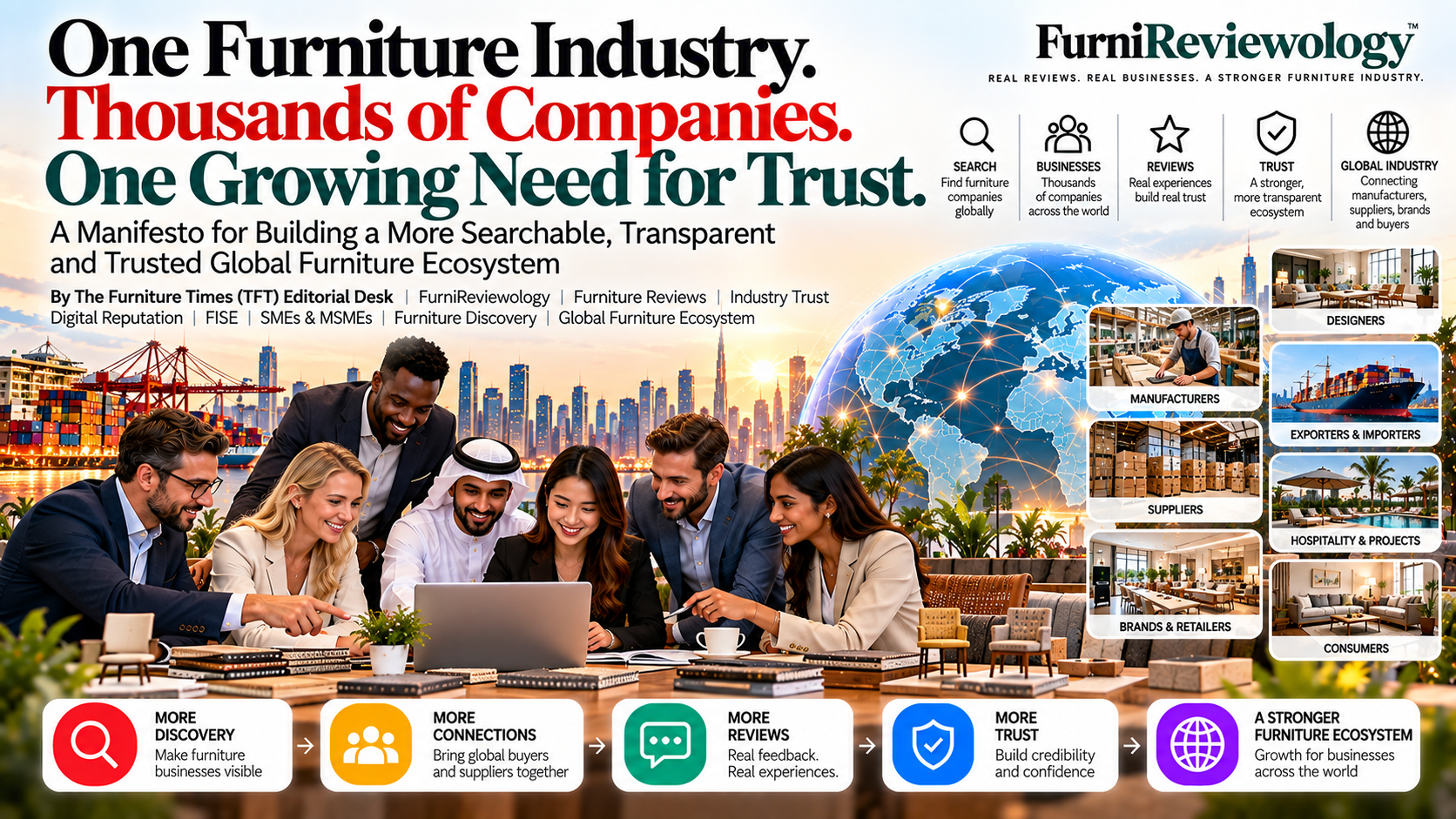
One Furniture Industry. Thousands of Companies. One Growing Need for Trust.
A Manifesto for Building a More Searchable, Transparent and Trusted Global Furniture Ecosystem
By The Furniture Times (TFT) Editorial Desk | FurniReviewology | Furniture Reviews | Industry Trust | Digital Reputation | FISE | SMEs & MSMEs | Furniture Discovery | Global Furniture Ecosystem
There is one global furniture industry.
But within it are thousands upon thousands of companies.
Manufacturers.
Brands.
Retailers.
Wholesalers.
Distributors.
Exporters.
Importers.
Designers.
Architects.
Artisans.
Component manufacturers.
Hardware suppliers.
Material companies.
Machinery providers.
Logistics companies.
Technology businesses.
Installers.
Repair specialists.
Hospitality suppliers.
Office furniture companies.
Outdoor furniture companies.
Mattress manufacturers.
Kitchen companies.
Contract furniture specialists.
Independent workshops.
Family businesses.
Startups.
SMEs.
MSMEs.
Global corporations.
All participating in an enormous interconnected economic ecosystem.
Every day, furniture moves between factories, warehouses, showrooms, hotels, offices, homes, retailers, distributors and countries.
Every day, someone somewhere is looking for a supplier.
Every day, a buyer is trying to determine:
Who can provide what I need?
And increasingly:
“Who Can I Trust Enough to Investigate Further?”
That question sits at the center of the next stage of furniture-industry digital transformation.
The industry has built manufacturing infrastructure.
Trade infrastructure.
Retail infrastructure.
Exhibition infrastructure.
Logistics infrastructure.
E-commerce infrastructure.
Now it needs stronger:
Reputation Infrastructure.
This Is a Manifesto for Furniture Trust
Not blind trust.
Not manufactured trust.
Not purchased ratings.
Not marketing claims disguised as evidence.
Not a system where every company is automatically declared reliable.
Real trust.
Trust supported by:
identity,
information,
discoverability,
customer experience,
transparency,
responsiveness,
industry context,
and appropriate verification.
The furniture industry deserves an environment where a good business can build a reputation over time—and where that reputation becomes easier for the world to discover.
Principle One: Every Legitimate Furniture Business Deserves a Digital Identity
The first principle is inclusion.
A company should not have to be a multinational corporation to become visible.
A 12-person workshop matters.
A regional furniture retailer matters.
A specialist hardware supplier matters.
A family-owned factory matters.
An artisan matters.
An MSME matters.
A startup matters.
A component producer matters.
A designer matters.
A local manufacturer matters.
If that business genuinely participates in the furniture ecosystem, it deserves the opportunity to establish a digital industry identity.
Visibility Should Not Belong Only to Those With the Largest Advertising Budgets.
Principle Two: Being in Business Is Not the Same as Being Discoverable
There are furniture companies that have existed for decades but remain almost invisible online.
Their customers know them.
Their suppliers know them.
Their employees know them.
Their local markets know them.
But a buyer 5,000 kilometers away may have no idea they exist.
That is a problem.
Because modern business increasingly begins with discovery.
A company cannot be considered if it is never found.
A supplier cannot enter the shortlist if the buyer does not know it exists.
A manufacturer cannot receive an RFQ if procurement cannot discover it.
A brand cannot build international awareness while remaining digitally invisible.
Excellence Hidden From Search Is Commercially Underutilized Excellence.
Principle Three: Searchability Is Becoming Part of Market Access
For generations, market access depended heavily on:
trade fairs,
agents,
distributors,
showrooms,
sales teams,
catalogues,
and personal networks.
These remain important.
But another gatekeeper has emerged:
Search.
Search engines.
Industry search.
Marketplace search.
Social search.
And increasingly:
AI-assisted search.
The company that becomes easier to discover has a better opportunity to enter the research process.
Not necessarily to win the business.
But to earn the opportunity to compete.
That distinction matters.
Principle Four: Discovery Is Not Enough
Being found does not automatically create trust.
A buyer discovers a furniture company.
Now the questions begin.
Who are they?
Where are they based?
What do they specialize in?
How long have they operated?
What products do they make?
What markets do they serve?
What have customers experienced?
How do they handle problems?
What has the company been doing?
Can the information be verified?
This is why discovery must connect to reputation.
Search Opens the Door.
Reputation Determines Whether the Buyer Wants to Walk Through It.
Principle Five: Reputation Must Be More Than Stars
The furniture industry should resist reducing reputation to:
★★★★★
A star rating can be useful.
But furniture is too complex to be explained by one number.
A meaningful reputation can involve:
product quality,
materials,
workmanship,
comfort,
durability,
communication,
delivery,
packaging,
installation,
project management,
lead times,
customization,
after-sales service,
warranty support,
and problem resolution.
For B2B buyers, it may also involve:
production consistency,
documentation,
quality control,
export capability,
technical understanding,
sample development,
and repeat-order reliability.
Furniture Reputation Needs Context.
Principle Six: Reviews Must Be Genuine
If reviews are to build trust, they must deserve trust.
Fake reviews destroy credibility.
Purchased praise destroys credibility.
Manipulated ratings destroy credibility.
Fabricated customer experiences destroy credibility.
Businesses should not ask:
“How do we get more five-star reviews?”
They should ask:
“How Do We Create Experiences Customers Genuinely Want to Recommend?”
That is the healthier question.
Better products.
Better communication.
Better delivery.
Better service.
Better problem resolution.
Then ask customers to share their honest experiences.
Reputation should be the result of performance.
Not a substitute for it.
Principle Seven: Critical Feedback Has a Place
A credible reputation ecosystem cannot contain only praise.
Real businesses occasionally make mistakes.
Products can fail.
Deliveries can be delayed.
Communication can break down.
Expectations can be misunderstood.
The important question is:
What happened next?
Did the company respond?
Did it investigate?
Did it repair?
Did it replace?
Did it communicate?
Did it learn?
A legitimate critical review can help future buyers.
It can also help the company.
Feedback Is Not Automatically an Attack.
Sometimes it is intelligence.
Principle Eight: Companies Deserve the Opportunity to Respond
Reputation should not become a one-way courtroom.
Businesses should have the opportunity to respond professionally to legitimate customer feedback.
Not to intimidate.
Not to attack.
Not to silence.
But to provide context.
A good response can say:
We understand.
Here is what happened.
Here is what we did.
Here is how we resolved it.
Here is what we changed.
That response becomes part of the reputation story.
Sometimes the way a company handles a problem tells buyers more than a perfect transaction.
Principle Nine: Reviews Should Inform — Not Replace Due Diligence
A five-star rating is not a factory audit.
A positive review is not a financial guarantee.
A company listing is not a certification of commercial reliability.
An industry article is not legal verification.
A digital profile is not a substitute for a contract.
Professional buyers must still perform appropriate due diligence.
Depending on the transaction, that may include:
factory visits,
samples,
references,
certification checks,
testing,
quality inspections,
business verification,
commercial agreements,
and appropriate financial or legal checks.
Reputation Helps Buyers Ask Better Questions.
It should never encourage them to stop asking questions.
Principle Ten: Small Businesses Must Not Be Digitally Left Behind
The furniture industry cannot call itself digitally transformed while thousands of SMEs and MSMEs remain invisible.
These companies are not peripheral.
They are fundamental.
They manufacture.
Supply.
Repair.
Innovate.
Employ.
Export.
Design.
Customize.
Install.
Serve communities.
Preserve craftsmanship.
Support larger companies.
Yet many have little digital infrastructure.
This must change.
Digital Inclusion Must Become Part of Furniture-Industry Development.
Free Listing Is More Important Than It Looks
A free company listing may appear simple.
But consider what it represents.
It says:
You exist.
You are part of this industry.
This is who you are.
This is what you do.
This is where buyers can begin researching you.
That is why the opportunity for a free FurniReviewology listing matters.
It lowers the first barrier.
An SME does not need a huge advertising budget simply to establish a basic industry presence.
The company can begin.
Then build.
Principle Eleven: Reputation Should Accumulate
A furniture company should not rebuild its identity from zero every year.
Its digital reputation should become an asset that grows.
Year one:
Company profile.
Year two:
Customer reviews.
Year three:
New products.
Year four:
Projects.
Year five:
Expansion.
Year six:
Certifications.
Year seven:
Export markets.
Year eight:
Innovation.
Over time, the digital footprint begins reflecting the real history of the company.
Reputation Should Compound.
Thirty Years in Furniture Should Look Like Thirty Years
Too many experienced companies suffer from digital amnesia.
The factory may have operated since 1995.
Online, it looks as though it appeared yesterday.
No history.
No milestones.
No project archive.
No reviews.
No searchable news.
No structured company information.
No documented achievements.
That is a loss not only for the company.
It is a loss for the industry.
Furniture history should be documented.
Principle Twelve: Industry Stories Are Part of Reputation
A company is not defined only by what customers say.
Its actions also matter.
A manufacturer expands production.
A supplier introduces a sustainable material.
A retailer opens a new showroom.
A furniture startup develops technology.
An MSME enters an export market.
A factory receives certification.
A company completes a major project.
A brand launches an innovative collection.
These developments contribute to industry reputation.
They deserve to become part of the searchable record.
That is where The Furniture Times — TFT contributes another layer.
TFT Tells Their Story.
Principle Thirteen: Discovery Must Become Industry-Specific
The furniture ecosystem is too complex to be treated as one generic business category.
“Furniture company” could mean:
a sofa factory,
a mattress retailer,
a hardware supplier,
a hotel furniture contractor,
an outdoor furniture manufacturer,
a timber company,
an interior designer,
a machinery supplier,
or a repair workshop.
Industry-specific discovery can create better context.
This is the role of FISE — Furniture Industry Search Engine.
FISE Helps the World Find Them.
Principle Fourteen: Reputation Needs a Furniture-Specific Home
General review platforms remain valuable.
But furniture has its own characteristics.
Furniture can be:
expensive,
large,
customized,
technical,
project-based,
internationally sourced,
difficult to return,
installed on site,
used for years,
and highly dependent on materials and workmanship.
B2B furniture relationships can continue for decades.
This complexity creates a case for furniture-specific reputation infrastructure.
That is the role FurniReviewology seeks to develop.
FurniReviewology Helps the World Trust Them.
Three Problems. Three Connected Functions.
The ecosystem can therefore address three fundamental information gaps.
Problem 1: “Nobody Can Find Us.”
FISE — Discovery
Problem 2: “Nobody Knows Our Customer Experience or Reputation.”
FurniReviewology — Reviews and Reputation
Problem 3: “Nobody Knows What Our Company Is Doing.”
The Furniture Times — Industry Storytelling and Intelligence
Together:
Find Them.
Understand Them.
Hear Their Story.
Research Their Reputation.
Then let buyers make their own informed decisions.
Principle Fifteen: The Industry Needs Structure
Trust without structure remains fragmented.
A review here.
A Facebook comment there.
A company profile somewhere else.
An old catalogue.
A trade-show listing.
A news article.
A website.
A marketplace profile.
A LinkedIn page.
A YouTube video.
Useful pieces.
But disconnected.
The opportunity is to connect them through structured company identities.
A company should increasingly be understood through:
name,
location,
business type,
categories,
products,
markets,
reviews,
news,
history,
capabilities,
and relevant digital references.
This structure makes reputation easier to research.
Structure Does Not Mean Centralized Control
A connected ecosystem should not mean one organization controls what people think.
Quite the opposite.
Healthy reputation infrastructure should preserve multiple voices.
The company has a voice.
Customers have voices.
Industry media has a role.
Search has a role.
Professional buyers perform verification.
Independent sources remain important.
The goal is not to create one version of truth controlled by one platform.
The goal is to make relevant information easier to discover and understand.
Principle Sixteen: Trust Must Be Earned
No listing can manufacture trust.
No logo can manufacture trust.
No platform can manufacture trust.
No advertising campaign can manufacture durable trust.
Trust comes from repeated behavior.
Deliver what you promise.
Communicate clearly.
Build good products.
Solve problems.
Respect customers.
Treat suppliers professionally.
Improve continuously.
Then allow that record to become visible.
Infrastructure Can Make Trust Discoverable.
Only Businesses Can Make Trust Real.
Principle Seventeen: Reputation Is Everyone’s Responsibility
Reputation is not only the marketing department’s job.
The factory creates reputation.
Quality control creates reputation.
Packaging creates reputation.
Logistics creates reputation.
Sales creates reputation.
Installation creates reputation.
Customer service creates reputation.
Management creates reputation.
After-sales creates reputation.
Leadership creates reputation.
Every interaction becomes part of the experience someone may later describe.
Reputation Is Operational Before It Is Digital.
Principle Eighteen: The Future Buyer May Be Human + AI
A major change is approaching furniture discovery.
Tomorrow’s buyer may not manually visit 50 websites.
They may ask an AI system:
“Find suitable furniture manufacturers for my hotel project.”
Or:
“Identify outdoor furniture suppliers with export experience and help me compare them.”
Or:
“Which furniture companies should I investigate for this requirement?”
AI may become an intermediary between companies and buyers.
That makes structured digital identity increasingly important.
Machines Cannot Understand What You Never Documented
A company may have:
excellent products,
30 years of experience,
hundreds of customers,
strong export capabilities,
and outstanding craftsmanship.
But if almost none of that exists digitally, search and AI systems have little information to work with.
This creates a new business imperative:
Document the Business You Have Already Built.
Accurately.
Consistently.
Structurally.
Principle Nineteen: The Best Companies Should Not Be the Hardest Companies to Find
This should become an industry objective.
Quality businesses should not remain hidden simply because they are small.
Craftsmanship should not disappear behind poor SEO.
A specialized manufacturer should not lose every digital opportunity to a weaker competitor simply because the competitor publishes more content.
The furniture ecosystem needs mechanisms that improve discoverability for relevant businesses.
Not guaranteed ranking.
Not guaranteed business.
But the opportunity to be found.
Principle Twenty: Trust Should Create Opportunity
Ultimately, reputation infrastructure exists for a commercial reason.
Better information can help:
buyers discover suppliers,
suppliers discover customers,
retailers discover brands,
brands discover manufacturers,
manufacturers discover component companies,
designers discover specialists,
hotels discover contract suppliers,
and consumers research businesses.
Trust reduces information friction.
Lower information friction can create more opportunities for connection.
Connection can create discussion.
Discussion can create business.
Search. Connect. Discuss. Deal.
This is why the broader FISE philosophy matters.
Search.
Find relevant participants.
Connect.
Establish contact.
Discuss.
Understand requirements, capabilities, specifications and commercial terms.
Deal.
Move toward business when both sides are satisfied.
Reputation infrastructure supports every stage.
This Is Bigger Than a Review Website
FurniReviewology should not be understood merely as a place to leave stars.
The larger opportunity is to help structure furniture-industry reputation.
Company identity.
Customer experiences.
Business profiles.
Industry context.
Searchability.
Digital history.
Reputation.
Connection.
The review is one component.
The ecosystem is the bigger idea.
This Is Bigger Than a Search Engine
FISE is not simply about returning links.
The larger opportunity is to make the furniture ecosystem more understandable.
Who manufactures what?
Who supplies what?
Where are they?
Which categories do they serve?
How can buyers discover them?
How can businesses discover one another?
Search becomes infrastructure for industry connection.
This Is Bigger Than Furniture News
TFT is not only about publishing headlines.
Industry media creates memory.
It documents:
companies,
markets,
innovations,
challenges,
people,
products,
policies,
technologies,
investments,
and changes.
Today’s news becomes tomorrow’s industry history.
The Furniture Times Helps Create the Searchable Memory of the Furniture Ecosystem.
One Industry Needs One Shared Commitment
The platforms can build infrastructure.
But the industry itself must participate.
Manufacturers must provide accurate information.
Brands must maintain profiles.
Retailers must engage.
Suppliers must become searchable.
Customers must provide genuine feedback.
Companies must respond professionally.
SMEs must step forward.
Industry professionals must contribute knowledge.
Media must document meaningful developments.
And everyone must reject fake reputation.
This cannot be built by technology alone.
Trust Is a Collective Project.
A Manifesto for Furniture Companies
We believe every legitimate furniture business deserves the opportunity to be discovered.
We believe SMEs and MSMEs should not be digitally invisible.
We believe decades of experience should become searchable history.
We believe genuine customer experiences should matter.
We believe reviews should contain context, not merely stars.
We believe businesses should have the opportunity to respond professionally.
We believe criticism can become improvement.
We believe fake reviews damage the entire ecosystem.
We believe industry information should become more structured.
We believe search should help relevant buyers find relevant businesses.
We believe industry journalism should document the companies building the sector.
We believe digital reputation should complement—not replace—professional due diligence.
We believe AI makes structured company information more urgent.
We believe the furniture industry’s digital infrastructure should become more connected.
And above all:
We Believe Trust Must Be Earned — But Once Earned, It Should Be Easier for the World to Discover.
A Manifesto for Buyers
Search widely.
Research carefully.
Read beyond star ratings.
Look for patterns.
Consider review context.
Check dates.
Examine company information.
Read independent sources.
Ask questions.
Request samples when appropriate.
Verify certifications where relevant.
Check references.
Visit factories when the transaction justifies it.
Conduct appropriate due diligence.
And remember:
A digital reputation is a research tool.
It is not a substitute for judgment.
A Manifesto for SMEs and MSMEs
Do not say:
“We are too small.”
Do not say:
“Everyone in our town already knows us.”
Do not say:
“We get business through referrals.”
Do not say:
“We will build our digital presence later.”
The buyer of tomorrow may not live in your town.
They may not know your customers.
They may never attend your local exhibition.
They may never see your showroom.
They may begin with a search.
Make Sure You Can Be Found.
Start With Your Free FurniReviewology Listing
Do not wait for the perfect digital strategy.
Begin with identity.
List your business.
Complete the information.
Describe what you actually do.
Select relevant categories.
Connect your website.
Keep contact information current.
Encourage genuine customer experiences.
Respond professionally.
Become searchable through FISE.
Share meaningful company developments with TFT.
Then continue building.
One step at a time.
Do Not Wait Until You Need Visibility
Build before the slowdown.
Build before entering a new market.
Build before searching for distributors.
Build before launching exports.
Build before the next trade fair.
Build before the buyer searches.
Build before AI becomes the dominant discovery interface.
Build while business is healthy.
Reputation Built in Advance Is More Valuable Than Reputation Built in Panic.
One Furniture Industry
Different countries.
Different languages.
Different cultures.
Different furniture traditions.
Different materials.
Different manufacturing systems.
Different price points.
Different company sizes.
Different customers.
But one interconnected global ecosystem.
And across that ecosystem, one need is becoming universal:
Trust.
Trust between buyer and seller.
Trust between manufacturer and supplier.
Trust between retailer and brand.
Trust between consumer and retailer.
Trust between hotel and contractor.
Trust between importer and exporter.
Trust between the physical company and its digital identity.
Thousands of Companies
Some already famous.
Many still unknown.
Some digitally sophisticated.
Many digitally invisible.
Some large.
Most smaller.
Some international.
Some local.
All contributing something to the ecosystem.
The future should not belong only to the companies that shout the loudest.
It should create space for businesses that can demonstrate:
quality,
service,
capability,
consistency,
innovation,
and genuine customer value.
One Growing Need for Trust
The global furniture industry does not need artificial perfection.
It needs better information.
Better discovery.
Better context.
Better reviews.
Better transparency.
Better company identities.
Better connections.
And better ways for genuine reputation to become visible.
That is the mission.
That is the opportunity.
And that is why industry reputation needs structure.
Get Listed.
Become Searchable.
Encourage Genuine Reviews.
Build Your Reputation.
Tell Your Story.
Join the Ecosystem.
Because the global furniture industry’s next great infrastructure may not be another factory, showroom, marketplace or exhibition hall.
It may be the infrastructure that helps the world answer one of the oldest questions in business:
“Who Can I Trust Enough to Do Business With?”
The Global Furniture Ecosystem
The Furniture Industry is a $1 Trillion USD Ecosystem in the world
Furniture Industry Search Engine – FISE helps the world find them.
The Furniture Times – TFT tells their story.
FurniReviewology helps the world trust them.

Related Posts
The Global Furniture Industry Is Huge — But Its Digital Reputation Infrastructure Remains Fragmented
The Global Furniture Industry Is Huge — But Its Digital Reputation Infrastructure Remains Fragmented