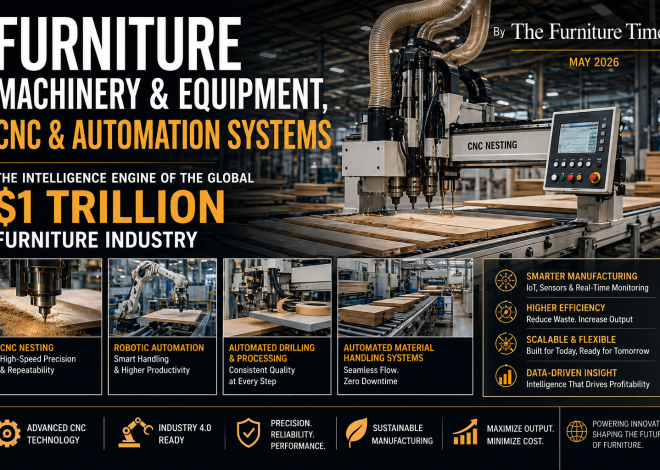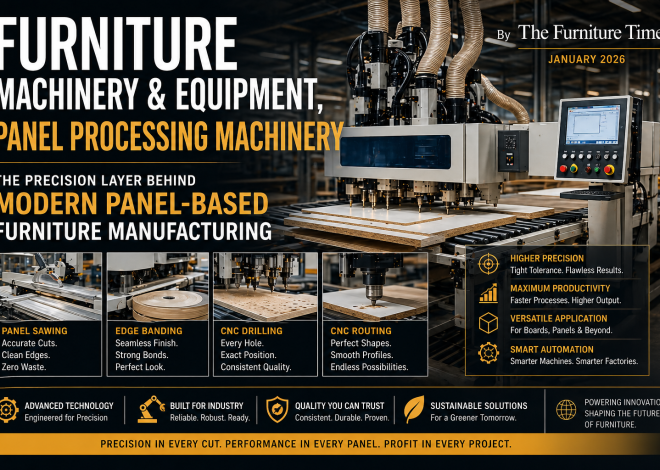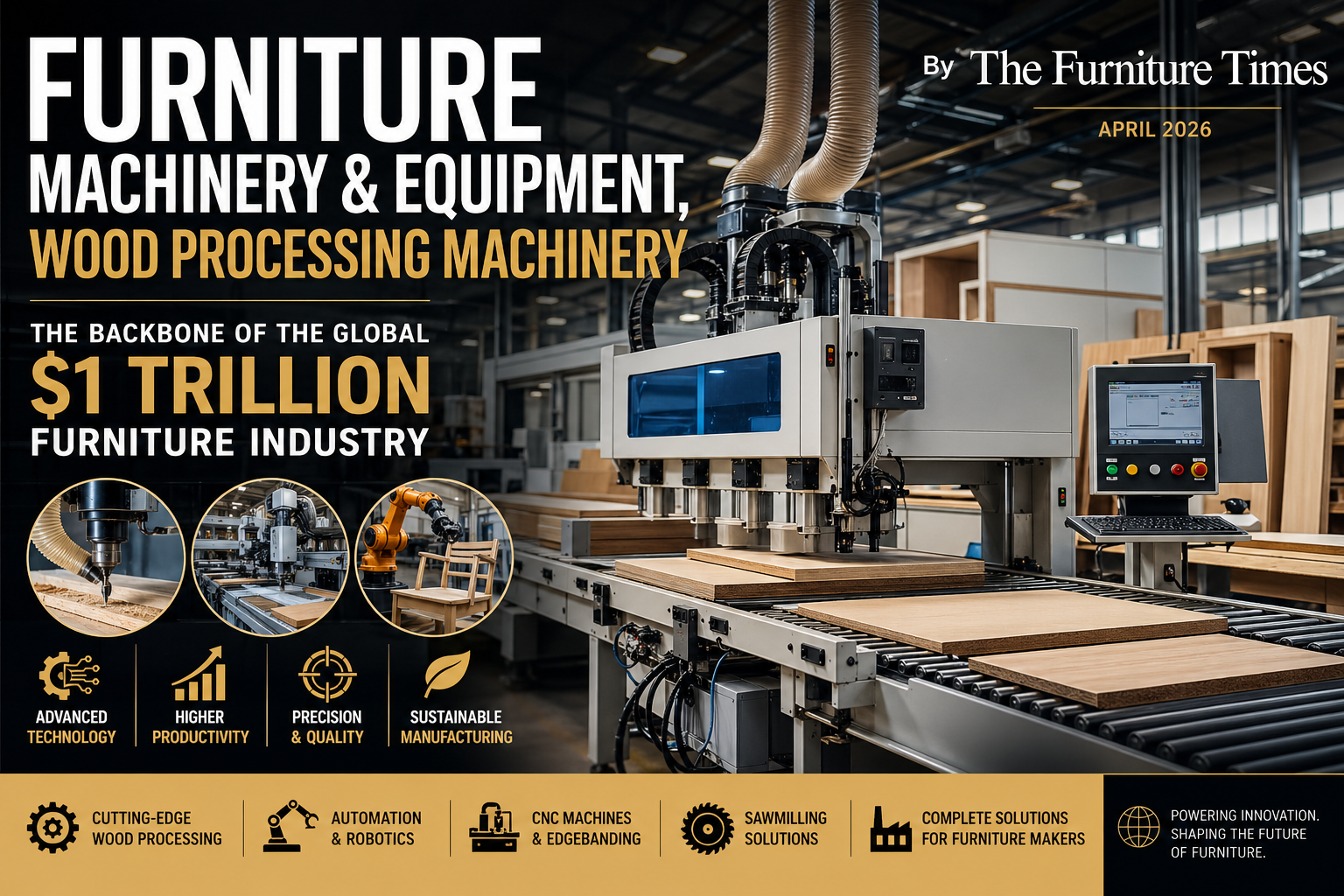
Furniture Machinery & Equipment, Wood Processing Machinery
The Backbone of the Global $1 Trillion Furniture Industry
By The Furniture Times — April 2026
Furniture manufacturing is no longer just about craftsmanship—it is about precision, speed, scalability, and automation. At the heart of this transformation lies Furniture Machinery & Equipment, particularly Wood Processing Machinery, which powers everything from raw timber conversion to high-end finished furniture.
In today’s competitive global ecosystem, manufacturers depend on advanced machinery to:
- Increase production efficiency
- Maintain consistent quality
- Reduce material waste
- Enable mass customization
- Integrate with digital and CNC-based workflows
From small workshops to large-scale automated factories, wood processing machinery defines productivity, profitability, and innovation across the furniture value chain.
This category includes a wide range of machines designed for cutting, shaping, drilling, finishing, and assembling wood and engineered panels such as MDF, plywood, and particleboard.
Core Categories & Machine Descriptions
1. Panel Saws
Panel saws are designed for cutting large wood panels like plywood, MDF, and laminates into precise sizes. They are widely used in cabinet making and modular furniture production, ensuring clean, straight cuts with minimal wastage.
2. Beam Saws
Beam saws are high-precision industrial machines used for cutting stacked panels simultaneously. Ideal for mass production environments, they offer automated control systems for accuracy, speed, and optimized material usage.
3. Circular Saws
Circular saws use a rotating toothed blade to cut wood and engineered boards. They are versatile, fast, and commonly used for straight cuts in both workshops and industrial settings.
4. Band Saws
Band saws utilize a continuous loop blade, making them perfect for curved cuts, irregular shapes, and resawing timber. They are essential for detailed woodworking and custom furniture design.
5. Table Saws
Table saws are one of the most fundamental woodworking machines, featuring a circular blade mounted on a table. They are used for ripping, cross-cutting, and precise dimensioning of wood pieces.
6. CNC Wood Cutting Machines
CNC (Computer Numerical Control) wood cutting machines automate cutting processes using digital designs. They deliver unmatched precision, repeatability, and efficiency, making them critical for modern furniture factories.
7. Wood Routers
Wood routers are used for hollowing out areas, carving designs, and shaping edges. CNC routers, in particular, enable intricate patterns and complex geometries in furniture components.
8. Wood Planers
Wood planers smooth the surface of rough lumber and reduce thickness to a uniform level. They are essential for preparing wood before further processing or finishing.
9. Thickness Planers
Thickness planers ensure wood pieces are cut to consistent thickness across the entire surface. They are widely used for achieving dimensional accuracy in furniture components.
10. Jointers
Jointers are used to flatten and straighten the edges of wood boards. They prepare wood for joining, ensuring seamless alignment and high-quality finishing.
11. Mortising Machines
Mortising machines create square or rectangular holes (mortises) in wood for joinery. They are critical for producing strong joints in furniture construction.
12. Tenoning Machines
Tenoning machines shape the corresponding tenon that fits into a mortise joint. Together with mortising machines, they form the backbone of traditional and industrial joinery systems.
13. Wood Turning Lathes
Wood lathes rotate wood pieces while cutting tools shape them into cylindrical forms. They are used for creating legs, columns, and decorative components in furniture.
14. Edge Squaring Machines
Edge squaring machines ensure that panel edges are perfectly straight and square. This is crucial for achieving precise joins and high-quality finishing in panel-based furniture.
15. Veneer Cutting Machines
Veneer cutting machines slice thin layers of wood from logs, which are then used for decorative surfaces. They play a key role in premium furniture production and cost optimization.
Strategic Industry Insight (For TFT / FISE Positioning)
The evolution of wood processing machinery is shaping the next phase of the furniture industry:
- Shift toward automation & CNC integration
- Rise of smart factories & Industry 4.0
- Increased demand for precision-driven production
- Growth of customization at scale
The future is not just about making furniture — it’s about engineering it with intelligence.
List your machinery business on FISE today — because in the $1 trillion furniture industry, visibility is everything