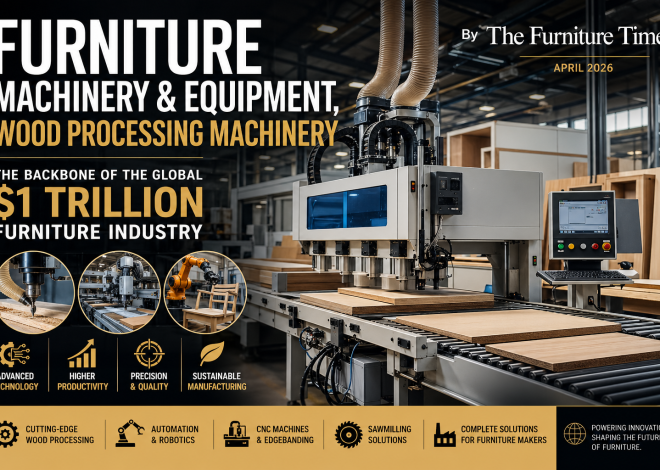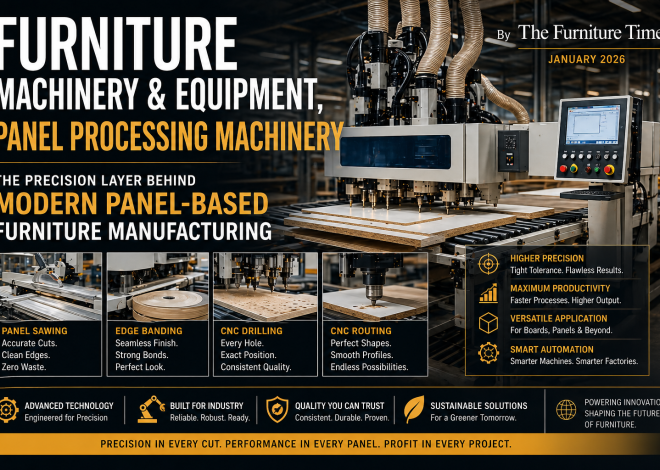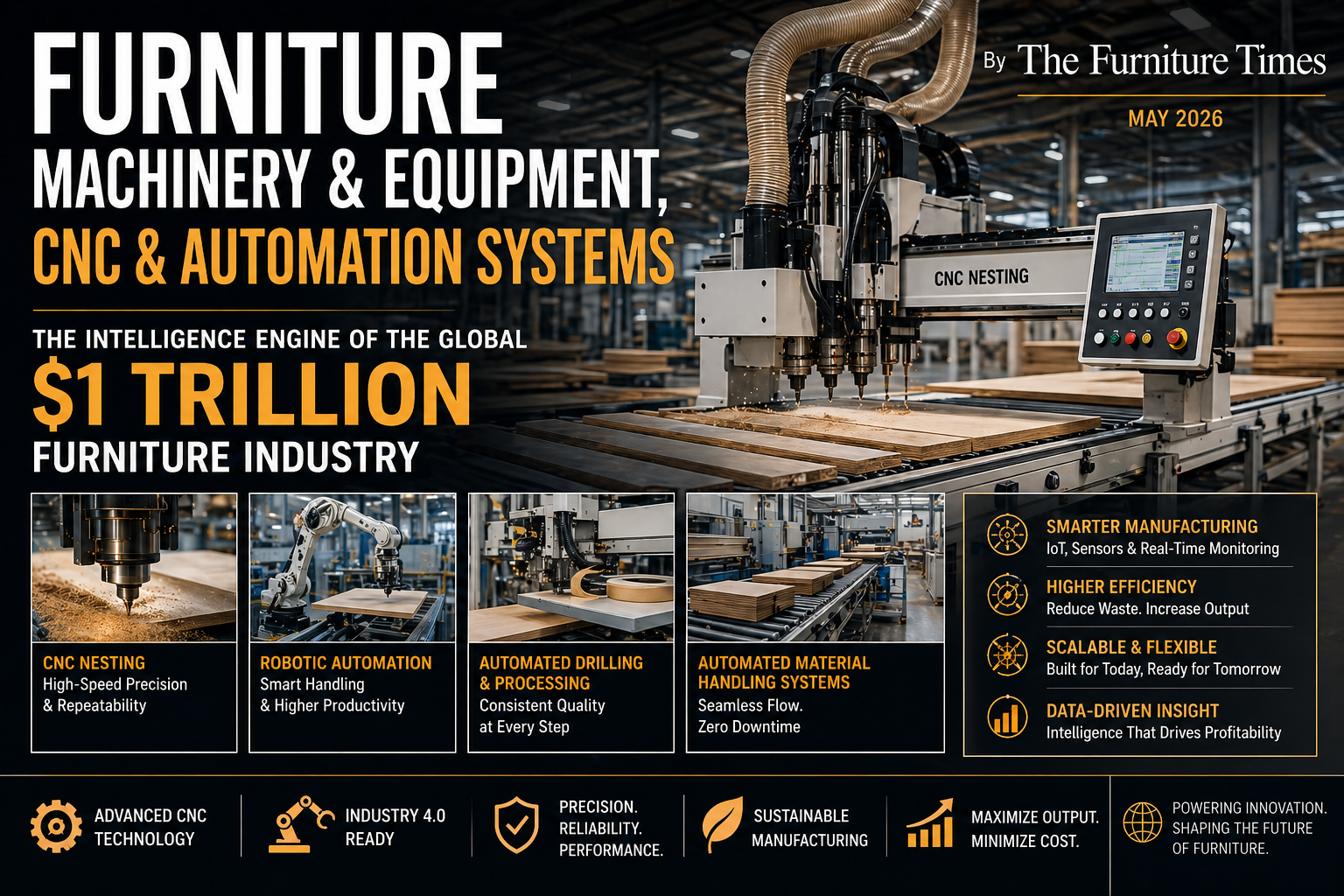
Furniture Machinery & Equipment, CNC & Automation Systems
The Intelligence Engine of the Global $1 Trillion Furniture Industry
By The Furniture Times — April 2026
The global furniture industry is entering a decisive transformation—shifting from traditional manufacturing to an era defined by automation, intelligence, and digital precision. At the center of this evolution lies CNC & Automation Systems, the technologies that are redefining how furniture is designed, produced, and delivered at scale.
No longer limited to cutting and shaping, modern furniture machinery is now deeply integrated with software, robotics, artificial intelligence, and IoT connectivity. This convergence is enabling manufacturers to:
- Achieve mass customization at industrial scale
- Reduce operational costs and material waste
- Improve production speed and consistency
- Integrate design-to-production workflows seamlessly
- Transition toward smart factories and Industry 4.0 ecosystems
From CNC-driven precision cutting to fully automated production lines and AI-powered optimization systems, this category represents the intelligence layer of modern furniture manufacturing.
Core Categories & System Descriptions
1. CNC Routers (3-axis, 5-axis)
CNC routers are computer-controlled cutting machines used for shaping, carving, and engraving wood and panels.
- 3-axis routers handle flat and 2D/2.5D operations.
- 5-axis routers enable complex 3D machining, multi-angle cutting, and intricate furniture designs.
These machines are critical for high-precision and design flexibility.
2. CNC Nesting Machines
CNC nesting machines optimize the layout of parts on large boards (MDF, plywood) to maximize material usage. They automatically cut multiple components in one cycle, significantly reducing waste and improving production efficiency in modular furniture manufacturing.
3. CNC Drilling Machines
These machines automate drilling operations for holes, dowels, and fittings with extreme accuracy. CNC drilling machines are essential for cabinet production, ensuring perfect alignment and repeatability in assembly.
4. CNC Milling Machines
CNC milling machines remove material from a workpiece using rotating cutting tools. They are used for complex shaping, slotting, and detailing, delivering high precision in structural and decorative furniture components.
5. Robotic Arms for Furniture Manufacturing
Robotic arms automate repetitive tasks such as assembly, sanding, painting, and material handling. They improve productivity, reduce human error, and enable continuous production in high-volume factories.
6. Automated Production Lines
Automated production lines integrate multiple machines and processes into a seamless workflow—from cutting and drilling to assembly and finishing. These systems are designed for high-speed, large-scale manufacturing with minimal human intervention.
7. Smart Factory Systems
Smart factory systems connect machines, data, and processes into a centralized digital ecosystem. Using real-time data analytics, manufacturers can monitor performance, predict maintenance needs, and optimize production efficiency.
8. IoT-enabled Machinery
IoT-enabled machines are equipped with sensors and connectivity features that allow real-time data collection and remote monitoring. This enhances transparency, predictive maintenance, and operational control across manufacturing units.
9. AI-based Cutting Optimization Systems
These systems use artificial intelligence to optimize cutting patterns, reduce material waste, and improve yield. By analyzing design data and material characteristics, AI ensures maximum efficiency and cost savings.
10. CAD/CAM Integration Systems
CAD (Computer-Aided Design) and CAM (Computer-Aided Manufacturing) integration systems bridge the gap between design and production. They allow digital designs to be directly converted into machine instructions, ensuring accuracy and faster turnaround.
11. Material Handling Robots
Material handling robots automate the movement of raw materials, panels, and finished products within the factory. They reduce manual labor, increase safety, and streamline workflow efficiency.
12. Automated Storage & Retrieval Systems (ASRS)
ASRS systems are advanced warehouse solutions that automatically store and retrieve materials using robotics and software control. They optimize space utilization, improve inventory management, and ensure quick access to materials during production.
Strategic Industry Insight | TFT Intelligence
The rise of CNC & Automation Systems marks a fundamental shift in the furniture industry:
- From manual craftsmanship → digital precision engineering
- From mass production → mass customization
- From standalone machines → connected smart ecosystems
Factories that adopt these technologies are not just improving efficiency—they are building future-ready, data-driven manufacturing systems.
The next phase of the furniture industry will not be defined by who produces more—
but by who produces smarter.
List your CNC & automation business on FISE today — because in the next phase of the $1 trillion furniture industry, intelligence and visibility will define the winners.