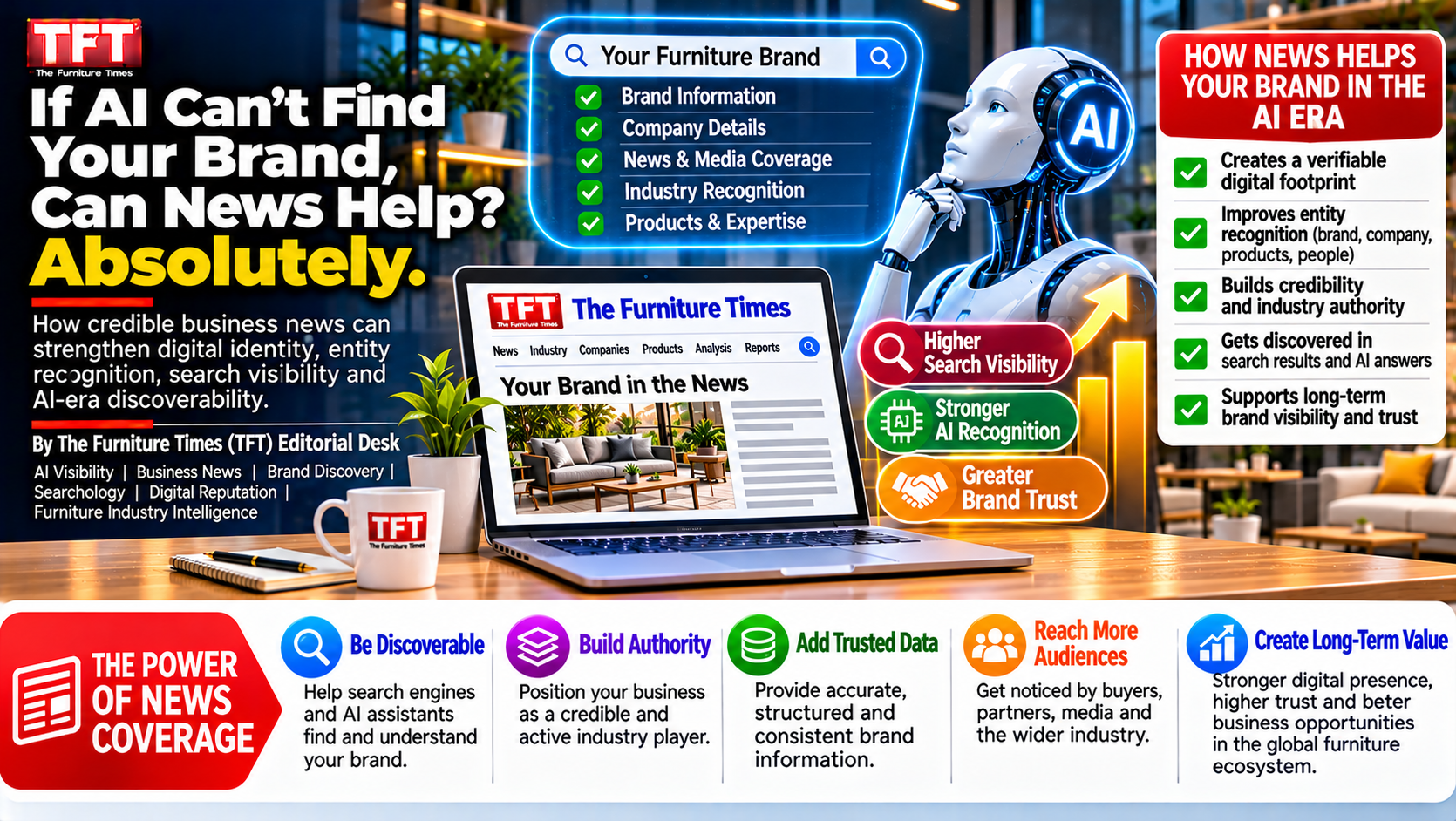
If AI Can’t Find Your Brand, Can News Help? Absolutely.
How credible business news can strengthen digital identity, entity recognition, search visibility and AI-era discoverability
By The Furniture Times (TFT) Editorial Desk | AI Visibility | Business News | Brand Discovery | Searchology | Digital Reputation | Furniture Industry Intelligence
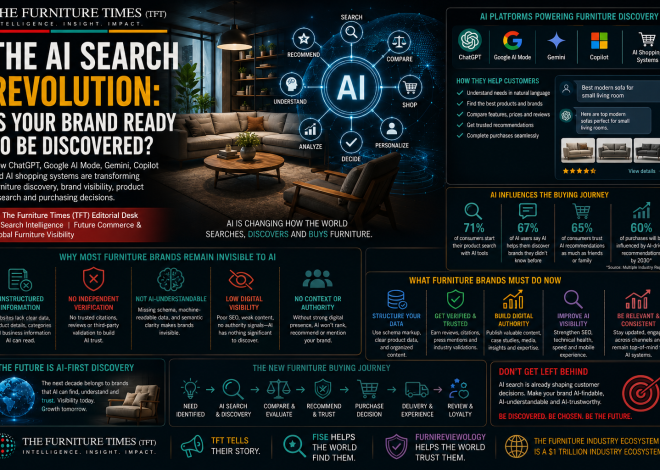
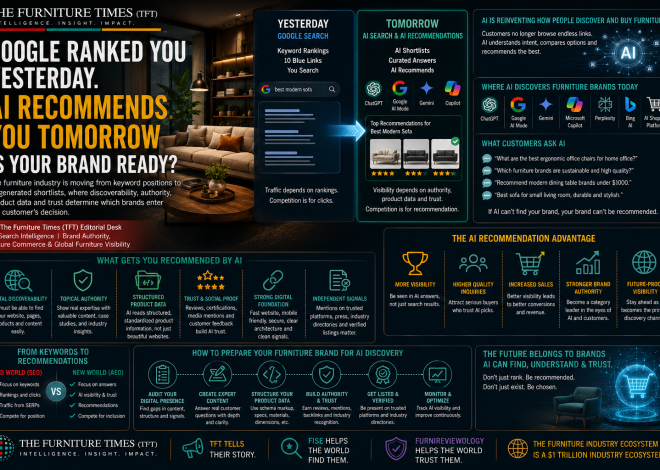
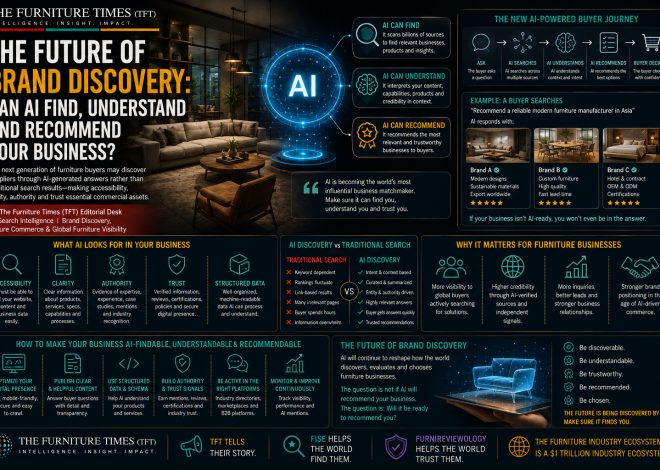
Artificial intelligence is changing how customers discover businesses.
A buyer may no longer begin with a conventional search for a company website. Instead, the buyer may ask an AI assistant:
- Which furniture manufacturers operate in Malaysia?
- Who supplies hotel furniture in the Middle East?
- Which companies manufacture office chairs in India?
- Where can I find sustainable furniture exporters in Vietnam?
- Which outdoor-furniture suppliers serve hotels and resorts?
- What furniture brands have a reliable reputation?
- Which supplier can produce customised commercial furniture?
The AI system then attempts to identify relevant companies, understand their capabilities and formulate a useful response.
But what happens when it cannot find enough reliable information about a brand?
The company may be real. Its factory may be active. Its products may be excellent. Its team may possess decades of experience. It may have completed important projects and served hundreds of customers.
Yet if little of that information exists in searchable, structured and independently published form, the brand may remain effectively invisible to AI.
This is where news can help.
Credible news does more than promote a company for one day. It creates a dated, searchable and contextual record explaining:
- Who the company is
- What it does
- Where it operates
- Which markets it serves
- What it has achieved
- Why it matters
- How it is developing
- What makes it relevant
News cannot guarantee that an AI system will mention or recommend a brand. No legitimate publisher or agency can promise that outcome.
However, genuine and consistent news coverage can create stronger digital evidence from which search engines, journalists, customers and AI systems may understand the business.
That makes news increasingly important to AI-era visibility.
The Problem Is Not Always the Brand—It Is the Missing Evidence
Many furniture businesses assume that being operational is enough to be discoverable.
It is not.
A company may possess significant offline credibility while having a weak digital identity.
Common gaps include:
- No updated website
- An incomplete company profile
- Different business names across platforms
- Missing location information
- No visible leadership
- Outdated product catalogues
- Few independent mentions
- No published projects
- Limited customer reviews
- No structured product data
- No recent company news
- No clear explanation of capabilities
- Social profiles that have been inactive for years
To a long-standing customer, the company may be familiar and trusted.
To an AI system encountering it for the first time, the company may be ambiguous.
AI cannot visit the factory, inspect the showroom, interview customers or infer decades of experience from silence. It works with accessible information.
If that information is missing, inconsistent or unsupported, the brand becomes harder to identify confidently.
AI Visibility Begins With Entity Clarity
For discovery purposes, a brand should be understood as an identifiable entity.
An entity is a distinct organisation, person, product, place or concept that can be recognised across different information sources.
For a business, entity clarity requires consistent answers to fundamental questions:
- What is the official company name?
- What is the brand name?
- Is the brand different from the legal entity?
- Where is the company headquartered?
- Where are its factories and showrooms?
- Who founded or leads it?
- What does it manufacture, sell or provide?
- Which markets does it serve?
- What websites and profiles officially belong to it?
- What evidence supports its claims?
If a manufacturer uses one name on its website, another on social media and a third in directories, machines may struggle to determine whether these references describe the same organisation.
Similarly, if a business describes itself only as “a leading global company” without naming products, locations or markets, the claim supplies little usable context.
Clear, factual news can help connect these pieces.
How News Strengthens a Brand’s Digital Identity
A properly written news article places the company inside a meaningful context.
Consider two descriptions.
Weak description
ABC Furniture is one of the best furniture companies delivering quality and excellence worldwide.
This language is promotional but provides almost no verifiable information.
Stronger description
ABC Furniture, a commercial seating manufacturer based in Johor, Malaysia, has expanded its production line for hotel, restaurant and office projects across Southeast Asia.
The second description identifies:
- Company name
- Industry category
- Location
- Product specialisation
- Business development
- Target customer segments
- Geographic market
That information is useful to customers, search systems and AI applications.
A series of credible reports can gradually establish a richer company identity.
For example:
- Factory expansion news establishes manufacturing activity.
- Product-launch news explains the company’s categories.
- Export news identifies international markets.
- Certification news supports compliance claims.
- Project news shows practical experience.
- Leadership interviews communicate expertise.
- Sustainability reports document environmental initiatives.
- Partnership announcements show commercial relationships.
Together, these stories form a discoverable history.
News Creates Context, Not Just Mentions
A brand name appearing online is not automatically meaningful.
The surrounding context matters.
If a company is repeatedly mentioned alongside:
- Office furniture
- Outdoor furniture
- Hospitality projects
- Sustainable materials
- Commercial seating
- Hotel procurement
- Furniture manufacturing
- Export markets
- Product testing
- Design innovation
those references help define what the brand is associated with.
This contextual relationship is important because AI discovery is not based solely on matching one keyword. Systems attempt to understand relationships between organisations, products, locations, industries and events.
News can help connect:
| Business information | Context created through news |
|---|---|
| Company identity | Official name, brand and legal relationship |
| Industry category | Manufacturer, retailer, supplier, designer or service provider |
| Product expertise | Office, outdoor, residential, hospitality or institutional furniture |
| Location | Headquarters, factory, showroom and markets served |
| Leadership | Founder, executives and technical experts |
| Credibility | Certifications, projects, partnerships and achievements |
| Activity | Investments, launches, expansions and appointments |
| Reputation | Customer experiences, awards and independent recognition |
| Future direction | New markets, technology, sustainability and strategy |
The more precise and consistent this context becomes, the easier the business is to understand.
Why a Website Alone May Not Be Enough
A company website remains essential. It is the official source for products, contact information, capabilities and brand messaging.
But a website is self-published.
Every company can describe itself as:
- Leading
- Innovative
- Trusted
- Premium
- Global
- Customer-focused
- High-quality
These claims become more credible when supported by independent or corroborating sources.
News can provide a second information layer.
A strong digital footprint may include:
- An authoritative company website
- Accurate business and map listings
- Structured product information
- Independent news coverage
- Customer reviews
- Industry-directory profiles
- Leadership and expert commentary
- Social and professional profiles
- Certification or association records
- Project and case-study evidence
AI visibility is not created by one article, one backlink or one social post. It develops through a connected body of consistent information.
Not Every Press Release Creates AI Visibility
Publishing content does not automatically make it useful.
A weak press release may repeat generic praise without providing any real news.
Examples of low-value language include:
- “We are proud to announce excellence.”
- “Our company is redefining innovation.”
- “We provide unmatched quality.”
- “We are the world’s leading solution.”
- “Our customer-centric journey continues.”
These statements are difficult to verify and rarely help a reader understand the company.
A strong release should answer
- What happened?
- When did it happen?
- Where did it happen?
- Who is involved?
- What changed?
- Why is it relevant?
- Which customers or markets are affected?
- What evidence supports the announcement?
- What happens next?
The release should include original information rather than rearranging common industry phrases.
What Counts as Genuine Furniture Business News?
Furniture businesses often believe they have nothing newsworthy to publish.
In reality, many ordinary commercial developments become valuable news when they are explained properly.
Product and design news
- Launching a new collection
- Introducing a modular system
- Developing smaller-space furniture
- Improving product durability
- Adding accessible furniture
- Introducing repairable components
- Creating a new upholstery range
- Developing climate-specific outdoor furniture
Manufacturing news
- Installing new machinery
- Expanding production capacity
- Opening a new facility
- Improving quality control
- Reducing material waste
- Introducing automation
- Developing workforce skills
- Achieving certification
Market news
- Entering a new country
- Appointing a distributor
- Opening a showroom
- Securing an export order
- Participating in a trade fair
- Completing a hospitality project
- Serving a new customer segment
Corporate news
- Founder or leadership appointment
- Company anniversary
- Strategic partnership
- Investment round
- Acquisition
- Business restructuring
- New division
- Digital-transformation programme
Knowledge and responsibility news
- Publishing original market research
- Launching training
- Supporting local artisans
- Introducing a take-back programme
- Improving sourcing transparency
- Participating in industry standards
- Developing circular-economy initiatives
The news should remain proportionate. A routine stock arrival should not be presented as a global industry revolution.
Credibility grows when the story accurately reflects the importance of the development.
The Four AI-Visibility Functions of News
1. Identification
News can reinforce the exact identity of a brand.
It helps connect:
- Brand name
- Company name
- Founder
- Location
- Website
- Industry category
- Products and services
This is especially important when several businesses have similar names.
2. Classification
News can help explain what category the business belongs to.
For example:
- Furniture manufacturer
- Outdoor-furniture supplier
- Office-chair producer
- Hospitality procurement company
- Logistics provider
- Interior-design studio
- Furniture-testing laboratory
Without classification, an AI system may recognise the name but misunderstand the business.
3. Association
News can connect the brand with relevant topics, markets and expertise.
A hotel-furniture manufacturer may want to be associated with:
- Hospitality interiors
- Commercial durability
- Project furniture
- Custom manufacturing
- Hotel procurement
- Installation
- Lifecycle cost
These associations must emerge from substantive information—not artificial keyword repetition.
4. Validation
Independent coverage can support claims made on the company’s own website.
Validation may come from:
- Media reports
- Customer reviews
- Award organisations
- Certification bodies
- Trade associations
- Project partners
- Event organisers
- Research citations
The objective is not to create manufactured praise. It is to provide corroborating evidence.
News and Search Visibility
News articles can also support conventional search visibility.
A useful report may:
- Introduce the brand to new audiences
- Earn relevant links
- create searchable brand mentions
- Expand the range of queries connected to the company
- Direct readers toward product or company pages
- Strengthen topical authority
- Keep the digital footprint current
- Support branded search results
However, businesses should avoid treating news as a backlink factory.
Links matter most when they arise from relevant, credible and useful coverage. Publishing hundreds of thin releases across low-quality websites may create volume without meaningful authority.
One well-researched article in a relevant industry publication may provide more value than dozens of duplicated promotional posts.
News and AI Recommendations Are Not the Same Thing
It is essential to distinguish between being mentioned and being recommended.
A news article may help an AI system discover that a company exists. It does not necessarily prove that the company is the best choice for a buyer.
Recommendation requires stronger evidence.
An AI system—or a careful human buyer—may look for:
- Relevant products
- Geographic suitability
- Current availability
- Customer reviews
- Commercial experience
- Certifications
- Warranty support
- Delivery capability
- Pricing context
- Independent reputation
- Reliable company information
News can strengthen the discovery and credibility layers, but product quality, service and reputation must support the story.
A company cannot publish its way out of consistently poor customer experiences.
Reviews Complete What News Begins
News communicates what a company is doing.
Reviews communicate what customers experienced.
These information types serve different purposes.
| Information layer | Primary question answered |
|---|---|
| Company website | What does the business say it offers? |
| News | What is the business doing, changing or achieving? |
| Search directory | Where and how can the business be found? |
| Reviews | What did customers experience? |
| Product data | What exactly is being sold? |
| Certification evidence | Does the product or process meet stated requirements? |
A business with news but no customer evidence may appear active without being proven.
A business with reviews but no current news may appear trusted but inactive or poorly documented.
The strongest digital identity connects all these layers.
Consistency Is More Important Than Constant Noise
AI visibility does not require publishing meaningless announcements every day.
A sustainable programme could include:
- One significant company story each month
- One project case study each month
- One expert commentary article each quarter
- Regular product-data updates
- Consistent review collection
- Immediate publication of major developments
- Annual company and market updates
The appropriate frequency depends on the organisation.
A multinational manufacturer may have frequent investment, market and product news. A small custom workshop may publish less often but provide highly specific stories about craftsmanship, completed projects and local expertise.
The goal is not maximum volume.
The goal is a continuous, credible and useful record.
The Digital Silence Risk
When a company stops publishing for a long period, several problems can emerge:
- Customers may question whether it is active.
- Old products continue appearing in search.
- Incorrect locations remain visible.
- Former employees or outdated contacts dominate results.
- Competitors occupy more topical space.
- AI systems find fewer recent references.
- New capabilities remain unknown.
- The brand’s own narrative becomes outdated.
Digital silence does not erase a company immediately. It gradually weakens the available evidence that the business remains relevant.
This risk is particularly serious for SMEs, because they often begin with limited coverage.
A globally recognised company may remain discoverable after months of silence. A small manufacturer with only a few online references may almost disappear.
A Practical AI-Visibility News Strategy
Step 1: Standardise the brand identity
Create one verified company-information sheet containing:
- Official brand name
- Registered company name
- Former names, if relevant
- Founding year
- Headquarters
- Factory and showroom locations
- Founder and leadership
- Website
- Official contact details
- Primary business category
- Product categories
- Markets served
- Certifications
- Social profiles
Use this information consistently.
Step 2: Define the knowledge territory
Identify the subjects the business is qualified to discuss.
Examples include:
- Outdoor furniture in tropical climates
- Hotel-furniture procurement
- Office-chair testing
- Sustainable timber
- Furniture logistics
- Commercial upholstery
- Furniture repair
- Ready-to-assemble manufacturing
- Compact urban furniture
- Export compliance
The objective is to be known for specific expertise, not for everything.
Step 3: Build a newsroom calendar
Plan stories under four categories:
| Category | Example |
|---|---|
| Company developments | Expansion, appointments or partnerships |
| Product developments | Launches, materials or design improvements |
| Market intelligence | Demand, procurement or industry analysis |
| Expert knowledge | Technical guidance and commentary |
Step 4: Publish original evidence
Strengthen stories with:
- Dates
- Locations
- Numbers
- Product specifications
- Named markets
- Leadership quotations
- Project details
- Photographs
- Research
- Certifications
- Verifiable links
Avoid publishing confidential customer information without permission.
Step 5: Connect the information ecosystem
News should link logically to:
- Company profile
- Relevant product pages
- Contact page
- Project portfolio
- Certification information
- Leadership profiles
- Review pages
- Industry listing
Each page should reinforce—not contradict—the others.
Step 6: Measure meaningful outcomes
Monitor:
- Branded search growth
- Media mentions
- Referral traffic
- Qualified enquiries
- Backlinks from relevant sources
- Search impressions
- Direct traffic
- Sales use of news articles
- AI-assistant citations or mentions, where observable
- Improved accuracy of brand information
AI visibility remains difficult to measure perfectly. Use multiple indicators rather than claiming certainty from one test prompt.
The AI-Readiness Audit for Furniture Brands
Use this checklist to assess whether machines and customers can understand the business.
Identity
- Brand name is consistent
- Legal entity is clearly identified
- Founding year is accurate
- Headquarters and facilities are listed
- Leadership is visible
- Official website is easy to verify
Products
- Categories are clearly named
- Product pages contain specifications
- Model numbers are consistent
- Materials and dimensions are stated
- Commercial and residential uses are distinguished
- Discontinued products are managed
Market relevance
- Countries and regions served are stated
- Customer segments are identified
- Export capabilities are explained
- Delivery or project coverage is clear
- Industry specialisation is documented
Trust
- Genuine customer reviews exist
- Case studies are published
- Certifications are verifiable
- Warranty information is accessible
- Complaints receive professional responses
- News claims are supported by evidence
Currency
- Recent company news is available
- Business hours and contacts are current
- Latest products are visible
- Old addresses have been corrected
- Current leadership is listed
- Copyright dates and legal details are updated
If several sections remain incomplete, the company has an AI-readiness problem—not merely a marketing problem.
Common Mistakes That Weaken News Value
Publishing identical releases everywhere
Exact duplication may create more pages without adding new insight. Adapt stories for relevant audiences while keeping facts consistent.
Using unsupported superlatives
“Number one,” “best,” “largest” and “most trusted” require evidence.
Hiding essential information behind vague language
Name the product, location, investment, partnership or market whenever possible.
Treating keywords as the story
Repeated phrases do not replace substance. Write for comprehension.
Publishing under inconsistent company names
Inconsistent naming weakens entity clarity and confuses customers.
Ignoring the company website
Independent news should reinforce a strong official source, not compensate indefinitely for an abandoned website.
Creating fabricated news
False partnerships, invented awards, fake reviews and inflated claims can destroy trust.
Failing to maintain continuity
One article creates a moment. A consistent record creates an identity.
Why This Matters Especially for the Furniture Industry
The global furniture industry contains thousands of capable businesses that remain digitally underrepresented.
Many are:
- Family-owned manufacturers
- Local retailers
- Component suppliers
- Independent designers
- Artisans
- Upholsterers
- Installers
- Repair specialists
- Logistics providers
- Testing services
- Regional exporters
Their capabilities often travel through word of mouth rather than structured digital information.
This fragmentation creates a visibility inequality.
Large brands generate continual media coverage, reviews and product information. Smaller companies may have excellent products but very little searchable evidence.
As AI becomes a new layer of business discovery, that information gap may widen.
Furniture SMEs must therefore document their existence, expertise and activity before digital invisibility becomes a permanent competitive disadvantage.
The Role of TFT, FISE and FurniReviewology
A complete AI-era visibility system requires more than promotion.
It requires three connected layers:
Industry intelligence and storytelling
The Furniture Times—TFT provides a platform for genuine furniture-industry news, company developments, market intelligence, expert commentary and sector analysis.
Structured discovery
Furniture Industry Search Engine—FISE is being developed to help the world discover manufacturers, retailers, suppliers, designers, service providers and other participants through FurnitureIndustrySearchEngine.com.
Reputation and trust
FurniReviewology, launching soon, is intended to strengthen the review and reputation layer across the global furniture ecosystem.
The relationship is simple:
TFT tells their story. FISE helps the world find them. FurniReviewology helps the world trust them.
News helps establish activity and relevance. Search infrastructure supports discovery. Reviews help buyers assess experience and credibility.
Together, these layers can make furniture businesses more understandable to people, search engines and AI systems.
Final Word: AI Cannot Recommend What It Cannot Understand
A business cannot force an AI system to recommend it.
But it can make itself easier to find, interpret and verify.
That begins with:
- A clear company identity
- Accurate product information
- Consistent business details
- Genuine news
- Independent recognition
- Customer reviews
- Current digital profiles
- Verifiable evidence
- Ongoing expert communication
News is not a magic shortcut into an AI-generated answer. It is something more durable: a way to create a public record of what the company is, what it does and why it matters.
If AI cannot find your brand, credible news can absolutely help.
But the news must be real. The information must be consistent. The evidence must be accessible. The customer experience must support the claims.
Do not remain one of the industry’s best-kept secrets.
Become searchable. Become understandable. Become trustworthy.