The Hidden Relationship Between Advertising Cuts and Price Sensitivity
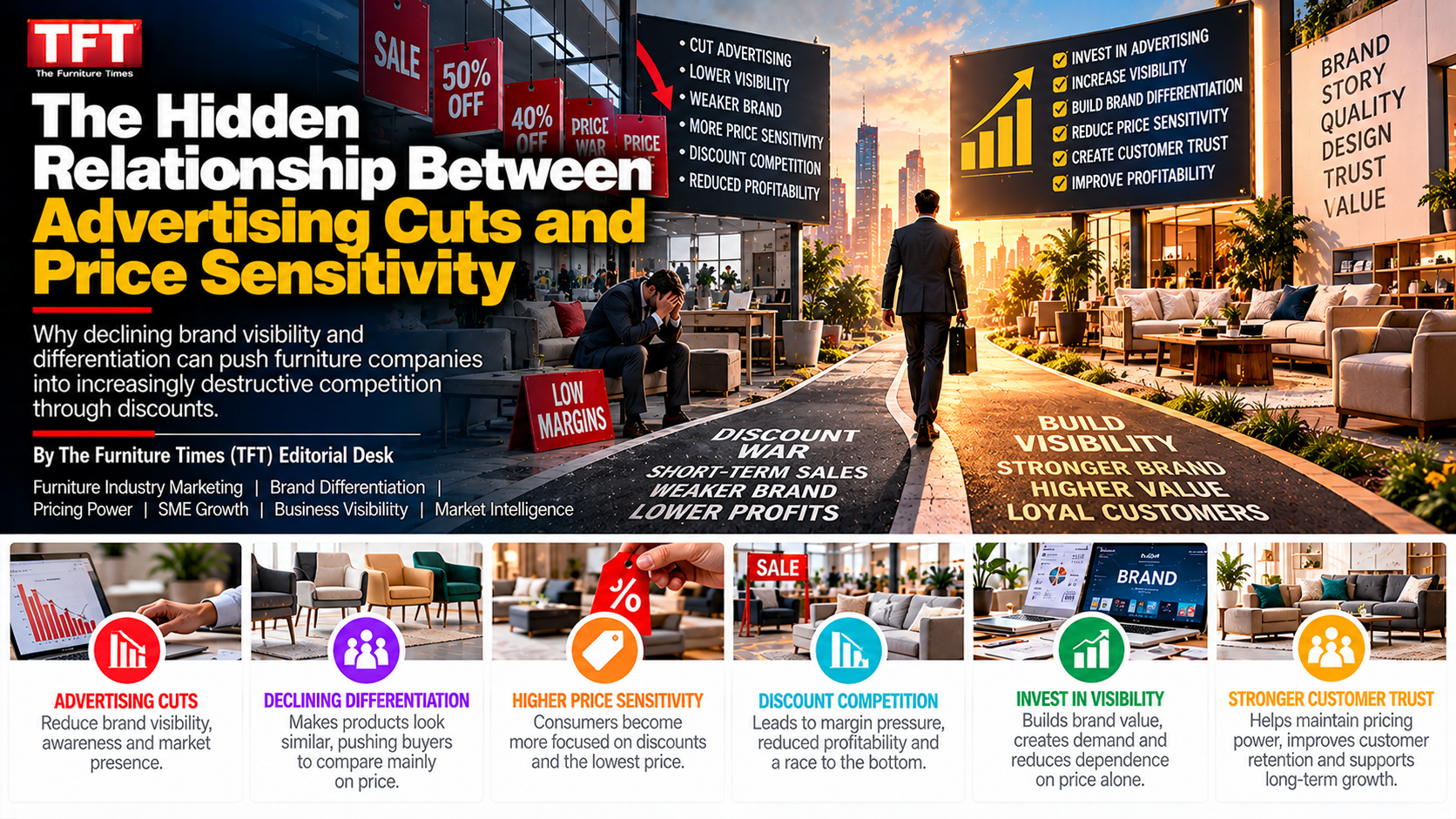
The Hidden Relationship Between Advertising Cuts and Price Sensitivity
Why declining brand visibility and differentiation can push furniture companies into increasingly destructive competition through discounts
By The Furniture Times (TFT) Editorial Desk
Furniture Industry Marketing | Brand Differentiation | Pricing Power | SME Growth | Business Visibility | Market Intelligence
When sales decline, advertising is often one of the first expenses placed under review.
Management reduces campaigns, postpones photography, stops publishing news, limits customer communication and suspends long-term brand development. The immediate objective is understandable: conserve cash and protect short-term profitability.
But advertising cuts can create a commercial consequence that may not appear immediately in the accounts.
As the brand becomes less visible and less distinctive, customers may find fewer reasons to prefer it. The company then begins to look interchangeable with competitors. Once products appear interchangeable, price becomes the simplest basis for comparison.
The business responds with promotions.
Competitors respond with larger promotions.
Customers learn to wait for the next sale.
Margins decline, the brand loses pricing power and the company has even less money available for future marketing.
This produces a dangerous cycle:
Advertising cuts → weaker brand memory → reduced differentiation → greater price comparison → more discounting → lower margins → less money for brand building
The relationship is not automatic. Reducing an inefficient advertising campaign does not instantly make customers price-sensitive, and strong products do not become commodities overnight.
However, when a business remains quiet for long enough—and when it does little else to demonstrate quality, expertise, trust or distinctive value—customers can increasingly judge it by the one variable that is easiest to understand: price.
Advertising Does More Than Generate Immediate Sales
Many businesses judge advertising only by short-term conversions.
They ask:
- How many clicks did we receive?
- How many enquiries came this week?
- How many products were sold?
- What was the immediate return on advertising spend?
These are important questions, particularly when cash is limited. But they capture only part of advertising’s commercial role.
Advertising can also help a business:
- Remain mentally available
- Reinforce product quality
- Communicate expertise
- Establish a distinctive identity
- Explain why the product is different
- Create familiarity
- Reduce perceived purchasing risk
- Support distributor confidence
- Strengthen customer trust
- Protect the ability to charge a premium
Advertising does not merely ask customers to buy today.
It can also shape how they evaluate the brand when they are ready to buy later.
Research summarised by the Institute of Practitioners in Advertising indicates that successful brand-building activity can strengthen pricing power and profitability. The IPA also argues that businesses achieve stronger outcomes by balancing long-term brand building with shorter-term activation.
What Is Price Sensitivity?
Price sensitivity describes how strongly customer demand changes when price changes.
A highly price-sensitive customer may switch brands, postpone buying or abandon the purchase after a small price increase.
A less price-sensitive customer may continue buying because the brand provides value that is difficult to replace.
Economists frequently express this through price elasticity of demand:\[ \text{Price Elasticity} = \frac{\%\text{ change in demand}}{\%\text{ change in price}} \]
Suppose a furniture retailer raises the price of a dining set by 5%, and demand falls by 15%.
The approximate price elasticity is:\[ \frac{-15\%}{5\%}=-3 \]
This indicates relatively high sensitivity.
If demand falls by only 2% after the same 5% increase, the approximate elasticity is:\[ \frac{-2\%}{5\%}=-0.4 \]
The second product has stronger resistance to price pressure.
In practice, price sensitivity is influenced by many factors:
- Household income
- Economic confidence
- Competitor pricing
- Product necessity
- Switching costs
- Availability
- Product quality
- Customer experience
- Brand trust
- Perceived differentiation
- Purchase urgency
- Financing options
- Replacement frequency
Advertising is not the only influence, but it can help shape several of these perceptions.
Differentiation Is a Form of Pricing Protection
A business has pricing power when customers believe its offer is worth more than available alternatives.
The difference may be functional:
- Stronger construction
- Better materials
- Faster delivery
- Longer warranty
- Easier repair
- Better customisation
- Superior comfort
- More reliable installation
It may also be experiential:
- Responsive service
- Trusted advice
- Easier buying process
- Professional communication
- Better project coordination
- Consistent after-sales support
And it may be perceptual:
- Recognisable design
- Brand heritage
- Specialist expertise
- Reputation
- Social proof
- Emotional relevance
- Distinctive identity
Kantar’s analysis of thousands of brands has found a strong relationship between perceived relative uniqueness and consumers’ willingness to pay more. Kantar argues that meaningful differentiation can reduce price sensitivity, support healthier margins and strengthen profitability.
In 2025, Kantar reported that meaningful difference explained a large proportion of the variation in its pricing-power measure. The practical lesson is not that businesses should manufacture artificial uniqueness. It is that customers are more likely to accept a premium when they can understand why the brand is valuable and different.
What Happens When a Brand Stops Communicating?
A brand does not normally disappear from customer memory in one day.
The decline is gradual.
Stage 1: Reduced exposure
Customers encounter the brand less often.
They see fewer:
- Advertisements
- Product stories
- Case studies
- News reports
- Social updates
- Educational articles
- Project photographs
- Customer testimonials
Stage 2: Weaker memory
When a buying occasion occurs, the brand is less likely to come to mind.
Research associated with marketing science describes advertising as capable of refreshing and building memory associations, increasing the chance that a brand will be recalled during a relevant buying situation.
Stage 3: Reduced perceived difference
When the business stops explaining its materials, service, expertise, warranties and design philosophy, customers may see only the product category.
The company is no longer perceived as a specialist furniture manufacturer. It becomes another supplier of tables.
It is no longer a trusted hospitality-furniture partner. It becomes another quotation.
Stage 4: Increased comparison
Customers compare offers through the easiest visible variables:
- Price
- Dimensions
- Colour
- Delivery date
- Discount percentage
Stage 5: Promotional dependence
The business uses price reductions to regain attention.
Stage 6: Margin erosion
The company has less money available for:
- Better materials
- Customer service
- Product development
- Employee training
- Photography
- Technology
- Advertising
The cycle strengthens itself.
The Furniture Industry Is Especially Vulnerable
Furniture businesses face particular differentiation challenges.
Many products appear similar online.
A customer may see ten wooden dining tables with:
- Similar dimensions
- Similar brown finishes
- Similar rectangular forms
- Similar lifestyle images
- Similar marketing language
If descriptions provide little meaningful information, the customer may conclude that the tables are equivalent.
Price becomes the deciding factor.
But the products may differ greatly in:
- Timber species
- Board construction
- Veneer quality
- Joint design
- Surface finish
- Hardware
- Weight
- Stability
- Repairability
- Warranty
- Delivery
- Installation
- Expected service life
If the manufacturer or retailer does not communicate those differences, the customer cannot be expected to value them.
Uncommunicated value is commercially invisible value.
Generic Product Information Creates Price Shoppers
Consider two descriptions.
Description A
Modern wooden dining table. High quality. Best price. Available now.
Description B
Six-seat dining table manufactured with a reinforced solid-wood underframe, protected surface finish and replaceable leg assemblies. Designed for daily family use, with professional delivery, assembly and a five-year structural warranty.
The second description gives the customer more criteria for evaluation.
It does not guarantee a sale, and every claim must be true. But it reduces the likelihood that the product will be judged only by price.
Furniture businesses frequently create price-sensitive customers through poor information.
If the website does not explain:
- Materials
- Construction
- Dimensions
- Durability
- Warranty
- Care
- Delivery
- Replacement parts
- After-sales support
then the customer is left with appearance and price.
Advertising Cuts Can Turn Quality Into a Hidden Cost
A manufacturer may use better materials than its competitors but fail to communicate them.
The business pays for:
- Thicker steel
- Better timber
- Stronger fittings
- Higher-density foam
- Superior finishes
- More durable mechanisms
- Professional inspection
Yet the customer sees only a higher price.
This creates a dangerous internal debate.
Management may conclude:
Customers do not appreciate quality, so we must reduce the product cost.
The real problem may be that customers were never given enough information to recognise the quality difference.
When communication disappears, product advantages can become hidden expenses rather than visible value.
The Discount Trap
Discounting is not inherently harmful.
It can be useful for:
- Clearing ageing inventory
- Managing seasonal products
- Introducing a new range
- Rewarding loyal customers
- Supporting a defined event
- Generating cash from discontinued stock
- Testing demand at different prices
The problem begins when discounts become the brand’s primary method of attracting attention.
The cycle develops quickly
- The company advertises a 20% discount.
- Sales improve temporarily.
- The promotion ends and demand weakens.
- The company launches another sale.
- Customers learn that the regular price is temporary.
- A competitor announces 30% off.
- The company responds with 40% off.
- The original price loses credibility.
- Margin becomes dependent on inflated list prices or reduced quality.
Eventually, customers stop asking:
Is this product worth the price?
They begin asking:
When will the next discount arrive?
The brand has trained the market to delay purchasing.
Advertising Cuts and Discounting Can Produce Opposite Types of Demand
Brand-building advertising and promotional advertising do not always attract customers in the same way.
A brand message may communicate:
- Durability
- Design
- Heritage
- Service
- Expertise
- Trust
- Comfort
- Reliability
A price promotion communicates:
- Buy now because the product is temporarily cheaper.
The first can build future preference.
The second can accelerate immediate transactions.
Both have a place. The danger is replacing almost all brand communication with discounts.
When customers repeatedly encounter only offers, the discount becomes the brand’s most distinctive feature.
That is difficult to reverse.
Short-Term Sales Can Hide Long-Term Damage
A discount campaign may show an attractive immediate return:
- Traffic increases
- Enquiries rise
- Inventory moves
- Revenue improves
However, management should also ask:
- How much gross margin was sacrificed?
- How many buyers would have purchased without the discount?
- Did the campaign attract repeat customers?
- Did customers buy only the promoted item?
- Did the campaign weaken future full-price sales?
- Did delivery and service costs increase?
- Did customers return more products?
- Did the sale create conflict with dealers?
- Did the promotion damage premium positioning?
A campaign can increase revenue while reducing profit.
It can also bring forward future demand rather than create new demand.
The Margin Mathematics of Discounting
Discount percentages can appear small while their effect on profit is large.
Suppose a sofa sells for $1,000.
The variable cost is $700.
The normal contribution is:\[ \$1,000-\$700=\$300 \]
Now the retailer offers a 20% discount.
The selling price becomes:\[ \$1,000 \times 0.80=\$800 \]
The contribution becomes:\[ \$800-\$700=\$100 \]
The selling price fell by 20%, but the contribution fell from $300 to $100—a decline of approximately 67%.
To generate the same total contribution, the retailer must sell three discounted sofas for every one previously sold at full price.
That calculation excludes additional costs such as:
- Delivery
- Installation
- Sales commission
- Payment fees
- Returns
- Warranty provision
- Advertising
This is why discount-led growth can generate activity without generating financial strength.
Price Sensitivity Is Not Always a Brand Problem
A balanced analysis must recognise that customers may become more price-sensitive even when a business maintains advertising.
External causes include:
- Inflation
- Lower disposable income
- Higher interest rates
- Housing-market weakness
- Job insecurity
- Currency movements
- Aggressive competitors
- Cheaper imports
- Changing product technology
- Reduced category demand
Advertising cannot eliminate economic reality.
A customer who cannot afford a premium sofa will not purchase it simply because the campaign is memorable.
The role of brand building is not to make price irrelevant. It is to prevent price from becoming the only relevant factor.
Cutting Waste Is Not the Same as Cutting the Brand
Some advertising should be reduced.
A company should stop spending when:
- Audiences are irrelevant
- Leads are consistently unqualified
- Campaign tracking is unreliable
- Creative is outdated
- Product margins cannot support acquisition costs
- The company cannot fulfil demand
- The channel produces no useful commercial result
- Agencies cannot explain performance
- Multiple campaigns duplicate one another
- Advertising promises do not match the customer experience
The mistake is applying the same cut to everything.
A thoughtful reduction distinguishes between:
- Waste and visibility
- Short-term activation and long-term brand building
- Poor execution and an unnecessary channel
- Expensive media and essential communication
- Vanity metrics and commercial evidence
The business may spend less while communicating more effectively.
How to Reduce Advertising Without Increasing Price Sensitivity
1. Protect the brand’s distinctive identity
Maintain consistent use of:
- Brand name
- Logo
- Colours
- Typography
- Tone of voice
- Product naming
- Photography style
- Core message
Consistency helps customers recognise the business even when media spending is lower.
2. Explain the product difference
Do not rely on claims such as:
- Premium quality
- Best design
- Superior furniture
- Trusted brand
Provide evidence.
Explain:
- Material specifications
- Structural construction
- Testing
- Warranty
- Design process
- Repairability
- Delivery service
- Project expertise
- Customer support
3. Focus on the most profitable categories
Do not divide a limited budget evenly across the entire catalogue.
Prioritise products that have:
- Strong margins
- Reliable availability
- Clear differentiation
- Positive reviews
- Repeat demand
- Strategic importance
4. Retain high-intent visibility
Protect channels used by customers who are actively searching.
These may include:
- Search advertising
- Local search
- Industry directories
- Marketplace listings
- Product feeds
- Dealer locators
- RFQ platforms
- Retargeting
5. Use genuine news
Press releases and industry coverage can document:
- Factory investments
- New collections
- Certifications
- Projects
- Partnerships
- Market expansion
- Sustainability achievements
- Leadership appointments
News can reinforce credibility without relying entirely on promotional claims.
6. Strengthen customer reviews
Genuine reviews help buyers assess:
- Quality
- Comfort
- Delivery
- Installation
- Service
- Durability
- Value
7. Improve customer retention
Existing customers already understand the business.
Use:
- Reorder communication
- Maintenance services
- Replacement-part offers
- Loyalty benefits
- Trade-customer updates
- Personal account management
8. Build owned media
Invest in assets the company controls:
- Website
- Email list
- Product database
- Case studies
- Project portfolio
- Video library
- Technical resources
- Newsroom
These assets continue working beyond a single paid campaign.
Furniture Differentiation Must Be Specific
Furniture companies should define value across practical dimensions.
Product differentiation
- Materials
- Construction
- Comfort
- Safety
- Durability
- Modularity
- Repairability
- Space efficiency
- Design originality
- Finish quality
Service differentiation
- Consultation
- Customisation
- Site measurement
- Delivery
- Installation
- Warranty
- Maintenance
- Spare parts
- Complaint resolution
Operational differentiation
- Lead times
- Stock availability
- Small-order flexibility
- Project management
- Export readiness
- Documentation
- Quality control
- Reliable communication
Reputation differentiation
- Reviews
- Certifications
- Case studies
- Media coverage
- Leadership expertise
- Customer references
- Industry participation
A company does not need to be different in every area.
It needs to be meaningfully better in areas that matter to its target customer.
B2B Furniture Companies Face the Same Risk
Manufacturers sometimes assume that branding matters only in consumer retail.
B2B buyers are also human. They use price, trust and perceived risk when evaluating suppliers.
A hotel procurement team may compare:
- Product cost
- Lifecycle cost
- Delivery capability
- Compliance
- Customisation
- Installation
- Replacement availability
- Warranty
- Financial reliability
- Previous projects
When several suppliers appear equally capable, the lowest quotation may win.
A manufacturer can reduce pure price comparison by demonstrating:
- Documented project experience
- Production capability
- Quality-control systems
- Product testing
- Engineering support
- Delivery performance
- Replacement programmes
- Repair services
- Verifiable customer references
The stronger the evidence, the less likely the decision will depend only on the first quotation.
Trust Supports Pricing Power
Customers may accept a higher price when they believe the transaction carries lower risk.
Trust can come from:
- Consistent communication
- Accurate claims
- Transparent policies
- Genuine reviews
- Independent news coverage
- Professional documentation
- Responsive service
- Proven complaint resolution
- Long-term market presence
Recent IPA-related research has also highlighted a connection between trust-building advertising and stronger business outcomes, including greater reported reductions in price sensitivity compared with campaigns that did not build trust.
For furniture businesses, trust has direct economic value because mistakes can be expensive, inconvenient and difficult to reverse.
Measure More Than Return on Advertising Spend
If management measures advertising only by immediate revenue, long-term brand activity will nearly always look weaker than discount advertising.
A more complete measurement system includes:
Short-term commercial measures
- Qualified enquiries
- Conversion rate
- Cost per acquisition
- Revenue
- Contribution margin
- Inventory movement
- Showroom appointments
Brand measures
- Branded-search volume
- Direct website traffic
- Unaided or aided awareness
- Consideration
- Perceived quality
- Trust
- Differentiation
- Willingness to pay
- Price sensitivity
Customer measures
- Repeat purchase
- Referral
- Review sentiment
- Complaint patterns
- Net revenue retention
- Customer lifetime value
Market measures
- Share of voice
- Search visibility
- Dealer enquiries
- Market share
- Competitive price position
- Organic media mentions
The objective is not to measure everything. It is to prevent management from optimising the company exclusively for this week’s transactions.
Warning Signs That Your Brand Is Becoming Price-Dependent
A furniture company should investigate if:
- Most enquiries begin with “best price?”
- Sales collapse when promotions end
- Customers delay purchases until sale periods
- Salespeople immediately offer discounts
- Competitors’ price changes dictate every decision
- Product features are rarely discussed
- Dealers complain about inconsistent pricing
- The website emphasises percentages more than value
- Regular prices have little credibility
- Gross margin keeps falling
- Brand searches decline
- Reviews mention price but little else
- Customers cannot explain why the brand is different
- The sales team cannot communicate lifecycle value
These are signs that differentiation may be weakening.
A 90-Day Plan to Rebuild Pricing Power
Days 1–30: Diagnose
- Review promotion frequency
- Calculate margin loss from discounting
- Identify the most price-sensitive products
- Analyse competitor positioning
- Interview customers
- Review search and brand visibility
- Audit product information
- Identify genuine differentiators
Days 31–60: Clarify value
- Rewrite priority product pages
- Publish material and construction details
- Create product comparisons
- Improve warranty information
- Document delivery and installation
- Produce customer case studies
- Collect genuine reviews
- Train sales teams to explain value
Days 61–90: Restore visibility
- Publish genuine company news
- Relaunch focused brand communication
- Protect high-intent advertising
- Replace permanent discounts with targeted offers
- Introduce value-added bundles
- Measure branded search and full-price conversion
- Test willingness to pay
- Review whether price changes improve contribution
The objective is not to eliminate all promotions in 90 days.
It is to reduce dependence on them.
Better Alternatives to Permanent Discounting
Instead of reducing the product’s value, a business can add value through:
- Free or improved delivery
- Professional assembly
- Extended warranty
- Maintenance package
- Replacement-part support
- Fabric-protection service
- Design consultation
- Flexible payment options
- Product bundles
- Trade-in or take-back programmes
- Loyalty rewards
- Priority delivery
- Custom colour or finish options
These offers still have costs and should be calculated carefully, but they may protect the product’s price position better than a permanent percentage reduction.
The Role of TFT, FISE and FurniReviewology
The furniture industry ecosystem is a $1 trillion industry ecosystem, but thousands of companies remain commercially invisible and poorly differentiated.
When buyers cannot find information about a business, they struggle to understand its value.
When they cannot verify its capabilities, they become cautious.
When they cannot distinguish it from competitors, they compare price.
This is why visibility, searchability and trust must work together.
The Furniture Times tells their story.
Furniture Industry Search Engine helps the world find them.
FurniReviewology helps the world trust them.
Furniture companies should document:
- Their story
- Their products
- Their manufacturing capability
- Their materials
- Their certifications
- Their projects
- Their services
- Their customer experiences
A business that communicates value consistently has a better chance of protecting its margins than one that appears only when it announces another sale.
Final Assessment
Advertising cuts do not automatically force a company to discount.
But extended silence can weaken brand memory, reduce perceived difference and make the business easier to compare with generic alternatives.
When differentiation disappears, price becomes louder.
When price becomes the primary message, promotions become more frequent.
When promotions become expected, margins weaken.
And when margins weaken, the company has even fewer resources to rebuild its identity.
The answer is not to maintain every advertising expense regardless of performance.
The answer is to:
- Remove waste
- Protect essential visibility
- Explain real differences
- Strengthen trust
- Improve product information
- Focus on profitable customers
- Measure contribution rather than revenue alone
- Use discounts selectively
- Continue building the brand
The strongest companies do not avoid price competition by pretending price is unimportant.
They avoid total dependence on price by giving customers credible reasons to choose them.
A brand that stops explaining its value will eventually be asked to prove that value through a lower price.
Cut waste—not differentiation.
If you are not searchable, you do not exist.
Sources:
Kantar—Can Brand Differentiation Reduce Customer Price Sensitivity?, Kantar—What if Price, Not Volume, Is Your Biggest Growth Opportunity?, IPA—Effectiveness Reports, Google—Marketing’s Impact on Pricing Power and Profitability, Advertising in a Downturn