India Furniture Industry News: Formalisation, Certification and Manufacturing Growth
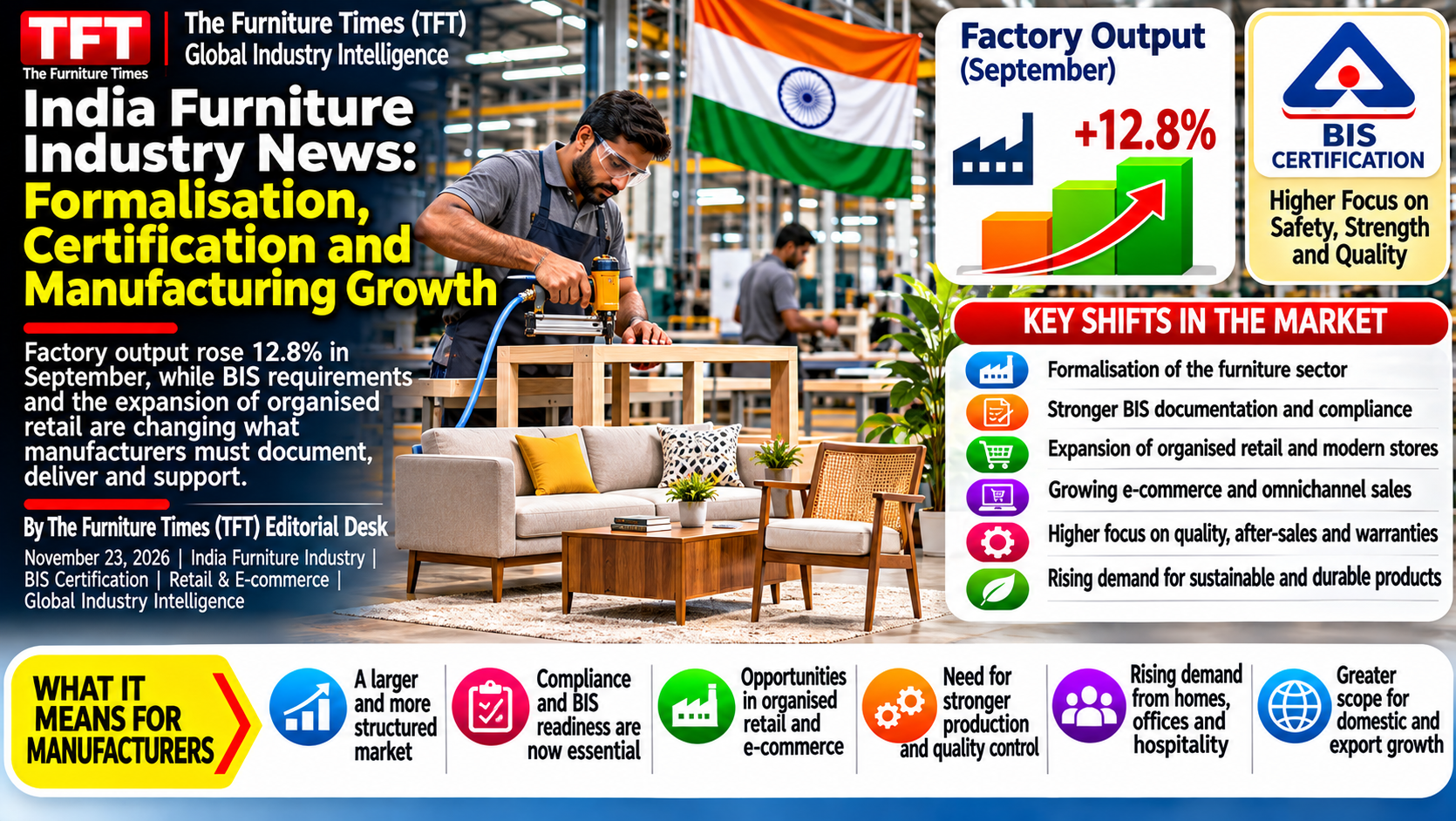
Factory output rose 12.8% in September, while BIS requirements and the expansion of organised retail are changing what manufacturers must document, deliver and support
By The Furniture Times (TFT) Editorial Desk | November 23, 2026 | India Furniture Industry | BIS Certification | Retail & E-commerce | Global Industry Intelligence
India’s furniture manufacturing output rose 12.8% year on year in September 2026, according to the National Statistical Office’s preliminary industrial production figures. The furniture manufacturing index was 8.6% higher across April–September than in the same period a year earlier. That is a positive production signal, but it is not a measure of nationwide furniture retail sales, factory profitability or output at every local workshop. mospi.gov.in
The growth comes as two other developments change how furniture reaches Indian buyers. The Furniture Quality Control Order puts specified product categories under a compulsory BIS certification framework, subject to applicable exemptions and transition provisions. At the same time, retailers such as Wakefit and IKEA are combining physical showrooms with wider ordering options. Together, these changes make the ability to identify a product, reproduce its specification and support it after delivery more commercially important. Bureau of Indian Standards
Domestic manufacturing: Output is growing, but the index does not tell the whole story
The official furniture manufacturing index rose from 123.4 in September 2025 to 139.2 in September 2026. Across April–September, broader manufacturing output rose 7.6%, while furniture manufacturing rose 8.6%. September’s furniture increase was stronger than the year-to-date pace, but one month is not enough to establish that the industry is accelerating sustainably. mospi.gov.in
For a furniture factory, the distinction between producing more and selling more profitably matters. Output can rise because a retailer is stocking a new line, a factory is fulfilling a contract, or more units are being made ahead of a selling season. The index does not tell a supplier how fast those units sell, how much cash is tied up in stock, or whether wholesale prices cover delivery, rework and warranties.
The figures do give manufacturers a reason to investigate where growth is coming from. The useful questions are category-specific: Are dealers reordering the same models? Are office projects moving from specification to purchase order? Are large retailers buying more from domestic factories or simply changing their supplier mix? A repeat order at a workable margin is a stronger signal for a production investment than a single large order or a headline growth figure.
BIS certification: Six categories, with different technical requirements
The Bureau of Indian Standards lists six furniture categories under Scheme I, the ISI Mark scheme. For goods subject to the order, the principal notification requires conformity to the corresponding Indian Standard and use of the Standard Mark under a BIS licence. The product list is specific: the order should not be read as a blanket rule covering every item sold by a furniture retailer. Bureau of Indian Standards
| Product category | Indian Standard |
|---|---|
| Work chairs | IS 17631:2022 |
| General-purpose chairs and stools | IS 17632:2022 |
| Tables and desks | IS 17633:2022 |
| Storage units | IS 17634:2022 |
| Beds | IS 17635:2022 |
| Bunk beds | IS 17636:2022 |
Classification is the first decision. A marketing label such as home office, multipurpose storage or children’s room collection does not determine the applicable standard. Manufacturers should identify the product’s intended use and construction, then check the current standard, amendments, product manual and grouping rules. A test report for one configuration should not be assumed to cover a different base, frame, mechanism or other material change. BIS, for example, issued revised manuals for tables and desks and for storage units following amendments to those standards. www.services.bis.gov.in
November import relief is limited, not a general extension
The third amendment, notified on November 2, 2026, provides conditional relief for certain imported consignments. It applies where the purchase order was placed by August 12, 2026, the Bill of Lading is issued by November 30, 2026, and the Bill of Entry is issued by December 31, 2026. The importer must also provide the signed supporting documentation to BIS within seven days of clearance. These conditions work together: meeting the shipping date alone is not enough. Businesses should verify their eligibility against the notification before relying on the relief. bis.gov.in
Formalisation: The real change is being able to trace what was sold
Formalisation does not mean every workshop becomes a large factory, or that every sale moves to a national chain. In practical terms, it means a business can answer basic questions reliably: Who made this unit? Which drawing and materials were used? Which model did the customer order? Who handles a defect or replacement?
Consider a manufacturer selling the same desk under different names through a dealer, a marketplace and its own website. If the three listings point to the same controlled specification, a service team can identify the correct part and a buyer can verify what was ordered. If the factory changes the underframe but the listings and records stay unchanged, neither the customer nor the retailer can easily tell which version was supplied. That is a product-control problem before it is a marketing problem.
For smaller factories, the practical starting point is not a complex software system. It is a controlled list of models, drawings and bills of materials, with one person accountable for approving substitutions. A panel, castor, hinge or fastener should not be changed solely because a replacement fits or costs less. For regulated products, the manufacturer must also determine whether the change affects the evidence supporting the licensed scope. www.services.bis.gov.in
Formalisation carries costs: testing, recordkeeping and tighter purchasing controls take time and money. Larger businesses may spread those costs over more units. Smaller ones can start with a narrower core range and separate genuinely custom orders from models they intend to produce repeatedly. The commercial benefit is fewer disputes over what was ordered, more dependable reorders and a clearer basis for supplying organised buyers.
Organised retail: The showroom is becoming one part of a wider network
Wakefit reported 205 company-owned, company-operated stores as of September 30, 2026, in its November investor release. It reported quarterly revenue from operations up 19.9% year on year, with furniture accounting for 30.1% of its quarterly sales mix. The revenue growth is a company-wide figure that includes mattresses and furnishings; it is not a furniture-only growth rate or a national retail statistic. It does, however, show how a direct-to-consumer brand can build a substantial physical store network. Press release_November.docx
IKEA’s Pune city-store announcement illustrates a different approach. Its 32,000-square-foot format was designed to let shoppers see room displays and take home selected products while ordering from a wider range. The showroom does not have to stock every model or finish if customers can see enough to make a decision and the rest of the network can deliver the order reliably. IKEA
That creates an opening for domestic suppliers, but it also changes the qualification test. A buyer serving several cities needs more than a good sample and a low first quote. It needs consistent finishes, reliable replenishment, packaging that survives multiple transfers, and clear responsibility for replacements. An independent dealer can compete on a different basis: quicker local delivery, space measurement, installation, custom sizing or repair. Those services are easier to sell when they are stated clearly and priced into the offer.
E-commerce: The product page is part of fulfilment
Furniture is easy to photograph and harder to deliver accurately. A buyer may like the sofa pictured online but still need to know whether it fits through a stairwell, whether the legs detach, how the fabric looks in daylight, and what happens if it arrives damaged. An incomplete listing can turn a successful checkout into a failed delivery, a return or an avoidable warranty dispute.
A reliable furniture listing should connect the SKU, dimensions, material and finish, packed size, assembly requirements, delivery coverage and warranty terms. Where certification is applicable, a retailer should check that the compliance information matches the particular model being sold rather than copying a broad claim across the entire catalogue. The listing, order record, carton and service system should all identify the same product.
This is also where online and physical retail can complement each other. A shopper can research dimensions online, test the seat in a showroom, then order a finish that is not displayed. The model works only if all three stages use the same information. If the floor sample and web listing differ, the customer may receive exactly what the warehouse dispatched and still not receive what they thought they bought.
For online sellers, the metrics worth watching extend beyond traffic and checkout conversion: damage per delivery, failed installations, returns caused by incorrect dimensions, time to resolve defects and margin after fulfilment. Those numbers tell management whether a product is genuinely ready to sell at scale.
What manufacturers, retailers and buyers should watch in 2027
| Business | Decision to prioritise | Evidence that it is working |
|---|---|---|
| Domestic manufacturers | Standardise a core range before taking on more variants | Repeat orders, consistent production batches and fewer specification discrepancies |
| Small workshops and MSMEs | Identify where custom work, local installation or repair creates an advantage | Profitable jobs and repeat referrals without excessive stock commitments |
| Retailers and marketplaces | Match suppliers, model data and applicable compliance records at SKU level | Fewer listing errors, failed deliveries and unresolved claims |
| Importers | Confirm product scope and shipment eligibility before committing inventory | Complete documentation and a clear plan for consignments outside any relief provision |
| Commercial buyers | Assess installed cost and service support alongside price | Matching replacements, predictable lead times and less downtime |
The TFT takeaway: India’s latest production figures show measurable growth. Store expansion shows how selected retailers are reaching buyers, and the BIS framework changes the obligations for specified products. None of this proves that the entire market is formalising at the same pace. The clearest commercial advantage belongs to the businesses that can make the same product reliably, show what it conforms to where required, deliver it as described, and support it after the sale.
TFT tells their story. FISE helps the world find them. FurniReviewology helps the world trust them.