
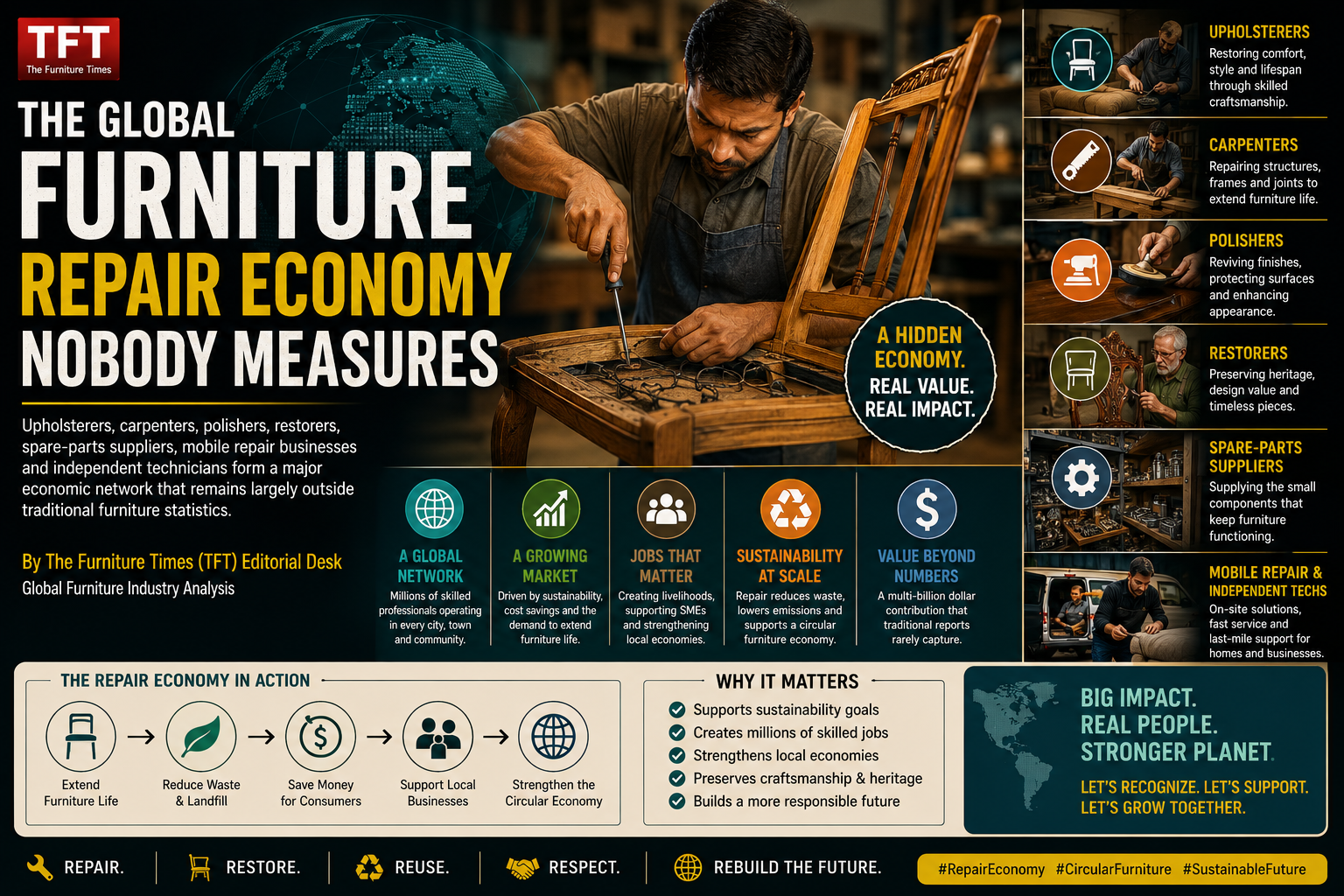
The Global Furniture Repair Economy Nobody Measures
Upholsterers, carpenters, polishers, restorers, spare-parts suppliers, mobile repair businesses and independent technicians form a major economic network that remains largely outside traditional furniture statistics
By The Furniture Times (TFT) Editorial Desk | Global Furniture Industry Analysis | August 26, 2026
When governments, investors and industry analysts measure the furniture economy, they generally count factories, exports, imports, retail sales, raw materials and new furniture consumption. What they rarely measure with equal seriousness is what happens after furniture has been purchased.
A chair with a broken joint goes to a carpenter. A sofa with damaged fabric reaches an upholsterer. A scratched dining table is sent to a polisher. A hotel replaces worn covers rather than replacing hundreds of chairs. An office calls a mobile technician to repair workstations, castors, drawers and height-adjustment systems. A family asks a local craftsperson to restore furniture inherited across generations.
Every transaction creates economic activity. Yet much of that activity remains scattered across informal employment, microenterprises, general repair classifications and household spending categories that do not clearly identify furniture.
The result is a substantial global furniture repair economy that operates in almost every country but is rarely measured as an industry in its own right.
This economy includes skilled labour, materials, replacement components, transportation, digital marketplaces, warranties, insurance, inspection, cleaning, refinishing, resale and after-sales service. It protects the value of existing furniture while supporting livelihoods that cannot always be seen in conventional manufacturing or retail data.
It may be one of the furniture industry’s largest statistical blind spots.
The industry hiding behind the finished product
The furniture industry does not end when a product leaves a factory or showroom. That moment begins another economic cycle—ownership, maintenance, repair, refurbishment, resale and eventual recovery or disposal.
The repair economy includes far more than the neighbourhood carpenter. It covers an extensive network of occupations and businesses:
- Furniture upholsterers and sewing specialists
- Carpenters, joiners and cabinetmakers
- Wood polishers, painters and refinishers
- Antique-furniture restorers and conservators
- Leather, vinyl and fabric-repair specialists
- Cane, wicker and rattan weavers
- Mattress, bed and sofa-repair businesses
- Recliner and motion-furniture technicians
- Office-chair and ergonomic-furniture technicians
- Welders repairing metal frames and structural components
- Glass, stone and surface-repair specialists
- Spare-parts and furniture-hardware suppliers
- Manufacturers of foam, springs, webbing and filling materials
- Suppliers of hinges, slides, castors, glides and connectors
- Mobile repair services and collection businesses
- Warranty inspection and service contractors
- Hotel, school and hospital maintenance departments
- Furniture refurbishment and remanufacturing companies
- Second-hand dealers and furniture-resale platforms
- Furniture cleaning, sanitisation and protective-treatment companies
- Vocational schools, trainers and apprenticeship programmes
A single furniture repair can therefore activate an entire commercial chain.
A technician may diagnose the problem. A spare-parts supplier provides a mechanism. A transport business collects the product. An upholsterer installs new material. A polisher restores the exposed frame. A digital platform generates the enquiry. A review service records the customer experience. A reseller may eventually market the restored product.
Measured separately, each transaction appears small. Connected together across cities, countries and product categories, they represent a significant economy.
Why conventional statistics fail to capture it
The furniture repair economy is difficult to measure because it does not fit neatly inside the traditional definition of the furniture industry.
Furniture manufacturing is usually classified according to factories and the products they manufacture. Retail statistics record the sale of new and, sometimes, used furniture. Trade statistics capture goods crossing national borders.
Repair activity is different. It is local, service-based, labour-intensive and highly fragmented.
Informality hides millions of transactions
Many repair professionals operate as sole traders, family businesses, home-based workshops or mobile technicians. Some have no formal business registration, specialised accounting system or permanent digital presence.
The International Labour Organization reported that approximately two billion people—more than 61% of the world’s employed population in its global estimate—worked in informal employment. This does not indicate how many are furniture repairers, but it demonstrates why local craft and service economies can remain substantially undercounted. International Labour Organization
In many markets, customers pay repairers directly. The transaction may never appear in an industry database, digital marketplace, tax category or furniture-sector report.
Repairers frequently serve several industries
A carpenter may repair furniture while also undertaking construction work, shopfitting and interior installation. A sewing workshop may handle furniture upholstery, automotive seating and curtains. A welder may repair beds, gates and machinery.
Government classification systems may record these businesses under general repair, construction, personal services, textile work or metal fabrication. Their furniture-related revenue becomes almost impossible to isolate.
In-house repair is rarely reported
Hotels, universities, hospitals, offices, restaurants and public institutions often employ maintenance teams. These employees may repair chairs, tables, beds, cabinets and workstations without creating an external commercial transaction.
Their work extends furniture life and avoids replacement expenditure, but it may appear only as payroll or facilities-management spending.
Repair value is confused with resale value
A used sofa may be collected, cleaned, reupholstered, repaired and resold. Statistics might record the final resale transaction but fail to identify the labour and components that restored its value.
Consequently, the economic contribution of repair disappears inside the second-hand market.
The repair economy is larger than repair labour
The price charged by a technician represents only part of the economic activity created by the intervention.
Consider a damaged commercial sofa. Its restoration could require:
- Inspection and quotation
- Collection and delivery
- Removal of old upholstery
- Frame and joint repairs
- Replacement of foam, webbing or springs
- New fabric or leather
- Sewing and installation
- Cleaning and finishing
- Quality inspection
- Warranty documentation
The transaction supports suppliers of adhesives, fasteners, foam, textiles, leather, thread, timber, springs and packaging. It can also support logistics providers, workshop landlords, equipment suppliers, payment companies, marketing platforms and professional training.
A meaningful estimate of the furniture repair economy must therefore measure direct labour, supply-chain expenditure and the value preserved by extending a product’s service life.
Where the repair economy is strongest
Furniture repair exists globally, but its structure differs by market.
Asia
Large parts of Asia retain strong traditions in carpentry, cane weaving, carving, polishing and upholstery. Repair is often economically attractive because skilled labour networks remain accessible and households are accustomed to maintaining valuable furniture.
At the same time, rapid urbanisation and the growth of flat-pack, engineered-board and low-cost furniture are changing the market. Some products are difficult to disassemble or economically repair, while premium furniture, solid-wood products and commercial installations continue to sustain skilled workshops.
The region’s high level of informal employment helps explain why a great deal of repair activity remains statistically invisible. The ILO’s global analysis estimated informal employment at 68.2% in Asia and the Pacific, although that figure covers the total economy rather than furniture repair specifically. International Labour Organization
Africa
Furniture repair is frequently integrated into neighbourhood manufacturing clusters, roadside workshops and local craft economies. Carpenters may build, repair and resell furniture from the same premises.
Repair can be essential where imported replacement furniture is expensive, supply chains are inconsistent or households prioritise extending the life of existing possessions. However, limited access to components, finance, modern machinery and professional visibility can prevent skilled technicians from expanding.
Middle East
The region supports an extensive repair market linked to residential furniture, hospitality, offices, palaces, restaurants and furnished properties.
Demand ranges from traditional woodwork and majlis upholstery to recliner mechanisms, hotel refurbishment and premium restoration. Frequent property fit-outs create opportunities for refurbishment, although replacement-oriented procurement can sometimes send repairable assets prematurely into disposal channels.
Europe
Europe’s repair and refurbishment market is receiving greater policy attention as durability, circularity and product information move into mainstream regulation.
Furniture and mattresses were included among priority product groups in the European Commission’s 2025–2030 working plan under the Ecodesign for Sustainable Products Regulation. Future measures may address product durability, repairability and circularity, but detailed obligations will depend on subsequent product-specific rules. European Commission
This distinction is important: the direction of policy supports repair, but businesses should not assume that a universal furniture repairability requirement already applies to every product.
North America
North America combines specialist restoration businesses with commercial refurbishment, warranty service, mobile repair franchises and a large resale economy.
High transport and labour costs can make repairs difficult for inexpensive furniture. Nevertheless, premium residential pieces, office systems, hospitality furniture and sentimental items can justify intervention. Municipal reuse initiatives also demonstrate growing recognition that extending furniture life can prevent bulky waste. For example, the U.S. Environmental Protection Agency supported a reuse warehouse in Austin intended to redistribute used furniture and building materials. U.S. Environmental Protection Agency
Latin America and the Caribbean
Repair is supported by strong woodworking and upholstery traditions, price-sensitive consumers and widespread microenterprise activity. Local craftspeople often combine production, customisation, repair and resale.
Their greatest challenge is not necessarily a lack of ability. It is limited discoverability, inconsistent access to materials, insufficient formal recognition and difficulty reaching customers beyond their immediate community.
Why furniture repair matters economically
Repair preserves value that would otherwise be destroyed.
If a hotel refurbishes 500 chairs instead of replacing them, the benefit is not simply the difference between two quotations. The decision may reduce procurement lead times, freight, installation disruption and waste-handling costs. It may also preserve an interior design scheme that would be difficult to reproduce.
For households, repair can protect sentimental, cultural and financial value. A mass-produced table and an inherited handcrafted table may perform the same basic function, but their economic and emotional replacement calculations are completely different.
For offices and institutions, repair can extend capital-asset life. Replacing castors, gas lifts, arm pads, hinges, drawer runners or worktop surfaces can return products to service without replacing complete systems.
For manufacturers, repair networks can reduce warranty losses, improve customer retention and produce valuable information about recurring failures. Every repair is also a source of product-performance intelligence.
Furniture’s most repairable—and least repairable—forms
Not all furniture is equally suited to repair.
Solid-wood furniture is often repairable because damaged joints can be reglued, surfaces refinished and individual components reconstructed. Traditional upholstery can be labour-intensive, but frames, springs, fillings and coverings can often be addressed separately.
Modular office furniture can also be highly repairable when parts remain available and product families use consistent components.
Repair becomes harder when products use:
- Permanent adhesives instead of removable fasteners
- Proprietary mechanisms without replacement parts
- Mixed materials that cannot be separated
- Thin composite panels with damaged fixing points
- Non-removable upholstery and covers
- Concealed fixings without service instructions
- Electronics embedded inside inaccessible structures
- Components that are discontinued immediately after production
- Unidentified materials or model numbers
- Designs requiring product destruction to reach one failed part
A sofa should not become waste because one recliner switch fails. An office chair should not be discarded because one castor or gas lift requires replacement. A cabinet should not be abandoned because its hinge is unidentified.
Repairability begins at the design stage.
Spare parts are the missing infrastructure
Skills alone cannot sustain a repair economy. Technicians require access to compatible components.
Among the most frequently needed items are:
- Hinges and mounting plates
- Drawer slides and runners
- Castors and glides
- Gas lifts and chair mechanisms
- Recliner motors, switches and cables
- Connectors, brackets and fasteners
- Springs, webbing and upholstery clips
- Handles, locks and keys
- Bed fittings and support components
- Foam, cushions and removable covers
- Replacement feet, legs and levelling devices
Manufacturers can strengthen repair networks by assigning permanent part numbers, maintaining compatibility tables and publishing exploded diagrams. They can specify safe alternatives when an original component is discontinued.
Without such information, technicians are forced to improvise. Improvisation may work for cosmetic repairs, but it can create serious risks when structural strength, stability, fire safety, electrical safety or load-bearing mechanisms are involved.
Safety must remain non-negotiable
Repair should extend safe product life—not keep dangerous furniture in service.
A technician must determine whether a product is economically and technically repairable. Structural damage, contamination, fire exposure, severe mould, recalled components or unknown electrical modifications may make replacement the responsible choice.
Particular care is required for:
- Bunk beds and children’s furniture
- Hospital and care furniture
- Motor-operated beds and recliners
- Height-adjustable desks
- Public-seating installations
- Load-bearing storage systems
- Furniture subject to fire-performance requirements
- Products damaged by flooding, infestation or contamination
Professionalisation of the repair economy must therefore include training, inspection protocols, documentation, appropriate insurance and clear responsibility for safety-critical work.
Digital product identities could transform repair
One of the repairer’s biggest problems is identifying the product in front of them.
Labels disappear. Model names change. Retailers close. Manufacturers merge. Mechanisms are modified between production batches. Owners lose invoices and manuals.
A permanent digital identity—accessible through a QR code or another data carrier—could connect a furniture product to:
- Manufacturer and model information
- Date or batch of manufacture
- Materials and finishes
- Assembly and disassembly instructions
- Parts diagrams and component numbers
- Maintenance guidance
- Safety warnings
- Warranty status
- Repair history
- Compatible replacement parts
- Authorised and independent service providers
- Resale and authenticity records
- End-of-life instructions
The European Union’s Digital Product Passport framework illustrates this broader direction. Depending on the product group and applicable rules, a passport may contain durability, repairability, spare-parts, maintenance and end-of-life information. However, the exact requirements will be defined for individual product groups; businesses should not interpret the framework as evidence that every item of furniture already requires a passport. European Commission—Digital Product Passport
A European circular-furniture initiative, Cir4Fun, is already examining furniture digital passports, circular business models and assessment methods for maintenance, repair, refurbishment, remanufacturing and recyclability. European Commission Circular Cities and Regions Initiative
For repairers, this is not merely a compliance development. It could become essential working infrastructure.
The environmental value of extending furniture life
The environmental case for repair is straightforward: preserving an existing product can avoid or delay the need to manufacture, package and transport a replacement.
The precise benefit varies according to the product, materials, repair process and energy source. Repairing a minor defect is not environmentally identical to undertaking a material-intensive reconstruction. Claims should therefore be based on lifecycle evidence rather than broad assumptions.
Nevertheless, repair and refurbishment are recognised as important value-retention strategies. Research highlighted by the UN Environment Programme found that repair, refurbishment, remanufacturing and reuse could significantly reduce material requirements and industrial waste in the sectors studied. Those findings were not furniture-specific, but they demonstrate the wider resource logic of retaining products and components in use. UN Environment Programme
Furniture is especially relevant because it is bulky. Disposal consumes collection, transport and landfill or processing capacity. Replacement generates further packaging and logistics demand.
Repair keeps value inside the product instead of treating the entire product as waste because one component failed.
Why skilled repair businesses remain invisible online
A craftsperson may be excellent at restoring a chair but almost impossible to find through search engines.
Many repair businesses depend on neighbourhood referrals, handwritten signs, social-media posts or messaging applications. Their online listings may lack service categories, operating areas, photographs, qualifications, languages, material expertise and verified reviews.
Customers consequently struggle to answer basic questions:
- Who repairs recliner mechanisms near me?
- Who restores antique furniture safely?
- Who can reupholster hotel seating at scale?
- Where can I obtain a discontinued hinge?
- Which technician understands ergonomic office chairs?
- Who repairs cane, rattan, leather or veneer?
- Can the business collect and return large furniture?
- Is the repairer insured and reviewed?
This discoverability failure reduces demand, limits competition and favours the small number of businesses capable of buying continuous advertising.
The industry needs searchable service identities—not simply websites.
A framework for measuring the hidden economy
Governments, industry associations, research firms and digital platforms could begin measuring the sector through a dedicated Furniture Repair Economy Index.
Such an index could track:
| Measurement area | Suggested indicators |
|---|---|
| Businesses | Registered and estimated informal repair enterprises |
| Employment | Owners, employees, apprentices and mobile technicians |
| Transactions | Number and value of completed repairs |
| Product categories | Seating, tables, storage, beds, upholstery and outdoor furniture |
| Intervention | Structural repair, surface restoration, parts replacement or reupholstery |
| Inputs | Labour, materials, components, transport and equipment |
| Outcome | Estimated years of product life added |
| Waste prevention | Weight or units diverted from disposal |
| Resale | Value before and after refurbishment |
| Customer impact | Satisfaction, repeat use and complaint rates |
| Commercial activity | Warranty, insurance, hospitality and institutional contracts |
| Skills | Qualifications, specialist capabilities and training needs |
Measurement must not be designed only for large formal companies. It should include confidential, low-burden methods for sole traders and informal workshops.
The objective should be visibility and better policy—not the exclusion of people who lack administrative resources.
A major employment opportunity
Furniture repair is difficult to automate completely because every damaged product presents a different combination of age, materials, construction and wear.
Digital tools can support diagnosis, quotation, parts identification and customer communication, but the physical work still requires judgement and manual skill.
That makes repair strategically important for local employment. It creates opportunities for young people, experienced craftspeople, migrants, family enterprises and workers transitioning from manufacturing.
However, the sector needs better pathways into professional practice:
- Recognised vocational qualifications
- Paid apprenticeships
- Health-and-safety education
- Dust, chemical and ventilation controls
- Modern upholstery and mechanism training
- Digital business skills
- Product-safety and documentation procedures
- Insurance and liability guidance
- Access to microfinance and equipment
- Collaboration with manufacturers and retailers
Without investment in skills, an increase in repair demand could expose a shortage of qualified technicians.
What the furniture industry should do now
Manufacturers should design for disassembly, assign part numbers, publish repair information and retain essential components for reasonable periods.
Retailers should treat repair as part of the customer relationship rather than as an inconvenient after-sales cost. A credible repair pathway can strengthen confidence at the moment of purchase.
Hotels, offices and institutions should compare lifecycle costs instead of relying only on replacement quotations. Procurement documents can request spare-parts availability, replaceable components and service support.
Governments should recognise repair businesses in statistical classifications, skills programmes, circular-economy policies and small-business support.
Marketplaces should create detailed repair categories and verify professional capabilities.
Customers should ask whether products can be repaired before purchasing them.
Most importantly, the sector must make repairers searchable, reviewable and connected to the wider furniture ecosystem.
TFT, FISE and FurniReviewology: making the invisible economy visible
The furniture repair economy does not lack talent. It lacks recognition, data and discoverability.
The Furniture Times can document the people and enterprises extending the life of furniture—from rural carpenters and family upholstery workshops to advanced commercial refurbishment companies.
The Furniture Industry Search Engine can help customers, brands, hotels, offices and institutions discover repair specialists by country, city, material, product category and technical capability.
FurniReviewology can add the trust layer through customer experiences, verified business information and transparent professional reputations.
Together, these platforms can connect products, skills, spare parts, service providers and customers across the complete furniture lifecycle.
The Furniture Times tells their story.
Furniture Industry Search Engine helps the world find them.
FurniReviewology helps the world trust them.
The furniture industry ecosystem is a $1 trillion industry ecosystem—and the people who keep its products in use deserve to be recognised as a vital part of it.
Be the next one. Be part of the movement.
Sources:
International Labour Organization—Informal Employment, European Commission—ESPR Working Plan, European Commission—Digital Product Passport, European Commission—Cir4Fun, U.S. Environmental Protection Agency, UN Environment Programme