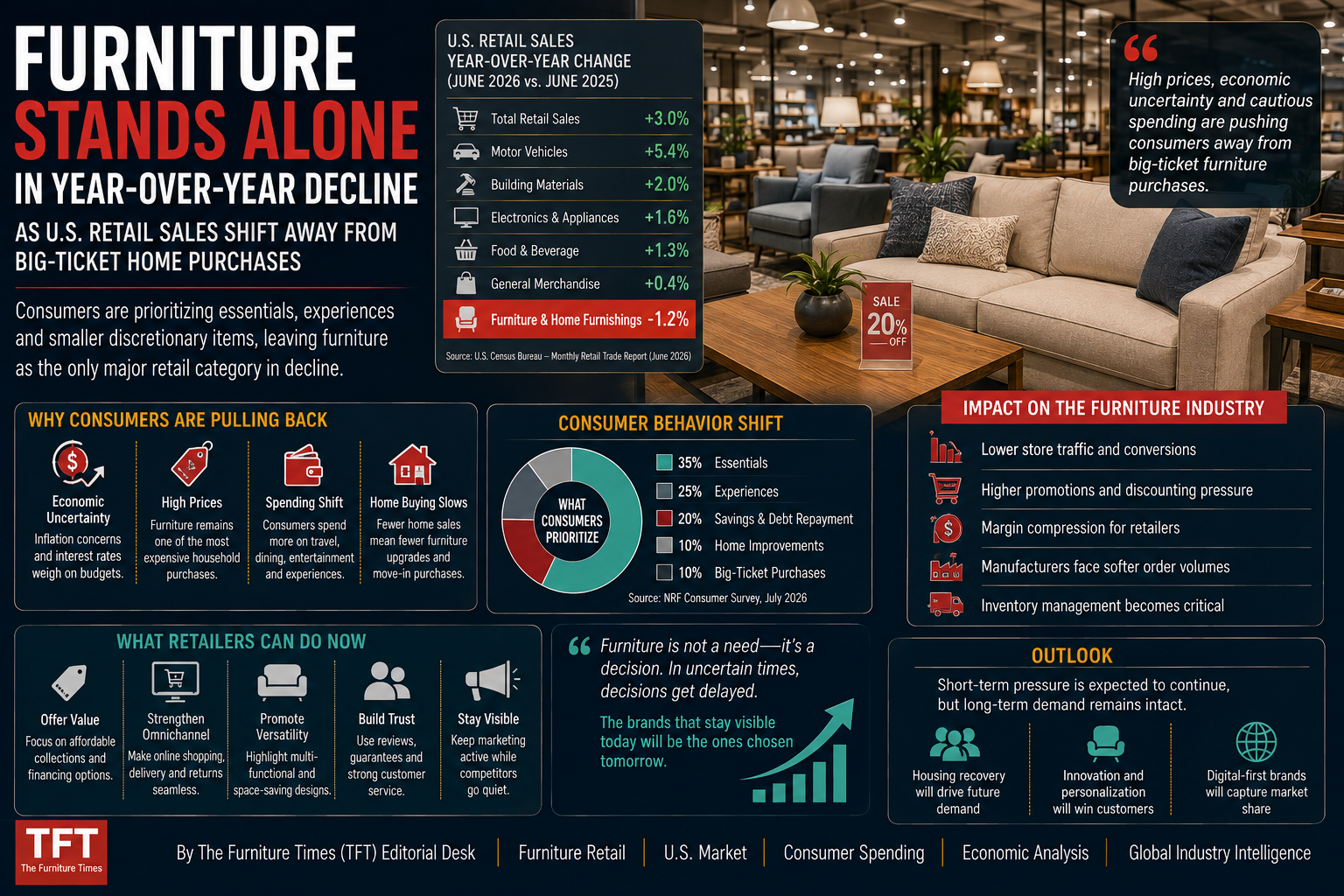
Furniture Stands Alone in Year-over-Year Decline as U.S. Retail Sales Shift Away From Big-Ticket Home Purchases
July 2026 furniture and home furnishings store sales edged higher from June but remained approximately 2.7% below last year, exposing the category’s continued struggle to convert wider consumer spending into sustained furniture demand
By The Furniture Times (TFT) Editorial Desk | Furniture Retail | U.S. Market | Consumer Spending | Economic Analysis | Global Industry Intelligence
The U.S. furniture retail sector entered the second half of 2026 with a troubling distinction: furniture and home furnishings stores were reportedly the only major retail category in the Commerce Department’s July report to remain below the previous year’s sales level.
According to Furniture Today’s analysis of the U.S. Department of Commerce’s July retail report, furniture and home furnishings stores generated an estimated US$11.346 billion in seasonally adjusted sales during July 2026.
That total represented a modest increase of approximately 0.3% from June, but it was roughly 2.7% lower than July 2025, when the category recorded approximately US$11.66 billion in adjusted sales.
The latest Federal Reserve Economic Data series, sourced from the U.S. Census Bureau, confirms adjusted furniture and home furnishings store sales of US$11.346 billion in July, compared with a revised US$11.315 billion in June.
The monthly increase offers a small sign of stabilization. The year-over-year decline, however, shows that the sector has not yet recovered the sales momentum it carried during the corresponding period of 2025.
This is particularly significant because total U.S. retail sales were approximately 5% higher than a year earlier, even though they declined 0.6% from June. Furniture therefore underperformed the wider retail economy by a substantial margin.
The July numbers do not suggest that Americans have stopped needing furniture. They indicate that demand is being delayed, redirected, fragmented and redistributed across different channels, price levels and product types.
For manufacturers, retailers, importers, suppliers and service providers, the central question is no longer whether furniture demand exists. It is why that demand is not flowing through conventional furniture stores at the same rate as spending in other retail categories.
July’s furniture sales picture at a glance
| Indicator | July 2026 result |
|---|---|
| Furniture and home furnishings store sales | US$11.346 billion |
| Change from June 2026 | Approximately +0.3% |
| Change from July 2025 | Approximately -2.7% |
| Total U.S. retail sales change from June | -0.6% |
| Total U.S. retail sales change from July 2025 | +5.0% |
| July furniture status | Only major category reportedly down year over year |
The distinction between monthly and annual performance is important.
The 0.3% increase from June means that sales did not deteriorate during July. But the approximately 2.7% year-over-year decline means the market remained meaningfully weaker than it was one year earlier.
A single month-to-month increase is therefore not yet evidence of a durable recovery. For that conclusion, the industry would need to see several months of consistent annual growth, improving order volumes, better conversion rates and reduced reliance on aggressive discounting.
A reversal from July 2025
The comparison with the previous year makes the latest result more striking.
In July 2025, furniture and home furnishings stores generated approximately US$11.66 billion, representing a 5.1% increase from July 2024. At that time, furniture was outperforming the broader retail market and continuing a period of year-over-year gains.
By July 2026, the position had reversed. The category was no longer leading retail growth; it was standing alone in annual decline.
The change demonstrates how quickly furniture demand can move. Furniture is a large, discretionary and often finance-sensitive purchase. Consumers may need a new sofa, mattress, dining set or bedroom collection, but they can frequently postpone the transaction when economic uncertainty rises.
Food, healthcare, transport and other recurring household expenses cannot be deferred so easily. Furniture often can.
This makes the sector particularly exposed to changes in:
- Household confidence
- Housing transactions
- Mortgage and borrowing costs
- Employment expectations
- Credit-card balances
- Consumer financing
- Moving activity
- Renovation spending
- Tariffs and import costs
- Freight and energy prices
- Promotional calendars
- Expectations of future discounts
The July report should therefore be viewed not as an isolated sales statistic but as a signal about the financial and psychological conditions surrounding major home purchases.
Furniture has stabilized—but has not recovered
The industry’s 2026 performance reveals a pattern of weakness followed by partial stabilization.
Furniture Today previously reported that the category experienced seven months of year-over-year declines before pulling approximately even in June 2026. June adjusted sales were reported at around US$11.32 billion, virtually unchanged from both May 2026 and June 2025.
July’s 0.3% monthly increase initially appears encouraging. However, because July 2025 had been a comparatively strong month, the latest total still produced a year-over-year decline of approximately 2.7%.
This creates a mixed interpretation:
- The market is no longer falling sharply month to month.
- Sales are holding around the US$11.3 billion level on an adjusted basis.
- The category has not returned to sustained annual growth.
- Furniture continues to underperform most other retail sectors.
- Consumers remain selective about large home-related purchases.
In other words, the market may be forming a floor, but it has not yet demonstrated a convincing upward trend.
The wider retail economy tells a different story
The broader U.S. retail picture in July was also complicated.
According to Reuters’ analysis of the Commerce Department report, total retail sales declined 0.6% from June—the first monthly decrease in nine months and the largest drop in 14 months. Nevertheless, overall retail spending remained 5% above July 2025.
The monthly decline was partly influenced by timing effects. Amazon shifted its Prime Day event into June, pulling some online spending forward. Nonstore retailer sales consequently dropped 2.2% in July. Motor-vehicle sales fell 1.8%, while electronics and appliance retailers declined 0.5%.
Furniture performed differently: it increased modestly from June but remained lower than a year earlier.
This tells the industry something important. Furniture’s problem is not simply that July was weak for all retailers. The category’s annual decline developed even as total retail spending grew strongly year over year.
Consumers are still spending. They are simply allocating less of that spending to furniture and home furnishings stores than they did one year ago.
Why furniture remains under pressure
There is unlikely to be one single explanation for the industry’s underperformance. Several forces are operating simultaneously.
1. Furniture purchases are closely connected to housing activity
Housing and furniture are separate markets, but they are deeply linked.
A home purchase frequently generates demand for mattresses, sofas, dining sets, storage, window coverings, outdoor furniture and decorative accessories. Moving also exposes gaps in existing furniture: an old sectional may not fit a new room, or a household may require additional bedrooms and storage.
When home transactions slow, a major furniture-purchasing trigger weakens.
Consumers who remain in their existing homes may still renovate or replace products, but these purchases are often more gradual than the furnishing cycle associated with relocation.
The industry should therefore monitor not only housing construction but also existing-home sales, rental mobility, household formation and remodeling activity.
2. Higher household expenses reduce discretionary capacity
Furniture competes for the same household budget used for food, fuel, healthcare, insurance, education, travel and debt repayment.
Even when wages are increasing, higher recurring expenses can leave consumers with less money for major discretionary purchases.
Furniture retailers may see customers continue browsing while delaying checkout, selecting smaller products or waiting for promotions. This can create the appearance of healthy interest without corresponding sales conversion.
Website traffic, showroom visits and enquiries may remain active while average transaction values or close rates decline.
3. Consumers expect promotions
Years of continuous promotional messaging have trained many furniture buyers to wait.
When retailers repeatedly advertise “final days,” “lowest prices,” holiday reductions and clearance events, customers may stop believing that the current price is genuinely time-sensitive.
This creates a difficult cycle:
- Demand softens.
- Retailers increase discounts.
- Customers learn to wait for larger promotions.
- Gross margins decline.
- Retailers need more sales to cover the same fixed costs.
- Promotional activity becomes even more aggressive.
Discounting can generate short-term traffic, but persistent discounting may weaken brand value and damage long-term profitability.
Retailers need clearer price architecture: entry-level value products, dependable everyday pricing, premium differentiated products and carefully controlled promotional events.
4. Furniture is competing with experiences and services
Household consumption is not limited to physical merchandise. Consumers also spend on restaurants, entertainment, travel, health, subscriptions and personal services.
Reuters reported that spending at food services and drinking places increased 0.5% in July, its fourth consecutive monthly gain. This suggests that consumers still had some willingness to spend but may have prioritized experiences over durable household goods.
Furniture companies cannot change consumer priorities, but they can make purchasing more compelling by connecting products with comfort, wellbeing, productivity, family life and long-term value.
A sofa is not only upholstery and foam. It is where a family gathers. A mattress is connected with health and sleep. An ergonomic chair affects comfort and work performance. A dining table supports social connection.
The industry must communicate these outcomes more effectively.
5. Digital furniture purchases may not all appear in the store category
The Commerce Department category needs to be interpreted carefully. It measures sales by establishments classified primarily as furniture and home furnishings stores. It does not necessarily measure every piece of furniture sold in the United States.
Furniture can also be purchased through:
- General merchandise retailers
- Warehouse clubs
- Department stores
- Home-improvement businesses
- Online marketplaces
- Mass merchants
- Direct-to-consumer websites
- Social-commerce channels
- Office-supply companies
- Second-hand marketplaces
If a general merchandise or nonstore retailer sells furniture, that transaction may be recorded under the retailer’s primary business category rather than furniture-store sales.
The July report is therefore a strong indicator of specialist furniture and home furnishings retail performance—but it is not a complete count of every furniture product sold across every channel.
This distinction is essential. Part of the weakness may represent a transfer of market share from traditional furniture stores to broader retail and digital platforms.
The July decline matters across the entire supply chain
Weak retail sales do not remain confined to showrooms. They move upstream through the furniture ecosystem.
When retail orders slow, stores may reduce purchases from manufacturers. Manufacturers then adjust production schedules and postpone material orders. Component suppliers receive fewer orders, logistics companies move fewer goods, and installation teams experience less demand.
The potential chain reaction can affect:
- Upholstery mills
- Foam manufacturers
- Timber and panel suppliers
- Furniture hardware producers
- Packaging companies
- Freight carriers
- Warehouses
- Importers
- Sales representatives
- Interior designers
- Advertising agencies
- Delivery contractors
- Installers
- Repair businesses
Small and medium-sized businesses can be particularly exposed because they have less working capital, fewer sales channels and limited bargaining power.
A large retailer may negotiate longer payment terms or reduce inventory commitments. Smaller manufacturers and suppliers are then required to carry more of the financial burden.
This is why a 2.7% retail decline can have a much larger operational impact than the headline percentage suggests.
Inventory becomes a critical risk
When sales fall below expectations, furniture inventory can become expensive very quickly.
Furniture requires substantial warehouse and showroom space. Unsold goods tie up capital while continuing to generate storage, handling, insurance and financing expenses. Seasonal finishes or trend-led products may also lose relevance over time.
Retailers facing weak demand may respond by cancelling orders, delaying shipments or increasing clearance activity. Manufacturers may then accumulate finished goods or unfinished materials.
The strongest response is not simply to cut inventory across every category. Companies need better visibility into:
- Sell-through rates
- Regional demand
- Product-level margins
- Delivery lead times
- Return rates
- Promotional dependency
- Stock aging
- Online search behavior
- Customer wish lists
- Supplier flexibility
Artificial intelligence and forecasting technology may help, but only when the underlying data is accurate.
Poor data processed by advanced software still produces poor decisions.
The category must separate price problems from value problems
One risk during a downturn is assuming that every weak sale is caused by price.
Affordability is important, but customers may also hesitate because of uncertainty relating to:
- Dimensions
- Comfort
- Material quality
- Delivery timing
- Color accuracy
- Assembly
- Warranty coverage
- Return difficulty
- Brand credibility
- Customer service
Lowering the price does not solve these concerns.
A retailer may preserve more margin by improving product information, offering fabric samples, providing room-planning support, displaying verified reviews or communicating delivery dates more accurately.
The industry must ask a better question—not only, “How much discount is required?” but “What prevents this customer from buying confidently?”
Furniture stores need stronger omnichannel strategies
The July numbers reinforce the need to integrate physical and digital retail.
Customers may discover a product through social media, compare it through search, read reviews on another platform, test it in a showroom and complete the purchase from a mobile device.
Retailers must support this fragmented journey.
A strong omnichannel furniture business should provide:
- Consistent prices across channels
- Real-time or dependable inventory information
- Accurate product specifications
- High-quality photography
- 360-degree or 3D visualization
- Online appointment booking
- Digital room-planning services
- Fabric and finish samples
- Financing information
- Transparent delivery charges
- Customer reviews
- Post-purchase tracking
- Easy access to support
The physical showroom still has a powerful role, especially for seating, mattresses and premium materials. But the store must be connected to the digital journey rather than operating as an isolated sales channel.
Visibility becomes more valuable during weak demand
When demand is limited, disappearing from the market is dangerous.
Some furniture businesses react to declining sales by cutting advertising, public relations, content, search optimization and customer communication. These measures may reduce immediate expenses, but they can also weaken future demand.
During a slow market, customers become more valuable because fewer are actively purchasing. The brands that remain visible have a greater opportunity to capture those customers.
The companies that continue communicating can gain:
- Higher relative share of voice
- Stronger search visibility
- Greater brand recall
- More customer data
- Better remarketing audiences
- Increased media authority
- Stronger AI discoverability
- A faster position when demand recovers
The correct strategy is to remove ineffective spending while protecting visibility.
Cut waste—not market presence.
Small retailers should compete through specialization
Independent furniture stores may not be able to match national chains on advertising expenditure, warehouse scale or purchasing power. But they can compete through knowledge, local relevance and service.
Potential areas of differentiation include:
- Locally made furniture
- Custom sizing
- Interior-design support
- Fast regional delivery
- White-glove installation
- Sustainable materials
- Senior-friendly products
- Small-space furniture
- Hospitality or commercial specialization
- Repair and restoration
- Authentic craftsmanship
- Strong community reputation
The greatest mistake for a smaller retailer is attempting to look like a reduced version of a national chain.
Its advantage is being more focused, responsive, knowledgeable and human.
However, those advantages only create value when customers can discover them. Independent businesses need accurate online listings, credible reviews, searchable product categories, localized content and media coverage.
Reviews can reduce purchase hesitation
When budgets are tight, buyers become more cautious. They spend longer comparing products and are more concerned about making an expensive mistake.
Customer reviews can help resolve that uncertainty.
Furniture buyers want to know:
- Is the product comfortable?
- Does it match the photographs?
- Was it delivered on time?
- Did it arrive damaged?
- Was assembly difficult?
- How did the retailer handle a complaint?
- Did the product remain durable after several months?
Reviews are therefore not merely testimonials. They are part of the information infrastructure supporting a furniture transaction.
Businesses should encourage verified customers to share detailed experiences and should respond professionally to critical feedback. A negative review handled transparently can sometimes build more trust than an unanswered five-star rating.
This is where FurniReviewology becomes relevant: visibility introduces the business, but credible review intelligence helps the customer trust it.
What manufacturers should learn from the report
Manufacturers may view July’s numbers as a retail problem, but the data carries important product-development and operational lessons.
Produce fewer undifferentiated products
A weak market exposes products that compete only on appearance and price. Manufacturers need clearer functional, quality or design advantages.
Make furniture easier to sell digitally
Retail partners require accurate dimensions, material information, photographs, video, 3D models and assembly documentation.
Design for logistics
Products that are frequently damaged, difficult to deliver or expensive to return create pressure throughout the distribution chain.
Support replacement and repair
Spare parts, replaceable components and repair instructions can reduce warranty costs and improve customer confidence.
Provide credible performance evidence
Testing, certifications, material traceability and warranty information can help justify value when consumers become more selective.
Increase production flexibility
Factories able to manage smaller batches, faster replenishment and controlled customization can reduce inventory risk.
What retailers should do next
The July result should prompt action, but not panic.
Furniture retailers should consider the following priorities:
1. Measure conversion, not only traffic
A showroom can be busy without producing profitable sales. Retailers must identify where customers abandon the purchasing journey.
2. Review aged inventory
Products consuming space and capital should be managed systematically rather than through repeated storewide discounting.
3. Protect gross margin
Discounts should be targeted, measurable and connected to inventory or customer-acquisition objectives.
4. Improve delivery communication
Accurate delivery promises can be more persuasive than another small price reduction.
5. Strengthen search visibility
Customers cannot purchase from businesses they cannot find.
6. Build AI-readable product information
Product specifications should be structured so search engines, marketplaces and AI assistants can understand them.
7. Use reviews as operational data
Recurring complaints should guide product selection, supplier management and customer-service improvement.
8. Communicate long-term value
Durability, warranty, repairability and service can justify the purchase during financially cautious periods.
9. Develop commercial opportunities
Hospitality, healthcare, education, office and property-development projects can diversify businesses heavily dependent on household demand.
10. Stay visible
Weak markets reward companies that continue building awareness while competitors become silent.
Is this a warning of deeper weakness?
One month does not establish a permanent trend. July furniture sales did increase slightly from June, and the latest figures are advance estimates that can be revised.
There are also reasons to avoid an excessively negative interpretation:
- The category has stabilized near its recent monthly level.
- Furniture sales improved modestly from June.
- Some digital furniture sales may be recorded outside the specialist-store category.
- Deferred household demand does not disappear permanently.
- Lower borrowing costs or stronger housing activity could release postponed purchases.
- Commercial, hospitality and institutional demand may provide additional opportunities.
At the same time, the annual decline cannot be dismissed. Furniture has underperformed while the wider retail economy expanded. Year-to-date sales remain below the previous year, and consumers continue to demonstrate caution around major household purchases.
The appropriate interpretation is therefore one of conditional stabilization.
The market may no longer be deteriorating rapidly, but it has not achieved a broad-based recovery.
The deeper industry message
The July Commerce Department report reveals a furniture market caught between need and hesitation.
Consumers still need beds, mattresses, seating, tables, storage and workplace furniture. Homes continue to age. Products continue to wear out. Families move, children grow, businesses renovate and hotels replace rooms.
Demand has not vanished.
But customers have become more selective about when they purchase, where they purchase, how much they spend and which brands they trust.
The businesses most likely to succeed will not rely on an automatic market recovery. They will improve their value propositions, inventory systems, digital visibility, customer communication and delivery performance now.
Furniture may have been alone in year-over-year decline in July, but the category is not without opportunity. The market is rewarding relevance, affordability, trust, convenience and discoverability.
The central challenge is not simply to sell more furniture. It is to remove the reasons customers are waiting.
Editorial and data note
This article is based on Furniture Today’s coverage of the U.S. Department of Commerce’s July 2026 advance retail estimates.
The reported US$11.346 billion furniture-store sales figure is confirmed by the Federal Reserve Bank of St. Louis FRED series, sourced from the U.S. Census Bureau. The figure is seasonally adjusted but not adjusted for inflation.
Advance estimates are based on a subsample of retail firms and may later be revised. The furniture and home furnishings store classification measures sales by businesses primarily assigned to that retail category; it does not capture every furniture product sold by marketplaces, mass merchants or retailers classified in other sectors.
The Furniture Times (TFT) & Furniture Industry Search Engine (FISE)
“TFT tells their story. FISE helps the world find them.”
FurniReviewology helps the world trust them.
The furniture industry ecosystem is a $1 trillion industry ecosystem.
Demand has not disappeared—it has become harder to win. Be visible, be relevant and be ready.