AI is becoming retail’s operating system
How artificial intelligence is moving beyond chatbots to coordinate product discovery, merchandising, pricing, inventory, fulfilment, customer service and decision-making across the furniture retail ecosystem
By The Furniture Times (TFT) Editorial Desk | Artificial Intelligence | Furniture Retail | Digital Commerce | Retail Technology | Global Industry Intelligence
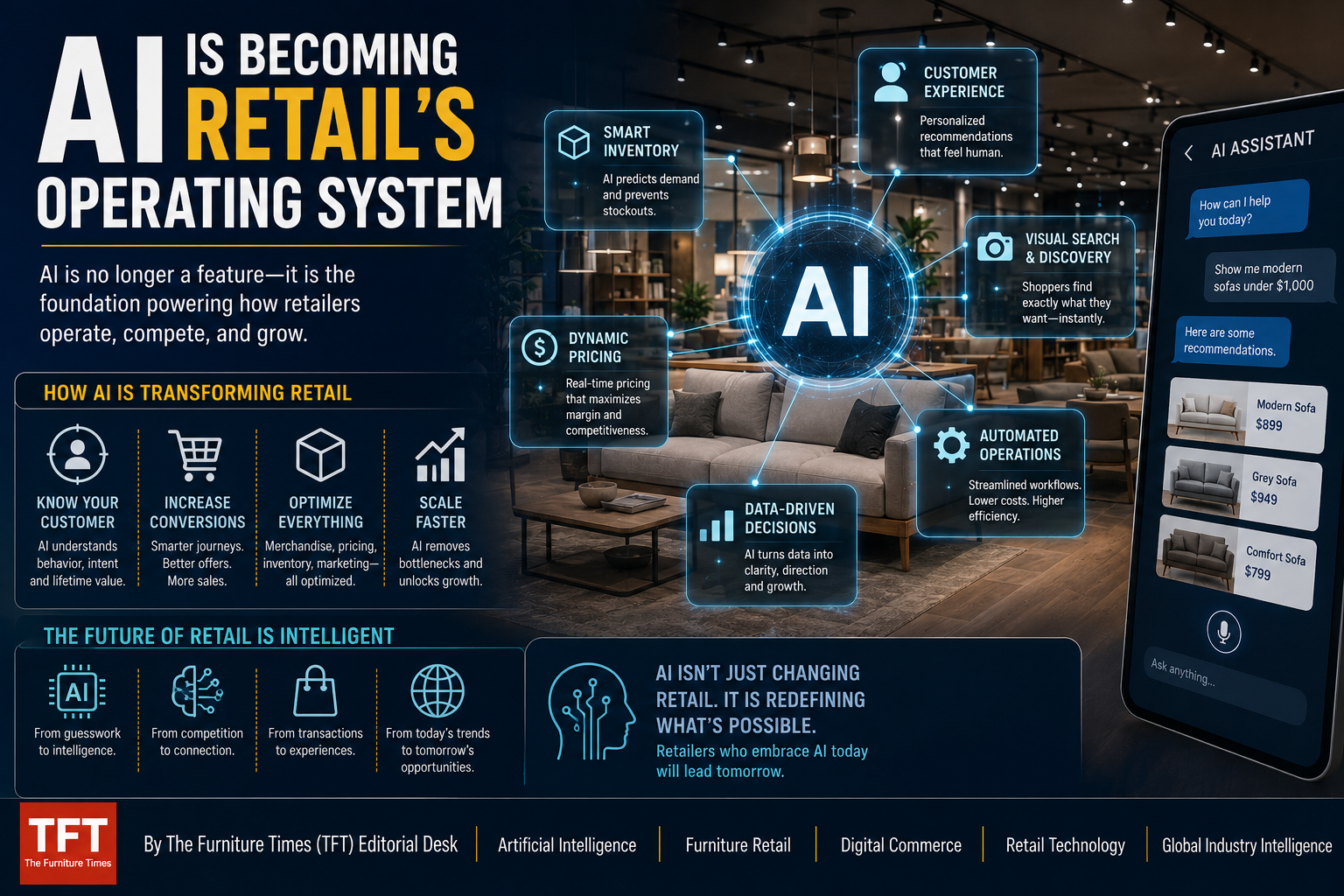
Artificial intelligence is no longer functioning as a single tool inside retail businesses.
It is becoming the operating system connecting almost everything retailers do.
In its earlier phase, retail AI was usually visible through isolated applications:
- A chatbot answered customer questions.
- A recommendation engine suggested related products.
- A forecasting tool predicted sales.
- An image generator created promotional material.
- An automated system classified customer enquiries.
These applications often worked independently. The chatbot did not always know the latest inventory. The recommendation engine did not understand delivery limitations. Marketing promotions were not always connected to product availability. Customer-service agents could not see why a pricing system had changed an offer.
The next phase is fundamentally different.
AI is beginning to connect:
- Customer intent.
- Product information.
- Inventory.
- Pricing.
- Promotions.
- suppliers.
- Warehouses.
- Delivery.
- Returns.
- Reviews.
- Loyalty data.
- Store operations.
- Financial planning.
When these systems share reliable information, AI can help coordinate decisions across the retailer instead of optimizing one isolated task.
This is why the idea of AI as retail’s operating system is becoming more than a metaphor.
At NRF 2026, SAP described an AI-enhanced retail operating system connecting planning, execution and customer engagement. Its announced retail-intelligence capabilities bring together sales, inventory, customer and supplier information for forecasting and planning. SAP’s NRF 2026 announcement reflects the wider movement toward embedded intelligence rather than stand-alone AI features.
For the furniture industry, this transformation is especially significant.
Furniture is a complex retail category involving:
- High-consideration purchases.
- Large and bulky products.
- Long replacement cycles.
- Multiple variations.
- Delivery scheduling.
- Room measurements.
- Assembly.
- Installation.
- Customization.
- Returns that are expensive to process.
- Products difficult to evaluate online.
- Extensive technical and visual data.
AI has the potential to reduce this complexity—but only if furniture retailers build the data, governance and human capabilities required to support it.
The future of furniture retail will not be defined by whether a company has a chatbot. It will be defined by whether intelligence connects every decision from product discovery to final delivery and after-sales service.
What does “retail operating system” mean?
A traditional operating system manages the relationship between hardware, applications, data and users. It allows different functions to work together.
In retail, AI can play a similar coordinating role.
It can continuously interpret signals from:
- Website behaviour.
- Search queries.
- Store visits.
- Sales.
- Inventory.
- Supplier lead times.
- Competitor activity.
- Weather.
- Housing conditions.
- Events.
- Customer reviews.
- Returns.
- Service requests.
- Delivery performance.
- Marketing campaigns.
It can then help humans make or execute decisions across the business.
For example:
- Search data indicates rising demand for compact dining tables.
- AI connects the trend to regional housing and customer behaviour.
- The merchandising team receives an assortment recommendation.
- Inventory planning estimates demand by store and warehouse.
- Procurement receives suggested order quantities.
- Marketing generates relevant campaigns.
- The website adjusts search results and recommendations.
- Store teams receive product-priority guidance.
- Delivery capacity is evaluated before promotions begin.
- Customer feedback is monitored after the campaign.
The value comes from coordination.
A retailer can already perform each task through conventional software and human teams. AI changes the speed, scale and level of connection between them.
Retailers are investing beyond the IT department
AI is moving from a technology project to an enterprise investment.
An IBM Institute for Business Value study found that surveyed retail and consumer-product executives expected AI spending outside traditional IT budgets to expand significantly. Respondents reported plans to apply AI across customer service, supply chains, marketing, talent and integrated planning—not merely software development. IBM’s global retail study also found a substantial gap between claimed governance frameworks and their complete operational implementation.
This distinction is crucial.
When AI affects pricing, inventory, customer communication and purchasing, it is no longer owned only by the technology department.
It becomes the responsibility of:
- Leadership.
- Merchandising.
- Marketing.
- Store operations.
- Procurement.
- Finance.
- Logistics.
- Customer service.
- Legal and compliance.
- Human resources.
- Data governance.
An AI operating system needs business ownership.
From predictive AI to generative and agentic AI
Retail AI has developed through several overlapping stages.
Predictive AI
Predictive systems estimate what is likely to happen.
Applications include:
- Demand forecasting.
- Customer churn prediction.
- Inventory planning.
- Fraud detection.
- Delivery-time prediction.
- Product recommendations.
- Return-risk analysis.
Generative AI
Generative systems create or transform content.
Applications include:
- Product descriptions.
- Customer-service replies.
- Marketing images.
- Room concepts.
- Sales summaries.
- Training material.
- Catalogue translations.
- Personalized campaigns.
Agentic AI
Agentic systems can interpret an objective, plan steps, use authorized tools and coordinate actions within defined limits.
Potential retail applications include:
- Monitoring stock and initiating replenishment proposals.
- Comparing suppliers.
- Creating promotional plans.
- Resolving routine service issues.
- Coordinating customer delivery.
- Updating product information.
- Managing marketplace listings.
- Following up abandoned projects.
- Supporting procurement workflows.
Agentic AI is attracting enormous attention, but deployment remains limited.
The 2026 TCS Global Retail Outlook, based on more than 800 senior retail executives across 18 countries, found that 85% of responding retailers had not begun implementing or planning multi-agent systems. Only 24% reported using AI for autonomous decision-making, while chatbots and virtual assistants remained the leading initiative for 51%. The TCS retail study shows that the industry’s ambition is ahead of its operational readiness.
The transition is real, but uneven.
AI is changing how furniture customers discover products
Traditional furniture discovery often began with:
- A retail showroom.
- Google search.
- A catalogue.
- A marketplace.
- Social media.
- An interior designer.
- A recommendation from family or friends.
Increasingly, customers begin with conversational requests:
- “Find a dining table for six people that fits a 3.5-metre room.”
- “Which office chair is suitable for long working hours?”
- “Show me a sofa under my budget that can be delivered next week.”
- “Which furniture brands offer replacement parts?”
- “What storage furniture works in a small apartment?”
- “Find a hotel furniture supplier in Malaysia.”
- “Compare solid wood and engineered wood beds.”
- “Which brands have reliable customer reviews?”
This changes the retailer’s visibility challenge.
Customers are no longer always searching for one exact keyword. They are describing a problem, constraint or desired outcome.
To appear in these results, retailers need product data that machines can understand.
That includes:
- Accurate names.
- Categories.
- Dimensions.
- Materials.
- Colours.
- Finishes.
- Prices.
- Availability.
- Delivery locations.
- Assembly requirements.
- Warranty.
- Intended use.
- Weight limits where applicable.
- Certification.
- Repair information.
- Customer reviews.
AI cannot confidently recommend a product when basic data is missing or contradictory.
AI agents may become customers on behalf of customers
The next development in retail is not only humans using AI to search. AI systems may act on behalf of customers.
An authorized shopping agent could eventually:
- Understand the customer’s room dimensions and budget.
- Compare products from multiple retailers.
- Check availability.
- Review delivery dates.
- Evaluate warranty and return policies.
- Confirm whether assembly is included.
- Examine customer reviews.
- Negotiate or identify offers.
- Prepare a recommended shortlist.
- Complete a transaction after approval.
Google has been developing infrastructure for AI-assisted commerce. Its 2026 marketing update described a Shopping Graph containing more than 60 billion product listings and introduced Universal Cart functionality across Google services. Google’s 2026 commerce update demonstrates how discovery, price monitoring, availability and shopping actions are moving closer together.
This creates a major strategic question:
Is your furniture store understandable not only to human shoppers, but also to the AI agents representing them?
A retailer may have a visually beautiful website but still be invisible to agents if its product data, pricing, inventory and policies are inaccessible or inconsistent.
Product data becomes the foundation of the operating system
AI cannot compensate for poor product information. It can amplify it.
If a furniture retailer has incorrect dimensions, AI may recommend a sofa that does not fit. If inventory data is outdated, it may promise unavailable stock. If material descriptions are vague, it may give customers misleading information. If model codes are inconsistent, it may combine details from different products.
Furniture retailers commonly face:
- Different measurements across websites and catalogues.
- Missing units.
- Inconsistent product names.
- Outdated prices.
- Unclear finish options.
- Incorrect photographs.
- Missing assembly information.
- Unstructured PDF catalogues.
- Duplicate products.
- Inconsistent stock codes.
- Conflicting warranty information.
- Missing component compatibility.
Before building advanced AI, retailers need a controlled product-information system.
Minimum product-data structure
| Data field | Why it matters |
|---|---|
| Product identity | Prevents confusion between models |
| Category | Supports discovery and comparison |
| Dimensions | Determines suitability and delivery requirements |
| Materials | Supports quality, sustainability and care decisions |
| Variants | Distinguishes colours, sizes, mechanisms and finishes |
| Price | Enables accurate comparison and transaction |
| Stock status | Prevents false availability promises |
| Lead time | Supports realistic customer expectations |
| Delivery geography | Determines whether the customer can purchase |
| Assembly | Clarifies service requirements |
| Warranty | Supports trust and risk evaluation |
| Care instructions | Supports product longevity |
| Certifications | Provides compliance evidence |
| Repairability | Supports after-sales and circularity |
| Images and 3D assets | Enables visual evaluation |
| Reviews | Provides customer experience evidence |
Without this foundation, AI becomes a confident layer on top of unreliable information.
AI-assisted furniture visualization
Furniture customers struggle to imagine products inside their own spaces.
They ask:
- Will the sofa fit?
- Does the colour match the flooring?
- Is the table too large?
- Will the wardrobe block a door?
- Which layout works best?
- Can the room accommodate six chairs?
- How will different finishes look?
AI-assisted visualization can reduce this uncertainty.
A customer may upload a room image or provide measurements. The system can then:
- Suggest appropriate products.
- Generate layouts.
- Compare styles.
- Test colours.
- Place 3D models.
- Identify clearance problems.
- Recommend related items.
- Create a room-level shopping list.
The risk of visual inaccuracy
Generated images can misrepresent:
- Scale.
- Colour.
- Fabric texture.
- Wood grain.
- Product proportions.
- Structural details.
- Included accessories.
Retailers must clearly distinguish inspirational visualization from an exact product representation.
If AI makes a compact chair appear larger, changes a sofa configuration or invents decorative details, customers may feel misled.
Visualization should be grounded in accurate product models, verified dimensions and clearly disclosed limitations.
AI in merchandising and assortment planning
Furniture retailers manage difficult assortment decisions.
They must choose:
- Which categories to stock.
- Which finishes to display.
- Which products belong in each store.
- Which price points to carry.
- When to introduce collections.
- Which products to discontinue.
- How much floor space each range deserves.
AI can analyze:
- Sales history.
- Customer searches.
- Store demographics.
- Local housing types.
- Product margins.
- Return rates.
- Supplier lead times.
- Competitor assortments.
- Review sentiment.
- Seasonal patterns.
- Online engagement.
A retailer could use this information to recommend different assortments for:
- Urban apartment markets.
- Suburban family locations.
- Tourist areas.
- Student communities.
- Premium districts.
- Commercial buyers.
The aim should not be to eliminate human merchants.
Furniture contains cultural, aesthetic and emotional dimensions that historical data may not recognize. Human buyers can identify emerging design movements before they become measurable trends.
The strongest approach combines machine-scale analysis with human taste and market judgment.
AI in demand forecasting
Furniture demand is difficult to forecast because it is influenced by:
- Housing transactions.
- Renovation cycles.
- Mortgage conditions.
- Consumer confidence.
- Weather.
- Holidays.
- Tourism.
- Office development.
- Hotel openings.
- Construction.
- Local events.
- Promotions.
- Fashion trends.
- Shipping delays.
AI forecasting can combine internal sales information with external signals.
For example, a retailer might detect:
- Rising searches for outdoor furniture before summer.
- Increased mattress demand near university intake.
- Office-chair demand following local business expansion.
- Dining-furniture demand before major festivals.
- Storage demand in high-density housing markets.
- Hospitality enquiries linked to hotel openings.
Better forecasting can help reduce:
- Stockouts.
- Excess inventory.
- Emergency airfreight.
- Warehouse pressure.
- Deep discounting.
- Missed sales.
But forecasts remain estimates. Unexpected geopolitical, economic or social events can rapidly invalidate predictions.
Human planners must retain the ability to challenge AI recommendations.
Inventory becomes intelligent rather than static
Traditional inventory systems tell retailers what they have.
AI systems can help explain:
- Where inventory should be.
- Which items may sell.
- Which stock is becoming risky.
- Which store needs replenishment.
- Which product should be transferred.
- Which discontinued item requires promotion.
- Which supplier delay threatens availability.
- Which online campaign should be reduced because stock is low.
For furniture retailers, inventory intelligence must consider more than unit count.
It should also consider:
- Warehouse space.
- Product volume.
- Assembly status.
- Damage.
- Display inventory.
- Reserved orders.
- Delivery geography.
- Component availability.
- Replacement parts.
- Supplier lead times.
A sofa and a cushion cannot be managed using the same inventory logic.
The physical characteristics of furniture must remain part of the model.
AI can connect promotions to real availability
Retail promotions frequently fail because marketing and inventory operate separately.
A campaign may advertise a popular bed while:
- Stock is nearly exhausted.
- The correct size is unavailable.
- Delivery capacity is full.
- Replacement inventory is delayed.
- Only one geographic market can fulfil the order.
An AI-connected retail system can evaluate availability before increasing promotional exposure.
It could recommend:
- Reducing advertising for low-stock products.
- Promoting substitutes.
- Targeting only deliverable locations.
- Adjusting the promotion period.
- Prioritizing high-margin stock.
- Coordinating campaigns with inbound shipments.
This is one of the practical meanings of an operating system: marketing does not act without awareness of operations.
Pricing moves toward continuous decision-making
AI can assist retailers in analyzing:
- Cost.
- Competitor pricing.
- Demand.
- Inventory age.
- Margin.
- Delivery expense.
- Regional differences.
- Customer response.
- Promotional history.
Potential applications include:
- Markdown recommendations.
- Bundle pricing.
- Clearance strategy.
- Geographic pricing.
- Personalized offers.
- Margin-protection alerts.
- Competitor-monitoring.
The trust risk
Dynamic pricing can create customer suspicion when two people receive different prices without understandable reasons.
Retailers must consider:
- Fairness.
- Consumer law.
- Transparency.
- Discrimination risk.
- Data privacy.
- Brand positioning.
- Employee overrides.
AI should not create prices that staff cannot explain or defend.
AI connects online and physical showrooms
The furniture industry cannot assume that AI will eliminate stores.
Physical experience remains important because customers want to:
- Sit on a sofa.
- Test a mattress.
- Feel a fabric.
- Open a drawer.
- Examine construction.
- Compare finishes.
- Understand scale.
AI can make stores more useful.
Store employees may use AI to access:
- Product specifications.
- Inventory across locations.
- Customer preferences.
- Alternative models.
- Delivery availability.
- Care instructions.
- Warranty information.
- Compatible products.
- Project history.
A customer could begin designing a room online, continue in a showroom and complete the purchase later through a mobile device without losing previous selections.
The future is not online versus offline. It is one connected retail experience.
AI-assisted salespeople
A well-designed AI system can help a salesperson prepare for a customer conversation.
It might summarize:
- Products viewed.
- Preferred styles.
- Room dimensions.
- Budget.
- Previous purchases.
- Delivery location.
- Unresolved questions.
- Suitable alternatives.
During the conversation, it can retrieve technical information or create a room proposal.
But the employee should remain accountable for the advice.
A customer furnishing a home, hotel or office may need empathy, negotiation and design judgment. AI can support these capabilities, but it should not reduce every interaction to automated upselling.
Customer service becomes connected to operations
Many retail chatbots fail because they can only answer general questions.
Customers ask:
- Where is my order?
- Can delivery be changed?
- Is assembly included?
- Which part is missing?
- When will replacement stock arrive?
- Can this product be returned?
- Is this covered by warranty?
- Can I order another matching piece?
A useful AI service agent needs governed access to:
- Orders.
- Stock.
- Delivery.
- Policies.
- Warranty.
- Parts.
- Customer history.
- Product specifications.
- Service appointments.
The system should know when it can act and when it must transfer the customer to a person.
Furniture service requires caution
Furniture complaints may involve:
- Structural failure.
- Tipping risk.
- Damaged glass.
- Bunk-bed safety.
- Incorrect assembly.
- Electrical mechanisms.
- Entrapment.
- Fire-related concerns.
These issues should not be handled solely by an unsupervised chatbot.
Potential safety matters require rapid human escalation and documented investigation.
AI in delivery and fulfilment
The final stage of furniture retail is frequently the most operationally difficult.
Furniture delivery requires consideration of:
- Product dimensions.
- Vehicle capacity.
- Route.
- Traffic.
- Customer availability.
- Building access.
- Lifts.
- Stairs.
- Parking.
- Assembly time.
- Installation skills.
- Packaging removal.
- Multiple delivery teams.
AI can help:
- Optimize routes.
- Match products to vehicles.
- Estimate service time.
- Identify access risks.
- Schedule crews.
- Communicate updates.
- Reduce failed deliveries.
- Coordinate assembly.
- Predict delay.
This can improve both economics and customer experience.
However, incorrect dimensions or access data can cause major failures. A system cannot optimize a wardrobe delivery if it does not know the packaged dimensions or whether the building lift is large enough.
Once again, data quality determines AI quality.
Returns and after-sales intelligence
Furniture returns are expensive because products are bulky and may be difficult to resell.
AI can help retailers analyze why customers return or complain about products.
Possible reasons include:
- Incorrect dimensions.
- Colour mismatch.
- Damage.
- Poor comfort.
- Difficult assembly.
- Missing components.
- Quality problems.
- Delivery delay.
- Misleading images.
- Product-description errors.
Review, complaint and return data can reveal patterns.
For example:
- One sofa may receive repeated complaints about seat firmness.
- A cabinet may be returned because instructions are unclear.
- A bed may arrive damaged from one distribution centre.
- A chair mechanism may fail more often from one supplier.
AI can identify the pattern, but humans must investigate the cause and implement corrective action.
After-sales information should flow back into:
- Product development.
- Supplier management.
- Packaging.
- Delivery.
- Website content.
- Sales training.
- Quality control.
That is operating-system behaviour: information from the end of the customer journey improves the beginning.
AI can transform furniture reviews into intelligence
Furniture retailers may receive thousands of reviews across:
- Their websites.
- Marketplaces.
- Google profiles.
- Social platforms.
- Dealers.
- Customer-service systems.
AI can summarize recurring themes such as:
- Comfort.
- Quality.
- Delivery.
- Assembly.
- Colour accuracy.
- Durability.
- Customer service.
- Value.
- Packaging.
This can help retailers identify:
- Strong products.
- Product risks.
- Misleading descriptions.
- Supplier quality differences.
- Service failures.
- Emerging customer needs.
But automated sentiment analysis can misunderstand sarcasm, language differences and cultural context. Review intelligence should support human analysis.
Fake reviews remain another serious risk. AI-generated review manipulation can damage the credibility of the entire market.
FurniReviewology’s role becomes increasingly relevant in this environment: review quantity alone is insufficient; review authenticity, recency, context and patterns matter.
AI can improve procurement and supplier management
Furniture retailers depend on suppliers with different:
- Prices.
- Lead times.
- Quality levels.
- Minimum quantities.
- Compliance records.
- Delivery performance.
- Material sources.
- Customization capabilities.
AI can help compare:
- Supplier reliability.
- Defect rates.
- Late deliveries.
- Cost movements.
- Currency exposure.
- Freight.
- Compliance.
- Warranty claims.
An agent may flag that a lower-priced supplier becomes more expensive after:
- Damage.
- Delays.
- Retesting.
- Warranty claims.
- Higher freight.
- Customer cancellations.
The cheapest purchase price is not always the lowest total cost.
Procurement authority requires controls
An autonomous system should not be allowed to place large orders without:
- Budget limits.
- Approved suppliers.
- Human authorization thresholds.
- Contract controls.
- Fraud detection.
- Quality requirements.
- Audit trails.
- Compliance review.
AI should increase procurement intelligence, not create uncontrolled purchasing risk.
The furniture store becomes a living data system
In the traditional model, product information changes periodically.
In an AI-operated model, the retailer constantly learns from:
- Searches.
- Purchases.
- Returns.
- Reviews.
- Stock movement.
- Delivery.
- Supplier performance.
- Store interactions.
- Competitor activity.
This allows continual adjustment.
However, perpetual optimization carries a danger: the company may become too reactive.
If every decision follows yesterday’s data, the retailer may lose:
- Creativity.
- Long-term brand identity.
- Design leadership.
- Cultural relevance.
- Willingness to introduce unfamiliar products.
AI is good at recognizing patterns. Retailers still need humans willing to create new ones.
The largest obstacle is not AI—it is fragmented systems
Many furniture retailers operate through disconnected technologies:
- Point-of-sale.
- E-commerce.
- Warehouse management.
- Accounting.
- Customer relationship management.
- Supplier spreadsheets.
- Delivery software.
- Product-information files.
- Review platforms.
- Marketplace accounts.
The same product may have different:
- Names.
- Codes.
- Prices.
- Stock levels.
- Dimensions.
- Images.
AI cannot coordinate retail effectively when the underlying systems disagree.
Before advanced automation, retailers may need to:
- Create a master product identity.
- Clean customer data.
- Connect inventory systems.
- Standardize pricing.
- Define policy sources.
- Integrate orders and delivery.
- Establish access permissions.
- Create data ownership.
- Document business rules.
- Monitor data quality.
AI transformation frequently begins as data and process transformation.
AI governance is a retail requirement
Retail AI can influence:
- What customers see.
- What they pay.
- Which products are recommended.
- Whether credit or financing is offered.
- How complaints are handled.
- Which suppliers receive business.
- Which employees receive tasks.
- Which orders are prioritized.
These decisions require governance.
A responsible framework should cover:
Data privacy
What customer data is collected, why is it used and who can access it?
Accuracy
How are incorrect responses detected and corrected?
Security
Can an agent expose customer, supplier or commercial information?
Bias
Does personalization unfairly exclude customer groups?
Transparency
Can customers identify when they are interacting with AI?
Human escalation
Which decisions require an employee?
Authorization
What actions can an agent execute?
Auditability
Can the company reconstruct what the system did and why?
Vendor risk
What happens to company data inside third-party platforms?
Continuity
Can the retailer operate if an AI provider becomes unavailable?
IBM’s research found a notable implementation gap: although many surveyed executives said they had governance frameworks, fewer than one-quarter had fully implemented and continuously reviewed the relevant risk-management tools. This gap becomes dangerous as AI gains operational authority.
AI will change furniture jobs more than eliminate all of them
The arrival of AI does not mean furniture retailers will immediately operate without people.
Instead, jobs are likely to change.
Tasks AI may reduce
- Repetitive product-data entry.
- Basic customer questions.
- Manual report preparation.
- Routine stock analysis.
- Simple catalogue translation.
- Initial product tagging.
- Standard order updates.
- Basic campaign variations.
Human responsibilities likely to grow
- Customer empathy.
- Complex sales.
- Design advice.
- Product curation.
- Quality investigation.
- Supplier negotiation.
- AI supervision.
- Data governance.
- Safety escalation.
- Brand strategy.
- Creative leadership.
- Relationship management.
Retailers must train employees to work with AI rather than merely instruct them to use a new tool.
Skills may include:
- Asking effective questions.
- Checking outputs.
- Identifying hallucinations.
- Protecting customer data.
- Understanding automated recommendations.
- Correcting product information.
- Escalating risks.
- Documenting overrides.
The AI-enabled retailer still needs judgment.
SMEs can access capabilities once limited to large retailers
Historically, sophisticated forecasting, personalization and automation required major technology budgets.
Cloud platforms and subscription tools are making some of these capabilities accessible to smaller furniture stores.
SMEs can use AI for:
- Product-description improvement.
- Translation.
- Customer-enquiry summaries.
- Social-media planning.
- Basic demand analysis.
- Review categorization.
- Image enhancement.
- Sales follow-up.
- Product tagging.
- FAQ assistance.
- Catalogue organization.
However, SMEs should avoid subscribing to many disconnected tools without a clear operating plan.
A practical adoption sequence is:
- Clean product information.
- Identify one high-value problem.
- Select a secure tool.
- Test on a limited dataset.
- Keep human review.
- Measure business outcomes.
- Train staff.
- Expand only after success.
Small companies do not need the most advanced AI. They need the right AI connected to a real business problem.
What furniture retailers should do now
01 — Create an AI readiness team
Include retail operations, merchandising, technology, customer service, logistics, marketing and management.
02 — Audit product data
Check dimensions, materials, images, variants, prices, stock and warranties.
03 — Map every system
Identify where product, customer, order, inventory and delivery information is stored.
04 — Choose priority use cases
Begin with problems that have measurable costs or customer impact.
05 — Establish governance
Define access, authorization, review, escalation and audit requirements.
06 — Integrate rather than accumulate
Avoid building a collection of isolated AI tools.
07 — Train employees
Teach staff how to verify and challenge AI output.
08 — Maintain human accountability
Do not allow high-risk decisions to become unreviewed automation.
09 — Measure the full outcome
Track more than cost savings.
Measures may include:
- Conversion.
- Margin.
- Inventory turnover.
- Stockouts.
- Delivery success.
- Customer satisfaction.
- Return rates.
- Response time.
- Employee productivity.
- Data accuracy.
10 — Prepare for agentic discovery
Make product information accessible, consistent and machine-readable.
The future architecture of AI-powered furniture retail
A mature furniture-retail operating system may connect five layers:
| Layer | Function |
|---|---|
| Data layer | Products, customers, inventory, pricing and suppliers |
| Intelligence layer | Forecasting, recommendations and pattern detection |
| Agent layer | Coordinated task execution within defined authority |
| Experience layer | Websites, stores, apps, marketplaces and AI assistants |
| Governance layer | Security, privacy, accuracy, audit and human oversight |
The governance layer should surround every other layer. It cannot be added after automation is already operating at scale.
AI will not rescue a broken retail model automatically
Artificial intelligence cannot permanently compensate for:
- Poor-quality furniture.
- Unreliable suppliers.
- Misleading product descriptions.
- Weak customer service.
- Uncompetitive prices.
- Late delivery.
- Fake reviews.
- Confused brand positioning.
- Inaccurate inventory.
- Untrained employees.
AI can improve a well-designed operating model.
It can also automate the weaknesses of a badly designed one.
A retailer should therefore ask:
“What process are we improving?”
before asking:
“Which AI should we buy?”
Technology should follow business clarity.
Conclusion: retail is becoming continuously intelligent
The first digital transformation moved furniture retail from stores into websites and marketplaces.
The next transformation will connect every part of the retailer through intelligence.
AI will help customers discover products, visualize rooms and compare options. It will assist merchants with assortments, planners with inventory, marketers with campaigns, salespeople with customer context, warehouses with fulfilment and service teams with after-sales support.
The companies that benefit most will not necessarily be those that use the greatest number of AI tools.
They will be the companies that:
- Possess accurate data.
- Connect their systems.
- Establish clear governance.
- Protect customer trust.
- Train their people.
- Select valuable use cases.
- Maintain human accountability.
- Remain understandable to AI-powered shopping systems.
McKinsey and EuroCommerce estimated that end-to-end AI transformation could represent a €240 billion to €320 billion opportunity for European retail through productivity, revenue and margin improvement. Their 2026 report argues that AI is already reshaping the complete retail value chain rather than remaining a future possibility. The McKinsey–EuroCommerce analysis captures the scale of the transition.
For furniture retailers, the operating-system comparison is particularly appropriate.
A furniture business contains thousands of relationships between products, rooms, customers, inventory, suppliers, delivery teams, installers and service obligations.
AI can help manage these relationships at a scale no human team can handle manually.
But the system must remain grounded in accurate products, responsible decisions and real customer needs.
AI is becoming retail’s operating system—but trust, data and human judgment must remain its governing principles.
The Furniture Times (TFT) & Furniture Industry Search Engine (FISE)
“TFT tells their story. FISE helps the world find them.”
FurniReviewology helps the world trust them.
The furniture industry ecosystem is a $1 trillion industry ecosystem.
Connect the data. Empower the people. Build the intelligent furniture retailer.