Why Furniture Manufacturers Fail BIS Certification
: The Product May Be Strong, but the Compliance System Is Not Ready
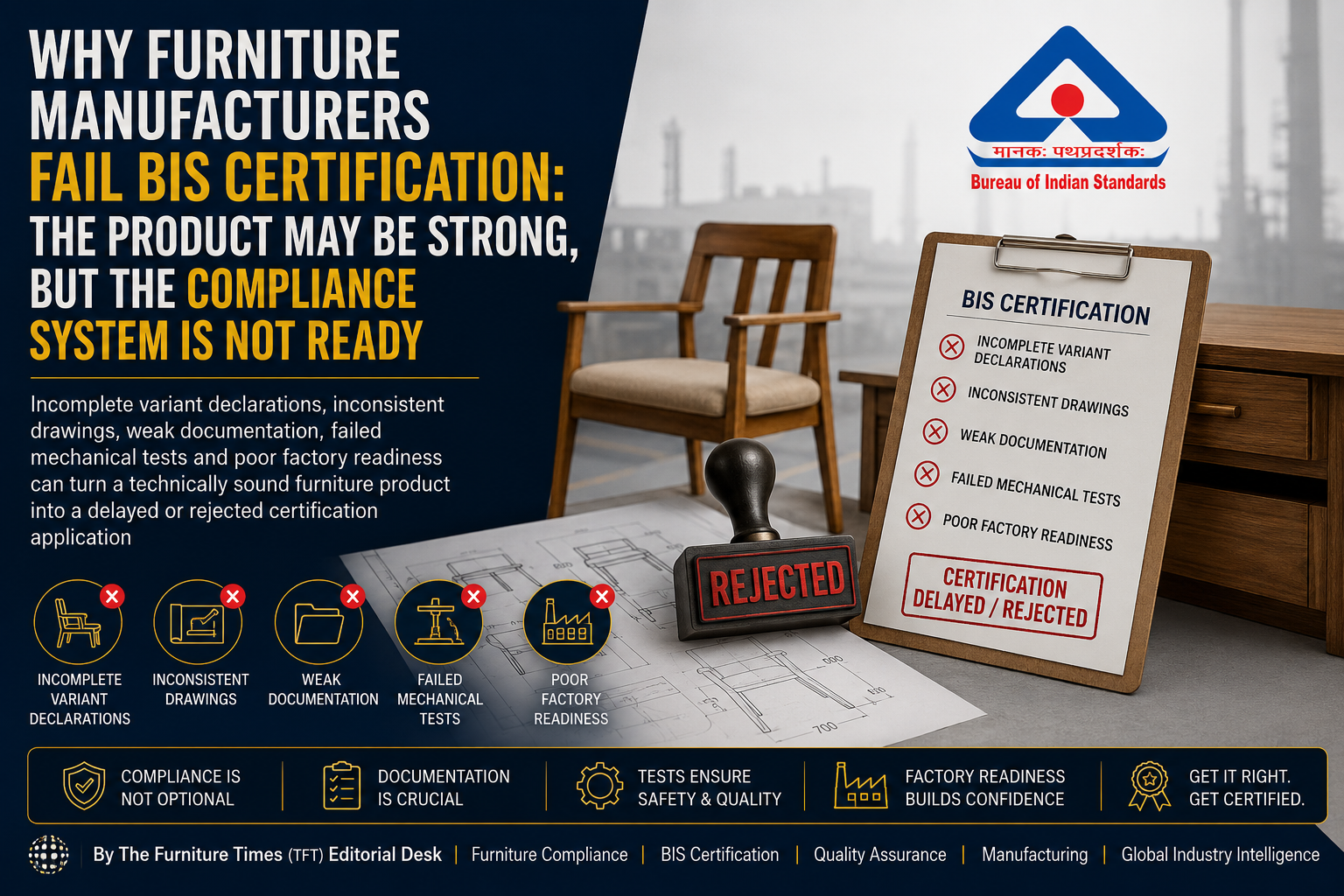
Incomplete variant declarations, inconsistent drawings, weak documentation, failed mechanical tests and poor factory readiness can turn a technically sound furniture product into a delayed or rejected certification application
By The Furniture Times (TFT) Editorial Desk | Furniture Compliance | BIS Certification | Quality Assurance | Manufacturing | Global Industry Intelligence
Furniture manufacturers frequently assume that obtaining Bureau of Indian Standards certification is primarily a matter of sending a product to a laboratory, passing several tests and receiving permission to display the BIS Standard Mark.
In practice, the process is far more comprehensive.
A well-built chair, table, bed or storage cabinet can still encounter certification difficulties when its documentation is incomplete, its variants have not been properly declared, its test sample does not represent the complete product range, or its factory is unable to demonstrate consistent control over production.
This is why many BIS certification problems do not begin in the testing laboratory. They begin much earlier—in product classification, model selection, drawings, bills of materials, supplier controls, manufacturing records and internal communication.
The central lesson for the furniture industry is clear:
BIS certification is not merely a test of one finished product. It is an assessment of whether a manufacturing system can consistently produce products that conform to the applicable Indian Standard.
For manufacturers, importers, exporters and furniture brand owners, understanding this distinction can prevent costly delays, repeated testing, restricted certification scopes and potential application rejection.
Furniture enters a more formal compliance environment
Furniture is increasingly being treated as an engineered product rather than merely a decorative or lifestyle purchase. A chair must safely carry repeated loads. A table must remain stable during foreseeable use. A bunk bed must manage fall and entrapment risks. Storage furniture must withstand loads without becoming dangerously unstable.
The Furniture (Quality Control) Order, 2025, as subsequently amended, brought notified furniture categories under mandatory conformity requirements. Manufacturers should always check the latest consolidated order, applicable commencement provisions, exemptions and product-specific BIS instructions before making commercial decisions.
The principal categories covered by the original notification include:
| Furniture category | Indian Standard |
|---|---|
| Work chairs | IS 17631:2022 |
| General-purpose chairs and stools | IS 17632:2022 |
| Tables and desks | IS 17633:2022 |
| Storage units | IS 17634:2022 |
| Beds | IS 17635:2022 |
| Bunk beds | IS 17636:2022 |
Under the notified framework, applicable products must conform to the relevant Indian Standard and bear the Standard Mark under a BIS licence. BIS lists notified furniture under its Scheme-I compulsory certification framework.
The Furniture Quality Control Order and later amendments should therefore be understood as a strategic change for the furniture ecosystem. Compliance is no longer solely a matter for the quality-control department. It affects product design, sourcing, manufacturing, imports, inventory planning, model launches, dealer commitments and brand reputation.
Why a good product can still fail certification
A manufacturer may have sold a product successfully for years without major customer complaints. That commercial history is useful, but it does not automatically prove conformity to every requirement of an Indian Standard.
A product may perform well in everyday use while still encountering certification problems because:
- The wrong Indian Standard was selected.
- The application does not clearly define the product.
- Commercial model names do not match factory records.
- Important variants were not declared.
- Drawings are incomplete or inconsistent.
- The tested sample does not represent the requested scope.
- Raw materials differ from those stated in the application.
- Components are changed without documented technical evaluation.
- Mechanical or safety tests reveal previously unknown weaknesses.
- In-house testing facilities do not meet applicable requirements.
- Measuring equipment is not properly calibrated.
- Factory staff cannot demonstrate required quality controls.
- Marking and labelling information is incomplete.
- Production records are missing or contradictory.
- The manufacturer is not ready to manage ongoing conformity after certification.
The weakness, therefore, may not be the core furniture design. It may be the absence of a controlled and verifiable compliance system around the design.
Normal and Simplified BIS Procedures: Understanding the Difference
BIS guidance describes application routes under Scheme-I, commonly referred to as the Normal Procedure and the Simplified Procedure. The route available to a manufacturer depends on product eligibility and the latest BIS requirements.
Normal Procedure
Under the Normal Procedure, the application is examined and the manufacturing premises are assessed as part of the certification process. Samples may be drawn and tested in accordance with the prescribed process.
The manufacturer must demonstrate that it possesses the necessary manufacturing capability, quality-control arrangements, testing facilities and competent personnel to maintain conformity.
The Normal Procedure may be appropriate when:
- The product is not eligible for the Simplified Procedure.
- The manufacturer does not already possess an acceptable test report.
- BIS needs to complete sampling and verification through the regular process.
- The product or requested scope requires detailed evaluation.
The manufacturer should not interpret “normal” as meaning that documentation can be prepared after the inspection. The application should be supported by accurate product information, manufacturing details, machinery lists, testing arrangements and quality records from the beginning.
Simplified Procedure
Under the Simplified Procedure, an applicant generally submits a conforming test report from a BIS-recognized third-party laboratory along with the application, subject to product eligibility and current BIS rules.
Historically, the procedure has been designed to reduce processing time for eligible applications. However, “simplified” does not mean that the technical standard is relaxed.
It does not mean:
- Testing can be incomplete.
- Variants can remain undeclared.
- Factory assessment is eliminated.
- Production controls are optional.
- Any laboratory report will be accepted.
- Certification automatically follows submission of a report.
- Ongoing surveillance and conformity obligations disappear.
A report must be from an acceptable BIS-recognized laboratory, remain valid for the applicable purpose and properly cover the product for which certification is requested.
| Issue | Normal Procedure | Simplified Procedure |
|---|---|---|
| Test report at application stage | Processed according to the normal assessment and sampling route | Conforming report from a BIS-recognized laboratory is generally submitted with the application |
| Product eligibility | Subject to Scheme-I requirements | Restricted to eligible products and current BIS provisions |
| Factory assessment | Required as applicable | Still required as applicable |
| Technical standard | Full compliance required | Full compliance required |
| Documentation | Comprehensive documentation required | Comprehensive documentation still required |
| Ongoing conformity | Mandatory | Mandatory |
Manufacturers should consult the current BIS Product Certification Process, product manual, Scheme of Inspection and Testing, grouping guidelines and instructions relevant to their product.
The most common reasons furniture BIS applications run into trouble
01 — Selecting the wrong product category or Indian Standard
Furniture products do not always fit neatly into the names used by the marketing department.
A “study chair” might be sold for domestic use, institutional use or work-related use. A storage product may function as a cabinet, locker, wardrobe or filing unit. A multifunctional furniture item may combine a desk, shelf and storage section.
The applicable standard should be identified according to the product’s construction, intended function and scope of the Indian Standard—not merely its commercial name.
An incorrect classification can affect:
- The tests performed.
- The product manual applied.
- The factory inspection checklist.
- The sample selected.
- The test equipment required.
- The certification scope.
- The product marking.
- The legal ability to sell the product under a claimed certification.
Manufacturers should resolve classification questions before finalizing samples or paying for testing.
02 — Incorrect model selection and undeclared variants
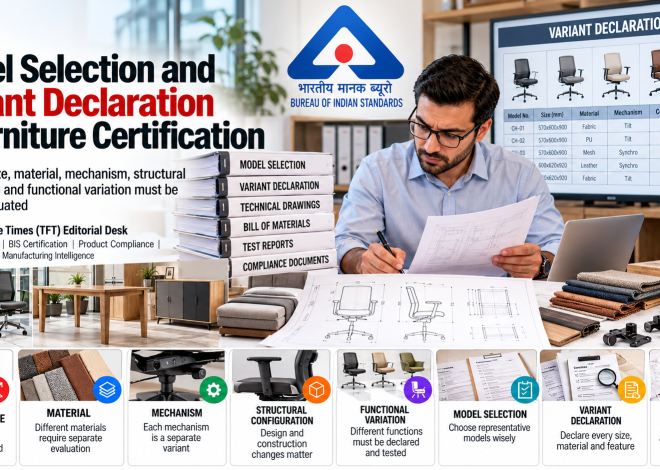
Variant management is one of the most important challenges in furniture certification.
A single chair range may have:
- Fixed and adjustable armrests.
- Mesh and upholstered backs.
- Nylon and aluminium bases.
- Different castors.
- Several gas-lift specifications.
- Multiple seat widths.
- High-back and mid-back versions.
- Headrest and non-headrest options.
- Different foam densities.
- Several structural frame materials.
From a marketing perspective, these may all belong to one collection. From a compliance perspective, each variation can affect strength, stability, durability, dimensions or safety.
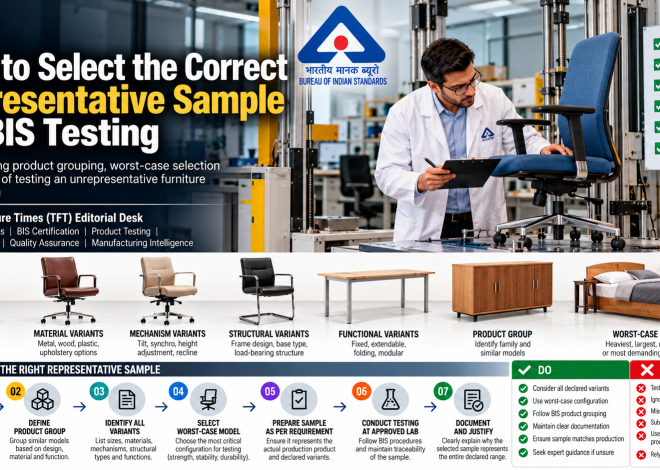
A manufacturer may test the strongest or most convenient configuration while requesting approval for an entire model family. If the chosen sample does not adequately represent the complete range, BIS may seek clarification, additional samples, further testing or a narrower certification scope.
A proper variant matrix should record:
- Model name and model code.
- Intended use.
- Product dimensions.
- Frame material and section sizes.
- Joint construction.
- Seat and back materials.
- Hardware and mechanism specifications.
- Load-bearing components.
- Surface finishing system.
- Accessories and optional features.
- Differences between variants.
- Technical justification for grouping.
- Proposed representative or worst-case sample.
The “worst-case” model is not always the largest product. It is the configuration most likely to create the greatest compliance challenge for the relevant requirement.
For example, a wider table might create a more demanding deflection condition, while a taller storage unit could present a greater stability concern. A chair with an adjustable mechanism may require a different assessment from a fixed chair.
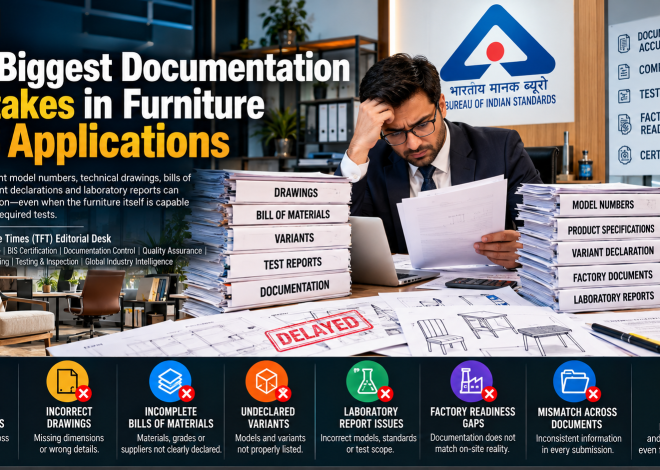
03 — Drawings that do not match the production product
Furniture drawings are often prepared for design, costing or customer approval rather than regulatory evaluation.
A certification-ready drawing should identify the product sufficiently to connect:
- The application.
- The bill of materials.
- The factory’s production process.
- The laboratory sample.
- The inspection observations.
- The requested licence scope.
Common drawing problems include:
- Missing dimensions.
- No tolerances.
- Unidentified materials.
- Missing component thicknesses.
- Undefined tube or section sizes.
- Hardware shown without specifications.
- Inconsistent model numbers.
- Drawings without revision numbers.
- Old drawings submitted after production changes.
- Different drawings held by design, production and quality teams.
Furniture manufacturers should introduce controlled engineering drawings with document numbers, revision histories, approval signatures and effective dates.
A product should not be sent for certification testing while its design is still changing informally on the shop floor.
04 — Bill-of-material inconsistencies and weak traceability
A bill of materials is not merely a purchasing list. For certification purposes, it helps establish the product’s technical identity.
The bill of materials should identify critical inputs such as:
- Timber, engineered wood or metal sections.
- Panel grades and thicknesses.
- Adhesives.
- Fasteners and connectors.
- Hinges and drawer slides.
- Chair mechanisms.
- Gas lifts and castors.
- Foam specifications.
- Upholstery materials.
- Coatings and surface finishes.
- Glass or other functional materials.
- Supplier names and internal material codes where applicable.
Problems arise when the test sample uses one component but regular production uses another.
For example, a chair might be tested with a high-specification mechanism sourced from one supplier, while normal production alternates between several mechanisms without equivalent performance evidence. A bed might be tested with thicker side rails than those subsequently used in mass production.
This creates a conformity gap.
Manufacturers should identify critical components, approve suppliers, maintain incoming inspection records and control material substitutions. A change in supplier does not always mean that the product is noncompliant, but an uncontrolled change can undermine confidence in continued conformity.
05 — Testing an unrepresentative prototype
A specially strengthened prototype may pass, but certification concerns consistent production—not the performance of a hand-built showpiece.
Warning signs include:
- Extra welding added only to the test sample.
- Higher-grade hardware used for laboratory testing.
- Hand-selected timber with no equivalent production controls.
- Thicker material used without updating the declared specification.
- Components purchased specifically for one test unit.
- Sample dimensions differing from commercial products.
- Additional adhesive, screws or reinforcements not present in regular production.
The laboratory sample should reflect the product that the factory intends to manufacture and sell.
If a design improvement is necessary to pass testing, that improvement should be incorporated into the controlled drawings, bill of materials, work instructions and production process.
06 — Material-related failures
Furniture standards may include performance and safety requirements that reveal weaknesses in raw materials or component selection.
Potential material issues include:
- Inadequate panel or timber strength.
- Variable moisture content.
- Weak adhesive bonding.
- Poor weld integrity.
- Insufficient metal-section thickness.
- Low-quality fasteners.
- Weak plastic components.
- Inconsistent foam or upholstery construction.
- Corrosion-prone hardware.
- Brittle components that fracture under impact.
- Coating or finish deficiencies where relevant.
Manufacturers sometimes rely heavily on supplier declarations. However, a supplier’s invoice or catalogue does not necessarily prove that every delivered batch meets the manufacturer’s controlled specification.
Incoming material inspection should be risk-based. Critical load-bearing parts deserve more attention than purely decorative elements.
07 — Mechanical performance failures
Furniture experiences repeated loads, impact, movement, twisting and misuse during its service life. Certification testing is intended to assess performance under standardized conditions.
Depending on the applicable Indian Standard, evaluation may include requirements associated with:
- Stability.
- Static strength.
- Durability.
- Impact resistance.
- Structural integrity.
- Deflection.
- Functional operation.
- Safety dimensions.
- Entrapment or shear hazards.
- Guardrails and access systems for bunk beds.
- Performance of moving mechanisms.
- Failure of joints, connectors or supports.
A chair may look strong but gradually loosen during durability cycles. A drawer unit may remain functional but create a tipping risk under an applicable test condition. A table may support a normal load but show excessive instability when horizontal force is applied.
Pre-compliance testing is therefore valuable. It allows weaknesses to be identified before an official sample enters the certification process.
08 — Inadequate in-house testing facilities
The exact testing requirements depend on the applicable product manual and Scheme of Inspection and Testing.
Factories should not assume that possessing a measuring tape, weighing scale and visual-inspection table is sufficient. They may need defined equipment, calibrated instruments, documented test methods and trained personnel for specified routine or periodic checks.
Typical weaknesses include:
- Required equipment is absent.
- Equipment is available but not operational.
- Calibration has expired.
- Calibration records cannot be traced to individual equipment.
- Factory personnel do not know how to perform the test.
- Test methods differ from the prescribed method.
- Results are recorded without actual testing.
- Acceptance criteria are missing.
- Failed test results are overwritten or ignored.
BIS certification is built around the manufacturer’s ability to maintain continuous conformity. The BIS laboratory overview emphasizes testing as an important element of conformity assessment.
09 — Poor factory inspection readiness
A factory inspection is not a ceremonial visit. It is an opportunity for the manufacturer to demonstrate that its declared production system actually exists and functions.
Inspecting personnel may need to examine:
- Manufacturing operations.
- Machinery.
- Process controls.
- Raw-material records.
- Testing facilities.
- Calibration status.
- Quality-control records.
- Product drawings.
- Bills of materials.
- Rejection procedures.
- Finished-goods identification.
- Storage conditions.
- Marking arrangements.
- Staff competency.
- Sample availability.
Factories often encounter difficulties because the application was prepared by an external consultant without adequately involving production personnel.
On the inspection date, the factory may discover that:
- Operators do not recognize the model listed in the application.
- Production records use a different model code.
- The declared machine is not installed.
- Required testing equipment has not arrived.
- Calibration certificates cannot be located.
- The production line is not running.
- Raw materials cannot be traced to the sample.
- Senior quality personnel are unavailable.
- The sample is incomplete.
- Different versions of the drawing are in circulation.
Factory readiness should be verified through an internal mock inspection before the BIS assessment.
10 — Unclear outsourcing and subcontracting arrangements
Furniture production often involves multiple specialized suppliers.
A manufacturer may fabricate metal frames internally while outsourcing:
- Powder coating.
- Wood machining.
- Upholstery.
- Component moulding.
- Glass processing.
- Hardware manufacturing.
- Surface finishing.
- Laboratory testing.
Outsourcing does not remove the manufacturer’s responsibility for product conformity.
The application and factory system should clearly identify critical outsourced processes, approved vendors, inspection methods and acceptance criteria. The licensed manufacturer must remain capable of controlling the conformity of the finished product.
11 — Marking and labelling errors
Manufacturers sometimes treat marking as a final graphic-design exercise. Under certification, marking is part of compliance.
The applicable standard, product manual and licence conditions may prescribe information that must accompany the Standard Mark.
Errors can include:
- Incorrect licence number.
- Wrong Indian Standard number.
- Mark placed on an unapproved model.
- Marking artwork printed before licence approval.
- Inconsistent manufacturer identity.
- Inadequate traceability.
- Labels that detach during normal handling.
- Uncontrolled use of the BIS mark in catalogues or online listings.
The Standard Mark should only be used in accordance with the licence conditions and BIS regulations. Manufacturers should establish formal approval controls for labels, cartons, catalogues, dealer materials and digital product pages.
12 — Documentation that contradicts itself
One of the most avoidable causes of delay is inconsistency across documents.
For example:
- The application states that the chair base is aluminium.
- The drawing identifies the base as nylon.
- The bill of materials lists both.
- The laboratory report does not identify the material.
- The factory produces a third variation.
Each document may appear reasonable when read separately, but together they create uncertainty about the product being certified.
Before submission, manufacturers should conduct a line-by-line consistency review across:
- Application forms.
- Model lists.
- Variant matrices.
- Drawings.
- Bills of materials.
- Manufacturing-process descriptions.
- Machinery lists.
- Test-equipment lists.
- Calibration records.
- Laboratory reports.
- Product labels.
- Factory registrations and legal documents.
A practical example: How one chair range can create a certification delay
Consider a hypothetical manufacturer called Nova Seating.
Nova sells an office chair named the Alpha Task Chair. The commercial catalogue offers:
- Mesh and fabric backs.
- Nylon and aluminium bases.
- Fixed and adjustable armrests.
- Two gas-lift classes.
- Standard and heavy-duty mechanisms.
- Headrest and non-headrest configurations.
Nova sends a mesh-back chair with a nylon base and fixed armrests to a laboratory. The sample passes the relevant tests.
The company then applies for certification covering the entire Alpha range.
During the assessment, several problems emerge:
- The application does not list the aluminium-base version.
- The drawing shows fixed arms, but the factory is producing adjustable arms.
- The gas-lift code on the bill of materials does not match the component installed in the sample.
- The mechanism supplier changed after laboratory testing.
- The commercial catalogue includes a high-back version absent from the model list.
- The factory’s durability-test arrangement is not ready.
- Calibration records for one measuring instrument have expired.
- Production records use internal codes that cannot be connected to the model names in the application.
The issue is not necessarily that every Alpha chair is unsafe. The problem is that Nova cannot demonstrate, through controlled evidence, which configuration was tested and whether the requested variants are technically covered.
Depending on the circumstances, the outcome could involve:
- Requests for clarification.
- Corrected documentation.
- Additional representative samples.
- Further laboratory testing.
- Exclusion of unsupported variants.
- Deferral of the application.
- Rejection where serious or unresolved nonconformities remain.
Had Nova created a variant matrix, frozen its design, controlled the bill of materials, chosen the correct representative sample and conducted a mock factory inspection, much of the delay could have been avoided.
The true cost of certification failure
The direct cost of retesting is only one part of the problem.
A delayed or unsuccessful certification exercise can lead to:
- Additional laboratory fees.
- Consultant and technical-service costs.
- Sample production costs.
- Transportation and handling expenses.
- Repeated inspection-related expenditure.
- Redesign and tooling expenses.
- Idle production capacity.
- Delayed product launches.
- Inventory accumulation.
- Cancelled dealer commitments.
- Missed institutional tenders.
- Import or supply-chain disruption.
- Reduced retailer confidence.
- Reputational damage.
- Management distraction.
For a furniture brand operating across multiple factories, the consequences can multiply quickly. A certification plan should therefore be connected to product-launch calendars, procurement schedules and inventory decisions.
A better approach: Build certification readiness in stages
Stage One — Establish regulatory applicability
Confirm:
- Whether the product falls within a notified furniture category.
- Which Indian Standard applies.
- Which factory manufactures the product.
- Whether any current exemption or transitional provision applies.
- Which product manual and grouping guidelines are current.
- Whether the Normal or Simplified Procedure is available and appropriate.
Stage Two — Freeze the product definition
Prepare a controlled technical file containing:
- Product description.
- Intended use.
- Model list.
- Variant matrix.
- Engineering drawings.
- Bill of materials.
- Critical-component specifications.
- Photographs.
- Manufacturing process.
- Marking plan.
Stage Three — Select the correct test sample
The representative sample should be chosen through technical analysis, not convenience.
Document why the selected configuration adequately represents the requested group and identify whether additional samples may be necessary.
Stage Four — Conduct a documentation audit
Verify that all model numbers, dimensions, materials and component codes are consistent across every document.
Stage Five — Complete pre-compliance testing
Conduct internal or third-party testing before the final certification test. Investigate failures properly and introduce controlled corrective action.
Stage Six — Prepare the factory
Confirm:
- Production machinery is operational.
- Required test equipment is available.
- Calibration is valid.
- Staff members are trained.
- Samples can be manufactured.
- Quality records are current.
- Raw materials are traceable.
- Nonconforming products are controlled.
- Product marking is understood.
Stage Seven — Conduct a mock inspection
A team independent of the daily production process should conduct an internal audit using the current product manual, Scheme of Inspection and Testing and factory documentation.
Stage Eight — Protect conformity after certification
Certification readiness does not end when the licence is granted.
Manufacturers need change-control procedures covering:
- New models.
- Variant additions.
- Material substitutions.
- Component-supplier changes.
- Design revisions.
- Factory relocation.
- New production processes.
- Changes to marking or brand identity.
- Outsourcing arrangements.
A commercial decision to change a component can become a compliance decision when that component affects the certified product.
Practical checklist for furniture manufacturers
Before submitting an application, management should be able to answer “yes” to the following questions:
01 — Have we confirmed the correct Indian Standard?
02 — Have we checked the latest QCO, amendments and BIS instructions?
03 — Is the manufacturing location correctly identified?
04 — Are all commercial and factory model names aligned?
05 — Have all construction variants been declared?
06 — Is there a technically justified grouping and sampling plan?
07 — Do drawings match the actual production product?
08 — Is the bill of materials controlled and current?
09 — Are critical suppliers approved and monitored?
10 — Is the laboratory sample representative of normal production?
11 — Have we conducted meaningful pre-compliance testing?
12 — Are required factory test facilities available and operational?
13 — Are calibration certificates valid and traceable?
14 — Can operators explain the relevant quality checks?
15 — Are production and inspection records available?
16 — Are rejected materials and products properly controlled?
17 — Are outsourced processes documented and monitored?
18 — Is proposed marking consistent with BIS requirements?
19 — Have we conducted a mock factory inspection?
20 — Is there a formal process for managing post-certification changes?
If several answers are “no,” the manufacturer is probably not ready to submit—even when the product itself appears strong.
Responsibilities of importers and brand owners
Importers and brand owners should not assume that certification responsibility can be handled entirely through contracts with suppliers.
Furniture certification is closely connected to the manufacturing location and approved scope. Products sourced from different factories may not automatically be covered under one manufacturing arrangement.
Before placing orders, importers and brands should verify:
- The identity of the licensed manufacturer.
- The address of the licensed factory.
- The Indian Standard covered.
- The models included in the approved scope.
- The validity and status of the licence.
- Whether the supplied configuration matches the certified construction.
- Whether the marking is genuine and correctly applied.
- Whether proposed component changes have been evaluated.
Foreign manufacturers should follow the applicable BIS requirements for overseas factories, including provisions related to authorized representation in India where required.
A licence should never be treated as a generic certificate that can be transferred across unrelated factories, models or suppliers.
BIS certification should begin at the design table
The furniture industry can reduce certification difficulties by integrating compliance into product development.
Designers should understand stability, strength and safety requirements. Procurement teams should control critical components. Production teams should follow approved drawings. Quality teams should maintain inspection and test records. Marketing teams should not advertise unapproved variants as certified.
Senior management must connect these functions.
The most successful compliance strategy is not to ask, “How do we get this sample to pass?”
It is to ask:
“How do we design, manufacture, verify and document this product so that every approved unit can consistently conform?”
That change in mindset transforms BIS certification from an emergency exercise into a system of product assurance.
Conclusion: Certification is a system, not a sticker
Furniture manufacturers do not necessarily encounter BIS certification problems because they lack manufacturing skill. Many produce technically capable products and employ experienced craftspeople.
Problems often occur because practical manufacturing knowledge has not been translated into controlled documentation, traceable materials, repeatable tests and inspection-ready evidence.
A successful application requires alignment between:
- The applicable Indian Standard.
- The product design.
- The tested sample.
- The declared variants.
- The bill of materials.
- The factory process.
- The testing system.
- The production records.
- The certification scope.
- The product supplied to the market.
When these elements agree, certification becomes more predictable. When they contradict one another, even an apparently strong product can face observations, retesting, delay, scope restrictions or rejection.
For India’s furniture industry, the new compliance environment can ultimately become an opportunity. Manufacturers that build strong conformity systems can improve product consistency, reduce failures, strengthen buyer confidence and compete more effectively in domestic and international markets.
The essential message is worth repeating:
BIS certification is not just about testing a product—it is about complete system readiness.
Editorial note: This article is intended for general industry information and does not constitute legal or certification advice. BIS standards, Quality Control Orders, product manuals, grouping guidelines, procedures and exemptions may be amended. Manufacturers should verify current requirements with BIS, the appropriate certification branch and a BIS-recognized laboratory before proceeding.
The Furniture Times (TFT) & Furniture Industry Search Engine (FISE)
“TFT tells their story. FISE helps the world find them.”
FurniReviewology helps the world trust them.
The furniture industry ecosystem is a $1 trillion industry ecosystem.
Be visible. Be verified. Be trusted. Be part of the movement.