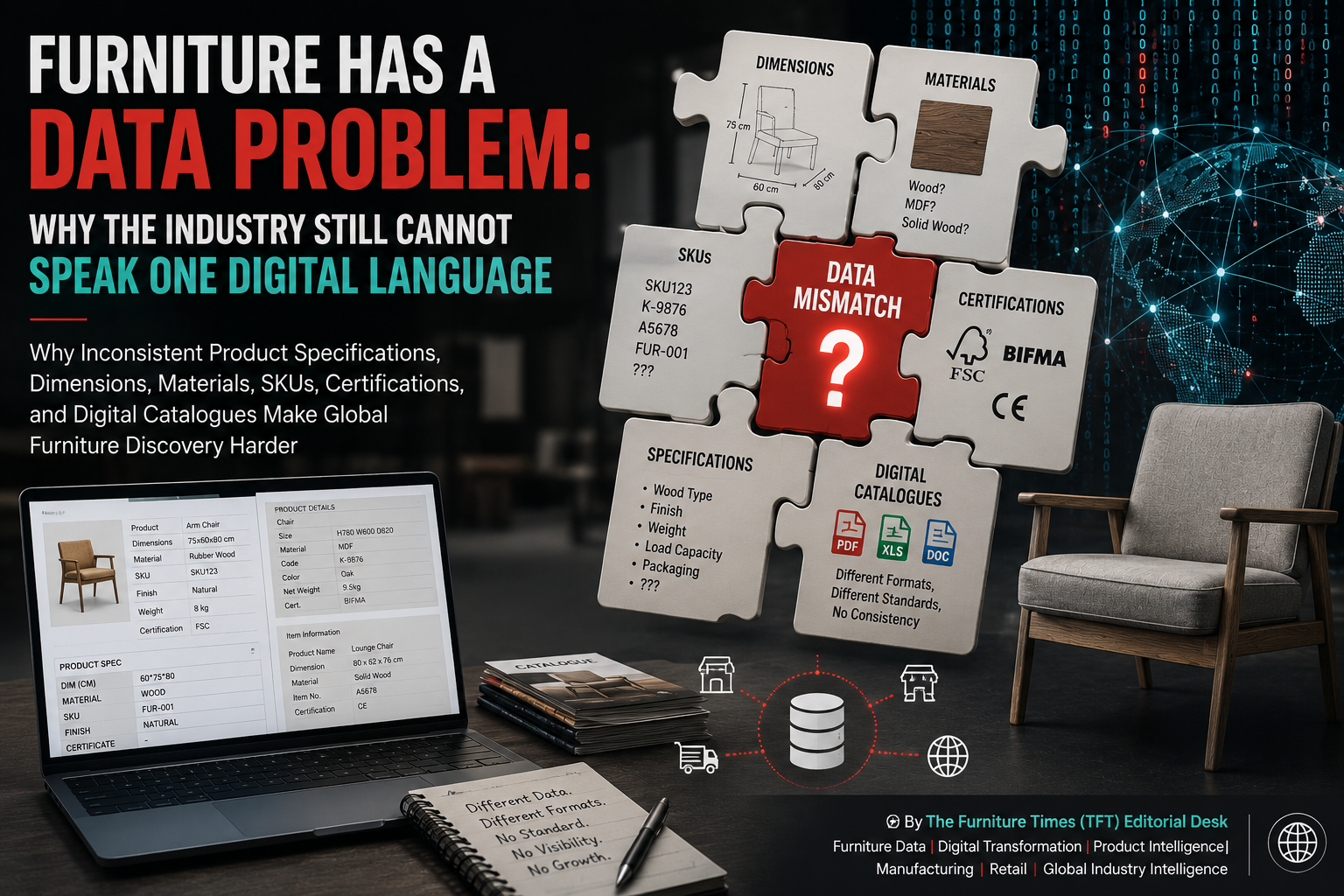
Furniture Has a Data Problem: Why the Industry Still Cannot Speak One Digital Language
Why Inconsistent Product Specifications, Dimensions, Materials, SKUs, Certifications, and Digital Catalogues Make Global Furniture Discovery Harder
By The Furniture Times (TFT) Editorial Desk | Furniture Data | Digital Transformation | Product Intelligence | Manufacturing | Retail | Global Industry Intelligence
The global furniture industry has spent decades improving manufacturing.
Factories have become faster.
Machinery has become more precise.
Logistics has become more sophisticated.
Retail has moved online.
Trade has become global.
Product catalogues have become digital.
And artificial intelligence is beginning to change how consumers discover, compare and purchase furniture.
Yet beneath all this progress sits a surprisingly basic problem:
The furniture industry still does not speak one digital language.
One manufacturer describes a table in millimetres.
Another uses centimetres.
Another uses inches.
One company lists solid oak.
Another says engineered wood with oak veneer.
Another simply writes “wood.”
One retailer calls a product a sectional sofa.
Another calls the same configuration a modular lounge.
Another calls it an L-shaped couch.
One company includes packed dimensions.
Another includes assembled dimensions.
Another includes only approximate measurements.
One catalogue contains certifications.
Another contains none.
One SKU identifies a complete product.
Another SKU identifies only a finish.
Another combines collection, fabric, size and region into a code that only the manufacturer understands.
To a human buyer, these inconsistencies are inconvenient.
To global search engines, marketplaces, procurement platforms and AI systems, they are much more serious.
They make furniture harder to understand, compare, discover and recommend.
The furniture industry’s next major transformation may therefore not begin with a new machine, material or retail concept.
It may begin with something much less glamorous:
better data.
Furniture Is Becoming a Data Product
Every physical furniture product increasingly has a digital twin.
Before a customer touches a sofa, they often encounter its data.
Before an architect specifies a chair, they read its data.
Before a hotel procurement team places an order, they study its data.
Before a search engine indexes a dining table, it analyzes its data.
Before an AI assistant recommends a bed, it must understand its data.
Furniture is therefore no longer simply:
wood,
metal,
foam,
fabric,
glass,
hardware,
and finishing.
It is also:
title,
description,
dimensions,
materials,
weight,
colour,
finish,
SKU,
price,
availability,
country of origin,
certification,
warranty,
images,
technical files,
assembly instructions,
compatibility,
care requirements,
shipping details,
and searchable metadata.
In the digital economy, poor product data can make excellent furniture nearly invisible.
The Industry’s First Problem: No Consistent Product Naming
Furniture terminology changes dramatically across regions, retailers and manufacturers.
Consider a simple product.
Is it a:
sofa,
couch,
settee,
lounge,
three-seater,
living-room sofa,
upholstered sofa,
or sectional component?
All may be correct in different contexts.
The same issue exists across almost every furniture category.
A bedside table may also be called:
nightstand,
bedside cabinet,
bedside unit,
night table,
or side table.
A wardrobe may be:
closet,
armoire,
cabinet,
robe,
storage unit,
or bedroom wardrobe.
For humans, context often solves the problem.
Machines do not always have that luxury.
If product naming is inconsistent, search systems can struggle to understand whether two products belong to the same category.
This becomes especially important as consumers increasingly search conversationally.
A person may ask:
“Show me a narrow bedside cabinet under 45 cm wide with two drawers in walnut.”
If product data uses inconsistent category names or omits width, drawer count or finish, the product may never appear.
Dimensions: One of the Simplest Data Fields Is Still Complicated
Furniture dimensions should be straightforward.
They often are not.
Companies may publish:
width × depth × height,
length × width × height,
height × width × depth,
overall dimensions,
seat dimensions,
packed dimensions,
assembled dimensions,
or approximate dimensions.
Some include millimetres.
Some centimetres.
Some inches.
Some mix units across different product collections.
Others omit units entirely.
Even terminology can create confusion.
For a sofa, does “depth” refer to:
overall depth,
seat depth,
or packaged depth?
For a dining table, does “length” mean its fixed size or extended size?
For a mattress, is thickness included?
For a wardrobe, do dimensions include handles?
These inconsistencies can create errors in:
e-commerce,
interior planning,
space visualization,
freight calculation,
warehouse management,
and specification.
Furniture is highly dependent on physical fit.
That makes dimension data one of the industry’s most important information assets.
Yet it remains poorly standardized.
Material Descriptions Are Often Too Vague
Furniture material data is another major problem.
A product may be described simply as:
wood.
But what does that mean?
Solid wood?
Engineered wood?
MDF?
Particleboard?
Plywood?
Veneer over engineered substrate?
A combination of materials?
The same ambiguity exists with upholstery.
A company may describe a sofa as:
fabric.
But that tells buyers very little.
What fibre composition?
What abrasion performance?
What stain resistance?
What fire-performance classification?
What colour-fastness?
What backing?
What cleaning method?
What certification?
Material transparency is becoming increasingly important because consumers, architects, regulators and procurement teams are asking more detailed questions.
Poor material data makes those questions difficult to answer.
The SKU Problem
Furniture SKUs can be extraordinarily complicated.
A single sofa collection may have different codes for:
size,
fabric,
colour,
leg finish,
configuration,
region,
packaging,
and channel.
Some manufacturers use meaningful SKU structures.
Others use internal codes that make sense only to their own systems.
A retailer may then create an entirely different SKU for the same product.
A distributor may create another.
A marketplace may assign another product identifier.
The result is that one physical product can exist under multiple digital identities.
This makes it harder to connect:
inventory,
pricing,
reviews,
warranty data,
repair information,
availability,
and product history.
Furniture desperately needs stronger methods for persistent product identification.
The Same Product Can Become Five Different Products Online
Imagine one dining chair manufactured by a factory.
The factory lists it as:
Model A173-WN
A wholesaler renames it:
Nordic Walnut Dining Chair
A retailer calls it:
Oslo Dining Chair
An e-commerce marketplace lists it as:
Modern Wooden Dining Chair with Upholstered Seat
Another seller lists it under a private-label brand.
From a consumer perspective, these may appear to be five separate products.
From a data perspective, the connection may be invisible.
This creates problems with:
comparison,
reviews,
price transparency,
warranty tracking,
product authenticity,
and supply-chain traceability.
Digital Catalogues Are Often Built for Humans, Not Machines
Many furniture companies proudly produce beautiful PDF catalogues.
Visually, they can be excellent.
From a machine-readable perspective, they can be terrible.
Critical product information may exist only inside:
images,
decorative text boxes,
scanned pages,
graphic layouts,
or downloadable files.
Search engines may not easily understand the structure.
AI systems may not reliably extract product relationships.
Marketplace platforms cannot automatically ingest the data.
Distributors may need to manually re-enter it.
The industry therefore suffers from an important contradiction:
A catalogue can look digitally modern while remaining structurally primitive.
A true digital catalogue should not simply be a PDF version of a printed brochure.
It should be a structured product database.
Furniture Data Is Repeatedly Re-entered
Because product information is rarely standardized, the same data often gets typed again and again.
The manufacturer creates it.
The distributor re-enters it.
The retailer re-enters it.
The marketplace restructures it.
The interior designer copies it.
The procurement company transfers it.
The logistics provider reformats it.
Every additional manual step creates another opportunity for:
errors,
missing fields,
wrong dimensions,
incorrect materials,
outdated prices,
duplicate products,
and inconsistent descriptions.
This is inefficient.
It also creates significant operational cost that few furniture companies measure.
Certifications Are Often Disconnected From Products
Furniture companies increasingly deal with certifications, testing and compliance documentation.
But certification data is often handled separately from product data.
A product page may say:
“Certified.”
Certified to what?
By whom?
For which exact model?
For which market?
When was it tested?
Does the certificate cover the full collection or only one variant?
Is the certification still valid?
Where is the supporting documentation?
Procurement teams increasingly need answers to these questions.
A well-structured product-data system should connect certifications directly to specific products and variants.
Without that linkage, compliance becomes harder to verify.
Furniture Data Has a Version-Control Problem
Products evolve.
A manufacturer may change:
a supplier,
a hinge,
a foam specification,
a fabric,
a coating,
a frame material,
a motor,
or packaging.
But does the digital product record change too?
Sometimes yes.
Sometimes no.
This creates a serious question:
Is the furniture product listed today exactly the same product that was sold two years ago?
If not, historical warranty, repair and review information may become misleading.
The furniture industry therefore needs better version control.
A product should have a record of significant changes over time.
That would improve:
quality analysis,
warranty tracking,
recall management,
and product traceability.
E-Commerce Exposes the Problem
Online furniture retail makes data quality visible immediately.
A customer cannot physically inspect the product.
They rely on information.
If that information is incomplete, uncertainty rises.
Common problems include:
missing measurements,
unclear material descriptions,
few images,
inaccurate colour names,
poor assembly information,
missing weight limits,
unclear delivery information,
and absent care instructions.
When online furniture is returned because expectations were wrong, the problem may not be the product.
It may be the data.
Product Data Is Part of Customer Experience
Furniture companies often separate product-data management from marketing and customer experience.
That is a mistake.
Imagine two retailers selling comparable dining tables.
Retailer A provides:
basic dimensions,
one image,
material listed simply as “wood.”
Retailer B provides:
precise dimensions,
extended dimensions,
clear material composition,
weight,
seating capacity,
care instructions,
assembly details,
certification,
delivery measurements,
multiple images,
and downloadable technical information.
Which retailer creates more confidence?
Better data reduces uncertainty.
And lower uncertainty can improve conversion.
Product data should therefore be treated as part of sales strategy.
Architects Need Better Data
Furniture specification in architecture and interior design creates another data challenge.
Design professionals may require:
2D drawings,
3D models,
material specifications,
finish codes,
dimensions,
fire-performance information,
sustainability information,
maintenance guidance,
and technical certifications.
Yet this information is often spread across multiple files.
A designer may need to request it manually.
Another manufacturer may provide it instantly.
In competitive contract furniture markets, the company with better product data can be easier to specify.
That can directly influence sales.
The Hospitality Industry Needs Structured Furniture Data
Hotels purchase large quantities of furniture across multiple categories.
They need information about:
room dimensions,
product specifications,
finishes,
maintenance,
replacement parts,
durability,
warranties,
and compliance.
If every supplier provides information differently, procurement becomes difficult.
Structured product data can simplify:
supplier comparison,
project management,
future replacement,
maintenance,
and renovation.
The same principle applies to:
restaurants,
offices,
schools,
healthcare,
public facilities,
and institutional procurement.
Logistics Needs Furniture Data Too
Furniture is expensive to transport.
Accurate logistics depend on:
packed dimensions,
gross weight,
net weight,
units per carton,
units per pallet,
container capacity,
stacking limitations,
handling requirements,
and fragility.
If this information is inaccurate, the consequences can include:
incorrect freight calculations,
warehouse inefficiency,
loading problems,
higher shipping costs,
and increased damage.
Product data is therefore not merely a digital-marketing issue.
It directly affects physical operations.
Sustainability Depends on Better Data
The furniture industry is under growing pressure to explain where products come from and what they contain.
Sustainability claims may involve:
wood origin,
recycled content,
material composition,
carbon data,
repairability,
recyclability,
chemical information,
and product lifespan.
These claims require structured information.
A company cannot build credible sustainability reporting on weak product data.
This means data quality may increasingly become part of environmental credibility.
AI Is Making the Problem More Urgent
Traditional search engines could often compensate for imperfect information.
AI systems are raising expectations.
A consumer may ask:
“Find a dining table for six people under 180 cm, made from certified wood, suitable for humid climates and available in Malaysia.”
To answer well, an AI system needs structured information about:
category,
dimensions,
capacity,
materials,
certification,
environmental suitability,
location,
availability,
and possibly delivery.
If one or more of those fields are missing, the product becomes harder to recommend.
The furniture industry therefore faces a new reality:
AI visibility begins with data quality.
A beautifully designed product with weak digital information can become invisible to intelligent search systems.
Furniture Brands May Be Invisible to AI Without Knowing It
A company may have thousands of products online.
Management may assume that because the products exist on a website, AI can understand them.
That assumption can be dangerous.
If product information is trapped inside:
PDFs,
images,
JavaScript interfaces,
scanned catalogues,
inconsistent templates,
or poorly structured pages,
machine systems may struggle to interpret it.
The company may technically be online but functionally invisible.
This is becoming one of the most important digital risks facing furniture brands.
The Industry Needs a Common Furniture Data Dictionary
One possible solution is the creation of a common furniture data dictionary.
Such a system would define standard fields for product information.
For example:
Product Identity
Product name
Unique identifier
SKU
Model number
Collection
Brand
Manufacturer
Classification
Furniture category
Subcategory
Application
Residential or commercial use
Dimensions
Width
Depth
Height
Seat height
Seat depth
Extended dimensions
Packed dimensions
Materials
Frame material
Surface material
Upholstery material
Foam
Hardware
Finish
Performance
Weight capacity
Durability rating
Commercial suitability
Outdoor suitability
Compliance
Certifications
Testing standards
Country-specific compliance
Logistics
Gross weight
Net weight
Carton quantity
Package volume
Container loading information
After-Sales
Warranty
Spare parts
Repairability
Assembly instructions
Care instructions
This would not eliminate brand creativity.
It would simply create a shared data foundation.
Furniture Needs Persistent Product IDs
One of the industry’s biggest long-term opportunities is a persistent digital identity for furniture products.
Imagine every product receiving a unique global identifier.
That identifier could connect to:
manufacturer,
materials,
dimensions,
certifications,
warranty,
repair instructions,
replacement parts,
recall information,
and eventually resale history.
The furniture product would maintain its identity throughout its life.
Factory.
Retail.
Consumer ownership.
Repair.
Resale.
Recycling.
This could become the foundation of a true digital furniture economy.
Digital Product Passports Could Transform Furniture
The concept of a digital product passport is particularly relevant to furniture.
A furniture passport could potentially contain:
origin,
materials,
component information,
manufacturing date,
certification,
care instructions,
repair guidance,
spare-part numbers,
warranty,
recycling instructions,
and product history.
Such a system could improve:
traceability,
repairability,
circularity,
resale,
and regulatory compliance.
It could also create new opportunities for furniture brands to remain connected to products long after the original sale.
Better Data Could Improve Furniture Resale
The second-hand furniture market faces severe information problems.
A used chair may be listed with little more than:
“Wooden chair, good condition.”
But imagine if the product’s original digital identity remained accessible.
A buyer could know:
manufacturer,
model,
materials,
original dimensions,
original warranty,
replacement parts,
care guidance,
and production date.
That would increase trust.
Furniture data could therefore become an important infrastructure for the circular economy.
Repairability Requires Product Data
Furniture repair becomes difficult when technicians cannot identify components.
Which hinge was used?
Which motor?
Which gas lift?
Which drawer slide?
Which fabric?
Which connector?
If the original product record contains that information, repair becomes easier.
If not, technicians may need to guess.
Better data can therefore extend product lifespan.
Furniture Data Could Reduce Waste
Poor data creates waste in multiple ways.
Products are returned because dimensions were misunderstood.
Items are replaced because spare parts cannot be identified.
Inventory becomes obsolete because product records are inaccurate.
Packaging is inefficient because measurements are wrong.
Products are discarded because materials are unknown.
Better data can reduce all of these problems.
Digital efficiency and sustainability are increasingly connected.
Data Quality Should Become a Board-Level KPI
Furniture companies often monitor:
sales,
margin,
inventory,
conversion,
returns,
production output,
and delivery performance.
They rarely monitor:
Product Data Completeness.
Yet this could become a valuable management metric.
For example:
What percentage of products have complete dimensions?
What percentage include full material composition?
What percentage include certification data?
What percentage have spare-part references?
What percentage have structured digital records?
What percentage can be reliably understood by AI systems?
These are increasingly strategic questions.
The Cost of Bad Furniture Data
Bad data creates hidden costs.
It leads to:
incorrect orders,
higher returns,
manual corrections,
lost sales,
procurement delays,
poor search visibility,
marketplace errors,
shipping mistakes,
duplicate listings,
customer complaints,
and specification problems.
A furniture company may never calculate these costs directly.
But they exist.
The industry needs to begin treating poor data as operational waste.
Data Could Become a Competitive Advantage
Imagine two furniture manufacturers producing similar quality products.
Manufacturer A has scattered PDFs, inconsistent descriptions and incomplete dimensions.
Manufacturer B provides structured data, downloadable files, accurate specifications, certifications, spare-part references, product passports and machine-readable information.
Which company will be easier for:
retailers,
architects,
developers,
marketplaces,
procurement teams,
search engines,
and AI agents
to work with?
The answer is obvious.
Data quality could become a new competitive advantage in furniture manufacturing.
SMEs Should Not Be Left Behind
Large furniture corporations may have advanced product-information systems.
Many SMEs still rely on:
Excel files,
PDF catalogues,
WhatsApp,
emails,
and manually maintained product lists.
This creates a digital divide.
But smaller manufacturers should not assume sophisticated data infrastructure is only for large corporations.
Even basic standardization can create major improvements.
An SME can begin by ensuring every product has:
consistent naming,
complete dimensions,
clear materials,
a unique SKU,
high-quality images,
warranty information,
certification data,
and structured digital records.
Digital maturity begins with discipline, not necessarily expensive technology.
The Furniture Industry Needs Data Standards Before It Needs More AI
The industry is understandably excited about artificial intelligence.
But AI cannot fix fundamentally poor data.
If manufacturers feed inconsistent, incomplete or incorrect information into AI systems, the results will remain unreliable.
The order matters:
Standardize → Structure → Verify → Connect → Then Apply AI.
Furniture companies that skip the first steps may spend heavily on technology without solving the underlying problem.
A Furniture Product Should Be Machine-Readable by Default
In the future, furniture product information should not be created only for brochures.
It should be created simultaneously for:
websites,
marketplaces,
search engines,
AI systems,
ERP platforms,
logistics,
architectural specification,
retail systems,
repair networks,
and product passports.
This requires a fundamental change in thinking.
The digital product record should become the primary source.
Everything else should be generated from it.
Not the other way around.
The Future Furniture Catalogue Is Not a Catalogue
The traditional catalogue may eventually evolve into something far more sophisticated.
Instead of a static document, the future catalogue could be a live product-information system.
Retailers could pull data automatically.
Designers could download technical files.
AI agents could compare specifications.
Consumers could verify materials.
Repair technicians could identify components.
Logistics teams could access packaging data.
Resale platforms could verify product identity.
The catalogue would stop being a marketing document.
It would become digital infrastructure.
The Industry Needs a Global Furniture Data Layer
The ultimate opportunity is larger than individual company databases.
Imagine a global furniture data layer connecting:
brands,
manufacturers,
products,
categories,
materials,
components,
certifications,
dimensions,
availability,
warranties,
reviews,
repairs,
and resale.
Search would become easier.
Procurement would become faster.
AI recommendations would become better.
Product comparison would become more accurate.
Furniture could become significantly more discoverable across borders.
This is the missing digital infrastructure behind the global furniture economy.
TFT Industry Perspective
For decades, the furniture industry’s competitive advantage came primarily from:
manufacturing,
design,
price,
distribution,
and brand.
Those advantages remain important.
But another competitive layer is emerging:
Data Readiness.
A furniture company can manufacture a world-class product.
But if that product has poor data, weak digital identity and inconsistent information, it may become increasingly difficult to discover in a world driven by search, marketplaces and AI.
The industry must therefore stop viewing product information as clerical work.
It is strategic infrastructure.
The furniture industry’s future digital language should allow a product to answer fundamental questions clearly:
What am I?
Who made me?
What am I made from?
How large am I?
Where can I be used?
What certifications do I have?
How should I be transported?
How should I be installed?
How can I be repaired?
How long should I last?
What happens when I reach the end of my life?
Until furniture products can answer these questions consistently in structured digital form, the industry will continue struggling to operate as one truly connected global ecosystem.
The problem is not that furniture lacks information.
The problem is that its information is fragmented.
And in the age of AI, fragmented data increasingly means fragmented visibility.
The furniture industry does not simply need more websites, more catalogues or more digital platforms.
It needs to learn how to speak one digital language.
The Furniture Times (TFT) — Global Furniture Industry Media & Intelligence
TFT tells their story. FISE helps the world find them. FurniReviewology helps the world trust them.