
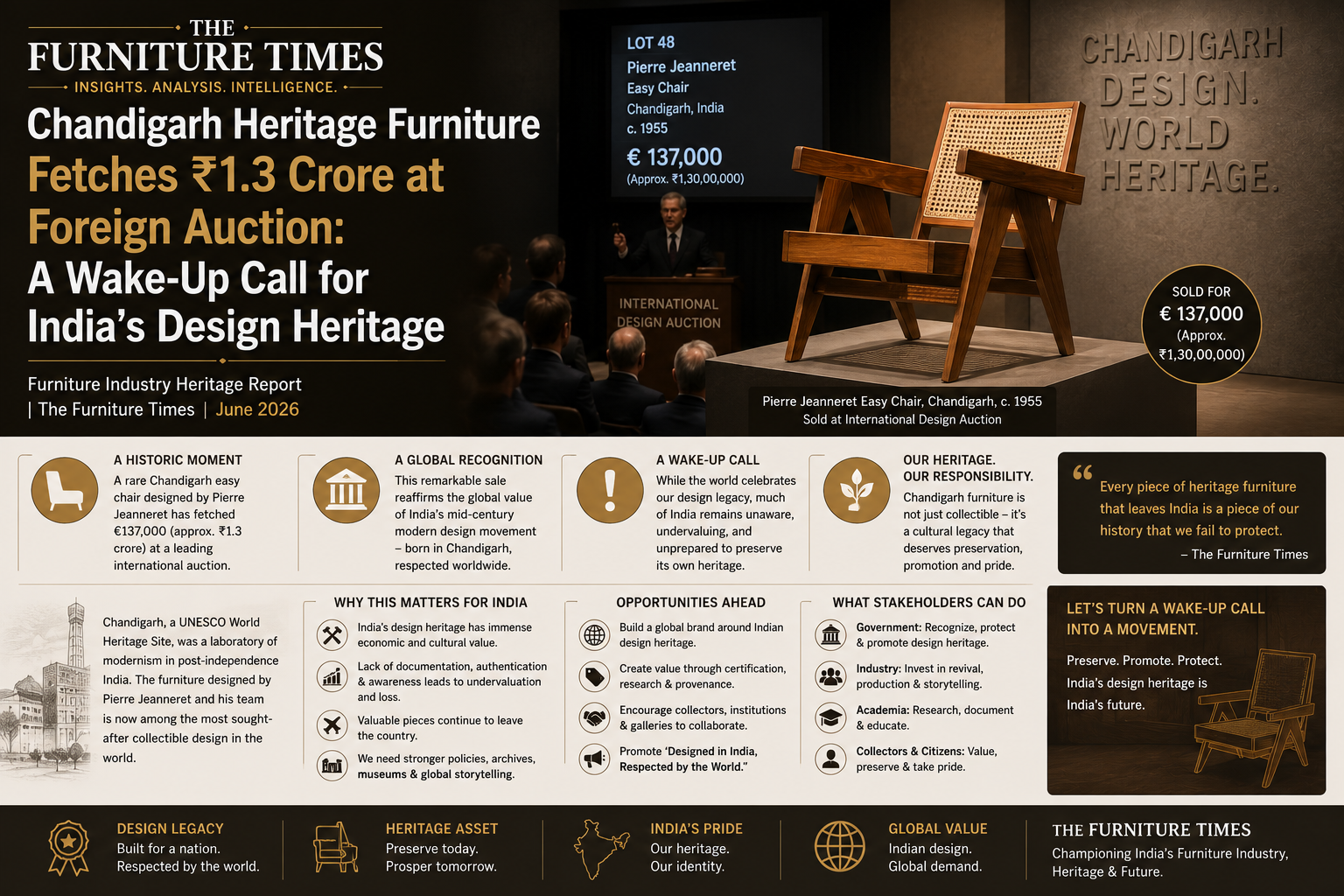
Chandigarh Heritage Furniture Fetches ₹1.3 Crore at Foreign Auction: A Wake-Up Call for India’s Design Heritage
Furniture Industry Heritage Report | June 2026
A collection of Chandigarh’s iconic heritage furniture, designed during the creation of India’s first planned city, has reportedly fetched approximately ₹1.3 crore at an overseas auction, once again drawing international attention to one of the most celebrated furniture legacies in modern architectural history. The auction highlights both the growing global demand for Chandigarh’s mid-century modern furniture and the continuing debate surrounding the preservation of India’s cultural and design heritage.
The Global Appeal of Chandigarh Furniture
The furniture pieces associated with Chandigarh are not ordinary chairs, tables, or cabinets. They represent a significant chapter in post-independence India’s architectural and design history.
When Chandigarh was conceived in the 1950s under the vision of Swiss-French architect Le Corbusier, his cousin and collaborator Pierre Jeanneret was entrusted with designing much of the furniture used in government buildings, educational institutions, and administrative offices.
Crafted primarily from teak wood and cane, these pieces embodied:
Functional modernism
Minimalist aesthetics
Indian craftsmanship
Institutional durability
Architectural harmony
Today, these furniture pieces have become highly sought-after collector’s items among museums, luxury collectors, interior designers, and design investors worldwide.
Why Are Buyers Paying Crores?
The answer lies in scarcity, provenance, and historical significance.
Original Chandigarh furniture pieces are considered among the most important examples of twentieth-century modernist furniture. Global collectors view them similarly to rare works from famous European design houses.
Several auction houses in Europe and North America have repeatedly offered Chandigarh-origin furniture, with pieces often selling for many times their original institutional value. The international design market increasingly treats Pierre Jeanneret’s creations as investment-grade collectibles.
Industry experts identify several reasons for rising prices:
Historical Value
Each piece is connected to the development of independent India’s modern identity.
Limited Supply
Original furniture from Chandigarh institutions is finite, making authentic examples increasingly rare.
Global Mid-Century Modern Trend
Demand for mid-century modern furniture continues to grow among architects, collectors, and luxury homeowners.
Museum Interest
Many institutions worldwide now collect Chandigarh furniture as examples of significant twentieth-century design.
Preservation Concerns Continue
The latest auction has reignited concerns among heritage activists and preservation advocates.
Over the years, several reports have documented Chandigarh-origin furniture appearing in foreign auctions despite restrictions intended to protect heritage assets. Legal and heritage experts have repeatedly raised questions regarding how certain pieces left public institutions and entered international markets.
Advocates have argued that many of these objects were originally commissioned using public funds for educational and governmental institutions and therefore represent a part of India’s collective heritage.
A Lesson for the Global Furniture Industry
The Chandigarh story offers important lessons for furniture manufacturers and design communities worldwide.
Furniture is often viewed simply as a functional product. However, history demonstrates that furniture can become:
Cultural heritage
National identity
Design investment assets
Museum artifacts
Historical records of craftsmanship
What was once used daily in offices, universities, and government buildings is now celebrated globally as collectible design.
Economic Opportunity for India
The international demand for Chandigarh furniture also presents opportunities.
Rather than seeing heritage furniture solely as an auction phenomenon, India could further strengthen:
Design museums
Furniture heritage archives
Educational programs
Design tourism initiatives
Licensed reproductions
Heritage exhibitions
Countries such as Denmark, Italy, and Finland have successfully transformed furniture design history into tourism, education, branding, and economic value. India possesses similar potential through the Chandigarh legacy.
What This Means for the Future
The ₹1.3 crore auction result is more than a sales headline. It reflects the extraordinary global recognition of Chandigarh’s design legacy.
As international collectors continue to compete for authentic Pierre Jeanneret furniture, the value of preserving and documenting India’s furniture heritage becomes even more critical.
For the global furniture industry, Chandigarh remains one of the strongest examples of how furniture transcends utility. It becomes culture, history, architecture, and identity—assets whose value can continue to grow decades after their creation.
The latest auction serves as both a celebration of Indian design excellence and a reminder that heritage preservation must remain a priority if future generations are to benefit from these remarkable pieces of history.
By The Furniture Times (TFT) – Heritage & Design Intelligence Desk
Bringing Furniture Brands Into Global Spotlight

Related Posts

Global Furniture Industry Faces a Conflict-Economy Test as Wars Disrupt Energy

Ireland’s €53 Million Government Jet Ignites Debate on Cost, Capability and National Priorities