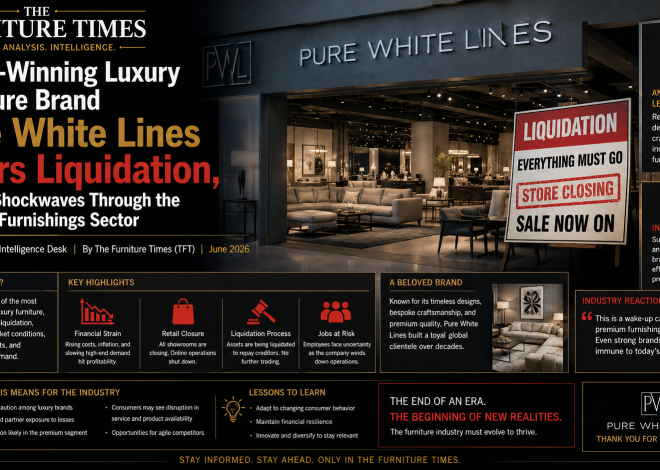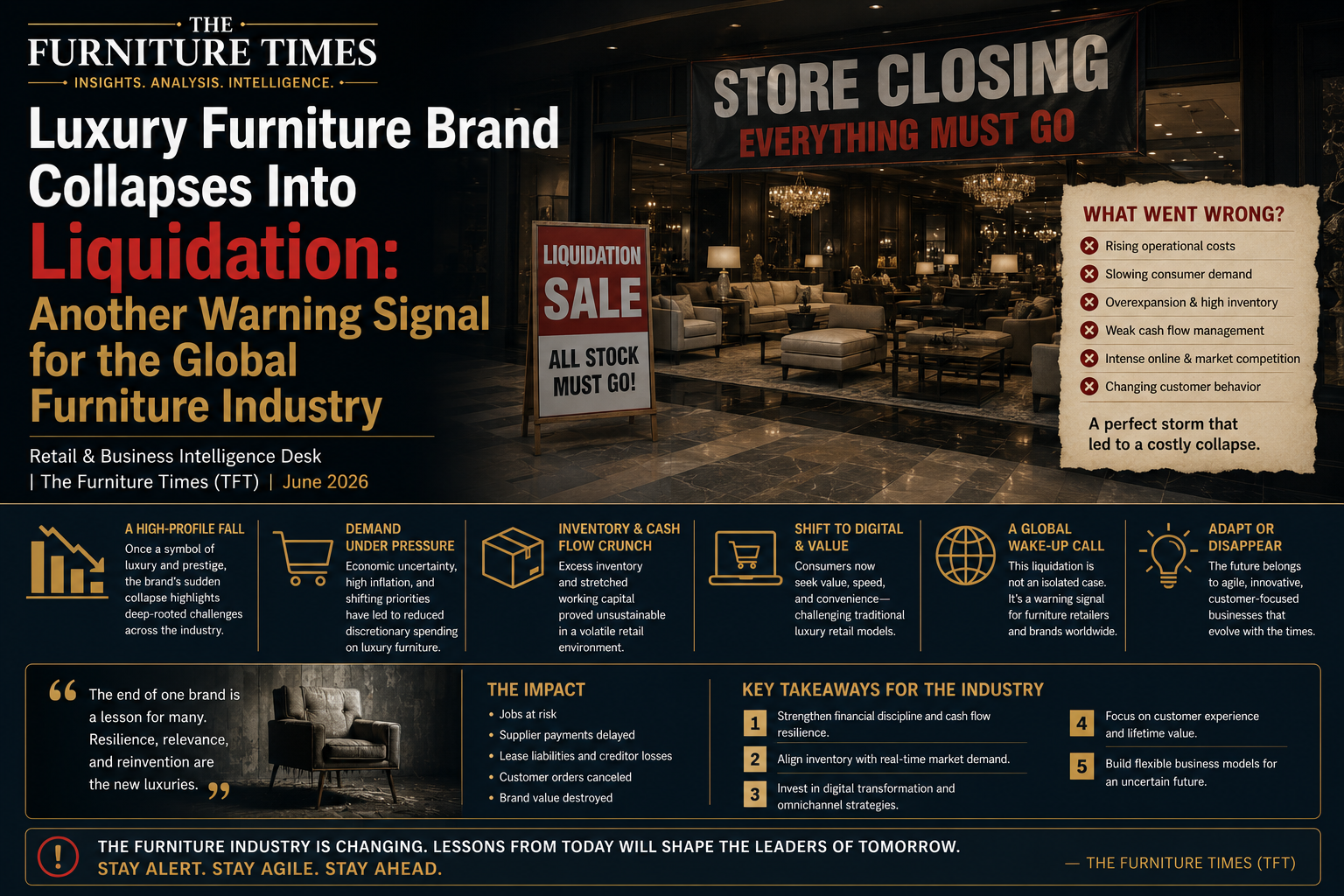
UK Luxury Furniture Brand Pure White Lines Collapses Into Liquidation Owing More Than £1.4 Million
Another Warning Sign for the Global Furniture & Interiors Industry
Retail & Business Intelligence Desk | By The Furniture Times (TFT) | June 2026
The United Kingdom’s furniture and interior design sector has been shaken by the collapse of luxury furniture brand Pure White Lines Ltd, a company once celebrated for its premium furniture collections, luxury lighting solutions, and high-end home décor offerings.
After operating for approximately fourteen years, the Sussex-based company has entered creditors’ voluntary liquidation, reportedly leaving behind debts exceeding £1.4 million, making it one of the latest casualties in an increasingly challenging retail and furnishings market.
The liquidation comes as a surprise to many industry observers, particularly because Pure White Lines had successfully positioned itself within the premium furniture segment and had earned recognition within the British interior design community.
From Luxury Success Story to Liquidation
Pure White Lines was known for its distinctive collection of:
Luxury furniture
Designer lighting
Decorative accessories
European antiques
Vintage furniture
Bespoke interior pieces
The company served affluent homeowners, luxury property developers, interior designers, hospitality projects, and premium residential markets throughout the United Kingdom and Europe.
Its London showroom became a destination for design-conscious buyers seeking exclusive statement pieces, while its warehouse facility in Belgium supported logistics and distribution across European markets.
The company built a reputation around elegant European-inspired aesthetics, handcrafted furnishings, and carefully curated collections that blended traditional luxury with contemporary design trends.
For many within the industry, Pure White Lines represented the type of independent luxury furniture brand that had successfully carved out a niche in an increasingly competitive marketplace.
Industry Recognition Was Not Enough
One of the most surprising aspects of the collapse is that Pure White Lines was not a struggling unknown retailer.
The company achieved notable industry recognition, including winning the Best Stand Award at Decorex 2022, one of the United Kingdom’s most prestigious interior design exhibitions.
Such accolades typically indicate strong brand positioning, market credibility, and customer engagement.
Yet despite these achievements, the business ultimately could not overcome mounting financial pressures.
The collapse highlights a reality that many furniture retailers and manufacturers are now facing: design excellence alone is no longer enough to guarantee commercial sustainability.
Understanding the Financial Collapse
According to published liquidation documents, the company reportedly owes unsecured creditors approximately £1.419 million. Meanwhile, estimated recoverable assets amount to less than £45,000, leaving a significant shortfall for creditors.
Among those reportedly owed money are:
HM Revenue & Customs (HMRC)
Suppliers
Service providers
Associated businesses
Local authorities
Reports indicate that nearly £200,000 is owed to Horsham District Council alone.
The figures illustrate how the collapse of a single furniture company can create ripple effects throughout a much broader business ecosystem.
When furniture companies fail, the impact extends beyond shareholders and management teams. Manufacturers, logistics providers, contractors, designers, installers, landlords, and local communities often feel the consequences as well.
The Luxury Furniture Market Is Changing
The collapse of Pure White Lines reflects wider structural shifts taking place across the furniture industry.
Historically, premium furniture brands relied heavily on:
Exclusive showrooms
Designer relationships
Print advertising
Word-of-mouth referrals
High-net-worth clientele
Today, customer behaviour has fundamentally changed.
Modern consumers increasingly begin their buying journey online through:
Search engines
Social media
Online reviews
AI-powered recommendations
Digital marketplaces
Interior design platforms
The customer who once spent weekends visiting showrooms now spends hours researching products online before making contact with a retailer.
This transformation has dramatically increased the importance of digital visibility and online authority.
Rising Costs Continue to Hurt Retailers
Like many furniture businesses globally, Pure White Lines operated during one of the most turbulent economic periods in recent history.
Furniture companies have faced continuous pressure from:
Rising Logistics Costs
International shipping rates and transportation expenses have remained volatile since the pandemic-era supply chain disruptions.
Increasing Warehouse Expenses
Storage and distribution costs continue to rise across Europe and the United Kingdom.
Labour Costs
Staffing shortages and wage increases have impacted businesses across retail, logistics, and manufacturing.
Material Inflation
Wood, metal, upholstery materials, foam, glass, and decorative components have experienced significant price fluctuations.
Energy Costs
Manufacturing, warehousing, and retail operations have all faced higher energy expenses.
For luxury brands, absorbing these costs while maintaining premium quality becomes increasingly difficult.
What Does This Mean for the Furniture Industry?
The liquidation of Pure White Lines is part of a larger story unfolding across the global furniture sector.
Furniture businesses are increasingly being evaluated on more than product quality.
Success today depends on:
Digital discoverability
Customer trust
Online visibility
Search engine presence
Operational efficiency
Inventory management
Omnichannel retail capability
Customer experience
Many industry analysts believe the furniture sector is transitioning from a product-first economy to a visibility-first economy.
In simple terms:
A company can manufacture exceptional furniture, but if customers cannot discover it online, growth becomes difficult.
TFT Industry Analysis
At The Furniture Times, we view the collapse of Pure White Lines as another signal that the furniture industry is entering a period of accelerated transformation.
The winners of the next decade are unlikely to be determined solely by:
Product quality
Showroom size
Brand heritage
Manufacturing scale
Instead, leadership will increasingly be defined by:
Searchability
Digital trust
Customer engagement
Data utilization
AI discoverability
Speed of adaptation
The future furniture brand must be simultaneously:
A furniture company
A media company
A technology company
A data company
A visibility company
Final Thoughts
The liquidation of Pure White Lines marks the end of a respected luxury furniture brand that once represented creativity, craftsmanship, and premium interior design.
Its closure serves as a reminder that even award-winning businesses are not immune to economic pressures and market disruption.
For furniture retailers, manufacturers, designers, and industry leaders worldwide, the lesson is clear:
The future belongs not only to those who build beautiful products—but also to those who can be found, trusted, and chosen in an increasingly digital marketplace.
By The Furniture Times (TFT)
Retail & Business Intelligence Desk
Bringing Furniture Brands Into Global Spotlight

Related Posts

Global Furniture Industry Faces a Conflict-Economy Test as Wars Disrupt Energy
Ireland’s €53 Million Government Jet Ignites Debate on Cost, Capability and National Priorities