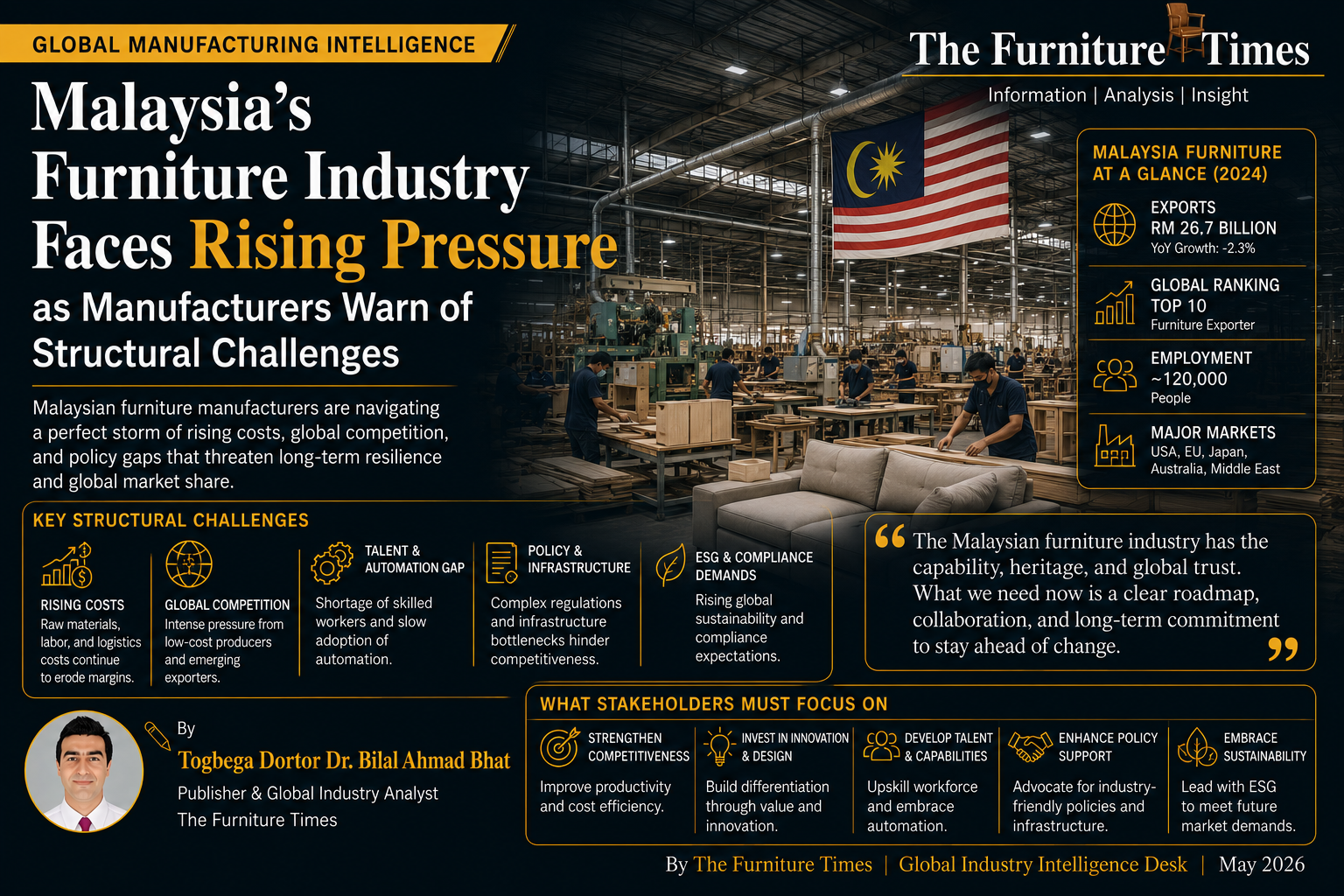
Malaysia’s Furniture Industry Faces Rising Pressure as Manufacturers Warn of Structural Challenges
Global Manufacturing Intelligence | The Furniture Times
By The Furniture Times | Global Industry Intelligence Desk | May 2026
Malaysia’s furniture industry, long recognized as one of Southeast Asia’s most important export manufacturing ecosystems, is entering a new period of economic and structural pressure.
Industry leaders are increasingly warning that rising labor costs, weakening global demand, intensifying regional competition, and shifting consumer buying behavior are reshaping the future of the sector.
The concerns were highlighted by furniture manufacturers and industry stakeholders during recent industry discussions surrounding Malaysia’s furniture export market and the future sustainability of the country’s manufacturing ecosystem.
🇲🇾 Malaysia’s Furniture Industry Remains a Strategic Manufacturing Hub
Malaysia continues to play an important role in the global furniture supply chain.
The country is known for:
- strong manufacturing capabilities
- export-oriented production
- wood-based furniture expertise
- integrated supply ecosystems
Johor, particularly Muar—often referred to as “Furniture City”—remains one of the largest furniture manufacturing clusters in the country, contributing a major share of Malaysia’s furniture exports.
The ecosystem includes:
- factories
- subcontractors
- component suppliers
- logistics operators
- exporters
- machinery providers
creating one of the region’s most established furniture production networks.
Rising Costs Are Pressuring Manufacturers
One of the biggest concerns raised by manufacturers is the increasing cost of doing business.
Industry players point to:
- minimum wage increases
- higher electricity costs
- additional labor-related contributions
- operational inflation
as major pressures affecting profitability.
Furniture manufacturing remains highly labour-intensive, especially for:
- upholstery
- finishing
- custom production
- handcrafted detailing
Many manufacturers depend heavily on foreign labor, making rising employment costs a significant challenge.
Global Competition Is Intensifying
Malaysia’s furniture sector is also facing stronger competition from regional manufacturing markets, including:
- Vietnam
- China
- India
These countries continue expanding:
- production scale
- automation capabilities
- export competitiveness
- pricing advantages
which places additional pressure on Malaysian exporters.
At the same time, global buyers are becoming increasingly selective, focusing more on:
- pricing
- supply chain stability
- design differentiation
- sustainability
- delivery reliability
Consumer Buying Behavior Is Changing
Furniture businesses globally are also experiencing changes in consumer demand patterns.
Industry leaders note that buyers are moving away from:
- large-volume traditional retail purchasing
toward:
- smaller batch orders
- online-first buying behavior
- customized production
- faster fulfillment expectations
The rise of e-commerce and digital sourcing systems has fundamentally changed the structure of furniture demand.
Automation Is Not a Simple Solution
While automation is frequently discussed as the future of manufacturing, many furniture manufacturers argue that full automation remains difficult in practice.
Furniture production still depends heavily on:
- craftsmanship
- finishing quality
- human detailing
- material handling
Certain products and design elements continue requiring skilled manual work, particularly in premium and culturally inspired furniture manufacturing.
Industry players emphasize that automation alone cannot solve every manufacturing challenge within the furniture sector.
Export Markets Are Becoming More Complex
The United States remains one of Malaysia’s largest furniture export destinations, but manufacturers are increasingly cautious due to:
- tariff risks
- anti-dumping measures
- pricing pressure
- geopolitical uncertainty
As a result, some exporters are diversifying into markets such as:
- Japan
- Middle East markets
- regional Asian markets
where buyers increasingly value:
- quality
- partnerships
- reliability
- design differentiation
rather than price alone.
Design, Branding & Innovation Becoming Critical
Industry experts believe Malaysian manufacturers must move beyond competing only on low-cost production.
The future competitive advantage may increasingly depend on:
- product innovation
- branding
- design capability
- sustainability
- operational efficiency
Furniture companies that invest in:
- R&D
- product uniqueness
- digital infrastructure
- ecosystem visibility
may be better positioned for long-term growth.
TFT Industry Insight
Malaysia’s furniture industry is not collapsing.
It is evolving under pressure.
The industry is entering a transition period where:
- manufacturing alone is no longer enough
- visibility matters
- systems matter
- branding matters
- connected infrastructure matters
The next phase of growth may belong to businesses that combine:
- manufacturing capability
- digital discoverability
- communication systems
- ecosystem integration
- global trust
inside modern industry platforms.
Final Thought
The future of the furniture industry will not be defined only by factories and production capacity.
It will be defined by which businesses can adapt fastest to a connected, digital, intelligent, and ecosystem-driven global market.
Malaysia still holds major strengths in manufacturing, entrepreneurship, and industry experience.
But the next chapter will require transformation—not just production.

Related Posts
Global Furniture Industry Shows Signs of Strategic Transformation Amid Economic Uncertainty
Why Core Values Will Become the New Competitive Advantage in the Furniture Industry