
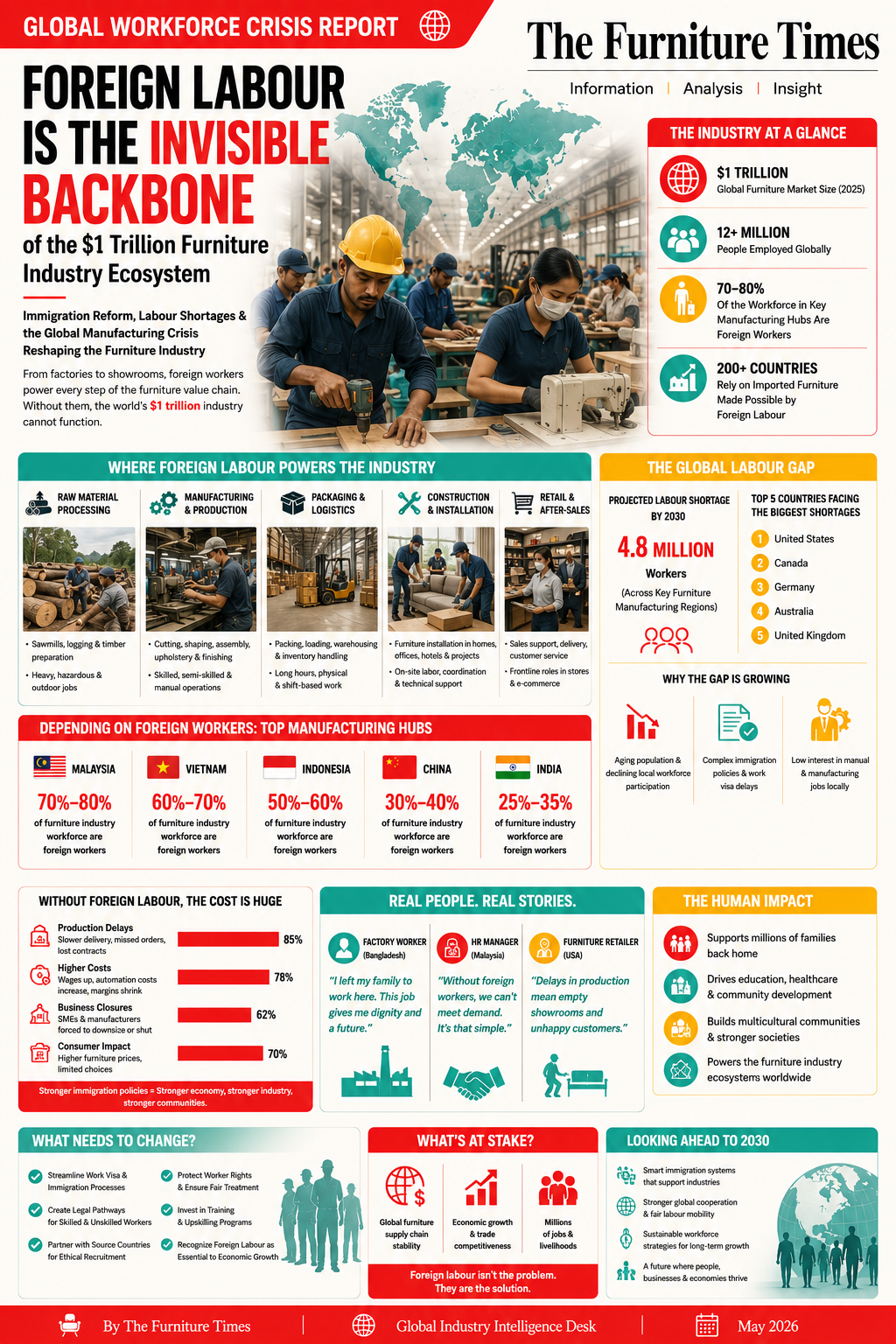
Foreign Labour Is the Invisible Backbone of the $1 Trillion Furniture Industry Ecosystem
Global Workforce Crisis Report | The Furniture Times
Immigration Reform, Labour Shortages & the Global Manufacturing Crisis Reshaping the Furniture Industry
By The Furniture Times | Global Industry Intelligence Desk | May 2026
The global furniture industry is often discussed through:
exports
manufacturing capacity
design
supply chains
retail growth
trade fairs
technology
AI
automation
But one of the most important realities inside the entire ecosystem is rarely discussed deeply enough:
The global furniture industry is heavily dependent on foreign labour.
Behind:
factories
upholstery workshops
woodworking plants
mattress production
sofa manufacturing
logistics operations
warehouse systems
installations
hospitality fit-outs
construction-linked furniture projects
millions of migrant and foreign workers quietly power the industry every single day.
Without them, many parts of the global furniture ecosystem would slow down dramatically.
And yet, tightening immigration policies, labour restrictions, workforce shortages, visa reforms, and geopolitical uncertainty are placing enormous pressure on the industry globally.
The Furniture Industry Was Built on Human Hands
Furniture manufacturing remains one of the world’s most labour-intensive industries.
Even with automation, robotics, and CNC systems, the industry still depends heavily on human craftsmanship and operational labour.
A sofa still needs:
upholstery stitching
foam fitting
manual assembly
fabric alignment
finishing work
A wooden chair still needs:
sanding
polishing
assembly
carving
inspection
A hotel fit-out still needs:
installers
movers
assemblers
transport workers
site coordination teams
The furniture industry is not purely industrial.
It is deeply human.
Why Foreign Labour Became Essential
Many developed and developing countries increasingly face:
ageing populations
declining manufacturing interest among locals
labor-intensive job rejection
wage pressure
urban migration shifts
Younger generations in many countries often prefer:
digital jobs
office work
technology sectors
remote work environments
instead of:
factory operations
woodworking
upholstery production
heavy lifting
manual manufacturing
As a result, foreign labour became essential for sustaining production capacity.
Countries Highly Dependent on Foreign Labour in Furniture Industry
The global furniture ecosystem relies heavily on migrant workers across multiple regions.
🇲🇾 Malaysia
Malaysia’s furniture industry is heavily dependent on foreign workers, especially in:
woodworking
upholstery
factory operations
logistics
export manufacturing
Workers often come from:
Bangladesh
Nepal
Indonesia
Myanmar
Pakistan
India
Malaysia’s furniture sector has repeatedly warned that labour shortages severely affect:
production timelines
export capability
operational efficiency
The Malaysian furniture industry has publicly highlighted workforce shortages and operational challenges in recent years.
🇦🇪 United Arab Emirates
The UAE’s furniture, fit-out, hospitality, and construction-related interiors ecosystem relies heavily on expatriate labour.
Foreign workers dominate:
factory work
installation
logistics
upholstery
carpentry
hospitality furniture setup
Without expatriate labour, much of the region’s furniture execution ecosystem would struggle operationally.
🇶🇦 Qatar
Qatar’s hospitality, fit-out, and luxury furniture sectors depend strongly on foreign labour for:
custom interiors
installations
upholstery
woodworking
commercial fit-outs
logistics operations
🇸🇬 Singapore
Singapore’s manufacturing and construction-linked furniture operations rely heavily on foreign labour due to:
limited domestic labour supply
ageing population
operational labour gaps
🇺🇸 United States
The U.S. furniture ecosystem also depends significantly on immigrant labour across:
upholstery
logistics
warehousing
woodworking
mattress manufacturing
installation services
Immigration reforms and labour shortages increasingly affect production capacity.
🇪🇺 Europe
Countries such as:
Germany
Italy
Poland
UK
also rely on migrant workers for:
woodworking
upholstery
logistics
warehouse operations
assembly work
especially in the manufacturing and export sectors.
The Silent Workforce Behind Luxury Furniture
One of the biggest paradoxes in the furniture industry is this:
Luxury furniture is often sold through:
glamorous showrooms
premium branding
designer campaigns
luxury hospitality
But behind many luxury products are migrant workers performing:
sanding
stitching
lifting
assembling
polishing
packaging
The global furniture industry often celebrates design.
But it rarely celebrates the labour behind the design.
Why Immigration Reforms Are Creating Industry Anxiety
Tightening immigration policies globally are creating serious uncertainty for the furniture industry.
Policies involving:
work permit restrictions
visa limitations
labour quotas
recruitment freezes
higher compliance costs
worker levies
deportation risks
can immediately affect:
factory production
export schedules
project delivery
hospitality installations
operational costs
Because:
The furniture industry cannot instantly replace skilled labour.
The Skill Gap Crisis
Furniture manufacturing requires:
technical skill
hand coordination
production experience
machine familiarity
upholstery expertise
finishing quality control
These skills take years to build.
When immigration restrictions reduce workforce availability:
production slows
quality suffers
timelines collapse
export commitments become risky
The Upholstery Industry Is Especially Vulnerable
One of the most labour-dependent sectors is upholstered furniture.
Sofa manufacturing requires:
cutting
stitching
fabric fitting
foam shaping
hand-finishing
assembly precision
Automation still cannot fully replace many upholstery skills.
This makes migrant labour especially critical in:
sofa factories
mattress plants
hospitality seating manufacturing
Furniture Installation Crisis
Another overlooked area is:
installation labour.
Hotels, offices, resorts, villas, and commercial spaces require teams for:
unloading
assembly
placement
fitting
adjustment
project coordination
Many countries depend heavily on foreign labour for these operations.
Without enough workers:
projects delay
costs rise
client satisfaction declines
SMEs Are the Most Vulnerable
Large corporations may survive labour shortages longer through:
automation investment
outsourcing
larger reserves
multinational operations
But SMEs often rely on:
small factory teams
trusted workers
experienced migrant labour
long-term workforce relationships
When labour policies suddenly tighten:
SMEs suffer first.
Emotional & Human Reality of Foreign Workers
Foreign workers are not just “labour units.”
They are:
fathers
mothers
families
migrants carrying economic hope
people supporting households across borders
Many leave:
families
children
home countries
to support industries abroad.
And many furniture ecosystems today are functioning because these workers continue showing up despite:
difficult conditions
uncertainty
rising living costs
immigration pressure
Why Local Workers Alone Cannot Immediately Replace the Gap
Many governments promote:
“local workforce prioritization.”
While understandable, the furniture industry faces structural realities:
Many younger locals often avoid:
physically demanding work
repetitive factory tasks
long-hour production environments
technical upholstery operations
This creates a labour mismatch.
Without gradual transition planning:
sudden immigration tightening can destabilize the entire ecosystem.
Automation Cannot Fully Replace Craftsmanship Yet
Many people believe:
“AI and robotics will replace furniture workers.”
But the reality is more complex.
Furniture manufacturing still depends heavily on:
touch
feel
craftsmanship
finishing
stitching precision
material judgment
assembly adjustment
Machines help.
But human craftsmanship still defines quality.
Rising Labour Costs Are Reshaping the Industry
As immigration restrictions tighten:
wages rise
operational costs increase
production expenses grow
margins shrink
This especially affects:
SMEs
export manufacturers
upholstery factories
custom furniture workshops
Some businesses may:
relocate production
reduce scale
automate partially
shut down entirely
The Global Furniture Industry Is Entering a Workforce Transition Era
The industry now faces multiple simultaneous pressures:
labour shortages
ageing workforce
immigration reform
automation pressure
geopolitical instability
rising living costs
declining manufacturing interest among youth
This is creating:
“The Global Furniture Workforce Crisis.”
So How Can the Industry Stabilize?
1. Smarter Immigration Policies
Governments should recognize:
the furniture industry is strategically dependent on skilled migrant labour.
Balanced policies are needed that:
protect local interests
support industry continuity
maintain workforce stability
ensure ethical labour systems
2. Workforce Upskilling
The industry needs:
vocational training
upholstery academies
woodworking schools
furniture manufacturing institutes
apprenticeship systems
This can gradually strengthen local workforce participation.
3. Better Worker Conditions
To retain labour, industries must improve:
housing
wages
safety
dignity
career growth
operational conditions
Because labour stability improves industry stability.
4. Automation + Human Hybrid Systems
The future will likely combine:
CNC automation
AI-assisted production
robotics
human craftsmanship
rather than full replacement.
5. Digital Ecosystem Transformation
The industry must become more connected through:
workforce management systems
supplier visibility
production intelligence
communication infrastructure
Platforms like:
can eventually support:
labour networking
supplier coordination
manufacturing visibility
operational continuity
TFT Philosophical Industry Insight
The global furniture industry often talks about:
products
brands
exports
factories
But behind the industry are millions of human hands.
And many of those hands belong to foreign workers.
The real foundation of the furniture industry is not wood, steel, or machinery.
It is people.
Without workers:
factories stop
sofas remain unfinished
hotels remain empty
exports freeze
showrooms lose inventory
The industry’s greatest hidden asset is its workforce.
Final Thought
The global furniture industry ecosystem is entering one of the most sensitive workforce periods in modern history.
COVID-19 exposed supply-chain fragility.
Tariffs exposed trade vulnerability.
Geopolitical conflicts exposed global instability.
And immigration tightening is now exposing:
workforce dependence.
The future of the furniture industry will not depend only on:
technology
AI
exports
automation
It will depend on:
workforce sustainability
human dignity
labour stability
ethical manufacturing ecosystems
balanced immigration policies
