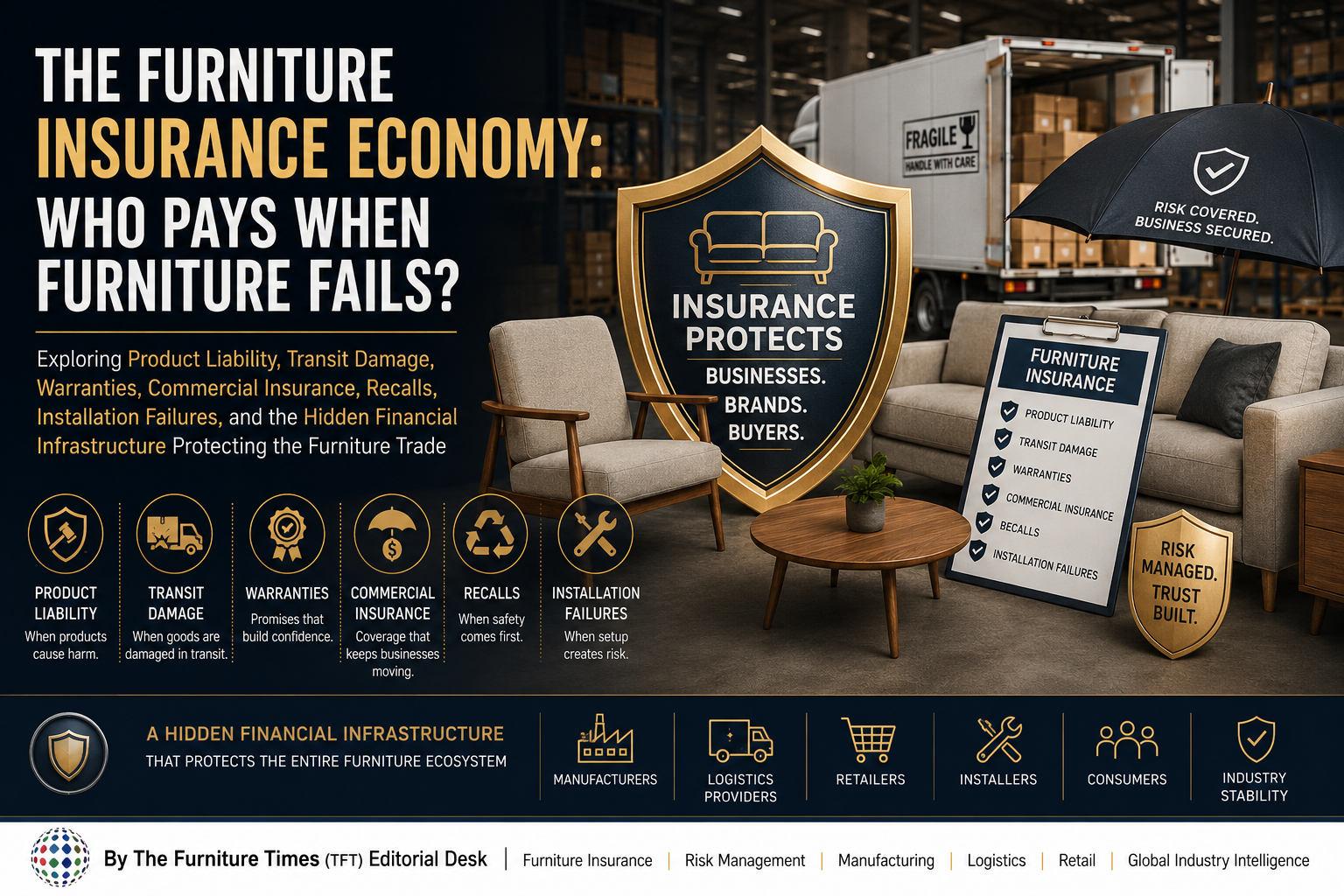
The Furniture Insurance Economy: Who Pays When Furniture Fails?
Exploring Product Liability, Transit Damage, Warranties, Commercial Insurance, Recalls, Installation Failures, and the Hidden Financial Infrastructure Protecting the Furniture Trade
By The Furniture Times (TFT) Editorial Desk | Furniture Insurance | Risk Management | Manufacturing | Logistics | Retail | Global Industry Intelligence
Furniture is normally discussed through the language of design, materials, manufacturing, retail, interiors and consumer trends.
But behind almost every sofa, bed, dining table, office workstation, hotel room, kitchen cabinet, outdoor furniture collection and contract-furniture installation lies another economy that receives remarkably little attention:
the furniture insurance and risk economy.
A dining chair collapses and someone is injured.
A container carrying furniture is damaged by water during an international shipment.
A hotel discovers defects across hundreds of newly installed headboards.
A motorized recliner develops an electrical problem.
A manufacturer receives thousands of warranty claims.
A furniture retailer experiences a warehouse fire.
A contractor damages expensive interiors during installation.
A commercial table fails months after a restaurant opens.
A large batch of furniture must be recalled.
A customer claims that a defective product damaged their property.
Suddenly, the conversation is no longer about design.
It becomes a conversation about risk, responsibility and money.
Who pays?
The manufacturer?
The component supplier?
The importer?
The distributor?
The retailer?
The logistics company?
The installer?
The insurer?
Or ultimately the customer?
These questions reveal an enormous but largely invisible financial infrastructure operating behind the global furniture industry.
For an industry ecosystem involving manufacturers, component suppliers, textile producers, foam manufacturers, timber processors, logistics companies, distributors, retailers, designers, architects, contractors, installers, hospitality companies, developers and consumers, understanding risk is becoming increasingly important.
Furniture companies therefore need to begin thinking beyond one fundamental question:
“Can we sell this product?”
They also need to ask:
“What happens financially if this product fails?”
Furniture Is a Physical Product—and Physical Products Carry Risk
Furniture occupies an unusual position in the consumer economy.
It is decorative, but it is also functional.
It can be inexpensive or extremely valuable.
It can remain inside a home for decades.
It can carry significant human weight.
It can contain electrical components.
It can be installed permanently into buildings.
It can be used thousands of times in commercial environments.
And increasingly, furniture can contain motors, sensors, batteries, USB connections, electronic controls and intelligent systems.
That creates multiple categories of risk.
A chair must support people safely.
A bunk bed must maintain structural integrity.
A cabinet must remain securely installed.
A motorized bed must operate safely.
Outdoor furniture must survive environmental exposure.
Office furniture may be used continuously by hundreds of employees.
Hotel furniture may experience intensive use far beyond normal residential conditions.
This means furniture manufacturers are not simply producing objects.
They are producing long-term physical liabilities that enter homes, workplaces, hotels, restaurants, schools, healthcare facilities and public spaces.
The Hidden Risk Chain Behind One Piece of Furniture
Consider something as ordinary as a dining chair.
The finished chair may involve:
- timber from one supplier,
- adhesives from another,
- screws and fasteners from another,
- fabric from another,
- foam from another,
- coatings from another,
- packaging from another,
- manufacturing by an OEM factory,
- export through a trading company,
- international transportation,
- warehousing,
- distribution,
- retail,
- delivery,
- assembly,
- and final consumer use.
If the chair collapses, identifying responsibility may not be straightforward.
Was the timber defective?
Did a fastener fail?
Was the adhesive unsuitable?
Was there a manufacturing defect?
Was the chair damaged during shipping?
Was it assembled incorrectly?
Did the customer misuse it?
Was the design structurally inadequate?
Did the retailer provide incorrect assembly instructions?
Was the product used commercially despite being designed only for residential use?
This illustrates why furniture risk cannot be understood simply at the factory level.
It exists across the entire furniture value chain.
1. Product Liability: When Furniture Causes Injury or Damage
Product liability represents one of the most serious potential risks facing furniture companies.
When furniture allegedly causes injury, property damage or another loss, questions of legal responsibility may arise.
Imagine:
A chair collapses.
A wardrobe tips over.
A glass tabletop breaks unexpectedly.
A bunk bed structure fails.
A cabinet falls from a wall.
A powered recliner malfunctions.
A children’s furniture product creates an entrapment hazard.
An outdoor umbrella structure collapses during unsuitable weather conditions.
Depending on the circumstances and jurisdiction, claims could potentially involve manufacturers, importers, distributors, retailers or other parties.
The consequences may extend far beyond replacing the furniture.
Potential costs can include:
legal expenses,
compensation,
medical-related claims,
property damage,
investigation costs,
recall expenses,
business interruption,
and reputational damage.
For SMEs in particular, a serious product incident can become financially devastating.
2. Transit Damage: Furniture’s Expensive Journey Around the World
Furniture is unusually vulnerable during transportation.
Unlike many compact consumer products, furniture is frequently:
large, heavy, fragile, bulky and expensive to transport.
A product may leave a factory in Vietnam, Malaysia, China, Indonesia, India, Türkiye, Italy, Poland or another manufacturing market and travel thousands of kilometres before reaching its final customer.
During that journey, furniture may encounter:
- container movement,
- moisture,
- water intrusion,
- rough handling,
- forklift damage,
- compression,
- packaging failure,
- warehouse accidents,
- theft,
- fire,
- port disruption,
- vehicle accidents,
- and loading or unloading damage.
A single damaged container can represent a substantial financial loss.
This is where cargo and transit insurance become part of the furniture industry’s hidden financial architecture.
But insurance does not eliminate the operational problem.
Insurers and logistics partners may investigate packaging quality, documentation, loading procedures and the exact point at which damage occurred.
Furniture manufacturers therefore need to recognize an important principle:
Packaging is not merely a cost. Packaging is risk management.
3. The Warranty Economy
The warranty is often viewed as a marketing promise.
In reality, it is also a financial obligation.
A manufacturer offering a five-year or ten-year warranty is effectively making a statement about future product performance.
Every warranty promise therefore carries a potential future cost.
Companies need to understand:
How frequently do products fail?
Which components generate the most claims?
How expensive are repairs?
How much does replacement shipping cost?
Can components be replaced without replacing the entire product?
Which suppliers are responsible for repeated failures?
Are warranty costs increasing?
The smartest furniture businesses should treat warranty data as intelligence.
If thousands of recliners experience the same mechanism problem, that information should immediately influence engineering and sourcing decisions.
If one drawer-slide supplier generates disproportionate complaints, procurement teams should know.
If one packaging configuration repeatedly results in damaged corners, logistics teams should investigate.
Warranty departments should therefore not exist only to process complaints.
They should function as early-warning systems for product quality.
4. The Enormous Cost of Furniture Recalls
A product recall can become one of the most expensive events in a furniture company’s history.
The direct cost may involve:
customer notifications,
product collection,
replacement products,
refunds,
transportation,
warehousing,
repair programs,
testing,
legal support,
and administrative operations.
But there is another cost that can be much greater:
loss of trust.
Furniture is fundamentally a trust-based purchase.
Consumers expect beds, chairs, cabinets and tables to be safe.
Hotels expect commercial furniture to perform reliably.
Developers expect installed furniture to meet specifications.
Retailers expect suppliers to deliver consistent quality.
When that trust collapses, the consequences can continue long after the technical problem has been corrected.
This makes recall planning an important component of corporate risk management.
5. Installation Failure: The Forgotten Liability
The furniture industry increasingly extends beyond factory-made standalone products.
Modern furniture businesses frequently provide:
built-in wardrobes,
kitchens,
office systems,
hotel furniture,
wall-mounted cabinets,
retail fixtures,
custom joinery,
and complete interior packages.
This means installation itself becomes a major risk category.
Consider a wall-mounted cabinet that falls.
Who is responsible?
The cabinet manufacturer?
The hardware manufacturer?
The installer?
The contractor?
The architect?
The building owner?
Responsibility may depend on the specific facts, contracts and applicable laws.
But the business lesson is clear:
Furniture installation requires documentation.
Professional companies increasingly need records of specifications, installation procedures, hardware requirements, site conditions, inspection processes and customer acceptance.
Documentation can become extremely important when disputes occur.
6. Commercial Furniture Carries Different Risks
Residential furniture and commercial furniture do not always experience comparable usage.
Consider a restaurant chair.
At home, a dining chair might be used several times per day.
In a busy restaurant, the same type of chair could experience repeated use throughout operating hours, every day.
Hotel furniture experiences similar intensity.
Office chairs may support employees for many hours each day.
Airport seating can experience near-continuous use.
Healthcare furniture may require specialized performance characteristics.
Educational furniture may face unusually demanding usage.
This makes product specification and intended use extremely important.
Furniture companies need to clearly understand whether products are intended for:
residential use,
commercial use,
hospitality,
healthcare,
education,
public spaces,
outdoor environments,
or specialized applications.
Selling an inadequately specified residential product into an intensive commercial environment can create significant risk.
7. Furniture Components Can Create Disproportionate Liability
One of the most important lessons in furniture risk management is that expensive failures can originate from extremely inexpensive components.
A low-cost fastener.
A hinge.
A caster.
A connector.
A drawer slide.
A gas lift.
A recliner mechanism.
An electrical controller.
A bracket.
An adhesive.
Any of these can become the failure point of a much more expensive furniture product.
Imagine a $5 component causing failure in a $2,000 piece of furniture.
The financial consequences may extend beyond replacing that $5 component.
The entire product may need servicing.
Technicians may need to visit customers.
Replacement products may need shipping.
Retailers may request compensation.
Customer service teams become involved.
Negative reviews may appear.
If the component was used across thousands of products, the financial exposure can multiply rapidly.
Component quality is therefore financial risk management.
8. Warehouse Risk: Millions in Inventory Under One Roof
Furniture warehouses concentrate enormous amounts of value.
A large distribution centre may contain millions of dollars in finished furniture.
That creates exposure to:
fire,
flooding,
storms,
structural damage,
theft,
equipment accidents,
water leakage,
and other operational disruptions.
Warehouse insurance can therefore be a critical part of furniture distribution.
But again, insurance should not replace prevention.
Risk-management practices can include fire protection, inventory documentation, appropriate storage procedures, security systems, equipment maintenance and emergency planning.
9. Business Interruption: When the Factory Stops
A factory does not need to lose its entire building to experience a serious financial crisis.
Production can stop because of:
fire,
flood,
machinery breakdown,
electrical problems,
supplier disruption,
natural disasters,
or damage to critical facilities.
The direct physical loss is only part of the problem.
The company may also lose weeks or months of production.
Orders may be delayed.
Customers may cancel.
Workers may be unable to operate.
Cash flow may deteriorate.
Contract penalties may arise.
Competitors may capture customers.
This is why business-interruption considerations can be just as important as physical-property protection.
10. The Growing Risk of Smart Furniture
Furniture is becoming technological.
Modern products increasingly incorporate:
motors,
batteries,
charging ports,
electronic controls,
sensors,
connectivity,
software,
and automated mechanisms.
This creates new categories of potential failure.
A traditional wooden desk primarily presents structural and material risks.
A connected height-adjustable desk introduces electrical, mechanical and potentially digital considerations.
Likewise, smart beds, powered recliners and connected workplace furniture move manufacturers closer to the technology industry.
The furniture industry’s insurance and risk structures may therefore evolve as products become more sophisticated.
11. Climate Change Is Rewriting Furniture Risk
Furniture supply chains are highly exposed to climate-related disruption.
Factories may be located in flood-prone industrial regions.
Timber supply can be affected by environmental conditions.
Ports can be disrupted by extreme weather.
Warehouses may face flooding.
Outdoor furniture faces increasingly demanding environmental exposure.
Long-distance transportation routes can be disrupted.
As extreme weather events influence global supply chains, insurers, manufacturers and logistics companies may need to reassess how furniture-related risks are priced and managed.
Climate resilience could therefore become another dimension of furniture competitiveness.
12. SMEs Are Particularly Vulnerable
Large corporations often have dedicated teams dealing with:
insurance,
legal affairs,
product compliance,
quality control,
risk management,
claims,
and supply-chain resilience.
Many furniture SMEs do not.
A small manufacturer may depend heavily on the founder or a small management team.
Insurance policies may be purchased without fully understanding exclusions.
Supplier agreements may be informal.
Product testing may be inconsistent.
Documentation may be incomplete.
Warranty reserves may not exist.
Recall plans may never have been created.
Yet SMEs can face many of the same risks as large corporations.
One significant incident can threaten years of business-building.
Risk management should therefore not be viewed as something only large corporations can afford.
For SMEs, it can be a matter of survival.
13. Insurance Cannot Replace Quality
This may be the most important principle in the entire discussion.
Insurance transfers certain financial risks.
It does not manufacture a stronger chair.
It does not improve packaging.
It does not tighten a loose fastener.
It does not select better timber.
It does not train an installer.
It does not prevent every product failure.
The first layer of protection must therefore remain:
quality.
The second is:
testing.
The third is:
documentation.
The fourth is:
traceability.
The fifth is:
appropriate insurance and financial protection.
Companies that reverse this order misunderstand risk management.
The Future: Furniture Risk Intelligence
The furniture industry generates enormous amounts of risk-related information:
warranty claims,
returns,
product reviews,
insurance claims,
repair records,
recalls,
component failures,
delivery damage,
installation problems,
and customer complaints.
Today, much of this information exists in disconnected systems.
But imagine what could happen if manufacturers analyzed it systematically.
A company could identify:
which products fail most frequently,
which components cause problems,
which shipping routes generate the most damage,
which packaging methods perform best,
which suppliers create disproportionate claims,
which installers experience recurring problems,
and which product designs generate unusually high warranty costs.
Artificial intelligence could eventually make this analysis even more powerful.
Furniture companies could move from reacting to failures to predicting them.
That would transform insurance data into operational intelligence.
A New KPI: Cost of Risk Per Product
Furniture companies traditionally measure:
sales,
gross margin,
manufacturing cost,
shipping cost,
inventory,
and returns.
Perhaps another metric deserves greater attention:
Cost of Risk Per Product
Imagine calculating the total expected cost associated with:
warranty claims,
returns,
damage,
repairs,
insurance,
recalls,
customer complaints,
replacement components,
and product failures.
Two products with identical gross margins could have dramatically different real profitability once these costs are included.
This could change how manufacturers evaluate product design, suppliers and pricing.
The Question Every Furniture CEO Should Ask
Furniture executives frequently ask:
How much are we selling?
What is our margin?
How much inventory do we have?
Which markets are growing?
Which products are performing?
Those questions remain essential.
But another question deserves a seat in the boardroom:
“What could financially destroy this company?”
For one business, it might be fire.
For another, a product-liability incident.
For another, a major recall.
For another, warehouse flooding.
For another, an uninsured shipment.
For another, a catastrophic installation failure.
For another, repeated component defects.
Understanding those exposures is the beginning of serious risk management.
The Furniture Insurance Economy Is Bigger Than Insurance
The deeper lesson is that this subject extends far beyond insurance policies.
It includes:
manufacturing quality,
engineering,
supplier management,
contracts,
logistics,
packaging,
testing,
compliance,
documentation,
installation,
maintenance,
warranties,
customer service,
finance,
legal responsibility,
and corporate governance.
Insurance sits inside this system.
It does not replace it.
The strongest furniture businesses of the future may therefore be those that understand that risk management is part of product management.
From Factory Floor to Financial Protection
The global furniture industry moves enormous quantities of physical products through complex international supply chains.
Every product carries economic value.
Every shipment carries exposure.
Every installation carries responsibility.
Every warranty carries a future obligation.
Every component carries a possibility of failure.
And every furniture company carries risks that may remain invisible until something goes wrong.
That is why the furniture insurance economy deserves far greater attention.
Because when furniture works perfectly, almost nobody thinks about risk.
But when furniture fails, one question suddenly becomes extremely important:
Who pays?
The answer can determine whether the incident becomes a manageable business expense—or a crisis capable of threatening the company itself.
For the global furniture industry, insurance should therefore not be viewed simply as paperwork purchased once a year.
It should be understood as one part of a much broader culture of quality, accountability, resilience and financial protection.
TFT Industry Perspective
The furniture industry ecosystem should begin treating risk intelligence with the same seriousness given to sales intelligence, market intelligence and consumer intelligence.
The future furniture company will not simply know what it sold.
It will know:
how the product performed,
where it failed,
why it failed,
what the failure cost,
which supplier contributed to the problem,
how the customer was protected,
and how the next generation of the product can be improved.
That is how risk becomes intelligence.
And that is how insurance moves from being a hidden cost of doing business to becoming part of the strategic infrastructure supporting a safer and more resilient global furniture industry.
The Furniture Times (TFT) — Global Furniture Industry Media & Intelligence
TFT tells their story. FISE helps the world find them. FurniReviewology helps the world trust them.

Related Posts
Global Smart Furniture Market Projected to Reach US$10.8 Billion by 2035

TEAKIA: Crafting Premium Teak Furniture That Outlives Trends and Builds Generations of Trust