Detailed Layout of Staircase Types: Understanding the Engineering, Architecture, and Functional Design of Modern Stair Systems
By The Furniture Times | Architecture & Interior Design Intelligence Desk
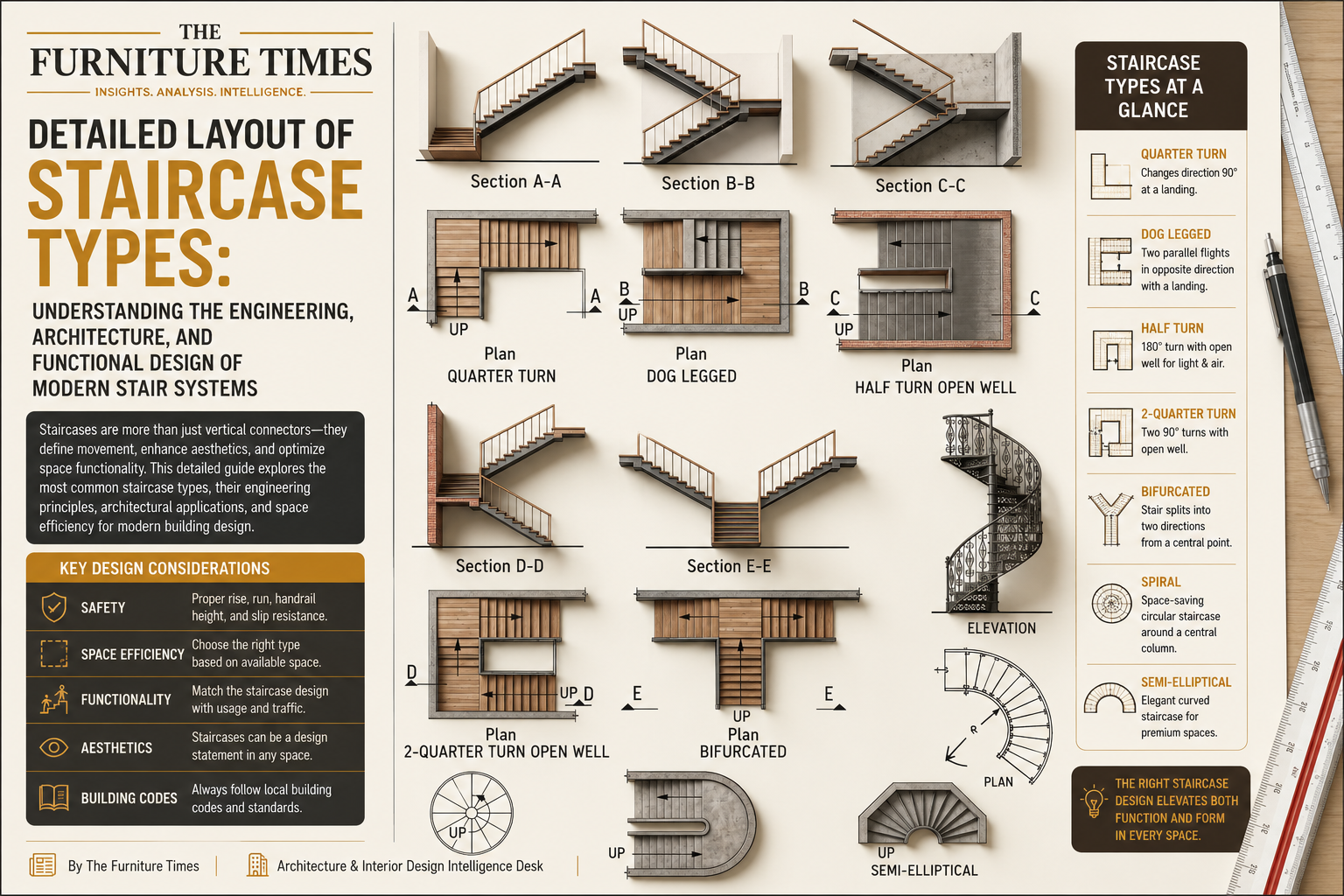
The image presented is a highly detailed architectural and engineering reference sheet illustrating some of the most widely used staircase configurations in residential, commercial, institutional, and hospitality construction. Combining section views, elevation drawings, and floor plans, the technical guide demonstrates how staircases are designed not only for movement between floors but also for spatial efficiency, structural performance, aesthetics, and user experience.
In architecture, staircases serve as both functional circulation systems and visual focal points. The layout selected can significantly impact floor planning, accessibility, safety, natural lighting, and overall interior design.
Why Staircase Design Matters
A staircase is one of the most important structural and architectural elements within a building.
Well-designed staircases:
Improve circulation flow
Enhance user safety
Maximize floor space utilization
Create architectural identity
Influence interior aesthetics
Improve natural light penetration
Support structural efficiency
The technical illustration categorizes staircases into six major design types commonly used worldwide.
1. Quarter Turn Staircase
Section A-A Analysis
The sectional drawing depicts a single flight staircase rising upward before arriving at a landing platform where the direction changes.
The handrail system appears minimalistic and modern, suitable for contemporary residential and office environments.
Plan View Analysis
The plan reveals an L-shaped staircase.
Key characteristics:
90-degree directional change
Intermediate landing
Compact footprint
Efficient corner utilization
Advantages
✔ Safer than long straight flights
✔ Reduces user fatigue
✔ Fits compact floor plans
✔ Improves architectural flexibility
Common Applications
Residential homes
Duplex units
Townhouses
Small commercial offices
2. Dog Legged Staircase
Section B-B Analysis
This design consists of two parallel flights running in opposite directions.
The flights are separated by a landing but contain no open space between them.
Plan View Analysis
The staircase folds back on itself through a 180-degree turn.
The arrangement minimizes floor area requirements.
Advantages
✔ Excellent space-saving solution
✔ Economical construction
✔ Simple structural support
✔ Popular in multi-story buildings
Common Applications
Apartment buildings
Educational institutions
Hospitals
Government buildings
3. Half Turn Open Well Staircase
Section C-C Analysis
The illustration shows a staircase system incorporating a central open void.
Unlike the dog-legged arrangement, a visible well exists between the stair flights.
Plan Analysis
The staircase reverses direction by 180 degrees while maintaining an open central area.
The open well improves:
Natural light distribution
Air circulation
Visual openness
Advantages
✔ More elegant appearance
✔ Better ventilation
✔ Enhanced lighting
✔ Strong architectural character
Common Applications
Luxury residences
Hotels
Villas
Corporate headquarters
4. Two-Quarter Turn Open Well Staircase
Section D-D Analysis
The staircase progresses through multiple directional changes.
A large central well remains visible throughout the structure.
Plan Analysis
Movement occurs through:
Initial flight
First 90-degree turn
Intermediate crossing
Second 90-degree turn
This creates a highly efficient circulation route around an open core.
Advantages
✔ Architectural elegance
✔ Large visual impact
✔ Improved daylight penetration
✔ Strong spatial organization
Common Applications
Shopping centers
Museums
Public institutions
High-end residences
5. Bifurcated Staircase
Section E-E Analysis
The bifurcated staircase is among the most recognizable staircase forms in architecture.
A broad central stair rises to a landing before splitting into two symmetrical side flights.
Plan Analysis
The layout resembles a “T” shape.
The central stair acts as the main ceremonial approach while side branches distribute circulation.
Advantages
✔ Creates grand visual impact
✔ Efficient crowd movement
✔ Architectural prestige
✔ Symbol of luxury
Common Applications
Luxury hotels
Palaces
Wedding venues
Museums
Government buildings
Historic architecture
6. Spiral Staircase
Elevation Analysis
The image includes an ornamental spiral staircase with decorative metal balustrades.
Unlike conventional stairs, the structure wraps around a central axis.
Plan Analysis
The circular plan demonstrates radial tread arrangement around a center point.
Advantages
✔ Minimal floor footprint
✔ Strong aesthetic appeal
✔ Ideal for confined spaces
✔ Iconic architectural feature
Limitations
Less convenient for moving large objects
Can be difficult for high traffic volumes
Requires careful safety detailing
Common Applications
Lofts
Penthouses
Observation towers
Libraries
Boutique hotels
7. Semi-Elliptical Staircase
The lower section of the image displays a semi-elliptical configuration.
This staircase uses curved geometry to create a dramatic architectural statement.
Key Features
Smooth circulation path
Luxury visual appearance
Sculptural form
Enhanced interior prestige
Common Applications
Luxury mansions
Five-star hotels
Presidential residences
Landmark architecture
Architectural Comparison Table
| Stair Type | Space Efficiency | Visual Impact | Construction Complexity |
| Quarter Turn | High | Medium | Low |
| Dog Legged | Very High | Medium | Low |
| Half Turn Open Well | Medium | High | Medium |
| Two-Quarter Turn Open Well | Medium | High | Medium |
| Bifurcated | Low | Very High | High |
| Spiral | Very High | Very High | Medium |
| Semi-Elliptical | Medium | Exceptional | Very High |
Future Trends in Staircase Design
Modern staircase engineering is evolving toward:
Floating stair systems
Glass staircases
LED-integrated steps
Smart handrails
Modular prefabricated stair units
Sustainable timber construction
Hybrid steel-wood systems
Parametric and AI-generated staircase geometries
As architecture increasingly blends functionality with aesthetics, staircases are becoming central design statements rather than merely circulation structures.
Final Analysis
This technical reference image serves as an excellent educational guide for architects, interior designers, furniture professionals, builders, engineers, and property developers. It demonstrates how staircase design directly influences building efficiency, user experience, structural organization, and visual identity.
From the highly efficient dog-legged staircase to the monumental bifurcated staircase and elegant spiral forms, each configuration solves a different architectural challenge. The selection of the correct staircase type depends on available space, budget, traffic requirements, safety standards, and the desired aesthetic outcome.
In modern architecture, a staircase is no longer simply a connection between floors—it is often the defining feature that shapes how people experience a building.