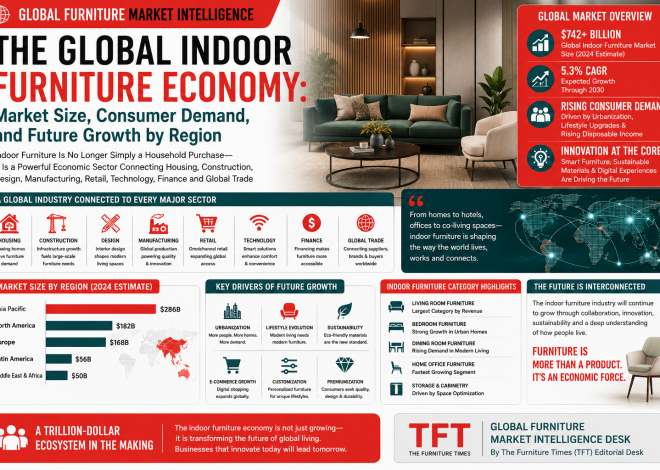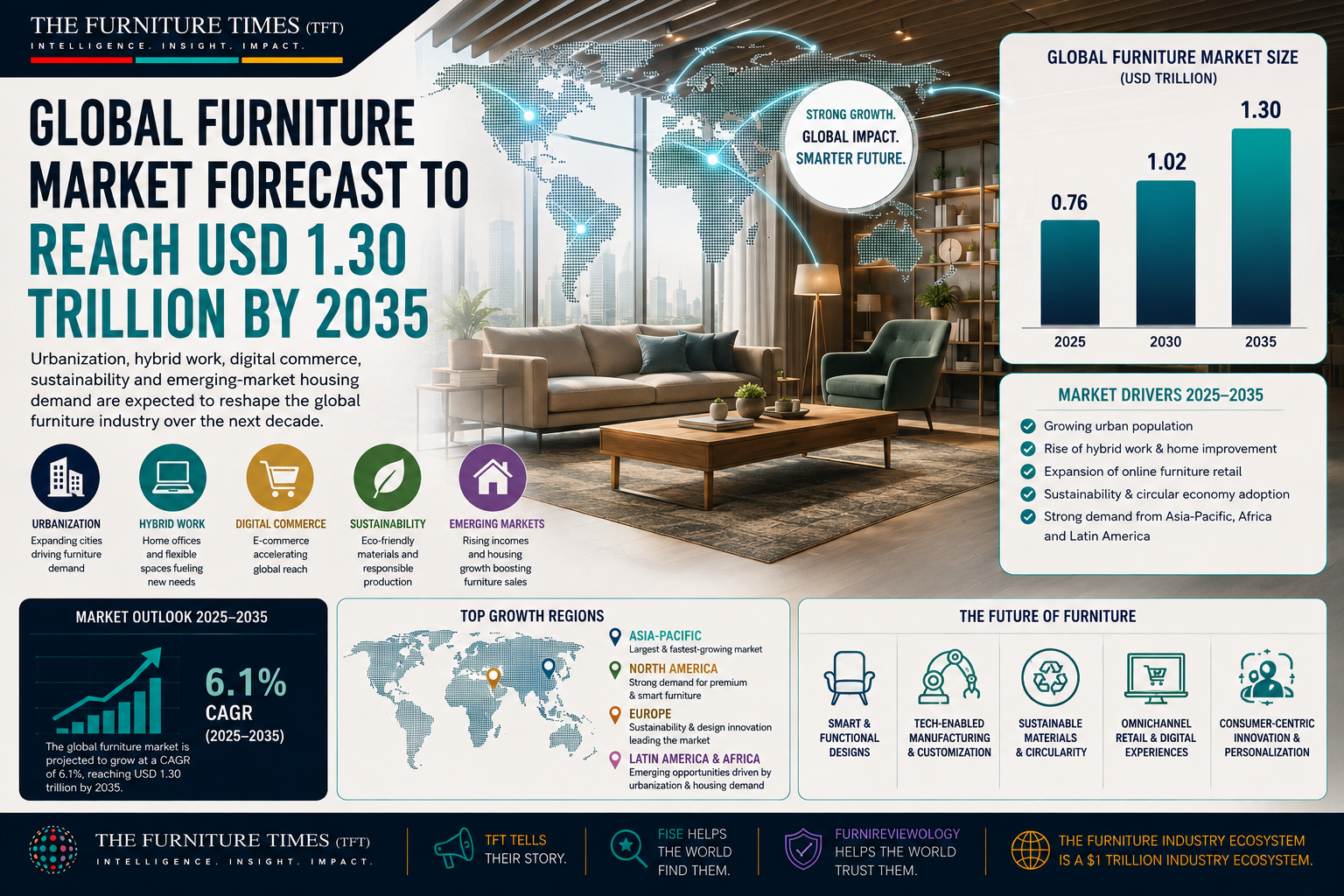
Global Furniture Market Forecast to Reach USD 1.30 Trillion by 2035
Urbanization, hybrid work, digital commerce, sustainability and emerging-market housing demand are expected to reshape the global furniture industry over the next decade
By The Furniture Times (TFT) Editorial Desk | Global Furniture Market | Industry Intelligence | Manufacturing & Retail
The global furniture market is entering a decade of significant structural change as urbanization, smaller living spaces, hybrid working, digital commerce, sustainability regulations and new housing development reshape demand across residential and commercial sectors.
According to Market Research Future, the global furniture market was valued at an estimated USD 740.20 billion in 2025 and is projected to increase from USD 783.13 billion in 2026 to USD 1,300.79 billion by 2035. This represents a projected compound annual growth rate of 5.80% between 2026 and 2035.
These figures are market-research estimates rather than guaranteed outcomes, but they illustrate the scale of the opportunity developing across furniture manufacturing, retail, materials, components, logistics, technology, design, installation, maintenance and circular services.
The forecast does not suggest that every company or market segment will grow at the same rate. The furniture industry remains highly fragmented and exposed to raw-material volatility, tariffs, freight costs, skilled-labor shortages, changing consumer confidence and digital competition.
Growth will increasingly favor businesses that can respond to smaller homes, flexible workplaces, sustainable procurement, personalized products and digitally assisted purchasing.
The report segments the market by application, material, price range and distribution channel. It also identifies Asia-Pacific as the largest regional market and highlights opportunities in circular furniture, smart products, emerging-market housing, flexible workspaces and on-demand manufacturing. Market Research Future’s Furniture Market Report, updated July 21, 2026
01 — Furniture Market Moves Toward the Trillion-Dollar Threshold
Market Research Future estimates that furniture-market revenue will expand by more than USD 560 billion between 2025 and 2035.
This projected increase reflects much more than population growth. It includes changes in:
- Household formation
- Homeownership
- Residential construction
- Renovation activity
- Workplace design
- Hospitality development
- Educational infrastructure
- Consumer replacement cycles
- E-commerce
- Product personalization
- Sustainability requirements
- Smart-furniture adoption
The market is becoming broader and more interconnected. A furniture sale can generate demand across multiple supporting industries, including panels, timber, metal, upholstery, foam, hardware, coatings, packaging, logistics, digital visualization, financing and installation.
This is why the broader furniture industry ecosystem may represent a commercial value significantly larger than furniture-product revenue alone.
The sector’s future should therefore be evaluated as an ecosystem rather than as a collection of factories and stores.
02 — Home Furniture Remains the Market’s Largest Foundation
Home furniture accounted for an estimated 58% of global revenue in 2025, according to the report.
Residential demand continues to be supported by:
- New housing construction
- First-time furnishing
- Home renovation
- Product replacement
- Urban household formation
- Rental-property furnishing
- Lifestyle changes
- Remote and hybrid working
Living-room and bedroom furniture remain major categories, while open-plan homes support demand for dining, kitchen-storage and multifunctional solutions.
The residential market is also becoming more varied. A first-time apartment buyer may need affordable, space-saving and ready-to-assemble furniture. An established homeowner may prioritize quality, customization and design. A landlord may prefer durability, easy replacement and standardized dimensions.
Furniture manufacturers cannot treat “home furniture” as one uniform customer segment.
They need collections designed around different:
- Budgets
- Life stages
- Property sizes
- Geographic markets
- Design preferences
- Maintenance expectations
- Delivery conditions
03 — Urbanization Is Changing Furniture Dimensions and Functions
Urbanization is one of the most important long-term forces influencing furniture demand.
As more people live in cities, dwelling sizes can become smaller and housing costs can rise. This creates demand for products that use space efficiently.
Growing categories may include:
- Sofa beds
- Storage beds
- Nesting tables
- Extendable dining tables
- Folding desks
- Modular seating
- Wall-mounted storage
- Mobile partitions
- Stackable chairs
- Multifunctional cabinets
- Convertible workstations
The future furniture market will not be defined only by appearance. Products will increasingly be evaluated according to how much useful function they provide within a limited area.
This change has implications for furniture components and accessories. Space-saving furniture requires dependable hinges, slides, lift systems, connectors, folding mechanisms and locking hardware.
A compact product may be used more intensively than conventional furniture. Its mechanisms must therefore be engineered for repeated movement, user safety and long service life.
04 — Hybrid Work Is Reshaping the Office Furniture Market
Market Research Future projects that office furniture will register a 6.7% CAGR through 2035, faster than the overall market estimate.
This does not necessarily mean a return to traditional offices filled with fixed desks. Workplace furniture demand is changing because organizations are reconsidering how office space should support employees.
Hybrid working has created greater interest in:
- Modular workstations
- Collaborative tables
- Acoustic pods
- Height-adjustable desks
- Flexible meeting furniture
- Mobile storage
- Lounge-style work settings
- Ergonomic seating
- Technology-integrated furniture
- Reconfigurable partitions
The office is moving from a place where every employee occupies a permanent desk toward a flexible environment supporting collaboration, concentration, meetings and social interaction.
Furniture suppliers serving this sector will need to provide more than products. Commercial clients increasingly expect:
- Space planning
- Workplace consultation
- Delivery
- Installation
- Reconfiguration
- Maintenance
- Replacement parts
- Take-back services
- Lifecycle information
This creates opportunities for manufacturers, dealers, designers, installers and workplace-technology providers.
05 — Hospitality Furniture Gains From Tourism and Development
The report valued hospitality furniture at approximately USD 62.40 billion in 2025.
Hotel, resort, restaurant and serviced-apartment development can create substantial demand because projects require coordinated products across:
- Guest rooms
- Lobbies
- Restaurants
- Lounges
- Meeting rooms
- Outdoor areas
- Spas
- Staff spaces
- Public circulation areas
Hospitality furniture differs from ordinary residential products. It often requires:
- Higher durability
- Fire-performance compliance
- Stain resistance
- Commercial warranties
- Project-specific finishes
- Coordinated room packages
- Installation support
- Replacement availability
- Strict delivery scheduling
Large tourism and mixed-use developments in the Middle East and Asia-Pacific may create important contract opportunities through 2035.
However, suppliers must be prepared for complex procurement, mock-up approval, documentation, quality consistency and project-management requirements.
06 — Educational and Institutional Furniture Creates Stable Demand
Educational furniture is projected by Market Research Future to expand at approximately 5.3% annually through 2035.
Schools, universities, libraries, training centers and public institutions are modernizing learning environments to support collaboration, technology and flexible teaching.
Demand may increasingly focus on:
- Adjustable desks
- Mobile tables
- Stackable seating
- Collaborative learning furniture
- Library systems
- Storage
- Laboratory furniture
- Charging-enabled tables
- Inclusive and accessible furniture
- Durable outdoor learning products
Institutional procurement frequently requires certification, standardized specifications, competitive tendering and long-term product support.
For SMEs, these markets can be attractive but demanding. Companies must understand tender documents, safety standards, material requirements, delivery schedules and after-sales obligations.
07 — Wood Retains Its Dominant Position
Wood accounted for an estimated 55.4% of furniture-market revenue in 2025, according to the source report.
The category includes:
- Solid hardwood
- Softwood
- Plywood
- MDF
- Particleboard
- Veneer
- Laminated panels
- Bamboo-based composites
- Other engineered products
Wood remains dominant because it offers broad flexibility across price levels, production methods and design styles.
Its future will be shaped increasingly by traceability and responsible sourcing. Buyers, especially institutional and commercial customers, may require greater evidence concerning:
- Forest origin
- Chain of custody
- Formaldehyde emissions
- Surface finishes
- Recycled content
- Product durability
- Repairability
- End-of-life options
Furniture companies using wood will need stronger documentation, not only attractive product descriptions.
08 — Metal Emerges as the Fastest-Growing Material Segment
The report identifies metal as the fastest-growing material category, projecting an 8.2% CAGR between 2026 and 2035.
Metal is widely used in:
- Office desks
- Chairs
- Storage systems
- Shelving
- Outdoor furniture
- Contract seating
- Table bases
- Bed frames
- Folding systems
- Furniture mechanisms
Its growth is supported by durability, structural efficiency and recyclability.
Steel and aluminum can support slim profiles and modular structures, making them suitable for compact homes and flexible commercial interiors.
However, metal furniture manufacturers must manage:
- Raw-material price volatility
- Welding quality
- Corrosion protection
- Powder-coating performance
- Joint design
- Product weight
- Transportation damage
- Recycling and material separation
The strongest opportunities may arise in products combining metal structures with wood, upholstery, glass, stone or composite surfaces.
09 — Mid-Range Furniture Represents the Largest Revenue Pool
Market Research Future estimates that mid-range furniture accounted for 49.5% of market revenue in 2025.
This segment serves a broad group of buyers seeking a balance between affordability, appearance and durability.
Mid-range consumers are often willing to pay more than the lowest possible price when they receive:
- Better materials
- Stronger warranties
- Reliable delivery
- Improved comfort
- Recognizable design
- Easier assembly
- Replacement parts
- Trustworthy reviews
- Clear after-sales support
Competition in this segment is intense because customers can compare local retailers, global chains, marketplaces and direct-to-consumer brands.
To compete effectively, companies need a clear value proposition. Simply offering an ordinary product at an average price may no longer be enough.
10 — Premium Furniture Is Expected to Grow Faster
The premium segment is projected to register a 7.4% CAGR through 2035.
Premium growth may be supported by buyers seeking:
- Design provenance
- Custom dimensions
- Sustainable materials
- Craftsmanship
- Exclusive finishes
- Smart features
- Designer collaboration
- Limited production
- Longer product life
- Personalized service
Premium furniture does not succeed merely because it is expensive. The product must communicate why it deserves a higher price.
Evidence may include:
- Material quality
- Construction detail
- Designer identity
- Manufacturing origin
- Certification
- Warranty
- Repair services
- Customization
- Authentic customer experience
Premium brands also require professional storytelling and digital presentation. Poor photography or incomplete product information can undermine the value of excellent furniture.
11 — B2C Retail Continues to Lead Distribution
B2C and retail channels represented an estimated 67.8% of furniture-market revenue in 2025.
These channels include:
- Physical showrooms
- Branded stores
- Company websites
- Online marketplaces
- Department stores
- Home-improvement retailers
- Social-commerce platforms
The future of B2C furniture retail will be omnichannel. Customers may research online, inspect products in a showroom, compare reviews on another platform and complete the transaction through a mobile device.
Retailers must connect these experiences.
Important capabilities include:
- Accurate inventory
- Consistent pricing
- Showroom availability
- Online appointment booking
- Digital product visualization
- Click-and-collect
- Delivery tracking
- Simple customer service
- Unified returns
- Product-care information
Retailers that operate separate and conflicting online and offline systems risk frustrating customers.
12 — B2B and Project Furniture Offer Faster Growth
The B2B and project channel is projected to grow at approximately 6.9% annually through 2035.
This includes furniture supplied to:
- Corporate offices
- Hotels
- Restaurants
- Schools
- Universities
- Hospitals
- Government institutions
- Co-working spaces
- Property developments
- Public facilities
Project furniture can generate large orders, but it also involves longer sales cycles and more complicated requirements.
Suppliers may need to provide:
- Specifications
- Samples
- Mock-ups
- Certifications
- Shop drawings
- Installation
- Project scheduling
- Coordination with designers
- Warranty management
- Replacement programs
Manufacturers seeking B2B growth should develop dedicated contract capabilities rather than treating projects as larger versions of retail orders.
13 — Asia-Pacific Holds the Largest Regional Share
Asia-Pacific accounted for approximately 43.2% of global furniture-market revenue in 2025, according to Market Research Future.
The region’s position reflects its combined role as:
- A major manufacturing base
- A large consumer market
- A rapidly urbanizing region
- A tourism-development center
- A source of residential construction
- A hub for furniture exports
China remains a major production and consumption market, while India is expected to expand through housing development, urbanization and organized retail.
ASEAN economies—including Malaysia, Indonesia, Vietnam, Thailand and the Philippines—offer opportunities connected with:
- Household formation
- Tourism
- Hospitality
- Export manufacturing
- Urban middle-class growth
- Digital commerce
- Regional supply chains
For Malaysia, the opportunity extends beyond conventional manufacturing. The country can strengthen its position through design, sustainable materials, automation, component development, furniture tourism, digital platforms and export intelligence.
14 — North America Remains a High-Value Market
North America represented an estimated 24.8% of global furniture revenue in 2025.
Demand is influenced by:
- Housing activity
- Renovation
- Replacement purchasing
- Commercial office refits
- Hospitality development
- E-commerce
- Cross-border trade
The United States remains the region’s largest market.
However, tariffs and supply-chain changes may influence sourcing decisions, landed costs and consumer pricing. Companies serving North America must monitor trade rules carefully and avoid building strategy around assumptions that may change.
Potential supplier responses include:
- Sourcing diversification
- Regional production
- Product redesign
- Greater material efficiency
- Nearshoring
- Improved inventory forecasting
- Stronger supplier documentation
Tariffs can create opportunities for alternative sourcing markets, but companies must assess total cost, quality, lead time and capacity.
15 — Europe Is Being Reshaped by Sustainability
Europe represented approximately 21.5% of global furniture revenue in 2025, based on the report.
The region remains important for premium products, design, machinery, components and sustainability policy.
European buyers are paying increasing attention to:
- Material traceability
- Product durability
- Repairability
- Recycled content
- Chemical safety
- Packaging
- End-of-life treatment
- Digital product information
Italy and Germany remain influential manufacturing and design markets, while Nordic countries continue to shape conversations about circularity and responsible production.
Furniture exporters serving Europe should prepare for a market where environmental documentation becomes increasingly connected with market access.
16 — South America Offers Housing-Led Opportunity
Market Research Future projects South America to grow at a 6.4% CAGR through 2035.
Brazil is expected to remain the region’s largest market, supported by housing development, urbanization and consumer-credit availability.
The regional opportunity may be strongest in:
- Economy furniture
- Mid-range furniture
- Ready-to-assemble products
- Residential storage
- Rental-property furniture
- Locally manufactured collections
Companies entering South America must understand local purchasing power, currencies, credit practices, logistics and regional design preferences.
17 — Middle East and Africa Gain From Major Development Projects
The report values the Middle East and Africa furniture market at approximately USD 34.79 billion in 2025.
Saudi Arabia, the United Arab Emirates and Egypt are identified as important growth markets because of tourism, hospitality, residential development and public infrastructure.
Major projects can create demand across:
- Luxury hospitality
- Residential communities
- Offices
- Retail spaces
- Restaurants
- Educational institutions
- Cultural facilities
- Public environments
These markets can attract global competition. Successful suppliers need local partnerships, project references, technical documentation and reliable installation capacity.
18 — Circular Furniture Creates a New Commercial Market
Circularity is moving from an environmental discussion toward an operating model.
Circular furniture may involve:
- Repair
- Refurbishment
- Resale
- Rental
- Leasing
- Take-back
- Parts replacement
- Material recovery
- Product remanufacturing
This changes how value is measured.
Under a conventional model, a manufacturer earns revenue once when the product is sold. Under a circular model, the same product may create value through leasing, maintenance, refurbishment and resale.
Companies must design furniture differently to support this model.
Circular-ready products need:
- Replaceable components
- Reversible connections
- Standardized hardware
- Durable materials
- Repair instructions
- Material identification
- Disassembly planning
- Spare-parts availability
The furniture-components sector will be central to making circularity commercially practical.
19 — Smart Furniture Builds a Premium Technology Layer
Smart furniture combines conventional products with electronics, sensors, connectivity or automated movement.
Examples include:
- Desks with wireless charging
- Height-adjustable workstations
- Posture-monitoring chairs
- Connected sleep systems
- Occupancy-sensing furniture
- Electrified meeting tables
- App-controlled recliners
- Integrated lighting and power
These products can create higher-value opportunities, particularly in offices, healthcare, hospitality and premium residential markets.
They also introduce new responsibilities:
- Electrical safety
- Software support
- Cybersecurity
- Component replacement
- Data privacy
- Compatibility
- Long-term maintenance
- Electronic-waste management
A smart product that becomes unusable when its software is discontinued is not necessarily sustainable.
Manufacturers must design both the furniture and its technology lifecycle.
20 — AI and Digital Visualization Transform Product Development
Artificial intelligence is entering furniture design, merchandising and customer engagement.
Possible applications include:
- Concept development
- Design variations
- Material visualization
- Demand analysis
- Product descriptions
- Room planning
- Personalized recommendations
- Trend forecasting
- Production optimization
- Customer service
AI can shorten early design and presentation work, but human expertise remains essential.
Designers and engineers must verify:
- Structural feasibility
- Ergonomics
- Safety
- Material behavior
- Manufacturing cost
- Component availability
- Transport requirements
- Environmental impact
AI can accelerate decisions, but it should not replace technical validation.
21 — E-Commerce Changes How Furniture Is Discovered
Market Research Future estimates that online furniture sales reached approximately USD 142 billion in 2024, representing around 19.2% of total market revenue at that time.
The online share may continue expanding as visualization, delivery coordination, reviews and digital payment improve.
Furniture e-commerce faces challenges that smaller products do not:
- Customers cannot test comfort
- Colors may appear differently on screens
- Dimensions can be misunderstood
- Delivery is expensive
- Returns are complicated
- Assembly may be required
- Product damage is costly
Retailers need to reduce uncertainty through:
- Complete dimensions
- Accurate photographs
- Videos
- Augmented-reality visualization
- Material samples
- Clear delivery information
- Verified reviews
- Detailed return terms
- Accessible customer service
Digital commerce should not merely move the catalog online. It should help customers make better decisions.
22 — Platforms Increase Reach but Can Compress Margins
Marketplaces give furniture companies access to large audiences. However, reliance on third-party platforms can reduce control over customer relationships, data and margins.
Platform risks include:
- Commission changes
- Advertising costs
- Copycat products
- Price competition
- Limited customer ownership
- Return-policy pressure
- Algorithm changes
- Account suspension
- Dependence on platform logistics
Furniture companies should use marketplaces strategically while continuing to build:
- Their own websites
- Customer databases
- Brand recognition
- Direct service channels
- Industry listings
- News visibility
- Review profiles
The objective is to gain reach without surrendering the entire business relationship.
23 — Raw-Material Volatility Remains a Major Restraint
The report identifies price volatility in timber and steel as an important market headwind.
Material-price changes can affect:
- Quotation accuracy
- Profit margins
- Production scheduling
- Product pricing
- Inventory decisions
- Contract performance
- Supplier relationships
Manufacturers should strengthen:
- Supplier diversification
- Material forecasting
- Contract terms
- Inventory control
- Product-costing systems
- Waste reduction
- Alternative-material research
Businesses that do not know the real cost of each product can grow revenue while losing profitability.
24 — Freight and Logistics Continue to Shape Competitiveness
Furniture is bulky, damage-sensitive and expensive to transport.
Logistics performance affects:
- Export competitiveness
- Delivery promises
- Customer satisfaction
- Return costs
- Product design
- Packaging
- Warehouse requirements
Companies can improve logistics efficiency through:
- Flat-pack engineering
- Knock-down construction
- Better container loading
- Protective packaging
- Regional warehousing
- Route planning
- Delivery tracking
- Local assembly
- Packaging reduction
Logistics should be considered during product design rather than after manufacturing is complete.
25 — Skilled-Labor Shortages Threaten Production Capacity
Woodworking, upholstery, finishing, sewing, engineering and installation all depend on skilled people.
The report identifies labor shortages as a significant constraint, particularly in Europe and North America.
The furniture industry must invest in:
- Apprenticeships
- Technical education
- Worker retention
- Safer factories
- Digital skills
- Automation training
- Career development
- Knowledge transfer
- International recruitment where lawful and appropriate
Automation can reduce repetitive work, but it cannot immediately replace all craftsmanship and technical judgment.
An aging workforce makes skills transfer urgent.
26 — The Industry Remains Highly Fragmented
Market Research Future describes the global furniture market as highly fragmented, estimating that the five largest participants collectively control only a minority of total global revenue.
The named companies include:
- IKEA
- Ashley Furniture Industries
- Steelcase
- MillerKnoll
- La-Z-Boy
- Haworth
- HNI Corporation
- Williams-Sonoma
- Hooker Furnishings
- Ethan Allen
Fragmentation creates opportunities for SMEs because no single company controls the entire global market.
However, smaller companies face challenges involving:
- Limited visibility
- Lower technology investment
- Smaller marketing budgets
- Weak product data
- Export barriers
- Limited logistics networks
- Dependence on intermediaries
Digital discoverability may become as important as production capability.
A factory that cannot be found, understood or trusted online may remain invisible to global buyers.
27 — What Manufacturers Should Prepare for Before 2035
Manufacturers should consider the following strategic priorities:
- Design for smaller spaces
- Build modular product systems
- Improve material traceability
- Prepare sustainability documentation
- Invest in digital product data
- Strengthen direct and project channels
- Develop circular services
- Protect margins through accurate costing
- Improve packaging and logistics
- Train the workforce
- Use automation selectively
- Maintain strong visibility
- Develop replacement-parts programs
- Protect design identity
- Diversify geographic demand
The market forecast offers opportunity, but growth will not automatically reach every manufacturer.
28 — What Furniture Retailers Should Prepare for
Retailers should focus on:
- Omnichannel integration
- Accurate online inventory
- AI-assisted product discovery
- Detailed product pages
- Visual search
- Room visualization
- Transparent delivery
- Verified customer reviews
- Better after-sales support
- Sustainable product information
- Showroom appointments
- Customer-data protection
- Search and AI visibility
Retailers must reduce uncertainty at every stage of the buying journey.
29 — What Component Suppliers Should Prepare for
Growth in furniture production creates corresponding opportunities for suppliers of:
- Hinges
- Drawer slides
- Fasteners
- Connectors
- Lift mechanisms
- Castors
- Furniture legs
- Handles
- Lighting systems
- Charging components
- Motion hardware
- Upholstery accessories
- Edge banding
- Surface finishes
Future component demand will increasingly focus on:
- Durability
- Quiet operation
- Modularity
- Repairability
- Recycled materials
- Disassembly
- Digital documentation
- Smart functionality
- Compliance
- Standardization
Components are small in size but strategically important to furniture quality and longevity.
30 — The Wider Meaning of the Forecast
A market projected to reach USD 1.30 trillion by 2035 is not only an opportunity for furniture brands.
It is an opportunity across the complete ecosystem:
- Raw materials
- Components
- Machinery
- Manufacturing
- Design
- Retail
- E-commerce
- Logistics
- Installation
- Financing
- Repair
- Resale
- Recycling
- Media
- Reviews
- Search technology
- Market intelligence
The global furniture economy is becoming more digital, service-oriented, circular and data dependent.
TFT, FISE and FurniReviewology address three increasingly important requirements:
- The Furniture Times helps the industry tell its stories.
- Furniture Industry Search Engine helps companies and products become discoverable.
- FurniReviewology helps buyers evaluate trust through reviews and reputation.
Growth alone does not guarantee that a company will be found or selected. Visibility, credibility and customer experience will determine how the opportunity is distributed.
Final Analysis
Market Research Future’s projection of growth from USD 740.20 billion in 2025 to USD 1,300.79 billion by 2035 presents an optimistic long-term picture for the global furniture market.
The opportunity is supported by urbanization, residential development, hybrid work, hospitality investment, digital commerce and rising demand for flexible products.
At the same time, the market faces serious challenges:
- Input-cost volatility
- Tariffs
- Logistics expenses
- Skills shortages
- Economic uncertainty
- Sustainability compliance
- Platform dependence
- Digital competition
The industry’s future will not be determined solely by how much furniture it produces.
It will be determined by how effectively companies design for changing lifestyles, organize product data, manage resources, maintain trust and become discoverable across traditional search and AI-powered platforms.
Manufacturers that continue producing conventional products without responding to compact living, circularity and digital procurement may struggle even inside a growing market.
Retailers that provide poor product information may lose customers to businesses offering clearer and more intelligent shopping experiences.
Component suppliers that support durability, repairability and smart functions may become increasingly strategic.
The global furniture market may be approaching the USD 1.30 trillion level, but the most valuable opportunity will belong to companies that prepare before the growth arrives.
Source:
Market Research Future — Furniture Market Size, Share, Trends and Forecast to 2035
Editorial Note:
All market sizes, growth rates, segment shares and projections attributed to Market Research Future are estimates from the cited report. Forecasts are subject to changes in economic conditions, trade policy, consumer demand and the report provider’s methodology.
The Furniture Times (TFT) & Furniture Industry Search Engine (FISE)
“TFT tells their story. FISE helps the world find them.”
FurniReviewology helps the world trust them.
The furniture industry ecosystem is a $1 trillion industry ecosystem.